Wednesday, June 30, 2010

Blatent Plug Department

Just got my hands on a hard copy/dead tree edition of The Kobold Guide to Game Design, Volume III, to which I contributed but a single sentence (the blurb on the front cover). However, it is a wonderful book, with essays by Monte Cook on Game Balance, Rob Heinsoo on Key Mechanics and Hooks, Ed Greenwood on Plots, Colin McComb on Combat Systems, and Wolfgang Baur on drums (and everything else). A great little book, and highly recommended.

More later,

Saturday, June 26, 2010

Origins Awards

Sigh. It is a sign of how far out of the RPG orbit I have drifted in that I almost missed linking to the winners of the Origins Awards this year. But it is nice to see that Margaret Weis's company took an award for Big Damn Heroes Handbook for Serenity. No power in the 'Verse can stop them.

More later,

Sunday, June 20, 2010

Solstice

This is a tough time of the year for me. My sleep patterns tend to be shaped by the sun, and while I can wake and function in darkness, I have a difficult time sleeping when it is light. In Seattle, the northernmost major city in the continental US, that makes for difficulties when the sky lightens a 5 AM and does not grow dark again until after 10.

You read that right. I am bagging on Seattle for having too much sunlight. Go figure.

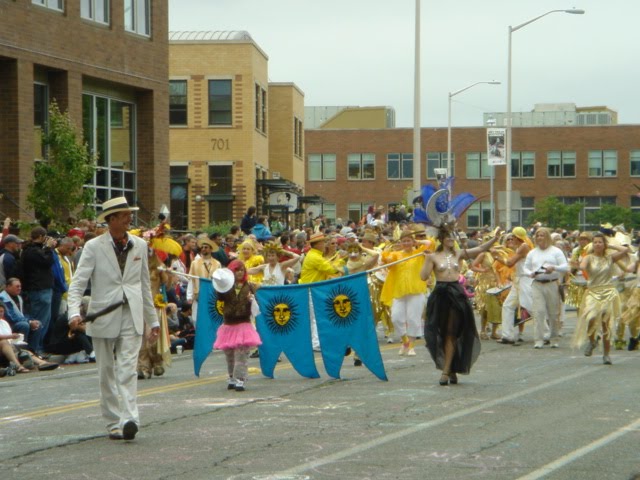
However, the official start of summer has its nice points, one of the chiefmost being the Fremont Solstice Parade, a whacky local event that draws most of the city to this off-kilter territory.

Fremont, for those who are not in the know, is the self-declared center of the universe, and home to both the Fremont Troll and the Lenin Statue. It was for many years a haven for artists, and under the rules of modern gentrification has been upgraded a couple times, but still seeks to maintain its quirky and peculiar charm. In particular, the parade, which bans logos, printed words, or motorized vehicles.

Oh yeah, it has the naked bicyclists as well. The organizers resisted it for many years, but have finally embraced the idea of a massive tour de nude at the start of the parade to just get it out of the system. The challenge, though, is that the rest of the parade is more of a saunter than a march, with teams of salsa dancers, belly dancers,gymnasts, puppeteers, and other foot traffic, so there is a big gap between when the cyclists come through and when the parade proper arrives. Fortunately, the "Chalk Fairies" (members of the local teamsters) pass out chalk and the kids (and adults) draw on the parade route until the parade meanders down to your area. If you're in a hurry, you're in the wrong neighborhood.

And it was cool this year, both in temperature and temperament. Much less political and anti-corp than in previous years. Dick Cheney in prison stripes on a bike was present, but seemed almost a little passe, like the guys in the Dick Nixon masks. But there were things like a float powered by pedaling Elvises (Elvii), the Flying Spaghetti Monster, a giant white dog puppet name Dogody, a giant spider puppet with stuffed animals and cabbage-patch kids in its web, the Sisters of Perpetual Indulgence, a treant (with sapling) and a giant walking totem pole. Oh, a big Yellow Submarine as part of a multi-part effort that included Green Apple Bonkers, Blue Meanies, Snapping Turtle Turks, Sgt. Pepper, and a bunch of ersatz Beatles leading a sing-along from the crowd.

And yeah, its an interactive parade, which accounts for its leisurely nature. Everyone gets pictures. The dodgeball team is encouraging small kids to kick balls into the street. And you too can play in the Sea of Holes or help paint an art piece being created over the parade route.And you can lay down in front of a big twenty-foot beach ball rolls down the street.

What there weren't a lot of was visible police presence. Most of the people keeping folk back towards the curbs were local volunteers in orange jackets, and the cops only seemed to reveal themselves at the very end, once the parade had passed down to Gasworks Park and the streets had to be reclaimed for car traffic. And like a passing dream, the Midsummer Dream of Fremont passed on.

And now we go into Summer, and I hopefully can get a bit more sleep.

More later.

Friday, June 18, 2010

Slouching Towards Olympia

The season is upon us. The early invites to town halls, kick-off lunches, and pizza parties have arrived. The phone calls at inopportune times. The first push polls (so pushy they call back when hung up on). In the wake of Memorial Day, election season has begun.

And I, for one, just can't get into the spirit.

Part of it probably campaign fatigue left over from 2008. A large number of blogs I've followed haven't updated since Obama's election. Part of it is the difficulty of actually watching people govern in troubled times. But I think a big chunk of it is simply that I was in Pennsylvania right before its primary last month.

And the land was awash in political campaign ads. Every opponent was either a member of Pelosi's soviet legions or the most cold-hearted Republican in all of Bedford Falls. Arlen Specter covered the airwaves with accusations that his opponent underpaid his campaign staff while family members got paychecks (That's the best you could throw at him? He doesn't pay retail for his help?). "Just another politician" sniffed the ads, which supported re-electing the newly democratic Specter for his 75th term (Specter lost, in case you didn't know).

And so I had a vision of the future that yawns before Washington State - the broken wellhead of political bile that will issue into our state. Yet there are handfuls (handfuls, I say!) of readers who tune in for the politics, so here we go again.

The GOOD news is that, despite our wonky primary system in which you can't be a Democrat but instead can only "prefer Democratic Party", there was minimal high-jinx in the registering to run. Republicans are confident to run as Republicans, shedding even the fig-leaf of the GOP brand or qualifier like "Real Republican Party". And I think that's a good thing.

There are two big races in my part of Washington State - Senate and the 8th District House. Senate has incumbent Dem Patty Murray against both traditional GOP choice Dino Rossi and more conservative GOP favorite Clint Didier (there are others, but they have already been discounted by the media). Rossi entered the race the week after the Seattle Times obligingly printed a hatchet job accusing anti-government farmer Didier of (gasp) taking government subsidies. Normally the two big teams line up and choose their guy and that's the end of it, but Didier on the Further Right (he has since snagged an endorsement from Sarah Palin) may make this interesting.

In the House, we flip the situation - the incumbent is Republican David Reichert, former King County Sheriff with a tendency to reveal his political motivation a tad too often. Against him is another progressive technocrat, Suzan DelBene, of which I know little but will end up finding out more. This is supposed to be an anti-incumbent year, but it never seems to be that way for incumbents from the OTHER party.

In Olympia, Geoff Simpson, Pat Sullivan, and Claudia Kaufmann are all up for re-election in the State House races (all three come up at once). More on them and their competition later, but the push poll mentioned at the top of the article was sounding out various strategies against Pat Sullivan and seeing what would "message" best.

And finally we have our initiative process, intended to further democratize the system but in reality being yet another arm for money to enter the political process. This year we have the possibility of two different measures to privatize liquor sales, a measure to decriminalize pot, a tax-the-wealthy measure put forward by Bill Gates' dad, and the regular "Pull out the engine so we can complain that the car won't start" anti-government measure from Tim Eyeman.

Fun all around. So now I'm heading to the store to buy election-season decorations and send out my "Sorry to hear you have to vote" cards.

More later,

Thursday, June 17, 2010

Mike Cook

The word went out earlier this week, by jungle drum, internet, and mojo wire, regarding the passing Mike Cook. Mike was (under various similar titles) the Vice President of TSR's creative departments under the Blume brothers, Gary Gygax, and Lorraine Williams. He was 60.

The thing I remember best of Mike was what I called at the time "Wisconsin Management Style". This meant using beer as a resource in smoothing the relationship between management and employee (this IS Wisconsin I'm talking about). There were a number of occasions when a general discussion or employee concern adjourned to the Next Door Pub for further discussion, or the designers were scheduled for an after-hours conference there. It sounds strange, but moving a concern out of the office and into a more relaxed setting did a lot to get around the normal problems of worker and management. It is a management and communication style that I've used to great effect - "Lemme get a coffee with you" or "So, who wants sushi?" - out on the West Coast.

This summer, as members of the late, great, TSR fraternity gather at conventions, memories will be revived and beers will be lifted in Mike's memory. He will be missed.

Tuesday, June 15, 2010

Lockdown

So for most of the morning, the police kept me at my desk.

OK, let me unspool this for you. There was an "incident" at our office park. A man bashed in the front windows of a debt collection agency with an axe. Needless to say, the workers at that agency retreated to a back room, pushed filing cabinets in front of the door, and called the cops.

The police arrived and sealed off the office complex (there are only two roads into it, and it is surrounded by water). They asked all the workers to stay indoors and the management locked the accessible doors. So for about three hours, half the staff was locked inside and half the staff was stopped at the roadblock and turned back. Most went to work at home.

We on the inside were treated to Bellevue police moving through the parking lots and King County Troopers with heavy weapons and K9 Units beating the bushes, followed by police choppers, and later on news copters. They did a pretty thorough job (we were watching them from the windows), but after three hours did not find the culprit and lifted the lockdown.

And yeah, its not the NORMAL state of affairs in our office, but things like this do happen to liven up our lives.

More later,

Monday, June 07, 2010

Oath

I've mentioned before, here and elsewhere, that we're in a new golden age of Cthulhu, in particular as far as RPGs concerned. Once the domain of once-every-blue-moon releases, this particular niche has grown into a highly populated gaming environment, with new works from Chaosium, Miskatonic Press, Super Genius Games, Goodman Games, Pelgrane Press, Pagan Publishing, Cubicle 7 and others.

So it is with scant surprise (and no need to reach for the percentile dice for a SAN check) to discover that The Unspeakable Oath is returning from its shallow grave. The Unspeakable Oath was a revolutionary magazine as far as the CoC universe is concerned, so much that I consider it and Delta Green to be the initiation of its own Age of Cthulhu (though I have since broadened the definition of that age). Its sensibilities were much more psychological that previous incarnations, and its ultimate theme was "The stars have come right, and we are the monsters".

The first new issue is going to be out at the end of year, and they are taking submissions until 19 July. In addition, their editorial board reads like a Who's Who of Cthulhu's disturbed sleep of the past twenty years.

I thought very highly of the original UO, and really look forward to this new one.

More later,

Thursday, June 03, 2010

Evolutionary Wars

The Greatest Show on Earth: The Evidence for Evolution by Richard Dawkins, Free Press, Distributed by Simon & Schuster Digital Sales, 2009

How I Got This Book: Recommended by a coworker who name-checked a number of books he has been reading. Since I was looking for books to take on my Pittsburgh trip, I downloaded a couple of them onto my Kindle.

I've talked about my Kindle before, and find it to be an excellent travel book, but some volumes do not fair well on the device. This is one of them. Greatest Show makes copious use of annotations and footnoted sources (which it navigates well enough). It uses extensive black and white illos and tables (which reproduce badly) and color plates (which reproduce worse), and the bibliography and index sprawl over more Kindle pages than they really need to, since the multiple indents in their formatting do not come across easily.

And while it is tempting to think about this book's possible evolutionary success within the environmental niche of e-publishing, that would be pretty wrong. Because evolution by natural selection belongs to one particular science, and when you transport it to another field, things get dodgy fast (like the "Social Darwinism" of Herbert Spenser, which takes Darwin's biology and transfers it into a rationale of why Rich People need not feel sympathy for Poor People). While tempting (and I do it all the time), when you're talking about natural selection, the natural part of the concept is applicable.

In any event, the book was both a good summary of stuff I knew (speciation, continental drift, mutation) and things I needed updated on (protein folding, which is sort of organic origami). Dawkins is best known for his avowed opposition to the religious who reject Darwinism (and most of the post-15th century) out of hand. He fires more than a few high hard ones against the religious institutions and their minions, but over the course of the book, I find that I can understand where the religious-based evolution-deniers are coming from.

I mean, if evolution was a religion, it would make the Cthulhu Mythos look all warm and cuddly.

First off, it take an uncaring universe to its logical extreme. There is a pass-fail existence where the tests come continually and the price of failure is always death. Old-Testament Jehovah is more forgiving than this grim clockwork of action and reaction.

And it's about species, and not about you. Not only are you just another of the striver in the universe, success of your species means absolutely nothing about your personal needs. It is about a larger genetic grading, of which you are a very very small part.

And its not really about you species than about your genes, stupid. The entire purpose of natural selection is the guarantee that the most suitable genes survive. You survive only because your genetic package crafted a suitable housing to create more genes. In these terms, the childless are evolutionary failures (I can envision a conservative evolutionary distopia where children are mandated, and only tested and harvested before they can reproduce). Genetic duplication (with all of its additional mutations) is about as close to salvation as you can hope for.

And because it is about your genes, your fate is sealed at birth. Never mind the concept of "Grace" among us Protestants - this is worse. Your genetic makeup is sealed before you even attained sentience. And if that makeup is suitable for the current environment, or even if that makeup is outdone by the makeups of OTHER individuals whose mutations are better, well, it sucks to be you.

And in the face of all this, we have a strong strain of "human exceptionalism". Despite this supposedly uncaring universe, we are here, and thriving (mostly). We take care of our suboptimal mutations and, spitting in the face of nature, allow them to pass on genetic material. We also pass along a "soft" heritage in culture, art, and knowledge, which exists outside the hardwired chemistry and biology of our forms. You can make a case of both secular and religious thought as being in direct opposition to the uncaring clockwork of natural selection.

The big thing is, of course, that evolution is NOT a belief system, any more than gravity (also called "Intelligent Falling") is. It is a scientific tool that explains the natural world, and knowing where that tool can be applied (like a hammer to a nail) and when it shouldn't (like a hammer to a screw) is part of the process. To haul evolution into the court of beliefs is like hauling religion into the court of science. It is condemning those apples for making overly tart orange juice.

But if you consider science to be an alternate belief system (as opposed to, you know, science), the frightening nature of evolution is apparent. You can suddenly sense the palpable revulsion in the faithful to the threat of this line of thought, even though there should be no threat.

Lovecraft would, on the other hand, be delighted.

More later,

Wednesday, June 02, 2010

Begun, the Serial Comma Wars Have ...

Head writer Bobby Stein has posted a great article on the ArenaNet blog about setting up the writing style for Guild Wars 2. And while his tone is light (he is a word-nerd adrift in a sea of game-nerds), his purpose is completely serious. One of the goals of the game is create a regular and consistent look and feel in the game experience, which is reflected by gameplay, mechanics, art, and yeah, the writing.

It sounds obvious, but it is not. Even though most of us have some form of writing chops, there are a lot of personal and regional variations. Go back to the early days of the country, and you could describe our spelling and language as "freestyle", with whatever personal solutions to communications worked out on the fly (what is this "Purfuit of Happineff stuff, anyway?). In the age of Spellcheck and Grammarcheck that has eased off a bit, but still, there are enough variations to make a multi-creator project like a computer game a veritable minefield of conflicting styles.

So putting together a style guide is a challenge because we are all married to the way we've done things. I get personally insulted when the word processor underlines in green a perfectly good sentence and says "fragment (consider revising)". No, Mr. Microsoft, YOU consider revising. And convincing people that your methodology is the best can lead to some very nasty encounters.

Here's a story from the old days of TSR. Our manager (no names, here), put one of the editors in charge of creating a style guide. Said editor put one together, including that we would use serial commas (that is putting a comma before a conjunction, such as "Parsley, sage, rosemary, and thyme"). However, said manager did not care for serial commas (it should be "Parsley, sage, rosemary and thyme"), and the two were soon butting heads. Soon salvos were fired off in the office mail, sides were taken, red pens were stockpiled, paragraphs were set ablaze,and everyone ended up feeling bad about it (and I don't think we ever solved that particular problem).

So style does stir up a lot of deep-seated feelings in people - how do we communicate? How much of my personal style much be sacrificed for the good of the project. Why the heck CAN'T I capitalize whatever I want (I blame Gary Gygax for this last one - he would begin his columns "Gentle Reader")? The passion behind such decisions, unseen by the ultimate consumer, is real and unwavering.

So I want the people supporting Strunk & White on the right hand side of the room, and those supporting Chicago Manual of Style over on the left. Dodgeballs will be passed out.

More later,

Tuesday, June 01, 2010

The Horrors

Arkham Horror designed by Richard Launius, Lynn Willis, Sandy Peterson, and Charlie Crank,1987, Chaosium Games
Arkham Horror designed by Richard Launius and Kevin Wilson, 2005, Fantasy Flight Games

Many years ago, I played the original Arkham Horror from Chaosium, and found it to be a fun game (though I don't remember if I finished it). Several years ago, I played the revised Arkham Horror from Fantasy Flight (and did not finish it). When I was in Pittsburgh recently, I had the chance to play the revised game (and did not finish it again), but resolved that I would eventually finish the game. And one evening, with my regular Call of Cthulhu crew, we DID finish the revised game (and there was much rejoicing). And then over the recent long weekend, I had the chance to play the original game (and did not finish it), but did regain enough knowledge and sanity to be able to compare the two.

So the question is: what is it about this game, a game where most of its sessions remain unfinished, that attracts one so?

Both games share the same framework - You're an investigator in Arkham, ground zero of the Cthulhu mythos. Gates are opening all over town to the Other Worldsh. And monsters are coming out. Your job is to close the gates. It is a cooperative game, which means that everyone wins (with a bonus to the one killing the most monsters), or everyone loses.

Now both versions skim the "eldritch horror in an uncaring universe" part of the Necronomicon, and bore more down on the "use everything and kitchen sink approach". All manner of mythos deities, minions, and locations make their head-nod, which leaves the games more of a primer to the mythos than a deep probing into the psyche of a hideous reality. But that doesn't really matter, since one of the joys of the game is explaining to others what a "shoggoth" is.

And both are "play to exhaustion" style games. The basic goal of the game is to close portals, which are springing up as fast (or faster) than you can shut them down. And with every new gate, the ending of the game comes closer, while every time you close a gate, that ending and the sweet, sweet release of completion moves further away. I think this is the reason that so many games end in everyone taking a deep breath and putting it all back into the box - you play until you decide to stop playing. Like hitting yourself with a board, the relief comes when you finally stop.

The first edition is ruled by tables - a table for where the gate appears, small tables for encounters in every location. Simple D6 rolls rule with all sorts of mods applied. High roll wins in combat. Fighting by magic is nigh-impossible, unless you got the Bind Monster, which is an auto door-closer as you throw you gug at the gate to the Abyss. All monsters are equal in chance to appear, so you have the same chance of hitting a maniac as finding Cthulhu wandering down the street.

The second edition has vastly improved physical components, but then uses them to create a bunch of different systems and tracking devices. You have three movable skill-pairs PLUS counters for your Sanity and Strength. The Candyland-like path-map of first edition is replaced with point-movement that does not give the same feeling of connectivity and sense of place. Instead of a high-role success combat shifts to a "number of successes" resolution, where you are looking for additional dice to increase your chances. And the "great powers" of Cthulhu are now moved to the endgame - instead of the game just ending after time, a particular pre-chosen Old-One (with particular universal effects during the game) shows up and everyone fights it (though they have the "classic game" solution if the baddie is Azathoth. He shows up at 13 gates and everyone dies automatically.

And while the second edition is incredibly popular (six or seven expansion), the sheer amount of fiddly bits included makes my head hurt. There is a lot more to the second game, and therefore a lot more to forget and get wrong (survival tip for the second edition - get multiple copies of the rule set (available in pdf from the Fantasy Flight site) before starting in). The ease-of-play of the original worked to its benefit, and the various modifications to add speed, depth, or variety just overloads the senses and capabilities.

Both games are rainy-day games for people in it for the long haul - not for folk starting something in late evening. It ranks with Talisman as one of those games you continue because you don't want to admit to be beaten by the game's sheer inertia. Yet my grognard heart goes out to the original as opposed to the later version.

More later,

Thursday, May 27, 2010

Collaboration

So currently up at Booklife is a short interview with Matt Forbeck about the joys and pitfalls of collaboration, in regards to our upcoming Guild Wars 2 novel, Ghosts of Ascalon (which finally has the correct cover at Amazon).

More later,

Wednesday, May 26, 2010

DOW Breaks 10,000

Now how did THAT happen?

No, really, was it only a month and change ago that the DOW surged over 11k, and everyone was sure that whatever was wrong, it wasn't wrong anymore, and things were going to get better, at least for the masters of the universe and the social investment funds that propped up the stock market. And we could stop kvetching about how Wall Street was falling apart and go back to complaining about how Wall Street was recovering and leaving Main Street behind (again)?

And it doesn't seem that there IS any one villain here, according to the trades. Market correction. People are mad that the gummint is being mean to the bankers. People are mad that the gummint is being insufficiently mean to the bankers. Greece, Iceland, Spain, or your favorite floundering western economy of the week. The BP spill. The fact that the BP spill is still spilling. Government action, government inaction, or (shakes magic 8-ball) just a market correction after all.

Actually, I think one of the culprits is High Frequency Traders. These aren't real traders in the pits, but rather financial bots armed with primitive AI and very, very short attention spans. A lot of operations work off algorithm trading, making their choices based on computer models. The HFTs, however, work at blinding speed, buying into and then selling within fractions of a second, finding opportunities where mere mortal meatspace traders cannot follow. Indeed, they can see a large retirement fund lumbering towards a target, dance ahead of it to invest, and then, when the fund has purchased, quickly sell off from the resultant bump the purchase gives the stock value. Then do it again, at a speed that would impress The Flash.

Such HFTs also create a lot of churn in the market, and a lot of liquidity. And that seems to reflect in the fact that it becomes a self-fulfilling prophesy. When stocks are trending up, they tend to follow that trend and help to perpetuate it beyond a supportable point. Similarly, when the market takes a short, sharp, shock, these same HFTs can be pulled quickly out of the system, drying up ready money and with it the liquidity that greases the wheels of modern capitalism. And that can make a sudden downturn a cliff for everyone still trading in Realtime.

This happened with the sudden precipitous drop a few weeks back when it seemed that the bottom fell out of the market (did I mention that these HFTs are not as regulated to the same degree as other investments? Ah, the joys of freedom of the marketplace). And now we see a general deflating as algorithms are rehoned and refined.

So there should be a lot of wild rides in the near future, and I would be unsure if we are moving upwards or downwards. But I am keeping my magic eight-ball handy.

More later, e

Tuesday, May 25, 2010

Comics: Blackest, Darkest, Night Siege

Major Star Trek flashback - there's an old episode of the original series, "I, Mudd", where the crew has to confuse a whole bunch of androids in order to burn out their circuits. So Spock goes up to a pair of beautiful androids (played by twins), and says to one. "I love you." and to the other "But I hate you". The second beautiful android says "But I am identical in every way to the other android." "And that is why I hate you," says Spock, and the beautiful androids burn out their circuits dealing with the contradiction.

So that's how I feel about the two major comic book company "events", which have recently resolved - the "Dark Reign/Seige" sequence from Marvel, and the "Blackest Night" event over at DC. I've been trying to figure out why I like the former when those same reasons also apply to the latter, which left me frustrated and cranky.

For those who don't follow comics on a weekly basis, here is the short form. Over in the Marvel Universe, at the end of the Skrull Invasion (don't ask), Norman Osborn (the Green Goblin) emerges as a hero, and is given Nick Fury's old job of defending the free world. He then proceeds to hire every other villain in creation with the intention of creating a "permanent super-powered majority" that lets them be villainous (within limits) and keep the heroes from making a comeback. Meanwhile, over in the DC universe, a dark cosmic entity, Nekron, raises the dead to confront the living heroes, allowing DC to literally resurrect old deceased characters.

And from these bases, they spool out pretty darn similar. There are titanic battles. There are a plethora of tie-ins, which vary from intriguing to lame. There are more titanic battles. There are forgotten villains which suddenly see a lot of screen time (I swear the Griffon, a minor-league Spidey villain, has gotten more work in the past year than in the previous thirty). There are heroes returning from the dead (Steve Rogers is back, Aquaman is back, Batman appears as a skull, but HE's coming back as well). There are heroes engaged in redemption (Hal Jordan blew up the Green Lantern corps, Tony Stark wandered deep into supervillain territory - both are back on the side of angels (Tony reloaded a back-up personality, which creates interesting legal problems). There are way too many superteams involved (Rainbow Lanterns for DC, all the flavors of Avengers in Marvel). The core books feel like a lot of "coming attraction" trailers for other books that spin off. And both end with a sense of redemption - a Brightest Day which leads to a Heroic Age.

And yet it works for me on the Marvel side, and not on the DC side. So much so that I am looking forward to the next step of the Marvel ongoing story (Heroic Age), but not the DC (Brightest Day)(Note that the DC Brightest Day already cheesed me off through the gratuitous slaying of a Next Generation Hero (the Ryan Choi version of the Atom) - but that's a rant for another day). And given all the similarities, that contradiction should burn out my circuits.

I guess what it all boils down to is this - I grokked the Marvel characters and enjoyed the stories more than the DC version. Given my own background in the MU, I recognized most of the D-listers that filled up the panels (Mandrill, anyone?) and felt the whole Dark Reign/Siege was an event that let all the characters react according to their natures (a Marvel strength). Blackest Night, on the other hand, sort of put all the heroes in the same box, with identical reactions to the threat du jour. In the end, the various heroic factions coming together made a lot more sense in the Marvel end than on the DC side.

Heck, Marvel even made its Sentry character, the latest in their sequence of Superman clones, interesting.

But I'm still trying to parse out the difference between the two - megaevents that sprawl through multiple books. Both were big events that should have had personal resolutions, yet only Marvel seems to have pulled that off.

Excuse me, I smell burning circuits. More later.

Monday, May 24, 2010

Terror

This past Saturday, the Lovely Bride had a Tai Chi class in the morning, and a Tai Chi demo in the afternoon at the Seattle Center, which left a four-hour block of time in Seattle. So we went to the MOHAI.

The MOHAI is the Museum of History and Industry, tucked into a thin wedge of land between 420 and the Montlake Cut (don't sweat about it, they are moving soon). It is a nice history and tech exhibit, heavy on the settlers and salmon and Fisher Communications, surprisingly light on Boeing, Microsoft, and Amazon. It is the final resting place of the Toe Truck, the Rainier R, and the cougar Eddie Baur shot. Boosterish but at the same time recognizing the racial challenges of the city (removing the Native Americans, Interning Nisei and Issei). Even Madame Damnable gets a passing nod.

But we were there for the Terror in America: The Enemy Within exhibit, a traveling show that will be running until 20 June. Sub-sub-titled 1776 to Today, it more accurately a history of the 20th Century of Terrorism, though it casts its net broadly. It name-checks the Boston Tea Party (which I would put down as vandalism as opposed to terrorism) and the burning of Washington (Done by an invading military force), but despite a large timeline to show the endemic nature of violence in American History, it really gets started with WWI sabotage and rolls forward from there.

And the general feel you get from the exhibits is that, while there were reasons for action (Union violence, Japanese spies, Communist agents), as much damage, if not more, was done through overreaction (Palmer Raids, internment camps, Red scares). In fact, we tend to seek sweeping results when dealing with the Other, and tend to bore down to individual crimes when dealing with groups that wrap themselves in the flag and faith (the Klan and the Militia movements). In the latter, we see the individual leaders being arrested and prosecuted, while entire families and classes of peoples where targeted when those responsible were members of minority groups.

It is pretty dour stuff, that reinforces the idea that we are still wrestling with the problem of balancing protection and basic rights, and all its takes is one action to crystallize the fears into action. Of particular amusement is a Jack Webb-narrated Red Scare film where Joe America wakes up to find the Commies in charge ("We tried to warn you, Dad! Sunday school has been closed by the State"). Interestingly, the film could be almost-effortlessly redubbed to represent our current right-wing radicals as the threat ("We tried to warn you, Dad! Sunday school has been closed for teaching about social justice").

The exhibit runs until June 20, and is worth catching, as is strolling through the rest of the mazelike exhibits (because we don't know what will be where when they move into their new digs). Check it out.

More later,

Tuesday, May 18, 2010

Thirty Years Ago

The Seattle Times did a good job on the current ecosystems here.

More later,

Monday, May 17, 2010

Someplace Special

Yes, I've been off the grid for the past ten days, on vacation, visiting family and friends in Pittsburgh.

No, I don't feel particularly responsible to tell anyone I was doing this in a public forum. In fact, all those continual posts I see from people saying "Hey, I'm at the beach this week" or "Hey, I'm at the local Starbucks!" is sort like saying "Hey, my house is empty and I won't be home for a while!"

Of course, when I DO leave for an extended period, I leave the lights on a timer, and my personal bodyguard, Steve "The Crusher" Miller comes in to make sure the dobermans (Hannibal and Lector) are properly fed and any stray trespassers are given proper rites and their scant remains buried in the back yard behind the shed.

But anyway, Pittsburgh. Pittsburgh itself was beautiful in May, ranging between heavy lightning-sparked downpours and warm cloudless blue days (and yeah, I have a little sunburn for a long walk without a proper hat). The trees have unfurled in a cascade of green shades, and the city's age works to its advantage - many of the trees planted decades ago now grace the area with the thick verdant cover. It remains a very green city.

The city itself (was in Downtown (correct pronunciation - Dahn-TAHN) picking up a nephew to take him to lunch) is pretty much pedestrian-based, and all they really have to do is shut down the side streets to all by delivery vans and it would be an effective walker's utopia. Part of that is the nature of 'Burghers themselves - if your vehicle is not physically in the crosswalk AT THAT SECOND, they feel they have right of way. It makes for an interesting experience.

As I mentioned I spent the week visiting family and friends. My nuclear family still all lives in the Greater Pittsburgh area, along with people I've known since high school. My parents are both, in the parlance, "getting up there" in years, but my father can still bid (and make) a three no trump bid at bridge. Yes, we played cards and the Lovely Bride and I did a little planting and we got the entire extended clan (including a married niece now living in Baltimore) got together on the Sunday before we came back.

And there were more sobering parts. My brother-in-law's brother-in-law passed on. As did the Lovely Bride's best friend's husband. And a lot of things I remember just aren't there anymore. At least I can say I caught a movie at the Galleria (we saw Iron Man 2) before they shut that down.

On the other hand, I managed to get back together with two of my groomsmen from my wedding for a gaming evening, and found another interesting new game - Draken, which is worth playing.

And now I'm back in the Seattle area, and recovering from the transit (Air Tran, by the way - Formerly Valujet - not a bad operation. The planes were not stuffed, and the gate crew seems to have their act together (if not the front desk)). So we may pick this up again and have a few more things to say.

More later,

Thursday, May 06, 2010

Caveat Lector

Those who come here seeking clues about what we’re up to regarding Guild Wars or other projects I am currently involved in tend to leave bitterly disappointed. I don’t talk much about what I’m working on, particularly in the office. I prefer to tell you when something is done, out, and available. But this time I relent in service to a greater cause.

In front of me sits the final galleys for Ghosts of Ascalon, by Matt Forbeck and myself. Four drafts, three galleys, a set of proofreading notes and all. And it is done. Checked, cross-checked, updated, revised and finally to the printer. It should be in your hands by the end of July. And I have to say that it is correct and complete, based on where the world and the game as it stands right this moment.

And that is an important set of weasel words - “right this moment”. Guild Wars 2 is still in development, and we will continue to grow the world and its stories as we move forward. We are a creatively fearless company, and we iterate and re-iterate a LOT. So if tomorrow we discover that hat color is a major component of the game, we will see charr wearing crimson sombreros by the end next week. But not in the novel. That boat, as they say, has sailed.

This would not be the first time I’ve seen the world change beneath my feet. Many years ago, I wrote The Last Guardian, for Warcraft. This was set in Azeroth, but in the Azeroth from before WoW, and the map I used was not the map that most people are now familiar with. Imagine my surprise when I started playing WoW and found that Stormhaven had been moved, and that Dalaran (then on an island, and known for its purple-tiled roofs) was now under a big dome (and now has been moved somewhere else entirely).

I’ve never written anything that was at Splinter of the Mind’s Eye level of disavowal (Luke and Leia have a love affair, which left everyone who saw Empire Strikes Back shuddering in revulsion), but I have seen that when you work with a living license, it will continue to evolve and grow and get better. What is here is a snapshot, beautiful, well-crafted, deep and meaningful, but a snapshot of a creative locomotive hurtling along the track, draped with asura all making additions and changes as it goes.

And one of those asura will be me, stressing my allusion-generator into the redline.

More later,

Wednesday, May 05, 2010

More Plugs

As if all the pluggage below were not enough, I've done a podcast with Ethan Parker over at Gamer's Haven, where I ramble on about Marvel Super Heroes, Call of Cthulhu and other bits of madness. The site is here, or you can download it directly here.

More later,

Tuesday, May 04, 2010

Forty Years Ago


Allison B. Krause
Jeffrey Glenn Miller
Sandra Lee Scheuer
William Knox Schroder

More later,

Monday, May 03, 2010

Naptha

My morning commute smells like mothballs, and to understand why you have to understand how houses are built in the Pacific Northwest.

Let's start off with roofs. Roof pitch is heavily influenced by snow load. You go up into the mountains, and the roofs get steeper, because you want to be able to shift that load to the supports. But with less-steep roofs, you also have less space underneath. No snow load tends to mean no attics.

Lets go down to the deeper levels of the houses, and here we see a time thing. Older houses tend to have basements, while newer ones not so much. Indeed, most basements have an ongoing fight about keeping dry, so sometime in the last 50 years they decided to drop them entirely. Particularly for the split level or tri-level houses, where the lowest floor was a quasi-basement, but a finished one.

So we don't have basements and we don't have attics. Where do we put our extra stuff? You know, holiday decorations and old books and stuff that we should throw out but may yet need? Well, we put them in our garage.

At Grubb Street, we have a house built in the sixties, without a basement or an attic, and with a one-car garage, pretty typical for the era. And since we have two cars and a lot of tools and stuff in the garage, we part out in the driveway, But I see larger, newer places with two and three car garages (I love the phrase used for them - Garage Mahals, and their owners are ALSO parking on the driveway. Why? Their garage is full of stuff.

OK, so everyone parks outside, but that makes for another problem - vehicles are more vulnerable to elements (including moss) and creatures. We know (from little cat prints on the hood and the alarm going off in the middle of the night) that feral felines often nap on the cooling hood in the night. But the greater peril is when mice get in under the hood. We've had friends with gnawed wires and found a dead mouse under our oil cap recently.

Hence the mothballs, slipped into some old hosiery (not mine) and tied to the undercarriage. And it seems to keep the hordes at nature at bay.

But it makes for a bracing morning drive of dichlorobenzene and camphor, at least until the smell clears out.

More later,