Sunday, February 19, 2023

Game: Imperius Lex

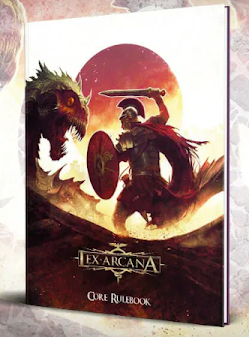
 Lex Arcana: An Empire Without End Core Rulebook by Leonardo Colovini, Dario De Toffoli, Marco Maggi, and Francesco Nepitello, 2019 Quality Games S.r.l.

Lex Arcana:  An Empire Without End Quickstarter by Marco Maggi, and Francesco Nepitello, adventure by Giacomo Marchi, 2019 Quality Games S.r.l.

Long-time readers know that I will often talk about newly-arrived games in the Grubbstreet household. Many come in. All are flipped through. Some are read. A few are actually played. When I talk about the new arrivals I don't go into a lot of details and hesitate to call my write-ups reviews. The big reason is that games should be played, and reviewing a game based on the text alone is like reviewing a play based on its script. It can be done and done well (look at the voluminous amount of Shakespeare commentary), but doesn't get the experience of the game itself. Similarly, reviewing a live play is like reviewing a performance, where a lot of elements come into play, but I think it is more honest to take it out for a spin. 

Anyway, this is a review. I had the chance to run my regular Saturday night crew through the Quickstarter, and got a fair idea of both the mechanics and the game world. So here goes.

Lex Arcana is the X-Files in a Roman Empire that never fell. The year is 476 CE in our parlance, which was when the (Western) Roman Empire fell. In this world is is AUC (Year of the City) 1229, and Rome is still chugging along at its maximum empirical extent. This is mainly because a) there are gods, and b) there is divinatory magic that allows Rome to avoid letting things fall apart.

That doesn't mean there are no threats to the empire, and that's where the Player Characters come in. You are custodes (watchmen, guards, agents)  of the Cohors Auxilaria Arcana, which is a special detachment of the Roman Legion, recruited from across the Empire to deal with supernatural dangers. You've been touched by the gods and act as agents of Rome. You may be sent off as the result of a vision, an omen, or a report from the hinterlands, and given wide leeway in dealing with threats to the Empire. 

You have Abilities (Called Virtutes) and Skills (called Peritiea) Ah, that's another thing. Everything is named in Latinate terms, which helps in getting the proper feeling but can create havoc in play. The good news is that most of  skills and abilities make sense to a non-Italian speaker - your coordination ability is Coordinatio, your combat skill is de Bello.  The bad news is they truly need a Pronunciation Guide for the poor semi-literate English-speakers. My dog-latin would make a hound howl, and I am afraid I risked one of Jove's Thunderbolts mangling the language. The game master, by the way, is called a Demiurge. 

Anyway, you have "Dice Points" in your Abilities and Skills, and this is interesting. You can roll any type of dice (d2, d3, d4, d6, d8,etc...) for an ability test up to the maximum number on that dice. So with a Coordinatio of 12, you can roll a d12, or 3d4, or 2d6, or a d10 plus a d2. It is an interesting mechanism. Adding to that is that the dice "explode" (like in Spelljammer's smoke powder rules) - if you get a maximum on your dice (all three d4s come up 4), you roll again and add that to your total. Which sometimes is overkill, since you will likely have made the Difficulty Threshold already. 

Results also come in degrees of success - You can increase damage or get more information if you beat the Difficulty Threshold by a sufficient number. For every three points you get an additional success. In combat, both sides roll their de Bello, and then high score wins damaging the loser (tying rolls do nothing - you are clanging swords at each other). Degrees of success can multiply the damage. Shields can affect whether damage is done, and armor reduces the damage itself.

One nasty bit is that multiple attackers on the same target add their rolls over a single round (tempo). The first attacker makes his de Bello, then that result is added to the next attacker's score and so on. So a mob can really overwhelm a solitary defender (One of the group was hit hard by a number of giggling child-demons and almost got wiped out).
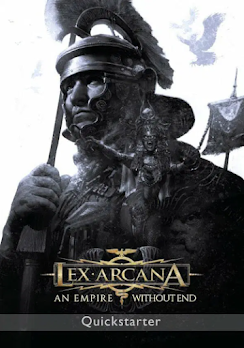
In play, all of the above works out pretty well. As Demiurge, I unleashed this on my regular Saturday night group - 3 or 4 players, which was a nice number, and used the Quickstarter adventure. The Quickstarter has all the basics from the Core Rules, and adds a few wrinkles, like offering a wild card deck of things the player can do to either speed or hinder the plot (Sortes). So here be some spoilers in this discussion, but I will try to make it light.

The group was sent by their local magister into long-conquered Gaul to check out a vision he had. They find a bandit lord who seems to be a lot more charismatic than he has any right to be. He is supposedly a "new Vercingetorix" (yeah, I tripped over that name, though I know it from Asterix et Obelix comics), who was the last great Gaulish chief. In tracking the Bandit Lord to his lair, they discover that the Celtic gods themselves are restless and seeking to mount their own resurrections and rebellion.

And the adventure moved pretty smoothly, with a good combination of action and interaction. There are a lot of random tables for the Celtic gods bedeviling the player characters, and not all of them immediately visible, so I chose results as opposed to rolled them. The story line does have a false branch, in that the heroes can explore the west or the east of the main city(my group, of course, investigated both, setting off ALL the encounters in the process). Regardless of choice, you eventually discover an outpost of the Bandits (same encounter regardless) which in turn leads you to their secret base and potentially a big battle scene (which runs pretty well for such a large number of combatants - my team forced them back into their keep and laid siege, forcing the Bandit Lord's surrender, much like Vercingetorix did). Unfortunately, the way the adventure is written, there is a very small chance the player characters find out WHAT was really going on - why this schmoe got the favor of his gods in the first place.

But all in all, it was a pretty good setup (we're a bit leisurely in our play, so we wrapped it up in about four or five nights). It gave some good challenges for a low-level group. There was a good mix of the prosaic and the fantastic. We had to walk through the combat carefully at first, but it came together naturally. 

The game has elements of traditional (D&D) style RPGs - the call and respond nature, the game master, the use of polyhedrals, to be comfortable, but enough new material (combat system, sortes) to challenge established players. The setting has great potential (I have a number of additional sourcebooks), and gives the players a strong direction of what they need to do (your boss had a bad dream - go check it out). In the Quickstarter, the differences between the classes is a matter of dice points you have, but that expands out in the core ruleset.

Final summary? Worth playing, and worth playing again. A good time was had by all. Just wish I had taken more ranks in dog-latin.

More later.


Thursday, February 16, 2023

Book: Burning Down The Haus

From Bauhaus to Our House by Tom Wolfe, Washington Square Press (Pocket Books) 1981

Provenance: This is again from the collection of Sacnoth, but lacks his normal marginalia and notes. I pulled the book off my bookshelf en route to the bathroom at one point, and it remained there for some time. In fact, I discovered I could ONLY read the book in the bathroom while I was ... otherwise occupied. If I took it elsewhere in the house, I would ignore it as I could only absorb it in small doses, as too much exposure to it raised my blood pressure. Ultimately, though, it has taken me a while to get around to panning it because I had to think about what I hated about it.

Review: Call this a Hate Read. I like Wolfe's work - The Right Stuff is spot-on. Bonfire of the Vanities was great when it was serialized in Rolling Stone (the movie? not so much). But I really didn't like what Wolfe was saying here, and like less the way he was saying it. But at the same time, he has a point - a lot of modern architecture varies between non-descript and outright ugly - big glass boxes without a lot of style or personality. 

Mind you, he's not wrong. Our cities have been overtaken by the big glass box. South Lake Union is full of them. But he ascribes this blandification to a group of architects in Germany that set themselves up as the end-all and be-all high priests, and their followers refining the process to the point that they abandon the physical plane altogether and enter the domain of theoretical architecture, which is planned but never built. And ultimately blaming the consumer and end user for not standing up to these architectural bullies.

Wolfe's text is as overwrought as the architectural ornamentation he mourns. His verbiage is dense and he fits as many obscure references in a he can. He comes off as that dinner party bore eager to share his opinions and width of knowledge without regard to who gets in the way. Here's a reference to a medieval philosopher, there a listing of archaic architectural features. And of course the de rigeur Latin reference that no one who went to college in the Midwest would understand. Tempora mutantur.

Ultimately, he is of that brand of Intelligentsia that scores its points by attacking other Intelligentsia. And he had become a brand, right down to his ice cream suit and smarmy literary pretensions. Heck, even the cover design of this particular edition says it is more about the author than the subject.

Much like critiques of modern literature that seem to begin and end at the MFA programs, Wolfe defines his world very narrowly, and then judges it for being so limited. For him, modernism is an exit to nowhere. Frank Lloyd Wright is mentioned but then discarded from the discussion, even though he did some of same overrunning of his client desires as his German colleagues, and in addition contributed more to American architecture. Brutalism doesn't show up because it is not German enough. The Craftsman and Unosian houses don't even exist. The US Steel Building in Pittsburgh, Sears (now Willis) Tower in Chicago and Transamerica Tower in SF were extant when he wrote this, but apparently didn't make a dent in his arguments. 

The book was written in the 1980s, talking about movement introduced in the 1920s. We are forty years further along, and I wonder what Wolfe would declare about PPG Place in Pittsburgh (A glass box with crenellations!) or The Seattle Library (which looks like it belongs on the back end of a Star Destroyer) or the multi-colored MOPOP in Seattle (identified by Ron Judd, a local columnist, as "The Wreck of the Partridge Family bus"). What about the sextoy-shaped Gherkin in London? The Cell Phone, which melts cars in the adjacent parking lot? Or that monstrosity of the ultra-thin glass box in New York City, the toothbrush box on Billionaire's Row, a thin glass box that towers over all the other glass boxes?

What would he say about open floor plans? The unification of controls, so only one set of switches commands the lights of an entire floor? The removal of false ceilings of asbestos tile, replaced by exposed HVAC systems, giving large rooms a comfy boiler-room feel. And on the consumer level, the rise of "snout houses", also called "Garage Mahals". where the street view is just he driveway and a garage (and are placed on tiny lots that barely demand a lawnmower).

But I digress.

The thing is, it is not (exclusively) the design habits of the Bauhaus school that evolved us to the current state. Advances in material science and design has brought about this change as well. We have moved from exterior walls as a primary means of support of the structure to facades that hang on steel frameworks, and most recently to strong central cores that allow those building-wide open floors. We ended up with these big, boxy buildings in part because we made it easier and more efficient to make them taller and bigger.

So that may be the heart of my dislike, no, my active hatred, of this text - it offends my engineering sensibilities. Science and commerce, not art, got us to this point.

Literally I exited this book feeling dumber than when I went in. It is a rare thing to dislike a book this much and still finish it. I feel a need to do more research in architecture just so I can fully elucidate my dislike of this slender volume. So I guess there is that. If you want a better take on the architectural blunders of the past and present, here's a young woman who has been picking on them on TikTok for some time. And it in turn led me to a podcast on modern architecture. And both are more illuminating and entertaining about the subject than this book.

More later,

Tuesday, February 14, 2023

Book: The Little War

The War of 1812: A Forgotten Conflict by Donald R. Hickey, University of Illinois Press, 1990 

Provenance: This volume has a Half-Price Books price tag on the front cover ($8.49 as of 2/99), but comes to me from the collection of Sacnoth. It has one of his business cards as a bookmark (tagged for "Design, Editing, Research, Proofing"), which is covered with his small, tight handwriting in pencil. It ALSO has another bookmark, saying "This Book Belongs to Rich Baker". Rich was a colleague at Wizards of the Coast with both of us, and is now a colleague with Zenimax Online. So the book has stayed in our orbit all these years.

Review: I've been looking for a long time for a good book on the War of 1812, and this fits the bill nicely. Books on the subject are few and far between, and tend to focus on only one element of the conflict. Part of this is because the war is so granular and diffuse, with many very separated theaters of operation (Great Lakes, Native Nations, New Orleans, the High Seas, Burning Washington) that a high-level view is hard to make. But also because it is a war that we as Americans really want to forget about - our reasons for getting into it are a bit murky, our performance erratic, and the resolution a tie (at best). 

There has been a lot of debate of about how we ended up in the war, possibly because the US usually goes to war as a result of an "inciting incident". Pearl Harbor. The Maine. Gulf of Tonkin. The Zimmerman Telegram. Fort Sumter. 9/11. Sometimes this inciting incident may prove to be fictitious or overblown, but we have it in our constitutional DNA that we don't hit first, but when we're hit, we hit back hard. 

The War of 1812 doesn't really have that. The US declared war first, based on British maritime actions, known as the Orders of Council, that allowed the Royal Navy to intercept and search ships heading for Napoleon's French Ports, and  also against impressment of formerly British sailors on US ships. The Orders of Council were rescinded two days before the vote to go to war, so that dropped away almost immediately. The impressment issue was much greater than it seems from this temporal distance - in the six years before the outbreak of war, some 6000 sailors on US ships were impressed by the British. Because we had a lot of Brits on our merchantmen. The Americans paid better than the British navy, and there was less chance of being shot at, so a lot of British tars came over (The administration estimated were that there were some 9000 British citizens serving on our ships at the start of the war). And there even was an "Incident" - The US Chesapeake affair, where a British  fired on and boarded a US ship to capture supposed deserters, killing four. But this was in 1807, and while it could have created a foundation for war, it didn't. We were not ready, yet.

So why did we go to war? Hickey puts forward the traditional viewpoint - that the Orders of Council and Impressment were the cassus belli. More recent historians push the idea we had a secret agenda to conquer Canada and this was just a cover story. And indeed Hickey notes that we were already building roads north to carry troops before the declaration of war, and during the peace negotiations, the negotiators received instructions to have Britain hand over Canada as one of the terms. So, yeah, we have the declared reasons for war, but if we could get rid of British influence in the New World, that would have been a nice bennie.

I think we declared war because we thought we could get away with it. Britain, with the most powerful navy in the world, was fighting with France, with the most powerful army. Clauswitz said "War is a continuation of policy with other means". The US thought that its issues were not being addressed by the Brits, and declaring war would make them take us seriously (spoiler: It didn't). It should be noted that we did not throw in with the French, but considered "our war" to belong entirely to us. And if it worked, we would get the spoils. 

And we did OK, from a standpoint of reducing British support of Native American tribes in territories we were trying to move into. The battles won were cases where the Brits were at the end of the logistic tether (the biggest navy didn't matter if you were fighting on a lake; one-on-one battles with over-cannoned frigates). But several attempts to invade Upper Canada came to naught, Washington was captured and burned, and the Brits grabbed most of northern Maine (to give them a better route to Newfoundland and their other coastal holdings). The final treaty restored the relationship to its pre-bellum state, and since by that time Napoleon had been contained, that was good enough for the British (No war, no need to stop ships and drag off British Nationals). 

The War was also the last gasp of the Federalist party as a national force. Originally the "Party in Power", they were during this period overwhelmed by the Virginia-controlled Republican Party(also called the Democratic-Republicans or the Jeffersonian Republicans, which would later split into the Democratic and National Republican (later Whig) parties. Yeah, it's complicated)  The Federalists were strongest in the Northeast, and were taking it more on the chin in the war. There was talk of New England leaving the union and seeking a separate peace with Britain, culminating in the Hartford Convention, where they did not do so, but instead sent a list of demands to Washington - which arrived a couple days AFTER the peace treaty did. That and the fact that the then-Republicans were embracing a lot of the things the Federalists stood for, like strong centralized government and economic controls (because wars are expensive), sort of spelled the end of the Feds as a major force.

Hickey pretty much lays that out in the book, but tends to be more forgiving of the Federalists, pointing out that we don't have any solid records of what went on at the Hartford Convention - as a result the Federalists come across as more hapless than rebellious. Still, like the anticipated invasions of Canada, there is enough evidence to support thoughts of secession. 

Hickey's The War of 1812 is an excellent and concise history of a diverse and far-flung war. It is pretty much what I was looking for. I'd love to find something from the British/Canadian perspective, or of the Native American peoples who fought in the war (Hickey does a better job than most bringing them into the conversation). There have been new editions over the years, but you might be able to find this one at Half-Price. Or in the libraries of other friends.

More later, 

Friday, February 10, 2023

Theatre: Story Time

 Metamorphoses, based on the works of Ovid, Written by Sami Ibrahim, Laura Lomis, & Sabrina Mahfouz, Directed by Shana Cooper, Seattle Rep through Feb 26

About 2000 years ago, a Roman poet named Ovid gathered together a collection of myths, legends, and stories and put them in epic poetry form. Some 250 stories, occupying 15 volumes. Lotta gods, lotta kings, lotta violence. That collection has survived to the present and has become one of our (usually unread) cultural foundation stones.

Here we have is a few of those stories, starting with a creation myth and running through the deification of Augustus Caesar (with Phaeton and the chariot of the sun as a bonus round). We have an Orpheus story (but not the one with Eurydice), Medea, Actaeon watching Diana bathing, Midas, and an argument between Jupiter and Juno arguing about who gets more out of sex - the man or the woman. It is not a "greatest hits" album, and there is a nice mix of the familiar and the forgotten.

And that's part of the problem here - it is a grab-bag of stories, so it starts, stops, and starts again. It doesn't build up a good head of steam, and you're left trying to figure out how everything fits together. The theme is stated as "what it mean to be human", but that doesn't seem to fit snuggly in with the vast variety of stories it contains.

What it does do is present a whole raft of storytelling styles, but it does it subtley, so I'm not sure if that's an intended point. The Juno/Jupiter argument opens up to audience presentation. It is followed by a tale of Bacchus that comes off as a flop-sweat comedian's routine. We have a singalong (geared to the age of most of the audience), a song about how sucky Midas is, and traditional story-telling of friends around a campfire. It is interesting, but uneven. 

What is excellent is the ensemble - Kjerstine Rose Anderson, Meme Garcia, Nike Imoru, and Darragh Kennan. Most have been at the Rep before, and I'm a sucker for returning actors. They also are excellent storytellers, and I could listen to them for much longer than the 90 minutes.

And the set is fine, though is outdone by the rotating platform and beaded scrim in the theater next door. The props are onstage, but come apart and enter into the stories, and in the end, the stage itself is a shambles. Which may be a point as well, but I'm just not sure.

It feels like a missed opportunity. If we're going to delve into various ways we tell stories (and, mind you, Ovid himself was all over the joint on his storytelling), they could expand it out. Daedelus and Icarus as a powerpoint. A point/counterpoint of Noah and Deucalion. The deification of Augustus as letter of recommendation. Something that could bring things together. As I said, 250 stories in the naked Greek isles, and these are just a few of them. AND telling stories in what makes us human.

Over twenty years ago, the Lovely Bride and I saw another production of  Metamorphoses. Mary Zimmerman's version, presented by the Seattle Rep at the former Intiman stage across the way. It told some of the same tales, and took advantage of the seats rising around a thrust stage to put a swimming pool in the center. And it felt that that production hung together more, though it took some of the same stories as the base. This production was OK, but pales in the memory of that one. It is not bad. It is just OK.

More later,


Monday, February 06, 2023

Theatre: Teenage Wasteland

 I Am Not Your Perfect Mexican Daughter by Isaac Gomez, Based on the novel by Erika L. Sanchez. Directed by Juliette Carrillo, Seattle Rep, through 5 February.

OK, this one works. Full play, large cast, even an intermission.  Yeah, I've had my fill of one-person performances for a while, and a bit of old-school theater (created recently, but in the old forms) is appreciated.  

Here's the basics: Julia is a volcanic fifteen-year-old nerd, half MTV's Daria and half Sam Kinison. She fights with her parents, comments sarcastically on everything, and lives in the shadow of her older sister, Olga, who IS the perfect Mexican daughter. Or WAS, because she got by a truck, while texting. We open with Olga's funeral, and Julia grousing about the mortician's makeup job. 

And the play is about grief and mourning and growing up. Julia blames herself for her sister's death, and for cutting herself off from her. There are a lot of incidents and accidents in the course of her maturing. We have dealing with family and friends. We have sex, drugs, violence, altercations major and minor. 

And it works. The actors across the board are excellent, with a lot of them taking on additional roles to swell this world even further. Karen Rodriguez is excellent a Julia, containing the infinities and pettiness that only a fifteen-year-old can have. Sofia Raquel Sanchez is an excellent Olga, sweet and perfect and flawed in her own right. Jazmin Corona is a tyrant mother in opposition with her willful child, and only when the child understands why does she become more sympathetic. And Marco Antonio Tzunux and Leslie Sophia Perez are stealing scenes right and left as Julia's over-the-top classmates. All of them come across as believable characters.

I usually pick on the business of the set design, but here it is broad and open, a set of moving rings in the center (thanks, Hamilton), with various props (doors, coffins, tables) drifting onto the stage or being dropped from above. The background is a beaded scrim, semi-translucent, with a beautiful hummingbird design on it. The actors have space to move and interact, and it really works. 

We watch Julia grow, fall, and rise again. Only when she recognized the flaws in others and in herself does she understand her world better, when she sees other people's scars in addition to her own. Over the course of the play, she evolves, and we get to grow with her. 

More later, 


Monday, January 30, 2023

Theatre: Nursing in the Times of the Virus

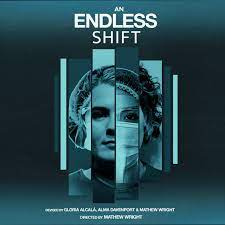
 An Endless Shift, devised by Gloria Alacal, Alma Davenport & Mathew Wright, Directed by Mathew Wright, Arts West, through Feb. 19th

Afterwards, in the car, the Lovely Bride said, "What were those books we had, the ones in which there were collections of interviews about jobs and World War II?"

I responded "The books were "Working" and "The Good War", by Studs Terkel." He compiled a lot of interviews on these subjects (and other subjects as well), edited them, and published them as oral histories.

And An Endless Shift works off the same principle. The three devisers (as opposed to playwrights) interviewed five health care professionals (four nurses and a respiratory technician) about their experiences during the pandemic. The endless shift of the title is both a reflection of the long hours and relentless pressure during the worst of the pandemic, and the shifting opinions on them as the crisis dragged on, from surprise to fear to support to doubt to hostility from some of the same people they were trying to save. 

The performance in one-woman, five characters, five chairs on the stage. Gloria Alacal, one of the devisers is the actor, supported by audio clips of both the news of the day and the women interviewed. And she does a good job, though some of her characters tend to blend and blur in the single-person retelling (I had some trouble telling apart when she was the older African American nurse. and the younger gay male nurse). And there is some repetition in tying it all together at the end, but it holds the (mostly masked) audience for the length of the performance.

And the play provides a narrative approach to the entire mess of the past three years. We've been buffeted by events and discoveries and reverses and politics. Particularly politics. As we move forward, figuring out what happened and why will be a big chunk of our history of these times, and the living record of those who went through it on the front lines will be a big part of that.

Ultimately as a performance? It's good, and can be better. Yes, the devisers are relaying the words and experiences of their subjects, but they are also choosing the questions and choosing which responses to present and in what order. Terkel presented himself as an author, and Alcal, Davenport, and Wright are similarly empowered to do so. The performance itself needs some editing (I thought we reached the end about three times), yet it was a powerful statement in the words of those that were boots on the ground at the center of this maelstrom.

More later,

Tuesday, January 17, 2023

This Just In: Holiday Gift Wrapup

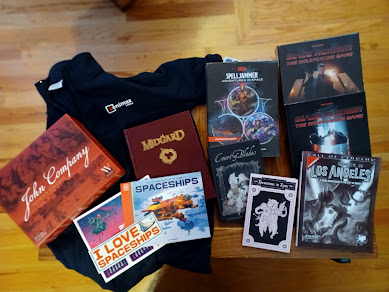
This latest batch of games and other stuff is interesting in that they are mostly not things I paid money for. And by that I don't mean I-got-it-on-Kickstarter-so-I-already-paid-for-it (and kicked in a bit more for shipping) but rather stuff that has tumbled into my lap as gifts. Here's the latest batch.

Zenimax Zippered Sweatshirt (Black with Zenimax logo on front)- This was a surprise holiday present from my new employers at Zenimax Online Studios. Oh, yeah, for those that don't follow my LinkedIn account, I have a new gig as a senior writer/designer at Zenimax. working on Elder Scrolls Online. Cool beans (and a nice pullover as well).

Midgard Worldbook (Wolfgang Baur, Richard Green, Dan Dillon, Chris Harris, Jeff Grubb, and Brian Suskind, Edited by Michele Carter, Kobold Press, 464 page hardbound book). I already have a copy of this book. Heck, I wrote (small) parts of this book. When Wolf was cleaning out a work area, he found an extra copy of the leather-bound, gold-foiled stamped edition, and passed it along. Which gave me the excuse to cruise through it again and wonder at how great is it. Midgard, the "home campaign" for Kobold Publishing, is a world full of worlds. Broken down into various broad areas, it not only reflects different cultures, but different styles of play as well. History, species, gods - regardless of your play style, there's something here for you.

Spelljammer (Christopher Perkins, Wizards of the Coast, three 64-page hardbound books with DM's screen, in Slipcase) Hang on, Jeff, I hear you say, didn't you already talk about this one? Well, yes, but Chris Perkins over at WotC was kind enough to pass along the "standard edition" of the setting, which is the same except for the art on the slipcase. I've had more of a chance to peruse what they have, and to a great degree it has grown on me. Yeah, there needs to be a better ship-to-ship combat systems, but back in the day we really did improve the basic system in original Spelljammer set with the later War Captain's Companion. This feels foundational, with a lot of room for individuals to grow and develop it.

Blade Runner RPG (Tomas Harenstam and Joe LeFavi, Free League, 232 page hardbound book) and Blade Runner Starter Set (Tomas Harenstam and Joe LeFavi, Free League, Boxed set w/rules, adventure, dice, cards, maps) I swear that Free League is either getting a subsidy from the Swedish government, or is secretly owned by a printing company/design house, since the company has some of the BEST looking products in the business (In addition to this one, we're looking at The One Ring, Vaasen, and Tales from the Loop as examples). Nice art, great production values, solid rules. Blade Runner pushes itself as being a dystopian SF world, and I don't think you escape a single paragraph in the book without being reminded that the future sucks, in particular for you.

John Company, Second Edition, A Game of Nepotism and Bureaucracy in the British East India Company for One to Six Players  (Cole Wehrle and Drew Wehrle, Wehrlegig Games, Boxed Game ) I've been spotty on doing board games from Kickstarter, if only because I have a couple boxes down in the basement that I intend to get around to playing some day. John Company is one of those games I supported on a whim, and upon delivery, I realize I may have bitten off more than I can chew. The box is crammed to the point where the lid does not quite fit. And the intro rules strongly recommend I spend a quiet hour, undisturbed, with a pot of coffee (what, no tea?) to puzzle them out. In the game you control a British family working for the East India Company (the John Company of the title), and maneuvering around others in order to set your familial line up for success and avoid total disaster. This is quite simply a labor of love - the game components and impressive and well-rendered, and even the box itself it artistically rendered. However, I am daunted by its sheer impressiveness. Reminds me of those long, engaging SPI/AH games I have on the shelves downstairs.

Kepler's Intergalactic Guide to Spaceships (Jake Parker, JP Creative, 128 page softbound book) I've also been hit and miss with art books - some good, some just average. Kepler's is just really, really good, and I found it a delight leafing through it. It is collection of various ship types, with commentary by Kepler, a four-armed starship mechanic. The ships themselves are pretty cool-looking and the world that is revealed by their descriptions (and the comic story that threads them together) is intriguing. My one regret is that these need more stats and a system for interactions (like ship-to-ship combat). In short, it would be a perfect setting for an RPG. Came with a calendar, two stickers (one bumper, one laptop) as Kickstarter tchotchkes. 

Court of Blades (Shawn and Navi Drake, A Couple of Drakes Publishing, 328 page hardbound book). There's a lot of discussion going on about D&D's OGL right now, but one thing it accomplished in the past 20 years is set the limits of the d20 system. And in doing so it allowed for a new generation of radically different RPGs. The Forged in the Dark system is one such solar system of RPGs, which depowers the GM, increases continual player interaction, and creates a more cinematic space of play. I've had the chance to play a few of these, and while I think it would a challenge for my grognard nature to run them, I really appreciate them. The system itself concentrates on one type of adventure, but as a result allows a wide variety of games to evolve from the core system. We have heists, military campaigns, space smuggling, and in this case, courtly intrigue. It describes itself as Gunpowder Diplomacy, the coterie of players represents servants of a particular noble house they are supporting, and would be comfortable from Shakespearean tales to the Three Musketeers. The rules follow the formatting of other Blades products, so if you are familiar with one, you will be able to follow along here, and the artwork is excellent. 

Downtime in Zyan ( Ben Laurence, Through Ultan's Door, 36 page pamphlet 'zine). After raving about the art and production values of the previous three items, I have to come clean and admit the art for this latest addition to Through Ultan's Door is below the quality of its predecessors. It is drawings of fantasy mole rats in a style similar to Adventure Time cartoons. But the subject matter and quality redeems all things. The entire subject involves what do do in the down time between adventures, including investment, social relationships, training, carousing, and spell research. We've all taken stabs at doing things between the sword-swinging, and this gives a great structure and some room for thought about entire process. Recommended. 

Secrets of Los Angeles (Peter Aperlo, Chaosium, 2007, 192 page softbound book) This was a gift from fellow creative Steve Winter, who discovered he had two copies and offered me one. My affection for the Call of Cthulhu RPG is well-know, and my shelves are starting to groan with the wide variety of products published over the years. But I have a special place in my heart of the layout and graphic design of the black and white sourcebooks they produced. Texturally dense but divided into bite-sized nuggets, with photos of the era and a large amount of sidebars, this is a grand tour of 1920s LA, along with two short scenarios to drive you players mad with. Yeah, I'm a softy for the presentation, the subject and the era (spilling over into the hard-boiled 1930s).

That's enough rambling for now. I think I need to settle down with a little light reading in Midgard at the moment.  

More later,


Thursday, December 22, 2022

Happy Holidays from Grubb Street

 Wishing everyone a safe and happy Holiday Season from Grubb Street.

Merson - Rest on the Flight into Egypt (1879)

More later,

Tuesday, December 06, 2022

Theatre: Dueling Carols, Part 2

Mr. Dickens and His Carol by Samantha Silva, Developed and Directed by Braden Abraham. Seattle Rep, through December 23rd.

And here is the other Dickensian play on my docket (there is a third in the Seattle area, from the ACT company, which looks fairly traditional, but I am not engaging with it). And I regret to say Mr. Dickens is disappointing. 

And that's a pity the play addresses directly a lot of my concerns about theatre in general. It has burgeoning cast in an era where four-person comedies and one-person monologues abound. It has a lot of familiar faces on the stage (If you call yourself a Rep, you should have a Repertory). It actually takes the time to be a full play, clocking in at 2 and half hours. But it all fell flat for me.

This is not Dickens "A Christmas Carol" but is more "A-Christmas-Carol-Adjacent". It tells a story about how "A Christmas Carol" was written. Here is the precis: Dickens hits a literary bump in his career. After early successes, his current serial is fizzling, and in addition he is a soft touch for every needy charity as well as his ever-growing family. Christmas spirit for him is reduced to opening his purse and watching his dwindling savings drain away. His agent proposes he write a quick Christmas book. Dickens hates the idea, drags his feet, and engages with it only because of his financial difficulties. He gets writer's block. He comes to embrace his inner Scrooge, chases friends and family away, and goes doggo, takes up with a local seamstress as his muse, acts horrible to all, then realizes he is being a ass, quickly reforms, writes the damned book and everyone once more rejoices in his talent. 

I'm not publicly fact-checking any of this, but let us say it plays fast and loose with the particulars of the situation and leave it at that.

Dickens, as portrayed by Adam Standley, is overmatched by the role. His Dickens is shallow, egotistic, and unlikable, full of himself at the start, his key literary being able to come up with funny names and grind out popular plots. As he slides into Scroogedom he becomes progressively worse and more unpleasant, and he is well into the second act, after two hours of being snarling at the world, before having his epiphany, doing the job, and being filled once more with Christmas spirit. Sequence after sequence of Dickens being put upon and snapping back in return tends to plod after a while.

Plus, the writing is as baroque and ornate as the interior of Westminster Abbey. At the interval I overheard one of the other patrons saying that she felt like English was no longer her first language. Plus, we get a lot of titles, characters, and references to other Dicksenian works, so if you're a fan, you'll get the jokes. And the act of writing is a basically lonely and boring task, so we see a lot of Dickens sitting down to write, and twenty seconds later saying "Ahah! I am finished!" (Would that this be always so - and "A Christmas Carol" WAS written in about six weeks).

The rest of the company is quite good - their characters are broad and they engage fully with them. As I said, familiar faces ease some of the pain, and Cheyenne Casebier as Dickens most recent muse was particularly good. I liked the children as well, both for the young actors portraying them and the fact the play actually gave them things to do, as opposed to using them as mobile set design.

The stagecraft is literally Hamiltonian, down to the rotating stage that allows the huge cast to bustle through it, recreating an extremely crowded London. The ensemble got their steps in as they moved continually through a crowded set, pulling on and off all sorts of props as the scenes changed. The first act is dominated by an spinning erector set of iron piping in the center, which combines neck-craning for the audience with various railings blocking line of sight. Yet there are a few scenes that are inspired in their presentation, that I think were marvelous, but they are badly outnumbered.

I dunno. Maybe it is the sudden snowfall, or the parking situation in the Seattle Center, or being under the weather right now, or the fact the show itself started late and "paused" for a bit with a tech problem, but the Lovely Bride and I were drained of our Christmas spirit by the end of this. The short version? Go check out the Q Brothers Christmas Carol for your cup of holiday cheer.

More later,

Sunday, November 27, 2022

Theatre: Dueling Carols, Part 1

 Q Brothers Christmas Carol, a musical by Q Brothers Collective, Directed by Daniel Cruz. Arts West through  December 23rd

Ah, the Holiday Season in the Theatre, when the standard, go-to, feel-good performance pieces pulls from a writer who died 150 years ago, and whose work has nestled the Victorian Era firmly into our Christmas Spirit. I speak of  Charles Dickena and A Christmas Carol. Both Arts West and the Seattle Rep are doing versions this year, so I (and you) are subjected to dueling Carols.

The story itself has incredibly plasticity over the years. I have encountered the original version, along with musical versions, deconstructed versions, back-stage comedy versions, innumerable TV show episodes, and all manner in between. It has been performed by Albert Phinney, George C Scott, Bill Murray, Patrick Stewart, Scrooge McDuck, Tim Curry Michael Caine (with the Muppets), and Mr. Magoo. The Oregon Shakespeare Festival is running version where the Christmas Spirits are played by the Marx Brothers. And here we have a hip-hop version of this timeless classic. 

Hang on, don't click away from here in fear. These are friendly spirits,  filled with good cheer, and this actually is a really good presentation of the story.

You all know the drill on this - everyone knows the drill. Ebeneezer Scrooge is wealthy rat fink who is visited by three spirits on Christmas Eve and from the lessons of the Past, Present, and Future, chooses to become less of a rat fink. It breaks down into pretty manageable chunks. We see Scrooge as a rat, then he gets a heads-up from his dead partner Marley that he is about to be ghosted, then we ratchet through the ghosts and end up with Scrooge so relieved by his change of heart that he makes people worry about his mental health. 

And yeah, this is hip-hop, all the way through. We are in the modern era, and this Scrooge is a former math nerd who turned to his capitalistic dark side. Marley is Bob, not Jacob. Christmas Past is Run DMCish with bucket hat and chunky chains, Christmas present echoes cooking-show era Snoop Dog, and the  spirits of Christmas Future invokes  the dance troupe Jabberwock. You don't need to know the history of the art form to enjoy it all as its sprawls out with hep beats and solid rhymes. Yeah, it is hip hop hooked to an ancient carriage, or perhaps a venerable vehicle with fresh horses, but it works.

We caught it on opening night, which had a late curtain and the program only available with a QR code. The house was friends, families, and financial supporters of the theater, and could be literally assumed to be "friendly". Yet the actors earned their many applauses, and bounced through the proceedings with a contagious energy that you can't help to embrace.

Christopher Kehoe Is Scrooge and portrays him in that white-boy-forced-to-be-funky dance moves when he cuts loose. The rest of the talented team (Dre Anderson, Jerik Fernandez, and Lola Rei Fukushima, who I will now think of as a "regular" for Arts West) get the good stuff, shimmering through proceedings as the ghosts, Marley's family, old friends, and encounters, often playing a couple parts simultaneously. The silliness gets contagious, and the performances are solid.

And they play it, for the most part, pretty straight. Scrooge talks to a sack of money he carries around and replaces "Bah Humbug" with "Chris-my-ASS-mis" as a tag line, and there is some Swiftian hints of cannibalism in the Marley household, but for the most part the really nail the beat, both narrative and musically.

I was going to wait for the Seattle Rep version to compare/contrast, but this was good enough to give you a good heads-up at the get-go. It is an enthusiastic entrance into the Holiday Season, and good rendition of the old Dickens chestnut. Go check it out.

More later,


Saturday, November 26, 2022

Shulz Centennial


Oh, Good Grief.

Psychiatric Help 5 Cents. Fussbudget. Slugs. Rats! Security Blanket. Kite-Eating Tree. Great Pumpkin. Sweet Baboo. Snicker-Snacks. Blockhead. Joe Shlabotnik. Round-Headed Kid. Supertime Dance. Sidney or the Bush. Cat Next Door. Beethoven. World War One Flying Ace. Sopwith Camel. Red Baron. Vincent Van Gogh. Joe Cool. Vulture. Miss Othmar. Lazy Eye. It Was a Dark and Stormy Night. The Six Bunny-Wunnies. I Got a Rock. Don't Call Me Sir. Naturally Curly Hair. Woodstock. 

Good Old Charlie Brown.

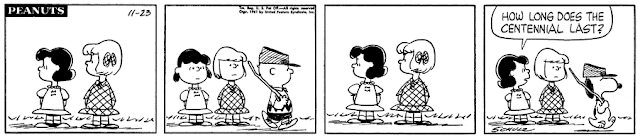
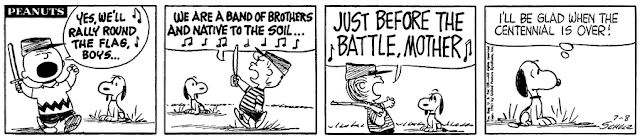
This weekend marks the 100th Birthday of Charles Shulz, creator of Peanuts. Peanuts was a touchstone for much of my generation and and for generations before and after us. It was incredibly popular, expanding from the daily and Sunday strips to movies, TV shows, comic books, records, songs and Broadway shows. Even its huxtering brought attention to Dolly Madison Cakes and Met Life. Its Christmas Special is one of the wonders of its age. 

A lot of people (in particular other cartoonists) are commemorating the centennial, but I just want to note how much of our childhood language was influenced by his comic strips. Words, history, and situations have taken on an extended life in our memories after being incorporated into his strips. The kids were kids, but they were very smart, generally well-informed kids.  Snoopy had an incredibly detailed alternate life, ranging from the coolest guy on campus to being a lawyer to an astronaut to captaining the Starship Enterprise. All of this formed a common ground for our generation, a shared experience told in four panels per day, with color versions in the Sunday paper. 

Shulz passed on in 2000, the day after his last comic strip was published. Yet his reprinted strips are still often the most amusing thing on the comic pages, and reach far beyond the nostalgia of our youth. Charles Shulz was one of the most influential writers of the later 20th Cent. He just did it while drawing the pictures as well.


More later, 

Tuesday, November 15, 2022

Theatre: Scottish Play

 Macbeth By William Shakespeare, Directed by John Langs, Seattle Shakespeare, Center Theatre at Seattle Center, through 20 November 2022

Wow, this was good.

While I appreciate a lot of what is happening in "today's theatre", offering a variety of performance styles and new works, I do really long for some meat-and-potatoes old-time-rock-n-roll type theatrical plays. And you don't get more Original Gangster Playwrite than Willy Shakes.

And there has been a lot of Shakespeare variants and Shakespeare-related works out there, but it takes a lot of effort to strike close to the original source material and make it stick. I've seen about a half-dozen Macbeths in my life, the most recent being one transported to a group of schoolgirls in a vacant lot (which was really good), but this is the real deal, the original flavor version and it is so good. 

Sacnoth and his lovely bride, Janice, were going and invited me along. The venue is in the basement of the Armory in the heart of the Seattle Center (large building between the fountain and the space needle - the one with the food court). The space itself is relatively low-ceilings and intimate, which brings the players right up to the actors. I've been there before, for a performance of Mother Courage from Book-It, which also uses the space. 

You should know the basics of the play by now. Three witches appear to warriors Macbeth and Banquo. They prophesy that Macbeth gets to be king, but Banquo's descendants get to be a lot of kings. Macbeth, along with his wife, choose to speed up the coronation by killing the current King, then turn on Banquo to try to foil the prophesy. That trick doesn't work, Macbeth and his wife go crazy in very different ways, and Macbeth's former allies overthrow the mad king in the name of Banquo's child, who goes on to become the ancestor of many kings of Scotland and James I of England (who just HAPPENED to be King of England when the play was written).

The performers are top notch.   Reginald Andre Jackson is a thoughtful Macbeth, determine to create his own fate, and increasingly losing control. Alexandra Tavares is an excellent Lady MacB. Both their natures are warm, turning to negatives as the full consequences of their actions descend on them. Banquo is gender-swapped, played spot-on by Jonelle Jordan, and that swap works so much better in this male-dominated play. The rest of the company are fine, and we spent part of the intermission checking the credit lists to see what else they had been in locally (another plus for this performance - local talent as opposed to being "thrilled to be in Seattle for the first time." in the credits). 

The direction was excellent, and John Langs chooses to embrace the supernatural fully, moving the play into the half-realm where the mystic meets the real. The witches don't just do their bits and get off, but rather remain as they see their prophesies become true. They evolve to become the Fates/Norns, embodying the destinies of the characters. Many productions banish Banquo from our sight, letting Macbeth react to nothing on the stage. Here Banquo is a guest at the worst dinner party ever, and Macbeth's terror feels earned. Plus, Lady Macbeth's ghost makes a curtain call right before her death is announced (Shakespeare has a tendency to let his female characters die off-stage).  Bringing the supernatural fully onto the stage is one of the things that really grounds this version of Macbeth. It is not one single ghost or haunt or phantasm, but rather an entire world overlapping on our own.

So, this is one to hunt down in the coming weekend and take a look. Seattle Shakespeare does not do a lot of plays each year, but when they do, they are worth it. Check it out.

More later,

Thursday, November 10, 2022

The Political Desk: Summing Up

So, how did things go?

For Washington State, surprisingly well. The Red Wave/Tide/Tsunami that the media was intoning about failed to materialize to a great degree. The Republicans made some advances on the national scale, which is to be expected in an off-year election, but in Washington State they hit a wall, and actually lost ground. The best news is that it looks like the Election Denier wing of the GOP took the worst hits, and will hopefully be replaced with more reasonable candidates in the future.

Election denial has struck me as a tough sell as far as an election campaign - "These elections are bogus! It's all a fraud! Please vote for me anyway!".

And in a land where a three-percentage point margin is usually considered a landslide and a mandate to govern, a lot of the candidates and measures not only beat the spread, but did so in handy numbers.

In any event, the numbers quoted are as of Thursday night, but it looks like most of them will hold as the late results come in (which tend to trend more liberal in any event). There is only one measure that is "hanging fire" right now, and ironically, it is one about how to vote. 

So. How did things go?

Advisory Vote No. 39 Engrossed Substitute Senate Bill 5974 and Advisory Vote No. 40 Engrossed Substitute House Bill 2076 - Both REPEALED  (by 59%-40% in one, 53-47 in the other). These are Advisory Votes and have no bearing on the bills as passed other than saying we are disappointed in you for doing so. I really think we need to either give these things some teeth, or get them off the ballot entirely.

Charter Amendment No. 1 Even-Numbered Election Years for Certain County Offices - YES, by overwhelming numbers (69-31). As a game designer, I will attempt to run for office/launch an initiative in odd-numbered years, but then I'm just going to cheese the system.  

Proposition No. 1 Conservation Futures Levy - overwhelmingly Approved (68-31), which is nice.

United States Senator - Patty Murray wins handily (57-43). Man, there was a media kerfuffle about how close this was going to be. Turns out that running against King County (where a third of the state's voters live) was not a winning strategy. Go figure.

United States Representative Congressional District No. 9 - Adam Smith (71-29). This was an honest-to-gosh wipe-out, and I've seen nothing in the press about the depth of this wipe-out. 

Secretary of State - Steve Hobbs (49.7-46.7 with 3.6% write-ins). This would have been much closer if not for write-in campaign by the organized GOP in the state, which bled off enough votes to really make a difference. Now the organized state GOP is blaming the media for actually POINTING OUT that the GOP was running their own candidate. Though really, this is a good argument for Ranked Choice Voting and Approval Voting, as it turns out.

Legislative District No. 11 Representative Position 1 - David Hackney (69-31)

Legislative District No. 11 Representative Position 2 - Steve Bergquist  (68-32)

King County Prosecuting Attorney - Leesa Manion (56-44). Oddly, I missed this race in the summary, but I will catch up here.

And on the Stuff I'm Not Voting on(TM)? 

Changing up how Seattle votes for particular offices is actually one of those where the votes are close, and the winner may change after all the votes are counted. Right now, enacting the change is losing by a thin margin (49-51), but may catch up in further voting. BUT if they do change, RCV is smoking the more easily understood Approval Voting (75-25).

And up in the 8th US House race, Kim Schrier is winning handily (52-47) over her Extremist GOP opponent, in a race that everyone said was also going to be a nail-biter. While down in the 11th US House, I am delighted to note that Marie Glusenkamp Perez has shown the election-denying MAGA candidate the door (also 52-47). Yeah, the 11th is considered a conservative district, but it looks like voters will be actually be willing to wait for a reasonable conservative.

And in the 47th State Rep (which includes much of Kent), Claudia Kaufmann is doing well (43-47). Her opposition gave me a robo-call late election day (note: I cannot vote in that race, so next time, just send me the money you would normally spend on such nonsense), where he did himself no favors by endorsing the Republican Senatorial candidate.

And I will note that the same media that embraced the whole "Red Wave" thing are now embracing the "Trump is gornisht, the GOP is in disarray" meme. These were the same outlets that said the Seahawks would be lucky to win three games this year. So yeah, I'm not buying that, either.

And with that, The Political Desk slouches off to the bar to have a few drinks and a good lie-down. See you next election.

More later, 


Wednesday, November 09, 2022

D&D: Relatively Speaking

 It's going to be a little while before all the dust settles and the votes are counted, so The Political Desk is on hold for the moment. In the meantime, I've been going through my LBBs (Little Brown Books for D&D) and thinking about how we played back in the old days (#BackInMyDay, #TrulyOldSchool, #OGDnD, #GetOffMyLawn). And here's a favorite section from the original Men & Magic booklet (Page 13).

Relatives: The referee may allow players to designate one relative of this character to inherit his possessions if for any reason the participant unexpected disappears, with or without "death" being positively established, for a period of one game month, let us say. At this time the relative would inherit the estate of the character, paying a 10% tax on all goods and monies. The relative must start at the lowest level of the class he opts for, but will have the advantage of the inheritance.

    If the character returns, he takes possession of his estate once more (referee's option as to willingness of the relative to give it up) but must pay an additional 10% tax in order to regain his own. Optionally the relative may be allowed to stay on as a non-player character in the service of the player-character. Loyalty of the relative in such circumstance would be at a penalty of from 0 to -6, and he would possibly intrigue to regain control.

    Characters with a relative will lose all their possessions should they disappear and not return before whatever period is designated at establishing death.

Note that at this early stage of the game, the DM is referred to as a "referee". Also note that "taxes" are a part of the game from the start. Also, given the amount of precise legalese in the entry, you KNOW that this had to be the result of a particular situation encountered in a game. 

Just thought it was amusing. More later,


Monday, November 07, 2022

Life in the Time of the Virus: Update

Railroad Train, Edward Hopper - 1908
 At the time of this writing, about 350 people per day are dying of coronavirus. For those morbidly keeping score at home, we lose 251 people/day to drug overdoses, 118/day to car accidents, and 123/day to firearms. So the pandemic keeps inching closer to daily life as "just one more thing" that can kill you around here.

One of the results of this is that Washington State and Seattle are ending the emergency. Which is sort of like an old Doonesbury cartoon where they ended the energy crisis because everyone was used to it by now, so it could hardly be a crisis, eh? We will continue to see hospitalizations and deaths, but they will be at a more manageable level as far as the institutional structure is concerned.

Most of those who are worst affected are, unsurprisingly, those who have eschewed shots in the first place. But a lot of friends and colleague, including the vaccinated, have come down with it and their symptoms have varied from mild and irritating to miserable and lingering. So even with proper vaccines, it remains dangerous.

On a local level, the Lovely Bride got her bivalent shot and seems to have emerged unscathed. I was grumping around for a day or so, but in my case, I triple-shotted a flu shot, COVID shot, and pneumonia shot in one go, which was probably a bad idea. Still, both the LB and I have dodged the viral bullet so far (touch wood).

Masks are still a thing, but in a much more limited sense. Theaters, medical offices, and tai chi are the only places that they seem mandatory. I haven't had to show my vac card for the past six months. so my freedoms have pretty much been intact. It is at most a very limited oppression. I still wear a mask when shopping. though I am in the minority these days. I am fortunate in that masks really don't bother me much (I have a bin of them by the door), and I seem to be able to communicate without too much difficulty (I have very expressive eyebrows).

On the horizon, there seems to be some new wave of variants coming out of Europe, which there has been a limited amount of information. And the flu season is hitting. AND there is a new RSV (Respiratory Syndrome Virus, similar to the common cold) going around. And Monkey Pox. So yeah, I'm still comfortable with a mask.

More later,

Sunday, November 06, 2022

The Political Desk: Bonus Round: Stuff I'm Not Voting On

Why yeah, I'm going to nag you about voting. I expect that most of the readers of this blog (both of them), have already voted, but if not, get out there and vote, and encourage others to do so.

There is stuff I can't vote on around here, primarily because I am not in particular district or community that has those elections. So this a lot of this is distant thunder, and may affect me (and you) eventually.

The big one is a two-part vote up in Seattle that monkeys with how they vote. The current system is that whoever gets the most votes wins. Pretty straightforward, but as the Primaries show, it is a bit of a pain with multiple candidates, and tends to be dominated by the major parties. So the first question is do you want to change the system?

If you do, the next question, do you want the beef  or the fish? I mean, do you want Approval Voting (AV) or Ranked Choice Voting (RCV). Here's the diff:

Approval Voting says you can vote for as many candidates for any office as you want. You like all four Democrats? Vote for 'em. Don't like the incumbent? Vote for everyone except that one person. All the votes have the same weight, so the candidates with the most votes win. Approval Voting has been playtested in a couple locations, though not extensively.

Ranked Choice Voting says you do that, but list them in order. You like the hot educated young professional but will settle for the incumbent but don't care for the climate-denier? Rank them 1, 2, and 3. when the votes are counted, the low guy gets thrown out and the ballots for them look at the second choice and toss those votes onto the higher-ranked candidate. Continue the process until you get to the winner. So if you don't get your first choice, you at least have a shot at getting a decent candidate. RCV has shown up in a number of places, including Alaska, New York City, and the Hugo awards, and has been pretty effective.

Both versions reduce the binary nature of campaigns and removes situations where multiple candidates running who have a particular viewpoint results in that viewpoint getting frozen out. It will likely push voting towards the middle as opposed to opposition camps. It can weaken the power of political parties and promote more independent candidates. That's all good. But it they are admittedly more complicated (knowing how difficult it is to get people to fill in ONE little oval on the ballot). They are intended to be for Seattle's Attorney, Mayor, and City Council, so there will be "hybrid ballots" with two different types of voting on them. And this is proposed for the primaries, which are still "top two". In fact, this type of voting can negate the need for primaries at all (though you'll end up with Goodspaceguy being considered for the general election).

Here's the thing I really want to do. The Secretary of State should call on a brain trust of game designers (hey, he knows a few) and turn them loose on the system with the question "How do we cheese this system?" If anyone knows how to milk exploits out of a set of rules, it will be game designers. Let's run a development cycle or three.

But then, that's not on my ballot. If it were, I'd say No, then swing over to RCV if forced to make a choice. And get rid of primaries entirely, but that's not on the ballot this time.

There are also races that are actually kinda tight, but because of the way they draw boundaries around here, I can't vote in them, either. A few blocks away is Legislative District 11th, a redrawn district that was once traditionally GOP, but last election went Democrat, so they redrew the boundaries to put more red and rural voters into it. Kim Schrier is the incumbent who has done well in her rookie season. Her opponent is Matt Larkin, who definitely on the whackadoodle train - he's just now getting around to saying "Yeah, Biden won" effectively gaslighting his own supporters. Both sides are running attack ads on the tube, the difference being while Larkin's are all about how scary Schrier is (Ominous music, grainy photos, yellow police tape), while ads against Larkin tend to just use voice clips from Larkin's speeches about how this is no time for moderation. So, yeah, there is a difference.

But Larkin's the not the worst GOP Candidate in Washington State. That away goes way to the south, far outside this blog's throw weight. Joe Kent is a newly-arrived carpetbagger looking for an easy grift in a conservative area around Vancouver, Washington. He's got Trump showing up to support him, and ticks all the MAGA boxes. Most recently, the Seattle Times notes that Joe Kent wants to go after those really responsible for Jan. 6 - the FBI. Because attacking the capitol building was a sting operation. So yeah, support his opponent - Marie Glusenkamp Perez. Southern Washington is "Let's Go Brandon" territory, but there are enough sane GOP supporters down there that the race is tight.

Finally, MOST of the city of Kent (but not this household) is in the 47th state legislative district, and actually has a race between two competent, reasonable candidates. Bill Boyce and Claudia Kauffman both come out of the Kent City Council, and have proved to reasonable and responsible grown-ups. This is a choice between two good candidates. I favor Claudia Kauffman because of her positions, it is one of those races where I feel the political responsibility is in safe hands. And I want to point out that there ARE sane Republicans out there. But I still don't like their positions.

In the meantime, if you are in Washington State, or any state that allows early voting. Go Vote, and encourage others to do so as well. 'Cause you have some real loons out there.

More later, 

Sunday, October 30, 2022

Book: Breath of Fresh Air.

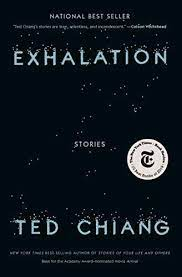
 Exhalation by Ted Chiang, Vintage Books, 2019

Provenance: Elliot Bay Bookstore, which was originally down in Pioneer Square but has moved up to Capitol Hill to occupy part of the old Oddfellows Hall. I was up there to meet a former colleague for dinner, and wanted to stop in and get a different book (which is a different story). 

Review: I was (very briefly) in a writer's group with Ted Chiang. Ted is one of those writers who publishes maybe one story a year, and that story in then nominated or wins various Hugos, Nebulas, and Locus awards. He's really that good. A short story from his previous collection, Stories of Your Life and Others was made into the movie Awakening.

This volume is a collection of tales from since that earlier volume, and is just as fantastic. He creates realistic alien worlds, and then plays within them - The title story involves a robotic race, where the narrator literally trepans himself in order to understand memory. In "Omphalos", he posits a universe where Young Earth Theory is backed up by the facts and evidence."The Truth of Fact, the Truth of Feeling" extends the always-recording lifestyles into creating a perfect history of what really happened. Each is a self-contained world that feels totally reasonable.

Chiang's stories also talk about free will, and the absence of it in a deterministic universe, a lot. in "The Merchant and the Alchemist's Gate" we deal with time travel in a deterministic universe, where the past cannot change because of what has happened, but those that travel into the past have their own reasons for not changing it. In "What's Expected of Us" he introduces a simple device that proves the future is deterministic and unchangeable, that Free Will is an illusion, and what happens to society when that is proved. And in "Anxiety is the Dizziness of Freedom" he posits the idea of a branching multiverse that still puts the question of free will to the test by allowing access between the various branches (quick answer - capitalism and a lot of therapy).

The most frightening story does not involve a robot operating on his own brain in realtime, but "The Lifecycle of Software Objects" that deals with living and thinking digital intelligence and corporate thinking. The meeting of those two I found chilling when I first read it years ago, and it still frightens me to some degree.

Chiang's worlds are deterministic, and he will not bend the rules for the sake of character and story. There are few full happy endings, because the universe doesn't play that way. At best, there is understanding and acceptance for what is to come.

It's a great collection, and if you haven't discovered Ted Chiang, here's your chance. 

More later,


Wednesday, October 26, 2022

The Political Desk - The Jeff Recommends.

OK, we have the ballot before us, looking all the world like one of those standardized tests from Junior High. We fight the panic attack from filling in little dots, and marvel all those unopposed Judge positions. What do we have?

Advisory Vote No. 39 Engrossed Substitute Senate Bill 5974 - Maintained, with the standard kvetches. 

Advisory Vote No. 40 Engrossed Substitute House Bill 2076 - Maintained.

Charter Amendment No. 1 Even-Numbered Election Years for Certain County Offices - No, but you be you.

Proposition No. 1 Conservation Futures Levy - Approved

United States Senator - Patty Murray

United States Representative Congressional District No. 9 - Adam Smith

Secretary of State - Steve Hobbs

Legislative District No,. 11 Representative Position 1 - David Hackney

Legislative District No,. 11 Representative Position 2 - Steve Bergquist

So, get your ballots in by 8 November. There are drop boxes all over, and you can mail it without a stamp if you have it postmarked by 8 November. You can also register to vote up to election day as well. And yeah, we'll be nagging you as we go along. Now we return you to your regularly scheduled book, game, and play reviews. 

More later,

Tuesday, October 25, 2022

The Political Desk - County Position

 The sole position to be filled at the county level is for Prosecuting Attorney. Gee, there would be more talk about if only we moved other county elections to even-numbered years (yeah, that's sarcasm).

The good news it that we're looking at two solid candidates with good experience and different approaches to crime. Jim Ferrell is a former prosecutor and Mayor of Federal Way who favors more law-and-order and incarceration for repeat offenders, and has endorsements from most police unions. Leesa Manion has spent the past 15 years as Chief of Staff for Dan Satterberg, the current King County Prosecutor, favors diversion and mitigation as opposed to incarceration, and has a pack of Democratic party endorsements. Both are serious on crime, just take very different approaches. I'm going to recommend Leesa Manion for the position. But again, we're looking at two impressive resumes here.

And.... that's it for the county level. Since I have the space, here are some anagrams for "Political Desk":

  • Politick Sal
  • Pickle Altoids
  • Politic Daleks
  • Licked Topsail
  • Ellipsoid Tack
  • Dali Stockpile
  • Despotic Kali
  • Callisto Piked
  • Aldi Elk Optics

OK, I'm done. More later,

The Political Desk - State Offices

For the state offices, there is one biggie, along with two good incumbents for our legislature.

 Secretary of State. This position is in charge of our Elections, which has been doing a pretty damned fine job for the past few decades. One big reason for this was Republican Kim Wyman, who left to take a job with the Biden Administration. Gov. Inslee appointed Steve Hobbs to the position to fill out her term (There will be another election in 2024), and he's done well continuing Wyman's professionalism and expanding on it. His opponent is Julie Anderson, who is running as a non-partisan and packs solid experience as Pierce County Auditor. 

This is one of those situations where both candidates are good choices. I support Steve Hobbs for a very personal reason - he's a gamer. He plays TTRPGs, and when he was in the State House, not only supported the small independent game companies in the state, but also hosted sessions to teach other Representatives about role-playing games. I have always said that most of our laws need a good play-test session and development cycle before being enacted, and having someone in charge who knows that is a bonus.

The campaign has been incredibly polite and professional so far, and that is to both candidate's credit. Naturally, it cannot last. The official Republicans, who were shut out in the primary have rallied and chosen Brad Klippert, an "election-skeptic" who lost out in the primary, as a write-in candidate. Write-in candidates are a tough go, mainly because getting the word out is a challenge, and the only promotion I have seen so far has been news reports saying that it is a thing. The end result will likely be that Klippert drains off the not-a-Democrat vote from Anderson, and that Hobbs will take it with a plurality, not a majority.

Down-ballot, Legislative District 11 JUST nicks the corner of Kent that Grubb Street occupies. We have two good incumbents who are rounding out their rookie season with accomplishments, and deserve to keep their jobs. 

Legislative District No,. 11 Representative Position 1 David Hackney has been strong on climate and conservation, and deserves to be returned to office.

Legislative District No,. 11 Representative Position 2. High school teacher Steve Bergquist ran on education issues and has delivered as well. Yeah, let's keep him as well.

That it it for the State level.  Then we bounce back down to the County level for one position. More later,