Wednesday, June 29, 2016

Gaming: Excellent. Most Excellent

The Excellent Traveling Volume  A Fanzine of M.A.R.Barker's World of Tekumel

It should not be a surprise to readers of this blog that I am a big fan of M.A.R. Barker's Tekumel and its first public incarnation, the Empire of the Petal Throne boxed set from TSR. I wrote about it way back here, discussing all its updates new rulesets, and probably have to update it further since new and exciting material, like Jeff Dee's Bethorm has shown up on the scene, and Brett Slocum's Heroic Age of Tekumel is in the offing.

But what I really want to talk about right now is fanzines. I'm a fan of fanzines, in particular since they drill right down to a specific, almost obsessive, level. On the creator's side, they are a labor of love, rarely money-makers, closer to hobbies, and contain only that which the the creators themselves wish to see. On the consumer side, they are for a very, very small group who have a deep interest in the particular subject. One without the other, and the fanzine ceases to be by or for fans.

Enter The Excellent Traveling Volume by James Maliszewski, who formerly ran the late, lamented Grognardia blog. It is a Tekumel fanzine, and even further concentrates on the original TSR (later reprinted by Different Worlds) versions of the game.

TETV is a hand-crafted music box of a 'zine, each issue laying out expanded content for the game. The original set concentrated on Tsolyanu, but the booklets increase character creation for the Red Hats of Mu'ugalavyani, the Salarvya, and the descendants of the dragon-riders of N'luss (No, I'm not putting in the accent marks. Live with it.). This expanded section gives both personal names and clans of the nations, and bits about their culture and religions, and how they compare back to the Tsolyanu that most fans are comfortable with.

Maliszewski also delivers in each issue patrons who can be the foundation of overland adventures. One of the challenges of Tekumel in its various incarnation has been a lack of what you do when you get there, though there have been definite attempts to rectify this. The patrons provide that vibe, very much in an old Traveller-style mode, where you get the background on the character, the job that is being offered, and then several options on what is really going on. It is both a good read and provides good hooks for the game.

Also in the issues to date have been small adventures, originally part of a larger dungeons for more traditional adventuring, but now expanding to a full tomb or abandoned spaceship (why yes, they have spaceships in Tekumel - didn't you know?) Again, this hits up the old canard for GMs unsure about what to do with their characters. Lastly, there are articles about new monsters, or races such as the Mihalli, or various Underpeople. All within 32 pages of nicely dense text.

And the art. It is charming in its own right, and evokes earlier zines like the early Unspeakable Oaths and old-school games like Arduin Grimoire. The cover shown above is by Zhu Bajie (A pseudonym from Journey to the West?), and interiors range from OK to excellent.

I am actually of two minds in recommending this 'zine. On one hand, it is very, very good, and if you are a fan of Tekumel, and the original EPT,  then it is worth the cost (ten bucks a pop, Paypal only). But one of the greatest dangers of a fanzine it is its own popularity. Success often drives improvements to the work, but often robs it of its charm. I loved the original digest-sized, color-paper cover versions of the Unspeakable Oath, for Call of Cthulhu. It felt like from fans, for fans. That 'zine still exists in a glossy, irregularly-published version with more ads from the increasing Cthulhu market, but it's not the same.

TETV is produced at Mr. Maliszewski's own speed, which produces excellent work but not a strict schedule (Call it Quarterly-ISH). There is no subscription (and with that no pressure to produce on a treadmill, allowing the work to grow), but he has a mailing list for announcing when the next volume is out. He has been making older issues available, and it is worth checking them out.

The Excellent Traveling Volume succeeds in its greatest form - it makes me want to play in Tekumel again. And that is high praise.

More later,

Thursday, June 09, 2016

DOW Breaks 18000!

I don't know if this is the weakest recovery from a recession, but it sure is the grumpiest. When confronted with good economic news of any stripe, we tend to view it in the worst possible way. It's too small. It's too weak. It's good but its temporary. Reminds me of an old joke.

Grandmother and her grandson were at the beach. Big wave comes in and sweeps the child out to sea. Grandmother falls to her knees and prays "Lord, please bring back my beautiful grandson. I will honor your name. I will pray daily. I will volunteer weekly. I dedicate my life to your service. Just bring back my grandchild!"

Another big wave comes in, and when it recedes there is her grandson, unscathed, with his sandpail and little plastic shovel. The grandmother looks up to sky and says. "Lord,  when he LEFT, he had a HAT, you know."

That's sort of the way we look at economic news. He had a HAT.

More later,

Monday, June 06, 2016

Comics: Uncivil

Civil War II #1, written by Brian Michael Bendis, Art by David Marquez, Marvel Comics.

OK, Jeff. You're intrigued by DC's Rebirth and impressed with the new Captain America. Is there anything that gets your dander up in the current universes?

Well, this.

Civil War II is the latest of the big Marvel cross-overs. They are coming so fast and furious these days that they don't even bother to clean up the mess left from the previous cross-over. The old order keeps changing at a rate that most of the supporting books are continually derailed into the current crisis, not allowing them to build up much of a head of steam. No sooner than the universe get remade, than suddenly SHIELD was locking up supercriminals using a newborn Cosmic Cube, and the dust hasn't really settled from that before we're looking at another big epic and mores super-hero punchery.

OK, here's the Spoiler Upon Spoiler Summary for Civil War II #1:

A  young Inhuman is discovered who can see the future. He warns everyone about a big attack. All the superheroes get together and save the day. Then they have a party. Tony (Iron Man) Stark freaks out about an Inhuman who can see the future, leaves in a huff. Later, the Young Inhuman has another vision, about Thanos coming back. The Ultimates, headed up by Captain Marvel go up against him. In the battle, Tony's best friend Rhodey (War Machine) is messily and permanently killed. She-Hulk is last seen going into cardiac arrest. Tony freaks and flies off, intending to "do something" about all this.

First thing you'll note is that the summary is a lot shorter than the ones I did for Captain America and Rebirth. That's because, while there is a lot of action and explosions and banter, there isn't a lot happening here. It's a first issue, but it doesn't really lay a lot of ground work. The assumption is that you already know these guys (Labeling is a big thing these days, just in case you don't). I could probably shorten that previous paragraph down to: "Tony Stark freaks out about something, intends to do something about it."

Dream Girl - Freaking out
Tony Stark since 1964
Is Tony Stark freaking out his new super-power? It seems that this and making poor personal choices are more his power than repulsor rays. In the original Civil War, he freaked out and ushered in Super Human Registration Act, which pretty much trashed Reed Richards as a heroic character. I'll grant that in the most recent Captain America movie, Tony's freaking out is pretty much justified, and there he actually generates sympathy and shows some character growth. And now here he is, freaking out about a new Inhuman with a new power.

And it's not that amazing a power. Dream Girl from the Legion of Super Heroes has this power, and you don't see her team freaking out. She's never wrong, but she's often mistaken. And we know from the front end of the book that the Young Inhuman's predictions are not foolproof, and can be avoided.  Yes, people died when they tried to be pro-active about it, but that's not exactly the Young Inhuman's fault.

And let's talk about the deaths, because that is what ultimately grinds my gears - permadeath for established characters as cheap rationalizations of actions. James "Rhodey" Rhodes was introduced back in the seventies, and took on the Iron Man suit when Stark was unavailable/ unwilling/ drunk. He got his own suit, and actually had a personality and some character development (with bonus points for dating Captain Marvel). He even earned a place in the movie universe. In a genre where the "fill-in guy" usually has a lifespan measured in mere issues (often dying just to have justification for the hero to take up the mantle again), he was a success story.

And She-Hulk? Sheesh, she was an excellent character in her own right. Like Rhodey, she was a character existing in the shadow of a more marketable hero (she was Bruce Banner's cousin, injected with his blood), and to be honest, she did better. Her original run wasn't particularly sharp (Her big enemy was Man-Elephant), but as a member of the FF and in her later book, she really took on her own nature and blossomed. She was comfortable in her green skin, was a professional woman, and looked like someone who could actually fight. And when she didn't have her own book, she was part of team or a great supporting character, currently in A-Force and Hellcat. And she was often the grown-up in the room, neither cosmic nor grim.

And yes, killing War Machine and potentially bumping off She-Hulk (simply to move forward a weak plot) bothers me more than Captain America saying "Hail Hydra".

Good things about the book? Well. I like the banter. Bendis banters with the best of them, and I can read his banter all day. But when he gets to people saying things that are important, defending their actions, yeah, we break down fast. Tony's arguments are weak and, in a universe where things get remade on a regular basis, just plain weird.

But for the most part, I'm going to drift through this one. Pick up the books I normally pick up, avoid the other tie-ins. This too will pass, as all things do.

More later,

PS: Oh yeah, and now we're keeping an eye on Captain America. What does he say? What does he do? Is he manipulating people? Handing out Hydra's business cards? That's part of the fallout of messing around with your major characters.

[UPDATE: Well, Issue 2 is out, War Machine is still dead, She-Hulk is just comatose, which it turns out is just a plot necessity since the next big dream is that the Hulk is going to kill everyone, something which, oddly enough, they mentioned as a possibility in issue one. Foreshadowing. Maybe this will turn out to be a Red Skull plot as well.

But I will say something nice about all this - They have committed to the bit. The tie-ins have been direct tie-ins to the events in the main book, in that we get the big horrible fight seen from a number of different angles, and the characters are debating about the pros and cons of having serious knowledge of the future, Sooo yeah. Still feel the death of War Machine is there as the needless death of a close friend in order to drive the hero forward (or, in Tony Stark's case, drive the hero nuts).]

Sunday, June 05, 2016

Comics: Yaheydere, Hydra!

Steve Rogers Captain America #1 written by Nick Spencer. Art by Jesus Saiz, Marvel Comics.

This is the one that has kicked up all sorts of dust. In an industry where bumping off Superman is a semi-regular feature, the reveal at the end of this one has caused massive internet rage. Which is a pity, because it is a very well-written book.

I've been a Marvel fan for many years, though I will freely admit that there are entire wings of the company I don't pay much attention to. I fell out with Peter Parker when they diabolically annulled his marriage to Mary Jane, and lost touch with the X-Men when it seemed like there were just too many of them. But Cap's pretty much been along for the entire ride since college, even including some of the stranger eras. Captain America is a favorite character, but I recognize that one of the reasons is that he is continually challenged, and rise up against those challenges. 

Here's the spoilerful summary. If you don't want spoilers, look away!

We start in a flashback - 1926, where Steve Roger's mom is being slapped around by her abusive husband. Mom and Steve are rescued by a woman with a kind heart and impressive martial arts skills. In the present Captain America fights a bunch of Hydra thugs on a runaway train. Driving the train is a young man who, like Steve, comes from an abusive home, but he ended up in crime, and eventually was recruited by the Red Skull. Cap stops the train, but the young man says "Hail Hydra" and blows himself up anyway. Then, along with two small-time patriotic heroes, Jack Flag and Free Spirit, Cap goes after Baron Zemo to rescue a scientist. Baron Zemo is defeated by Cap and Jack Flag, but Cap is unhappy Jack is there to help. We bounce back to 1926 one more time, where the mysterious guardian angel reveals she works for Hydra, and recruits young Steve Rogers into their ranks. Back in the present, Cap pushes Jack Flag out of the aircraft to his supposed death, then utters in the final panel "Hail Hydra."

Duh-duh-DUH!

So, has Captain America, symbol of liberty, always been a bad guy! Hydra has been taking it on the chin for years, solely to put Captain America in the deepest of deep cover! It is amazing! Exasperating!  Maddening!

And what really is maddening is that this is a very well-written and well-presented book. It moves smoothly, has a lot of character moments, and feels firmly grounded in the Marvel Universe. Parts of the subplot involve a recent pan-company team-up involving the Cosmic Cube (which, um, changes reality, so that may be a hint to what's going on) and also drenches itself deeply with Captain America lore (including the fact that minor hero Jack Flag had been a member of the Guardians of the Galaxy). Also, comparing the situation of young Steve Rogers and the Hydra suicide train driver strengthens the main character, so the final reveal doesn't drop totally out of the blue.

The book is extremely texturally dense. We get a full-page rally speech by the Red Skull that you could actually see someone buying into. A two-page Maria Hill/Sharon Carter debate that frames the challenge of SHIELD in the modern world while passing the Bechtel test. Breakroom camaraderie between Flagg, Spirit, and Rick (Everyone's sidekick) Jones. Even a flippant, almost comic, Baron Zemo, who comes across as playing by an outdated rulebook.

The art is excellent as well. The flashbacks are duotintes in shadows and bright red. There are a huge number of characters in book, and they all have their own feel and personalities. The moment-frozen combat with the Hydra thugs is impressive. Great art here. 

And I think that's one reason that people are upset by all this. Spencer and Saiz sells the idea that Cap is a traitor perfectly. They set it up how someone can go over to the dark side, show the moral qualms with dealing with superheroes, and they deliver that final punch. If it was less well-done, there would not have been so much anger and so many pixels spilled on Facebook.

Hydra have become Nazi-analogs for our fictional world. And while they first showed up inspired more by Dr. No than the Third Reich, they were founded/controlled by a bunch of former Nazis like Baron Strucker, so, yeah, close enough to army work.  But what Hydra hasn't had previously has been much of a pre-WWII heritage. Yet here they are in 1926 running the equivalent of the German American Bund. And from some the guardian angel's comments about how Steve will someday be remarkable, I smell time travel. For a story that really did its homework, the timeshifted Hydra is odd.

I was so upset I made a meme about it
The other weirdness is the Red Skull in the basement. The Red Skull is currently one of the most powerful telepaths on earth, having had the brain of Professor X surgically implanted in his skull (don't ask. just ... don't). Yet he's running a rally in some basement? OK, that's weird, but so was Kingpin running a Las Vegas gang for the Red Skull, and that's canon as well.

Now, this may all go away next issue, comics being what they are. But Marvel has been resisting that particular reset button trope of late. They brought the original young X-Men into the present, and everyone assumed they would send them back. They haven't. By the same token, they did an entire universe reset recently where some things changed (Tony Stark was a bad guy, Kitty Pryde became a cosmic became being. Everyone knows that Matt Murdock was Daredevil - none of those things are true anymore). but others did not (Sabertooth is a good guy, Iceman is gay). What this gets as a result is a sense of uncertainty among the fans - How long is this Hydracap going to go on?

Its a good book in that it raises the stakes to an incredible degree. and does it effectively, hitting readers so emotionally that they have have had an amazing reaction, even if that reaction is anger. Now, comic book universes (and Marvel in particular) have been good at setting things like this up, but lousy at resolving them. So I really want to see how they (and Cap) work their way out of this one.

More later,

[UPDATE: So, issue #2 showed up, and the winner is ... Cosmic Cube Mind Control! Cap hasn't been a Hydra agent all these years - he just THINKS he's been a Hydra Agent all these years (and given the damage he's done to Hydra, that must mean he's the WORST HYDRA AGENT EVER). The title of the second issue should be "How I Did It by R. Skull" and consists of an involved tale of how Mr. Skull befriended a small child who was really a cosmic cube and convinced her the right thing to do to help people was to make them Hydra agents ('cause Hydra is cool!). The issue also declares the recent SHIELD attempt to mind control bad guys and turn them into the road cast of the Music Man (Another horrible idea) was also part of the plot.

OK, it's not time travel, and it is a pity when fandom's ideas of what happened are cooler than what turned out. Still doesn't explain fully why the Red S, who has the mental powers of Professor X, is mucking about with such a convoluted plot against Captain America when he has, well, the brain of Professor X at his disposal. They sort of put a lampshade on this in the text, with a couple characters asking, a la Scott Evil, Why Don't You Just Shoot Him? So, like the Red Skull in the basement, it is still weird.

As mind control, I wonder if they are going to get into the cognitive dissonence that Cap will face where his past actions don't line up with his current mindset (Punch Hitler? Why would I ever punch Hitler?). On the other hand, if Cap remains a pillar of virtue, wouldn't there be a threat that he would turn Hydra into a voter registration and daycare center? That he would not take over the organization and use its resources to help the flood-ravaged counties of West Virginia? I don't know if he would do either, but if he does, you read it here first.]


Saturday, June 04, 2016

Comics: Relaunching

DC UNIVERSE REBIRTH #1 by Geoff Johns, Art by Gary Franks and others, DC Comics

It's been a long time since I've talked about comics in this space. I've still been a regular reader for decades, of course, and my tastes fluctuate over time. At the moment, I've been reading practically NO DC books, an unhealthy amount of Marvel, and a lot of Indies. So when DC launched a new "reboot"/"relaunch"/"retry" I decided to take a look.


[Digression the First: This article is going to be filled with spoilers. Up to the brim and overflowing with spoilers. Spoiley-spoiley spoilers. Because I want to get into some of the nitty gritty and analyze the bloody thing, both from a standpoint of the meta-universes and the writing itself. I waited a week, but if you want to NOT get your stuff spoiled, banish this article from your computer. I won't mind.]

 I had been drifting away from DC for years, but things really pitched off a cliff with two recent initiatives - Flashpoint and the New 52. Their brilliant idea was to end the current universe and then rebuild it.  New stories! New challenges! New customers! The truth of the matter is that this trick rarely works. Inevitably the inertia of both creatives and fans brings things back to a supposed "normal". For me, this New 52 approach resulted in a lot of characters that were suddenly strangers, and I moved on. That's OK. I have way too many longboxes of the old stories downstairs.

That's where I stand walking into this. Here's the spoilerific summary:

Wally West (once Kid Flash, once Flash) has been in exile outside the current universe, in the speed force (the source of the Flash's superhuman speed). He manifests back in the current universe, re-appearing to Batman, who doesn't recognize him. Wally bounces through the universe, trying to find someone who remembers him in this strange new universe. He despairs. Finally Wally appears to Barry Allen, the once and current Flash, who  recognizes Wally and keeps him from being fully absorbed by the speed force. Wally explains that someone else is responsible for the strangeness of the New 52. Meanwhile, back in the batcave, Batman finds the iconic, blood-smeared smile button from the Watchman series. In an epilogue, we get quoted lines from Watchman indicating that Dr. Manhattan, a godlike being, may be responsible.

[Digression the Second: Back in the eighties, the local paper out of Chicago posted "This Week in Soaps, which tells everyone what happened in the various soap operas ("Monica reveals to Brad her relationship with Candice, while Summer continues to stalk Montgomery"). We really need this for comic books.]

Anyway, that's pretty heavy stuff - the universe is, if not broken, definitely sprained. And the one responsible is from a popular comic series from another DC property that is now part of the DC Universe (maybe).

This is a launch book, so it poses more questions that it answers. As Wally bounces through time, we get teases for all sorts of stuff that will hopefully be paid off in future parts of the universe. The JSA may come back. Maybe the Legion of the Superheroes. The current Superman is dead (talk about burying your lede) but there is a secret Superman from another universe running around. There are three Jokers running around. The current Robin turns 13. Some guy stares at a fish tank (OK, you got me on that one. No idea what that means).

In researching all this, I discovered
that the WATCHMAN comics button
and the WATCHMAN movie button
were different. Go figure.
Normally such scattershot vignettes are frustrating and smack of plugs for other books, but by grounding it in Wally's story, they pull them all together under the general category of "something is amiss". And Wally's story is what's important here - returning him to the universe, challenging him, bringing him to brink of failure, forcing acceptance of his fate, then bringing him back with hope. Yeah, that's the sort of spirit I miss. Wally's Flash was a favorite of mine, much more so than the Barry Allen Flash I grew up with. It is good to have him back.

One thing of interest in all this. We get a LOT of backstory on Wally here, which makes sense given that he may be a forgotten figure for a lot of fans who have shown up in the past few years. His entire backstory (and that of the DC Universe from the Silver Age to introduction of the New 52) is laid out. But the final tease, laying the responsibility on the doorstep of Dr. Manhattan, relies on not only knowing the unseen Dr. Manhattan character (telekinetic, fascination with watches,lives on Mars), but in knowing lines from the final issue of that book.

Two other small things that I haven't noticed being mentioned elsewhere that happen in this book.

1. Hands. DC has a thing with the hand as a symbol of creation. The origin story of the universe for many incarnations involved a hand (that of god) coming out of nothing, creating the universe. The DC Universe's big bang. Check the cover (above) to see a hand coming out of the lightning. we see another hand, reaching out as a threat, with the assumption that it's Dr. Manhattan.

2. Watches. The story opens with a broken watch (Wally's), and closes with the watch being repaired (telekinetically) on Mars. The thing is, after the watch is repaired, it runs backwards. Don't know if that's a thing, but it seems pretty major, and not a lot of people have noticed.

So now this "soft reboot" and so far doesn't change what has happened in the most recent, "New 52" universe, but it does try to re-steer the tone and conversation of the universe, and bring it back towards a more comfortable, positive edition. The story is solid, even if it has more hooks that a fisherman's tackle-box. It writes a lot of checks, and now challenges the rest of the line to see it they cover them.

And I'm willing to give them a chance. More later,

Tuesday, May 17, 2016

Political Desk: Primaries Matter, or Do They?

So, those of you in Washington State have received (yet another) ballot by mail. This one is for the presidential primary, due next Tuesday, May 24. You should review it, carefully consider the candidates, fill out the ballot, burn it, and bury the ashes in your backyard.

Wait, what?

I know, I know, I'm the goo-goo (good government) type who exhorts everyone to vote on everything. Off-year elections. Hospital Boards. Local taxes. Initiatives. Leader of the Legion of Super Heroes. How can I come before you with a straight face and tell you that you don't have to vote?

Well, to be honest, this really IS a case where your vote doesn't matter. Unless it does. Look, just follow along with me down the rabbit hole and decide for yourself.

Washington State doesn't always have a presidential primary. It didn't have one in 2008, because neither party wanted to spend the state funds on this. And that is one of the problems with primaries in this state - we the people are paying for them, but we the people don't really control them. I suppose it depends on your opinion of how deeply engaged the political parties should be with the actual running of government.

The de jure (by the rules) idea is that the parties are not officially part of the government, but are rather a good or service provided, and as such can choose their candidates any way they see fit, and should pay for the process themselves. That's a good idea.

The de facto (in reality) idea is that parties are an engrained part of the government, and the people support their internal processes with their taxes, and as such EVERYONE should be able to vote in everything. That's a good idea as well.

However, the process we have is that the parties choose how they're going to select the candidates, can exclude or ignore people, and we foot the bill. Sort of the worst of two worlds.

Add to that the frustration the fact that these elections are so far back in the nomination calendar that any choice we have is usually negated by what has gone before. Mind you, the Secretary of State has tried to change this, but the political parties would not budge from the late date. 

So, if all this doesn't convince you to ignore this situation, let's look at the process and how the parties treat the primary.

First off, you have to declare a party on the envelope. And your vote within should conform with your declared party. Really a Democrat but don't like to admit it? Really a Republican but want to vote for the Democratic Party? Kind of Independent? Fine. They've already said they aren't checking. You can be an Independent voter and decide you want to be part of the process, and if they ever check, merely say "Yes sir, I was a Republican when I voted in that primary. It was the worst five minutes of my life."

On the DEMOCRATIC Party side, they have said at the outset that this vote doesn't count - it is effectively a beauty contest, a state-paid poll. All the action has already happened in the caucus system. Under this system, people get together on a Saturday at the local level and chose, by mildly arcane processes, who they will support. It is democracy on the down-low, right in your face, and that's a good thing. It is also a marathon. The first caucus that everyone can attend chooses delegates, who then go to a second caucus, where the process occurs again, and then a third, winnowing the choices down to those who will go to the convention in New York and vote for their candidate.

This makes caucusing an activity for the hard-core - those who believe passionately for a candidate or have been deeply invested in the party for years. Because it happens over series of long, brain-numbing meetings, it tends to self-select even further to the most devoted and dedicated of the group. For the initial caucuses, a number of Facebook friends made the first hurdle, and then a few weeks later regretted the fact a few weeks later when they were trapped in six hours of meetings without break and had not even voted as minutia are being debated. As a result, the winner of a caucus can over time see their support erode or strengthen as the weak fall behind and are devoured by wolves.

The Democrats made an infographic.
At this year's Democratic caucuses, with the non-establishment candidate, Mr. Sanders, took the field, with 74% of the vote. So he'll get 74% of the 118 national delegates, right? Not quite. If everything holds, he get 74% of the 67 delegates that are chosen by this method. Another 34 delegates are chosen by the Washington State Democratic Central Committee, which in turn is made up of representatives chosen by the precincts (which again, are those who are invested in the system). Supposedly these 34 members are supposed to reflect the will of the caucus results as well. THEN there are the super-delegates, which you may have heard of.

These super-delegates of Washington State are 13 in number, and represent high muckities within the party at the state level - congresspeople, the governor, etc.  These folk are overwhelming declared supporters of Ms. Clinton, but there is an off-chance that the primary will have an effect on these votes, because, you know, will of the people and all that.. So your vote may have an influence on their ultimate decision. Or not.

Let me hit the candidates real quick:

Bernie Sanders is an excellent choice, and I respect delegates who are supporting him. I like a lot of what he says, and ultimately he would get my vote in November. Hillary Clinton is an excellent choice, and respect the delegates who are supporting her. I like her experience, directness and tenacity and ultimately she would get my vote in November. And since I WILL be voting for the Democrat this year, that makes the current huggamugga even less of a matter.

You may disagree with my conclusions. This is fine. I encourage you to engage your franchise.

On the REPUBLICAN side, they DO believe in the Primary. Kinda. But they have already had precinct caucuses back in February, and district caucuses more recently, and right after the Tuesday election with have the state convention which will decide who goes to Cleveland for the national convention. What they've done at each caucus is select delegates who who will then vote, supposedly, according to the results of the Primary.

But this applies to just the first ballot at the national convention. After that the delegates are free to vote their consciences, and there was a move afoot to stock the delegation with supporters of one candidate in the hopes that, should the election go more than one ballot, they would be free to change their votes. But that is not happening, in that Donald Trump has an apparent majority and will be the nominee on the first ballot. So right now a good chunk of the GOP is resigning themselves to voting for Mr. Trump, justifying it in name of party unity, of saving the Republic from Democrats, or in the forlorn hope that Mr. Trump might have better advisors to keep him from embarrassing them completely.

So, if you're a Republican, you don't need to vote because things are apparently already settled. Unless you feel the need to register a complaint about the process or the presumptive nominee. This is the political equivalent of a stern letter to the Times, but there are a number of candidates who have officially dropped out of the race, but who are still available to be voted on. Go engage your franchise.

I know what you're thinking - you don't like ANYBODY that is left in this demo derby of a political season. This would be the moment to go elsewhere, like the Libertarians. They have their OWN national convention, not being large enough to rate a place on the taxpayer-paid ballot, and have a slew of candidates, most of whom are still officially in the running. The main ones at the moment are a former GOP Governor of New Mexico, a guy who plays a Libertarian on Fox Business, and the founder of McAfee software, who has just returned from his adventures in Central America. Needless to say, they are all angry at each other. Because that's the type of year we're looking at.

So, there we have it. It is convoluted, messy, and in many ways patently unfair. Yet it is the system we have. I wouldn't blame you if you passed on this one - indeed, I will probably vote, out of habit if nothing else. Even though that I am fully aware that this will just encourage them.

More later,

Friday, May 06, 2016

The (Truly Amazing) Return of No Quarter (Part VII)

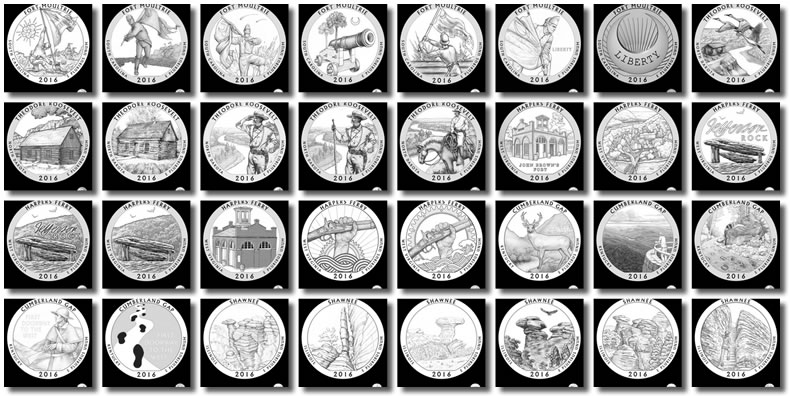
Before I start in on the quarters from the America The Beautiful series for this year (also called the National Parks Quarters, though most of them are not about National Parks), there's another matter I want to address.

Are quarters getting lighter?

I'm starting to wonder if it is simply nostagia, but it feels like the new quarters really weighing less than their earlier non-state-oriented kindred. Are the old quarters heavier? Is it just an illusion with the new ones being shinier? Or is it that the old quarters have all sorts of patina and junk built up on them over the years?

I don't have an accurate scale, but someone out there does. So really, is the reason we don't feel a comfortable jingle in our pockets because there is less metal in our change?

Anyway, on to this year's crop of collectible quarters. For those new to this (and shame on you, it starts way back here and here ), here's the rating system:

Way Cool =A
Not Bad = B
Kinda Lame (also known as Meh) = C
Very Lame = D
Not even vending machines will accept these = E

Let us begin:


Shawnee National Forest - Illinois

It's a pile of rocks. It's a very nice pile of rocks, as piles of rocks go, but still, it's a pile of rocks. Actually this particular pile of rocks is actually Camel Rock, one of the, um, attractions in Shawnee National Forest on the Ohio River, so far away from the REST of Illinois that it is almost Kentucky.

As a coin, its ,... just all right. I mean, not horrible. The use of white space to frame Camel Rock (which doesn't look MUCH like a camel - on the coin more like an AT-AT, really) is good. And the addition of a hawk soaring on the updrafts gives a badly-needed sense of animation and life.

But, you know, its still a pile of rocks, and the Western states have a lot bigger piles. 

Rating:  C (Just ... meh)

Cumberland Gap National Historical Park - Kentucky

Kentucky returns the favor of Illinois by choosing a location that's almost out of state as well, on the border with Virginia and North Carolina. But at least they have an excuse here - most the early settlers in Kentucky (those that did not come down the Ohio) came through this gap. This is the path that early pioneers like Daniel Boone (not shown) and Father Guido Sarducci (shown w/o mustache) and their ilk took to get through the Appalachians - looking for a bathroom, hence the inscription "The first doorway to the left, after the den."

And before we go any further - yes, he is holding that gun correctly. The whole over-the-shoulder-revolutionary-soldier look worked well enough for parade grounds, but if you're going over rough terrain, having your hand on the lock is a pretty safe move. So yeah, that part's not going to get any flack from me. 

The layout is pretty nice, with the open white space forming a nice background for the lettering, One gripe would be that the hills behind Guido tend to blend in with jacket, making the pioneer look a little chunkier than he really is. But that's a minor thing, and may play out in the final carving.

Rating: B (Not Bad)

Harpers Ferry National Historical Park - West Virginia

Well, you have to give West Virginia its props. Not only are they commemorating an event that predated West Virginia's founding, but one that was one of the kick-off points for the Civil War.

Here's the story for those of you who did not binge-watch the Ken Burns series and have been wondering why John Brown's body has been moldering in that grave. In 1859, Abolitionist John Brown launched an attack on the US Armory at Harpers Ferry, planning to steal the weapons there and use them to arm a slave revolt. He had invited Harriet Tubman along for the raid (she cancelled because of sickness), and Frederick Douglass (who turned Brown down, telling him it was very, very, very stupid thing to attack the US Government). 

The raid went pretty much as you'd think it would - early success capturing the armory, followed by the raiders being surrounded and their escape cut off by townsfolk and militia. Brown's raiders pulled back to a more easily defended fire engine house (which is what is shown on the coin as "John Brown's Fort"). President Buchanan dispatched a marine detachment under (then) Colonel Robert E. Lee (on leave from his unit in Texas) . Lee arrived on the scene and sent his volunteer aide-de-camp, "Jeb" Stuart to meet with Brown and secure a peaceful surrender. Brown refused, and the military stormed the "fort". Ten raiders were killed, and seven more (including Brown) were captured and later hanged. The trial and unrepentant nature made Brown a cause celeb and ratcheted up the tension between north and slaveholding south.

The coin itself is a shot of that firehouse (now on that site in reproduction) from its brief time as a "fort". Three-quarters view, it fits the coin nicely, and lacks the animation of other coins, but is still a solide presentation of an important part of American History. Probably the best coin of this year's group.

Rating: B (Not Bad)

Theodore Roosevelt National Park - North Dakota

North Dakota has it rough - all the cool stuff (such as it is) is in South Dakota. They could have shown one of the local hoodoos (a local word for "pile of rocks") but instead managed to put together a nice coin that celebrates Teddy Roosevelt. Which, given the fact that he got this whole National Park thing going as a major franchise, makes a modicum of sense. It makes even more sense when you realize that Roosevelt, though a New Yorker, came out here a lot, and the state is littered with statues, parks, and monuments to the man.

Teddy spent some time in his 20s out in this neck of the woods, in his early, pre-Rough Rider era, post-mustache but pre-spectacles. The coin shows him on horseback because, you know, what else are they going to show? A pile of rocks? The river (That's the Little Missouri, FYI)? Bison from the state quarter that accidentally got all shot up? All the drilling sites that now surround the park, coupled with whiny notes from the companies griping that can't have THAT land too?

The coin itself is not bad at all. The Little Missouri snakes through the landscape, providing a band of white space and allows us to look down from a vista with Teddy. And and putting him on a high point, on horseback, captures the relative flatness of the land, which actually is a sell point for North Dakota, as it disappears in the badland hills far beyond.

Rating B (Not Bad)

Fort Moultrie (Fort Sumter National Monument) - South Carolina

OK, this weird, in that it commemorates something that happened at Fort Sumter, but not the BIG thing that happened at Fort Sumter. There is no Fort Moultrie National ANYTHING, but rather it is wrapped up as a part of Fort Sumter National Monument, and calling the Moultrie piece out as a monument for a coin is kind of like praising Dennis Rodman's basketball career with the Chicago Bulls while Michael Jordan standing RIGHT THERE next to him.

What the coin commemorates is this plucky little fort standing up to a naval bombardment by the Brits, protecting Charleston from invasion (for a whole four years before more Brits showed up and took the city anyway). It portrays not a shriner with a Turkish flag but rather a Sergeant WIlliam Jasper returning a home-made flag to the ramparts at the start of the American Revolution. The fort was known as Fort Sullivan  back then, but commanded by William Moultrie, who repelled a British Naval force and had time to create the "Moutrie flag" which is shown on the quarter - a blue field with a white moon in the upper left. Actually, cool flag.  In any event, the Brits came back and captured the Fort four years later, and renamed it Fort Arbuthnot, and held it until the end of the war.

It's not a bad story, but kind of overshadowed by what happened just next door, where less than a hundred years later separatist forces fired on the United States garrison at Fort Sumter, kicking off the most bitter struggle on American soil (Because, as we know, attacking the US Government was a very, very, very bad idea). Moultrie is very nice and all, but given a choice, which would YOU name the National Monument after? If West Virginia can fess up to a heist film gone horribly wrong, then SoCare can at least say - yeah, this was important to history, even if it was not a particularly shining moment.

The coin itself is ... weird. Look at Jasper's feet, and how the rest of his body is twisted in the opposite direction. If he was using the flag as a bat and trying for a pop fly, maybe that pose would work, but rather it is replacing a flag while under assault by the Brits ... who are  ... behind him. It looks like he's leading the attack on the fort, which is not the case.

This is probably the strangest coin I've seen, part for carving, and part for subject matter.  There were other design candidates with a lot more promise (Here's a link to a picture of all the prospective candidates - most cases they have chosen the best of their group, though Shawnee coins are resolutely always a pile of rocks),

Rating D (Even subject matter aside, that pose is just weird)

That wraps this year. Next year is four states and the District of Columbia, where Fredrick Douglass gets the moment he missed when he decided to not go hang out with John Brown at Harpers Ferry.

More later, 

Tuesday, May 03, 2016

Play: Holmes Away From Holmes

Sherlock Holmes and the American Problem by R. Hamilton Wright, Inspired by the works of Sir Arthur Conan Doyle, Directed by Allison Narver

I went to a play on Sunday, and it was OK. It wasn't great, but it was OK, a nice comfy slice of product delivered by a theatrical vector. And I find that frustrating, given the strength of the rest of the season. It's a bit disappointing. And the whys and wherefores take me deeply down the rabbit hole.

So, naturally, spoilers follow.

Sherlock Holmes and The American Problem (SHatAP - no, I think I'll find another short-form to call it) is a local production. The playwright is an incredibly talented actor who I have tagged before. The cast have all showed up at the Rep and other local theaters before, with not a "previous worked all in New York and California and an episode of Law & Order and is happy to be making their Seattle debut" in the lot. So I'm expecting a lot from the local team.

In addition, this is a sequel, in that two years ago the same playwright co-wrote The Hound of the Baskervilles a few seasons back, with the same actors returning as Holmes, Watson, and Mrs. Hudson. But Watson is more of a supporting dullard this time out, and Mrs. Hudson lacking her sharp replies to Holmes boorishness and Holmes ...

Well, there are lot of different Holmses (Holmesi?) out in the popular media. Robert Downey Jr's action hero, Cumberbatch's though-palace Gallifreyan, the CBS's irritating detective in rehab. They share common traits and are all fair game in Holmisana.  The Holmes of the American Problem charts his own course. He is a much more emotional, a childlike and childish Holmes, often hoisted by his own petard, outwitted and outfoxed and frustrated.

The trouble is that American's Holmes is different than the Baskerville's Holmes. The Baskerville Holmes delighted in masked deception and could not accurate quote the classics to save his life. The American's Holmes suddenly likes anagrams, and has synesthesia - that is, he smells numbers and hears colors. That last one is a pretty interesting trait to build a play around, but instead, it comes across as Holmes entering a drug-fugue state, as the SFX swells and the color changes onstage to bring us in Holmes mind. OK, I can roll with it - not really the same Holmes, but it is one of several re-adjustments I make as I go through the play.

Our same-but-different Holmes is cast into a whirlpool of clues and happenstance. Plates from the Royal Mint have been stolen. A mystery woman wants Holmes to find her brother. A mechanical digging device is stolen from the docks. Several criminal leaders have been killed. Holmes' brother Mycroft shows up to demand Holmes attend a reception. Earthquakes in the East End. And all this during the Queen's jubilee, which for Homes means that London is awash with foriegners - sorry, with Americans like Buffalo Bill and Mark Twain.

That's a lot of balls to keep in the air, such that the final scene has to sum up and tell the audience what is truly happening. But I'm never sure when Holmes figures out things and why - more often he tumbles into his revelations, searching for one thing and finding another. For a man who hates coincidences, he is confronted them at every turn.

And, all the deductions made or sudden twists don't leave a lot of room for character development. Baskerville had a thematic spine to it, revolving around the Holmes/Watson relationship, and resolves with Holmes trying to be less of an A-hole about things. Here Watson is relegated more to supporting character, faithful aid and person Holmes gets to show off his brilliance to. Pity, that.

And, since it involves Americans, there are a LOT of gunshots in the play, sufficient to carve the queen's initials in the back wall. We've had explosives in Holmes presentations before, but this was a excess.

The actors are fine - Darragh Kennan as Holmes is a more passionate, random sort of Great Detective. Andrew McGinn is a dutiful Watson, and Marianne Owen is a frustrated Mrs. Hudson. Christine Marie Brown is good as the mystery woman, Phoebe Anne Moses, who tries to hire Holmes, and Alex Matthews as a Pinkerton (because, you know, American). Cheyenne Casebier takes on a dual roles as a female engineer (because why not) and a criminal gang leader. Chalres Leggett is an dour undertaker of a Mycroft, one of those flock of Mycrofts released from the Diogenes Club to pester Holmes. And Rob Burgess is a dotty brit pigeon fancier who is more than he seems.

But they all seems like they're struggling with the script, trying to deteremine the levels of mystery, tragedy, and humor in the play. As a result it all feels very thin, almost episodic - indeed, the final reveal almost promises another installment. One of my fellow attendees made the comment "As soon as I decided it was fan-fic, I was good with it."

Indeed. This has the trappings and tropes of Holmes, compacted is a nice, attractive package that will full the seats at the end of a championship season. Yet when all said and done it is aperitif, a pleasant little custard, workmanlike (god, how writers hate that term) but in need of a bit more time in the oven.

More later, but probably not about plays until we kick in the next season, which features a pop opera by David Byrne and Fatboy Slim about Imelda Marcos and set in a disco. May the Lord have mercy on us all.


Sunday, April 24, 2016

Play: Memorial

brownsville song (b-side for tray) by Kimber Lee, Directed by Juliette Carrillo, Seattle Repertory Theatre through April 24 (so, yeah, its already too late).

This is one we pushed back from our original date because of deadlines and other things, which is a pity, because it continues this year's exceptional run at the Rep. Were this play in other years, it would be a highpoint, but here it just continues this year's winning track.

brownsville song is a tragedy with a positive ending. Tray Thompson (Chinaza Uche) is a young man full of promise cut down in a gang shooting. And it is about both the boy and the hole he left behind, the play flips him like Schodinger's Cat, from alive to dead, from real to memory. Tray is an incredibly well-rounded, well-presented, well-acted character that caries the weight of the play. Uche carries him well as a talented young man, messing up, gifted in boxing, and struggling with a college application essay. Extremely human, made more so by playwright Lee's poetic text, which leaves nothing of the street behind but weaves its patterns throughout.

The survivors are his Grandmother Lena (Denise Burse), his sister from another mother Devine (two young actresses play this role - we got Leah DeLynn Dual for this matinee), and Devine's long-absent mom Merrell (Vanessa Kai). The three work through their own grief in different ways, and it is clear how Tray's shooting ripped through them as well and challenged them to go on.  Burse is the strongest as the grandmother who refuses to take any backtalk from her grandson or the rest of the world. Merrell slides back into Tray's life a little too neatly, but Kai carries her forward with both passion and a sense of desperation.

The plot slides back and forth in time like the settings, similar to the flying props and scenery of Luna Gale.  The actors spin and turn just as easily. And there comes a moment (and this is a bit of a spoiler, but show does close tonight) when Tray's message of hope for the future comes through. And he is dressed in his red boxing trunks, and a white t-shirt with stars and stripes.

And he's Captain America. Right at the moment. Everything that is right about a person, distilled down to that moment.

This was the last show, and the three rows ahead of us were pretty sparse, which is a pity. This has been one amazing season at the Rep, and it closes next with a gimme - a Sherlock Holmes play. Pity, because this one deserves a lot more attention.

More later,


Saturday, April 23, 2016

Political Desk: Local Funding

Some very, very few of you who read this in King County received ballots a few weeks back, which, like solicitations for public radio, you promptly put aside to be addressed/considered/recycled. Like the charity solicitations, they are asking for money. Unlike them, they are not offering a stylish tote bag. But dig it out anyway.

In our case, up on Grubbstreet, we have two things on the agenda. Oen is for approving bonds for Kent School District #415. The other is for re-authorizing an existing benefit charge to help pay for fire services for the Kent Fire Department Regional Fire Authority, which covers Kent and Covington.

And here's the regular complaint I have about such measures - we don't get to vote on tax breaks on large aerospace firms or legislator pay, but on things that you or I would consider basic services, the purpose of taxes in the first place, THAT we get to vote on.

But you've heard those complaints before. Let's get to the meat of the situation.

Kent School District No. 415 Proposition No. 1 Capital Improvement and School Construction General Obligations Bonds - $252,000,000 puts about everything in the title. This replaces retiring bond issues, and won't result in an increase in tax rate - you're voting for status quo. Its got a big list of improvements - two new schools, 20 additional rooms, new facilities and parking. A full list can be found here and here.

The problem is that this measure requires not just a majority, but a super-majority to pass. Thanks to the weirdness of our current casters-up tax law, this measure must pass with 60% of the vote. Let the court note that if a CANDIDATE gets 53%, people talk about a landslide victory. I think I can get 40% of the voting population to vote against anything, particularly if it involves taxes.

In any event, I will recommend voting Approved on this sucker, even though it doesn't talk about replacing the temporary school rooms at Glenridge, which have been there since I moved into the neighborhood over 15 years ago.

The other matter is Kent Fire Department Regional Fire Authority Proposition No. 1 Continuation of Benefit Charge, which continues an existing tax (so yes, keeping the status quo). This is not a bond but a benefit charge, supplementing the normal budget (but not exceeding 60% of the total budget (currently it is at 46%, down from the previous year)), and assigned based upon building use, floor space, hazardous materials, and the like (pretty much how much an effort it is going to be to put out a fire at that location).

It is, according to the Kent Reporter, ANOTHER one of those super-majority situations, where it doesn't just have to win, you have to win with 60% of the vote. And yeah, it is to keep doing what it's been doing. So YES on this authorization.

And finally, while I was writing this, the Voter's Pamphlet for the May primary showed up in my mailbox. So even when I get ahead, I get sucked back in.

In meantime, vote by this Tuesday. Here are the details.

More later,


Tuesday, April 19, 2016

DOW breaks 1700, I mean 1800!


Don't you just hate it when someone quits blogging for a month, and then come back with some lame excuse and a promise it won't happen again, and you're thinking "Yeah, right" and it will be another month before we hear from them again.

Well, in my case it is simply a matter of a new job (going very well, thank you) and a horrible commute (and no, I won't subject you to the details- bad enough my friends have to hear about it) and a couple outside projects that I was wrapping up, but the simple fact is I haven't had time or inclination to write. Which is a bit of a prob, since there are things I ALWAYS write about, like politics, and plays and collectible quarters. And the economy, as measured by the completely inaccurate Dow Jones industrials. (Yes, they're an inaccurate representation of the health of the economy in general, or even in your personal well-being, but still, they are reported daily on the news, so go figure). 

But even given my sabbatical, this was a fast turnaround. Only a few months back we were in the grip of the Dire Tremblies (which are like the regular tremblies, but a size class larger and equipped with horns that inflict double fire damage). Since then things have apparently righted themselves and everything is back to moving in a positive direction, which is weird. I mean, The Chinese economy is still a overheated as it was before. Greece is still broken. The oil market is flooded and may become worse. Heck, add to that the fact that the Panama Papers went live, telling everyone how the rich are hiding their money from the rest of us, and that Brazil is mired in economic hardships so bad that they are impeaching their president. Yet, the Stock Market prevails. Howcum?

Well, one theory, and this is a theory, is that the US Market is a safe haven for foreign funds. Relatively stable government, notwithstanding some of the actions of the GOP. Corporate-friendly leaders. Infrastructure hasn't quite fallen in on itself yet. All of that indicates a place where people want to put the cash. And the fact that it is separated from Main Street, which DOES have crummy infrastructure and old pipes, makes it even more accomodating. 

Just a thought.

More later

Sunday, March 20, 2016

Films: SIFF SFF SFF

11th Annual Science Fiction & Fantasy Short Film Festival, Cinerama Theatre, Seattle.

So yesterday Stan and I went down to the Cinerama in Seattle (not too far from where I work) to spend about five hours watching short science fiction films. This would be the Science Fiction & Fantasy Short Film Festival, presented by the EMP and SIFF (Seattle International Film Festival).So yeah, it is the SFF SFF presented by SIFF.

The reason for us going was that a friend from WOTC, Cindi Rice, was a producer on one of these pieces. She wasn't go to make the showing, but knew that the director, Reed Shusterman, was going to make it, and had some extra tickets. Hence, Cinerama theatre, Saturday afternoon for about five hours, encompassing 19 films.

Their film is Goblin Queen, and (spoilers) was my fave of the group. The setup is pure Disney Channel - teenage girl finds magic amulet that transports her to a fantasy universe. What makes it cool is that it does not follow the girl, but rather her mother - a bit of a control freak, who is dealing with her daughter disappearing at a moment's notice. And then when things from the OTHER universe comes spilling into ours, things get wild. Goblin Queen is well-written and well-acted, but what really makes it a fave is that it works without a huge amount of special effects. Tightly-packed and concise, kept to the small house in the real world, it worked its magic without a lot of post-production (Indeed, in the after-movie interviews, the directors who made it to the festival complained that their films were two days to shoot, two years to get the post-production right).

One thing I also liked about Goblin Queen was the sense of resolution to the film. A lot of the short films shown are demos, teasers, trailers, or proof-of-concepts for potential larger films. The problem is that if they don't resolve the story, they leave the viewer hanging. There was a lot of that in the festival - Aden (winner of the Judges Prize and the Douglas Trumbull Award for Visual Effects) was an extremely well-done, well-conceived, well-executed chase sequence between an agent of unknown origins and child's mechanized imaginary friend, but it was the first ten minutes of an unfinished movie. The Garden, a tale of humanity integrated into AIs is excellent but also felt like it strained to be a full feature. Mis-Drop, a take on a green soldier going into battle, would be a great first five minutes of a video game. The Red Thunder WOULD be the first five minutes of a Disney Channel show where a teenage girl borrows her mom's car and discovers her mom's secret.

All this is well and good (and make no mistake, these are short films that if they grow up to long films, I would watch), but all left me with more questions than answers.

Then there are the WTFs - In Bionic Girl a scientist creates an big-headed android duplicate who replaces her and sends her to hell (There's a lot of singing. In french). Disco Inferno starts with Hammer-Film virgin sacrifice and ends with an office party and has a lot of weirdness in between. Tristes Deserts (A Robot's Tale) was described on Twitter as a Daft Punk video, and involves a white robot with an Elizabethan neck ruff fighting an ebony octopus. And poodles. There are poodles involved.

OK, but what else did I LIKE? Frost, a tale of arctic hunter scavenging in a sleeping city was extremely evocative. The No Look Dunk was cute and short and played with time travel just as long as it had to. Juliet links sex doll robots with iPhones in news clips and commercials.

And The Brain Hack. Serious seizure warning on this one. No, not kidding. This one took the Audience Award, was an excellent, subversive, knowing film that built suspense mercilessly in a film about a refining images to stimulating the "god" center of the brain. Its very good, and got me seriously creeped out, and would not be out of place at the HPLovecraft film festival.

All in all? Good. If you get a chance to see these films (and some are on YouTube or Vimeo from the links above, while others get attached to other films in showing), hunt them down.

More later

Friday, March 18, 2016

Play: Social Studies

Luna Gale by Rebecca Gilman, Directed by Braden Abraham, Seattle Rep through March 26

The Rep continues a very, very strong season with a play about social work. And this is one of the benefits of season tickets: I honestly can imagine a world where I would wake up one Sunday morning and say, "You know, I'm in the mood for a play about social workers, meth addicts, and religious fundies all using a baby as a football", but that's only because I have a very good imagination. Most of the time it would (at best) a "heh, that sounds interesting" and never follow up on it. Season tickets, prepaid, gets me to the theater for gems such as this.

That previous described scenario, by the way, is the plot. We meet the meth addict parents of Luna Gale first in the emergency room. The infant child of the title has been brought in with extreme dehydration. Both parents are strung out at different stages - Karlie (Hannah Mootz) hyper and Peter (Drew Highlands) crashing. They are confronted by child protective services worker Caroline (Pamela Reed), who challenges the parents to clean up their acts and in the meantime must find a safe home for the child. Fortunately, Karlie's mom Cindy (Anne Allgood) is a enthusiastic and willing candidate, and is a nurse's assistant with a clean home and a sunny attitude. But Caroline finds out that that grandma is a holy roller of the end-of-days variety, and when the grandmother wants full custody Caroline drags her heels. Pastor Jay (Adrian LaTourelle) from Cindy's church tries to moderate the situation, while Caroline's boss (Alex Matthews) pushes hard for a speedy resolution, plus Caroline is dealing with a horrible case load and the former client (Pilar O'Connell) who has now aged out of the system.

There's more going on, but Caroline is at the center of it all, a straight-forward professional woman with an eye for what goes by the book and how the rules can be bent in order to get the best resolution for the children entrusted to her. She works from the gut and is by turns measured and threatening, knowing the power she wields while being frustrated by the limitations of that power. She is resolute and defiant and heartbroken all at the same time, and Ms. Reed does a fine job assaying her.

Indeed, all the cast does well, and in part it because the playwright's deft hand with characters and situations. Gilman does her original work with the Goodman in Chicago, but a lot of her plays have made it west to Seattle. Bad Dates (which I missed), Spinning into Butter, and the haunting Boy Gets Girl all have shown up at the Rep, so she is as much a regular as the actors.

And through her plays, Gilman examines and power and powerlessness of institution, of the precarious balance of playing by the rules and playing with the rules. Caroline is a master of the subtlety of working within the system, and while not given to quixotic tilts at windmills, is used to folding the system back on itself to attempt some measure of a happy ending. And Gilman promises no happy endings in her works, so you have to satisfied with what you get, just as in real life.

Gilman also masterfully shies away from making characters black and white, instead looking at them as shades of grey, with their own traumas and triumphs. The meth addict parents have their redemptive moments, and the Christian characters are presented in a positive, extremely balanced fashion And this is red meat for actors. Anne Allgood is fantastic as Grandmother Cindy, mixing vulnerability and desire to make good in such a convincing fashion that you wonder if Caroline is wrong to deny her the child. Similarly, Pastor Jay is not some Simpson's-level preacher, but comes across as a real individual maintaining his faith in an often-hostile work. Similarly, Drew Highlands' drugged out Peter rises to the challenge of making his surfer-dude father more than a caricature.

But at the center of it, is social worker Caroline, beset from all sides, trying to figure out what is best for the child while dealing with her own failures. Pamela Reed, who was excellent in Who's Afraid of Virginia Woolf as the lush, brazen Martha, is equally amazing as a tired, worn Caroline summoning up the courage to believe in her own gut instincts, and navigating the channels of bureaucratic organization with the goal of saving Luna Gale.

The stagework itself bears mentioning - it is sliding box of Tertris pieces, with scenery gliding onto and off stage in both directions in a neat and concise manner, selling the various scenes without requiring a great deal of setup or letting the action lag. It is minor point in face of both excellent writing and fine acting, but delivers a call-out.

If Ms. Gilman's work is representative of modern theatre at the turn of this present century, then we can say that the medium is still moving forward and evolving using the most basic of components, creating engaging drama with believable characters and strong underlying morals. A very well-done play.

More later,


Sunday, February 28, 2016

Game: Glory Days

Sails of Glory, Designed by Andrea Angiolino and Andrea Mainini, Published by Ares Games


The sailing ship was the single most complex machine of the early 1800s. It is constructed as a study in off-set stresses, sailed under the tension of its lines and sails, expected to function is the most extreme conditions (storms, battles), and dependent entirely on a human-driven switch system to control all its mechanisms. It is a complex, precise, overwhelming machine. On the other hand, it is also a very personalized experience - one feels one with a single ship
as its captain, determining the fate of it and all others aboard. Great grist for a game, but balancing those two opposing forces is more difficult than simply luffing the sails when beating to windward.


Sails of Glory pulls it off admirably. The game is a descendant of their air game Wings of Glory (which feature another set of technologically advanced but individually romanticized machines) and uses the same base mechanics as the earlier game. Each ship is represented by a single model, and cards lay out how the ships can move. You set the card at the front of the ship, it moves to the set location on the card (depending on the wind), then, remove the card from under it. The movement system is an improvement over the Wings of Glory in that you don't have to effectively pick up the craft it order to retrieve the card. In a miniatures game, the exact placement of a unit is critically important as far a being able to hit, so moving it around during game play is a challenge.

Combat is determined by range (short or long, as measured by a custom ruler) and by the type of fire (chain, shot). Each type of fire has its own basket of randomized chips to represent damage (long range has less-damage-inflicting chips, close range does more damage). In addition, there is small arms fire, which affects the crew. Damage to a ship can be against the ship itself, or the crew, and each ship has its own.

The rules themselves are broken up into nice bite-sized levels. The basic rules lay out card use and basic firing. With the standard rules you start laying out movements in advance and options for types of shot. More advanced levels add specific damage as well as assigned crew to particular stations. This was a little too granular for my group, but it does get into deep into the weeds of running a fighting ship.

Our Monday night group has played this a number of times, progressing through the rules, and found a learning curve as well in mastering the game. First major task was to stop sailing off the top of the table. Second was to accurately figure out how to bring the ship into the wind in order to turn. We actually have gotten quite good at it. There is a dual challenge to mastering the game -  both knowing the rules, and utilizing those rules on the tabletop. Doing both required a number of play sessions.

The core game has two British and two French ship models, of a light and heavy version for each. The heavier ships inflict more damage, while the lighter ships are faster and more maneuverable. In the last play sessions we would say that the heavies have the advantage, but the game itself was extremely enjoyable. Additional ships are available separately (with their own cards handling manuver), though the game could use a rating system for balancing battles between different ships.

Sails of Glory fits that nice category of games that are easy to learn at first, then ramp up the difficultly as they become more accurate simulations. The basic is game is fun to master, and brings you along to more difficult attempts. I've been a fan of various sailing games over the years, and this one combines ease of play, use of miniatures, variety of ships, and expandability. If you can find it, check it out.

More later,


Monday, February 01, 2016

The Gaming News: Departures and Arrivals

Just one item, but it is a doozy.

February 12th will be my last day at ArenaNet. I have been here nearly a decade, and am extremely proud of what I and my co-workers have achieved in creating a deep, engaging MMO with broad appeal. I know that both Tyria and Guild Wars are in good hands with my departure. Over the years, ArenaNet has put together an amazing team of talented individuals and empowered them to create cool things.
And so it begins ...

February 15th will be my first day at Amazon Game Studios. I have accepted a position as senior narrative designer. I can't say much at this point, but readers of this blog know that I rarely share information until it is time to do so (So yeah, you'll find out what I'm working on when it ships). I'm really looking forward to the new opportunities (though not, of course, the commute).

It is a start of a new chapter in my life. I am both thrilled and terrified by the possibilities.

More later,


Sunday, January 31, 2016

Play: Pickapath Universes

Constellations by Nick Payne, directed by Desdemona Chiang Seattle Rep, through 21 February

Constellations is a quirky little love story set against the theory of multiple universes. It consists of a series of vignettes between beekeeper Roland (Max Gordon Moore) and cosmologist Marianne (Alexandra Tavares) on a bare stage. They meet at a mutual friend's barbecue. She flirts, he says he's involved. A bell sounds, they start again. She flirts, he says he's just broken up and isn't interested. Bell sounds, start again. She flirts and he responds, then mentions he's married. Bell sounds, start again.

It goes on like this as we move through the cute meet, the first date, the relationship, the breakup, the reuniting, the marriage, the diagnosis, the choices we make at the end of life. Starts and stops, alternate scenes in alternate universes where the characters are the same but not identical. A bell sounds, we start again. And it is a perilous path for a playwright to take and a challenge for the actors. The third time that  Roland tries to use an explanation of bee society to a marriage proposal is funny, the sixth time we are deeply into Monte Python looking to wrap up an episode. 

Moore and Tavares are very good in all this, but the play often feels like they are looking for the right line reading in rehearsal, trying the words on with various levels of engagement and intensity. Tavares in particular has the tougher time as she shifts convincingly into the ravages of her cancer and out again as the play messes not only with alternities but with time itself, foreshadowing with future scenes and leaping back to earlier temporal nodes. But ultimately, as the Lovely B noted, nothing here that Dr. Who has not addressed earlier and better. 

(And yes, I am using British comparisons because it is set in Great Britain and everything sounds better in British. I wonder if the play would fly as well as it does if Roland and Mariane were Ronald and Mary Anne from Chicago.)

There are deep ideas rolling around in here beneath the surface, and the play gets marks for not calling them out to dance on the stage, but rather uses them quietly to power the action. The title, while not directly commented on, reflects part of the quandary of quantum physics - Constellations do not truly exist, except in the minds of those on Earth gathering stars into particular patterns. The observers are determining the nature of the universe. Time and free will exists because we determine it to be so. But while the play opens the doors for the curious, I don't thnk it delivers on them. A pair of ladies behind us read a summary of the play from the program book (loudly), and one declared, "Well, I read all that and I still don't know what its about". I fear the may still be in that boat at the play's conclusions.

In a season when the Rep has been knocking plays out of the park right and left with amazing accuracy, Constellations is a bunt, or maybe even a base on balls. It was OK, and probably would not disappoint in a normal year. But the Rep has gotten so good recently that it just feels like an average theater outing as opposed to must-see stagecraft. 

More later, 

Saturday, January 30, 2016

DOW Breaks 16000!

So this happened last week. After floating above the 17000 mark for some time, stalled in its supposedly inevitable climb, the market took a dramatic shift southward. This is either short term (which they call "a correction") or long term (which they call "the start of a new recession ohmighod!"). Since that time, it has engaged is leisurely 200 and 300-point sweeps up and down the new posting of 16000.

Most times, when there is a major milestone crossed (up or down), there is no one thing one can point to, and the analysts are clustered around a grab-bag of theories. In this case, conventional wisdom seems to have coalesced into two big things - Oil and China. Neither is completely true by itself, but combined makes a market skittish.

Oil is in oversupply right now. Saudi Arabia is overproducing in order to drive other, more expensive oil production venues (like oil from Dakota shale or the Albertan oil sands or deep-water drilling in the Pacific) off the market. Add to that the fact that, with the end of sanctions, Iranian oil will be coming back online. As opposed to the era of OPEC when a gathering of like-minded oiligarchies gathered together to boost the prices in the 70s, now we see a lot of price-slashing.

And this should be a good thing for you and me, and indeed, gas prices have plummeted (well, in most places - not so much in the Pacific Northwest). Prices below two bucks a gallon are getting common. We should be happy, right?

Not exactly. The stock market has made as one of its foundation stones the idea that prices will continue to go upward, making the oil reserves a more valuable trade commodity. Taking that away makes them very nervous.

China has been booming over the past few years, and continues to grow. But the volatility of the Shanghai Stock Exchange, boosted by an influx of mid-level investors, have created a number of financial bubbles that have required the government has had to step into to fix once they burst. Given the size of the economy, when China sneezes, a lot of other folk catch cold. It is considered volatile and therefore bad, and as a result the other markets are volatile.

But the weirdness in all this underscores the nature of the DOW and other stock markets themselves. They seem to be based on fantasies of a magnitude greater than those spun by Tolkien or Dunsany. Low oil prices should result more money for the consumers which should result in greater consumer spending. China continues to grow in the midst its free-market teething problems (Oh, and on the West Coast, a lot of the money being made is being poured into US real estate).

This sense of fantasy is reflected in the reception of news on individual stocks as well. Company A had an amazing year, but because the forecast was for an even MORE amazing year, its stock has fallen. Company B shipped more units than ever this year, but next year looks less productive, so its stock has fallen. Company C has seen some key sales slip, but beat profit estimates, so its stock has risen. Go figure.

It does feel all kind of mystical, where things happen in outer world and then are retrofitted to justify whatever is happening within an economic hothouse environment. Yet I suppose that provides more economic solace than a Lovecraftian economic universe, where the invisible hands of uncaring finanical titans move without regard to the ripples of their passing make.

More later,

Saturday, January 23, 2016

Play: Hail to the King, Baby!

King Kirby by Fred Van Lente and Crystal Skillman, Directed by Rob Raas-Bergquist. Ghost Light Theatricals

Jack Kirby was one of the great creative forces of American comics. His art is dramatic, iconic, and immediately recognized. He built much of the modern comics mythology. His story is that of the rise and fall and rise again of the media. We have movies about superheroes, why not have plays about comic book creators?

The play itself is by Fred Van Lente, comic author, who wrote the excellent Action Philosophers series (explaining philosophy in comic book iconography - think of Plato as the Incredible Hulk) and award winning playwright Crystal Skillman. In fact good sequences of the play first showed up in Comic Book Comics by Van Lente and Ryan Dunlavey.

The play chronicles Kirby's life, bookended by a Sotheby's auction of his work for prices he was never paid. Tough kid on the lower east side with artistic talent, became an in-betweener for Popeye cartoons before teaming up with Joe Simon to create Captain America, followed by a stint in Europe really punching Hitler in the face, followed by a return to comics upset by Fred Wertham and the comics code, followed by Marvel and the machinating Stan Lee. Through it all Kirby comes through as a brilliant talent who was often too cautious to press for his own rights. First Simon and then Lee were the opportunistic suits/partners who brought Kirby into their plans and encouraged (and often took over) his creations.

The actors are excellent. Rick Espaillat is Kirby, and gets the man down, right down to his smile (I had a fleeting, comic book convention meeting with the original - he was friendly and professional, I was gob-smacked to be in his presence). Espaillat is on-stage the entire play, the rest of ensemble switches in and out of roles with a fluid grace, main characters rising and then diminishing as the years pass. Jason Huff is a sound-bite spouting Funky Flashman of a Stan Lee. James Lyle is a tall drink of water version of Joe Simon, but gives up the role to Anastasia Greeley easily. Greeley for her part is the young Roz, Kirby's wife, who passes it on to Eileen McCann, who is also is the Sotheby's auctioneer. Steven Sterne is delightful as the never-ending slew of bosses who Kirby worked for over the years. They work with a drill-team precision for scenes, and change chameleon-like from major characters to minor ones at the drop of the hat.  Espaillat commands his way through the entire proceedings as Kirby.

The proceedings at the Ghost Light are in the round, which sadly guarantees that for any major scene, there is a one in four chance that you are looking at someone's back. That said, the staging (four entrances to a raised central stage) in minimal and allows for the quick changing of setting, often in mid-scene.

Kirby's story is that of a man who just wants to create, who revels in bringing to life great concepts, but that conception does not line up entirely with the demands of the machine that produces the final product for general consumption. From mobbed-up distributors to government intervention to corporate lawyers, the "real world" has a nasty tendency to impinge on the golden glow of creation from Kirby's fertile mind who ended up creating, but not controlling, a modern mythology.

And yeah, to a much smaller degree, I know the feeling.

More later,