Saturday, January 08, 2011

Picasso

So Friday I took the day off from work, with the excuse to go see the Picasso Exhibit at the Seattle Art Museum (SAM for you non-locals). The SAM itself merits its own entry, so let me concentrate on the exhibit itself. And mention the crush of people who ALSO decided that that last Friday was the time to go. So there were a LOT of people, such that with timed ticket and two sets of lines, it was a crush of school kids, old folks, and bozos like me listening to the provided audio track (and kudos to the young woman who thought enough of others to park her stroller in the media room and carry her child, just like in the old days. You, my dear woman, rock).

So Picasso himself, I've had mixed emotion about. On one had he is Twentieth Century Art with a capital "A". On the other hand, the process of the art is such that it becomes unmoored from representational art and starts drifting, balloon like, into an emotional realm.

What that means is, that when it works, it works very, very well, and when it doesn't, you end up scratching the side of you head and asking "Is that a nose? Is that an idealization of a nose?" When I was young LIFE or LOOK magazine did an article on Picasso (this was in the 60s) and then two weeks later ran a series of letters, each one of which declared that their seven/six/five/four/three/two year old could paint better. Which is part of the point and nothing like the point.

This Picasso, he confuses me, and I think he wanted it that way.

The exhibition itself comes from the Musee National Piccaso in Paris and reflects works that the artist considered part of this legacy, and consists of finished works as well as sketches, studies, and uncompleted projects. That gives an idea of what lies behind the thinking, as well as minor or personal work. Les Demoiselles d'Avignon is not here, but represented by similar works, and Guernica shows up as preliminaries and a photo-progression of the work shot by one of his lovers. Yet he has generated so much material, in so many different media and in so many different ways, that the entire experience is unexpectedly overwhelming. I overheard one patron say that he felt like he had just left a Thanksgiving dinner - he was overloaded on art.

And of the art, yes, the early Blue and Rose periods show him capable and establishing himself as an Artist-with-an-A. It is his cubist work that connects for me at the most basic level - I find the transformation of figure into planes and the creation of motion through angles to be exciting. This is the part that works. And yet after this, as it moves most fully into Picasso' style of teardrop shapes and morphable eyesockets that I lose a bit, that the excitement is not as present. It feels like he is doing art because that is what he does.
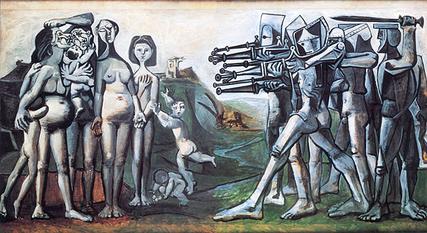
Massacre in Korea, Pablo Picasso, 1951
My greatest surprise was to find Massacre in Korea at the exhibit. A "sequel" to Guernica, inspired by Goya's The Third of May, 1808. I had thought its purported subject matter was part of the resistance to the work (it was supposedly critical of American involvement in Korea, and it easier to chastise fascists than Americans), but now dealing with the piece up close, I find that it is effectively a lesser work - clunky where Guernica was fluid, heavy-handed where Guernica was universal. The message is clear, but execution fumbles.

I guess that is where I come down to on one of the finest artists of the 20th Century. When inspired, when in action (ever with still lives and portraits), the artist Pablo Picasso was impossible to define except in terms of his own brilliance. He had the ability to reach into the heart of his subject without directly stating it - he was jazz in a visual media. And when it doesn't work, whether for limitations on the part of the artist or the viewer, it feels like a parody of his material, like the 60s comic artists (and yeah, you can see Bob Crumb in some of the work, or Basil Wolverton),

Sometimes he was pushing the envelope to see what lies next, and sometimes Pablo Picasso was following in the well-trod path of ... well, Pablo Picasso.

The exhibit is in town for only a week more, and worth cutting class to see it. Good luck with the crowds.

More later,

Thursday, January 06, 2011

Ten Years

ArenaNet celebrates its tenth year anniversary with a retrospective about us, our games, and our world. Enjoy.


More later,

Saturday, January 01, 2011

New Year's Expansions

Last night we had an New Year's Gaming Eve here at Grubb Street, and had a very nice evening indeed, with a variety of games played, in particular expansions of games we already knew.

I asked the Lovely Bride for a Christmas for a game we could play together. Usually that is my job in the relationship, and we would end up with a nice European board game or something for Playstation 3 (we just finished the Indiana Jones Lego game after a year or two). I discovered that I should NOT leave the LB alone in a game store with such a directive, since she picked up THREE expansions - for Settlers of Catan, Carcasonne, and Alhambra. Plus I had an expansion for Ticket to Ride that I hadn't cracked open yet, so this became a gaming session to play expansions.

Board game expansions are a little wonky, or rather wonkier than RPG expansions. How far do you go with it? Are you looking to create a new experience with well-known features? Are you seeking to extend the experience of the original game? Are you trying to correct weaknesses in the original? Are you trying to make a popular original (which would be one reason to do it in the first place) even more popular? It is sort of like movie sequels, and filled with many of the same perils.

So here's how we did:

Carcasonne: Princess and Dragon. The original Carcasonne is a tilebuilding game with a lot of quirky little rules in it (we tend to play the later Carcasonne: Hunters and Gatherers, which is set in prehistory and is a bit more streamlines). One of the challenges with Carcasonne is that it is like watching someone put together a jigsaw puzzle for most of it. Indeed, the game pulls people together as someone gets a city piece that he can't put anywhere, and people start lobbying for a particular play to help themselves. In addition, the original game had a problem with "mega-farms" - large, sprawling amounts of territory that will tip the game for one player.

The Princess and Dragon expansion is billed as taking the game into fantasy, but actually takes it more into randomness. New tiles bring into play and move around the Dragon piece, which takes pieces (meeples) off the board. The sudden swinginess introduced prevents someone from taking an early lead and holding it, but proceeded to carve a huge swath of empty cities, untended farms, and abandoned cloisters through the center of the map. We went through a phase where the time-honored strategies were suddenly blowing up in our faces, and quickly descended into a giggling mass of disaster. Result: It did make the game more fun by making it less serious. Your well-thought-out play can be overturned by a Dragon rampaging through your home.


Settlers of Catan: Traders and Barbarians. The original Settlers is a classic, the first to hit the beach in the new wave of European Boardgames, and remains an excellent game to teach people who has grown up on Candyland and Monopoly to show that board games don't have to be boring. It is nearly a perfect game in itself, the Platonic ideal, which makes it tough to expand. Traders and Barbarians is a bunch of individual expansions which could encourage repeated play, but the sheer number of them left the gang unwilling to experiment - after one "reminder game" to teach new people, we moved on to other activities. The addition of Fishermen, Camel caravans, and Barbarian raiders looks interesting, but it is toy box that will have to be sifted through.

Ticket to Ride: 1910 Edition. The original Ticket to Ride was brilliant and flawed. A train-building game that was easy to access, its small cards were difficult for the young and the old to shuffle, and its game play (determined through routes pre-selected on cards) tended to funnel everyone through the same corridor of the Mississippi valley, which made for frustrated play and nearly destroyed relationships. 1910 is a patch that works nicely - New decks of reasonably-sized cards, plus a 1910 deck of destination tickets, which concentrated on more east-west lines than north-south lines, making the valley of death less frustrating. Using both original and 1910 cards produces a much more random game where what tickets people had were not as clear.

Alhambra: First Expansion. The original Alhambra is another excellent core game involving tile-building a city, and buying those tiles with four different types of money cards. This expansion creeps around the edges, tweaking the game with small improvements that increase complexity without gumming things up too much. There is now a mechanic to interrupt the game to grab the city piece you really want. There are cards that let you change one type of money card to another. There are bonus cards that make you want one particular piece very, very much. And there are worker's tiles, which can increase in value depending on their adjacent tiles. We added ALL of these, and found that the original game stood up very well, and encouraged people to engage with the game when it was not their turn.

That's the lot of them, for the moment. In general, expansions, like the games themselves, vary in success. Carcasonne created a very different game, while Alhambra's deepened the play experience and Ticket to Ride's patched some issues. I don't make resolutions, but were I to make one to play more games, I would say that I was well on the way to keeping it.

More later.

Friday, December 31, 2010

Happy New Year

We leave 2010 with these words, apparently a traditional poem but gathered, set to music, and sung beautifully by Pete Seeger:

I get up each morning and dust off my wits
Open the paper and read the obits
If I'm not there I know I'm not dead
So I eat a good breakfast and go back to bed.


Happy New Year, everyone.

More later,

Monday, December 27, 2010

Commercial Break

Busy at the moment, but I wanted to note a couple things before they get past me.

First off, the new Guild Wars novel: Edge of Destiny, by J Robert King, is now on the shelves, and it is, in a word, excellent. Strongly recommend it for fans of both Guild Wars and of fantasy in general. Here's Chapter One as a PDF.

And speaking of Guild Wars, my co-author on the first Guild Wars book, Matt Forbeck, sees the US release of his original novel, Ammortals. Also worth checking out!

And finally, I've done a foreword for a new PDF product from Zombie Sky Press, called The Faerie Ring, designed by Scott Gable, on the Lords and Ladies of the Fey.

OK, back to the subjects at hand.

More later,

Friday, December 24, 2010

Happy Holidays!

Art by Joseph Christian Leyendecker
Merry Christmas from everyone at Grubb Street, and best wishes for a safe, sane, and festive Holiday Season.

More later,

Tuesday, December 21, 2010

Solstice

Now begins the long climb back to daylight.

More later,

Monday, December 20, 2010

The Power of the Hat

So one of my favorite gifts this year arrived early. The Lovely Bride has been trying to get me a Santa Claus hat for like three years running, and encountering some basic problems:
     1) It is too early in the season. Apparently despite the fact that you've been bombarded by Christmas carols on the Muzak since Halloween, the hats don't show up until later. Like after 1 December.
     2) It is too late in the season. Near as I can figure, only three Santa hats are delivered to each store, and they disappear within twenty minutes of delivery.
     3) No one makes plain Santa hats. Previous experiments involved ones with antlers, and one with a salmon through it. They didn't fit me anyway, so they get put on the stone dragon out front, or on the bronze cat out back.

Yet this year the Lovely B was in the correct spot at the correct time and gave me a hat of the correct size, and I have been wearing it throughout the season, eschewing my normal baseball caps. The results have been interesting to say the least.
     - It is a perfect disguise. People see the hat and not me. Had a couple encounters with people who looked right through me. since I looked so unlike me in the hat. I became amazingly invisible. Should I ever launch a multi-state crime spree, this is the hat I will wear!
     - Strangers talk to me. Usually it is a "nice hat" kind of comment, but it took me aback the first time it happened. Now I manage a "ho, ho, ho" in response.
     - Small children find me amusing. I am asked if I am Santa. I tell them that I am temping for him. That seems to put them in a quandary about my status, since I am obviously not an elf.
     - Older friends are merely amused. And these are people who know I wear Hawaiian shirts in the dead of winter! They know for a fact that my fashion sense is not on the same scale as, say, Daredevil's radar-sense or Spider-Man's Spider-Sense. But still, they are amused by this daring fashion choice. It takes nerves of steel to wear a Santa hat
     - People think I work there. When I've been shopping, people assume I am a sales person, because who ELSE would where a hat?

All in all, I would say that it is a most successful present, and I am delighted to be wearing it. And the Lovely Bride has sworn she will steal it back and put it away as soon as the season is over, so everyone is spared having to put up with this in June.

More later,

Friday, December 17, 2010

Busy Box

So Mark Evanier, over on his blog, always posts a picture of Campbell's Cream of Mushroom soup whenever he's busy, a state that lasts one, maybe two days at the outside. I've been busy for the past week and feel like I'll be busy for some time to come, so you guys get Campbell's Cream of Tomato. Why? Because I like Cream of Tomato better.

I am busy because of:
   A) The Day Job
   B) The Novel
   C) Christmas
   D) The new season of Iron Chef.

And the answer is:
  E) All of the above, plus I now have an iPad.

This last was a Christmas gift from the company (yes, I will pause for a moment as everyone says "I wish -I- worked for a company like that). A couple years ago it was a Kindle, which brought me into the world of E-books, something I would not likely do of my own volition. So I am dragged, with only modest kicking and screaming, into a new thing.

And to be honest, I am still discovering what I want to do with this new device. How it fits into my personal cosmology. The Kindle turned into my travel book, and has not slowed my purchase and consumption of dead tree editions. The iPad is still up the air, and has been used primarily so far for 1) impromptu access to the Internet, and 2) playing games. For the former, I've ended up installing a WiFi hotspot up here at Grubb Street, and for the latter, I've started slow (because of the other four things on my list). I started checking out Rogue clones, and ended up with a very good descendant called 100 Rogues - more compact and colorful than the original type-face version. But beyond that (and the free planetarium program), I really haven't had much chance to explore.

So where do I go with it? I don't know quite yet. It feels like it could be a large chunk of life in 2011, or just a interesting distraction. I'll keep you posted, when I have more time.

More later,

Tuesday, December 07, 2010

What New York Superheroes See

I found this particularly amazing:


More information on the flight here.

More later,

Sunday, December 05, 2010

Old School Tekumel

So a group of us had the chance this afternoon to play Empire of the Petal Throne. Not the more mind-bending Sources and Glory version, or the more genteel TOME version, or even the GOO version. No, the original, first published by TSR in 1975 (!) and later reprinted by Different Worlds.

It was the old, refreshing rush you get from the old National Geographics that have been in your grandparents' attic for a bajillion years.

The plot was fairly straightforward - the group in Jakalla, gets word of an abandoned temple of Ksarul (Doomed Prince of the Blue Room) up in the hinterlands, decides to check it out. Kidnaps a priest of Ksarul en route as a guide. Since I got there late, I entered the game as said Priest of Ksarul, and we fought Vorodla ("the Flying Undead") and Hra ("the Bloodsuckers") before my priest angered the god Ksarul (grabbing a magical scepter that the god specifically told me NOT to grab) and being bodily lifted into the Blue Room, where he would be tortured forever. Then I generated a slave we uplifted from the group to carry on the fight.

And it was fun. A definite roll back to the good old days of roleplaying. Character creation was easy, and life was cheap. The mechanics were simplistic to the extreme, but there was a lot of room the PCs and the GM to move around. Most of the mechanics were ill-formed to handle the challenges of the adventure (How do you detect a trap in those pre-Thief days?). We were making stuff up on the fly. My Priest managed to face down a horde of Ksarul-created undead (at least once - then I had to have magical help). And one of our players ran through three characters over the course of the afternoon.

It was a great reminder of how wonderful and how frustrating the old rules were, and how you could not take it horribly seriously, and how the interaction between characters would be as interesting as those against the monsters. (The party wizard was a Wizard worshipping Thumis, Ksarul's rival, and my priest was planning an accident for him before we left the ruined temple). And it had all sorts of wonkiness, like award XP to the one who killed the monster, which encouraged kill-stealing but also made it possible to give XP over the course of battle. Or making everyone over 4th level divide XP by two, which meant we would be forth level forever, except the wizard (sorry, magic-user) who found the Book of Qiyor and ended up skipping a level immediately.

And a good time was had by all. More later,

Friday, December 03, 2010

Make 'Em Laugh - 15 Things

So we talked about 15 influential games, and 15 things which influenced my games. And then one of co-workers mentioned 15 things that influenced her sense of humor. And I thought about it considerably longer than 15 minutes, and come up with the following list of 15 things that influenced my strange sense of humor:

The Dick Van Dyke Show: I am not alone with this - about half the scriptwriters in Hollywood were sold on the idea that this was how comedy was written, and in a broader sense, how corporate creatives lived in the world. You worked with people you liked. You made jokes. Your bosses were mildly insane. You were married to Mary Tyler Moore. When everything is working well, this is the TV show I am living in.

M*A*S*H: The TV show, not the movie. The show was in endless syndication even when I was in college, and represents the TV show I am living in when things are not going so good. I and my design colleges have talked about "Meatball Design" and "Editorial Triage" like we were honestly subjected to attacks by Five O'Clock Charlie.

George Carlin: Representing the stand-ups, George was another college addiction, with his album Class Clown. I was too young for Lenny Bruce, which is Carlin's predecessor, but Carlin's love of language roped me in. Plus, ANYONE can do his "Hippy-Dippy Weather Man, with the Hippy-Dippy Weather, Man" routine. He got old and more pointed but I still love his stuff.

Tom Lehrer: Of course this is obvious, from other entries in this blog, but he gets the nod from the album/musician comics and the political comics, edging out Alan Sherman. "Pollution" was the first one I remember hearing, but his stuff is just a cool now as it was in the 60s (though now it sometimes requires footnotes to explain what we thought was so troubling back there).

Doctor Demento: Wind up your radios! I got to hear a lot of Tom Lehrer and others thanks to the good doctor, broadcasting on Friday or Saturday or Sunday nights on the Pittsburgh radio. That and Pirate games (with Nellie King and Bob Prince) were reasons to have a radio.

Monty Python: Back to college, where the Pythons were a regular feature of late-night PBS out of the Chicago stations. It was, for many people, the first introduction of what Britain was supposed to be like.

It's a Mad, Mad, Mad, Mad, Mad World: Edges out A Funny Thing Happened On The Way To the Forum only by the fact that I saw it first. The first time I saw it, at the old South Hills Village theater, I didn't know most of the cast, but I knew they were funny. Only later did I get the idea that this was a collection of the comedic talent of the age. Others have tried to replicate it - Cannonball Run, Rat Race, but none have succeeded.

Woody Allen: From the movie people, he just edges out Mel Brooks. Yeah, there was standup before, but What's Up, Tiger Lilly, Bananas, Take the Money and Run, Love and Death and Sleeper were a run of seriously funny films.

P.G.Wodehouse: Does this surprise anyone? I mean, does this surprise anyone who encountered Giogi Wyvernspur and Tertius Wands, who were cut, if not of the same cloth, of at least cloth two bolts down? Before the entire Stephen Frye and Hugh Laurie presentation on BBC, I read a lot of the adventures of Bertie and Jeeves. And it was genre as high art form - there was a single plot with continual variations.

The Odd Couple: The TV show, the movie, and the play that predated both of them. You can see the eroding effect of other media on the characters as you make the progression between them. Still, though the combination is classic (Two and a Half Men really should be sending a piece of the action to Neil Simon), Klugman and Randal are the best Oscar and Felix. Oh, and like Monty Python instructed about Great Britain, so did the TV show instruct about New York City.

Blackadder: Back to the Brits, with this funny, erudite, and literate bit of fun, which unleashed Rowan Atkinson on the rest of the West. The second and third seasons are the best, when Blackadder gets to devour the dictionary and spit out the best parts.

Warner Brother Cartoons: I know way too much about stars of the 30s and 40s from watching these as a kid on TV. They were on TV because they were cheap, and if the kids didn't get the references to Bogart and WC Fields, who cared? I think my interest in that era (and black and white films) comes out of those old cartoons.

Marx Brothers: And speaking of old movies, the Brothers Marx were the gold standard of the era. Yeah, they were creatures of vaudeville, and Groucho's character was an evolution of the stock figure "The German Teacher", but still it was classic comedy, and they get the nod for that era.

MAD Magazine: Another view into New York City, it showed you could go after both political and economic issues. By claiming Madison Avenue as one of its early targets, it had a lot more depth than any of its imitators, and infused an entire generation with good-natured cynicism about the consumer marketplace.


Firesign Theater: Another group that reached me by a comedy album, they were more head-oriented than Cheech and Chong, and that's saying a lot. Their most coherent production, and the one I would send you to first, was "The Adventures of Nick Danger, Third Eye," which was on the album How Can You Be Two Places At Once When You're Not Anywhere At All, which had the album cover of the cast (duplicated) in front of a poster saying All Hail Marx and Lenin (with Groucho and John Lennon) shown below.

And you wonder while I am such a strange individual.

More later.

Thursday, December 02, 2010

The Triumph of Intellect and Romance

OK, I was going to post something else here, but this just completely boggled me.


More later,

Tuesday, November 30, 2010

Dancing On The Edge

Dancing at Lughnasa: by Brian Friel, Directed by Sheila Daniels, Through 5 December, 2010.

Many (many) years ago I had the chance to see this play at the Milwaukee Rep, but demurred. Instead the Lovely Bride took a Good Friend to it and enjoyed it thoroughly, such that it went into the category of "things you really should have seen" that would pop up every so often in our conversations in the years since.

I, for my part, felt little guilt about passing up on this opportunity, as the play had been presented to me as being a) Irish, and b) about five sisters. For the first case, I am only merely tolerant of plays in Irish brogue - it takes about ten minutes for my ears to properly callus up and I can understand what is being said. Further, theater about the Irish (in particular theater about RURAL Irish) usually deal with bonecrushing despair, deprivation, and oppression, and English-Language theater loves it because its within walking distance of London.

For the second point, I knew that it would be about female bonding, and any males presented would be fool or leches or both. Team that up with Irish and you know you are not heading towards any kind of happy ending.

Still, when the opportunity presented itself once again to attend it with the Lovely Bride, I did not shirk, but faced this Irish play like a man. And while it was very much as I expected it (indeed, the couple next to me bailed at intermission), it was very good, well-written and well-acted, and worth the trip (sorry, couple next to me - you lose).

The play is the adult reminiscence of the adult Michael (Benjamin Harris) of a summer in his aunts' cottage in rural Ireland (warning!) in 1936. He is the illegitimate child of Christine (Elizabeth Raetz), and the pair live with Christine's four sisters - inflexible Kate (Mari Nelson), joking Maggie (Gretchen Krich), motherly Agnes (Linda K. Morris), and simple Rose (Cheyenne Casebier). Elder brother Jack (Todd Jefferson Moore) has returned from Africa, where he was a chaplain at a leper colony and has gone a bit off his nut (male figure as fool). And Michael's bio-father (Troy Fischnaller) is a con artist whose infrequent returns delight Michael's mother and then plunge her into depression when he leaves.

And the household is both light and dark - struggling to get by while at the same time exuding warmth and family. The dancing of the title fits in as analogy for sex, for society, for the world outside, and for tradition. And all this brightness as adult Michael foreshadows the storms that will swamp the home.

And about half-way through the final act, I finally get it. This is what it is all about - that last summer when they are all together, when they are dancing. After this everything caves in slowly as the family breaks up, as hearts are broken, as the flesh weakens and the mind wanders and things will never be the same. But for the moment, everything fits together, everything works, and there is hope for survival. Yeah, that makes the trip worthwhile.

The cast is generally brilliant, in particular the women. Maggie swaggers and kids effortlessly. Kate is brittle almost to the point of breaking, Agnes has deep waters flowing, and Christine is by turns commanding and vulnerable. And Cheyenne completely disappears into the role of Rose.

The men are a bit more of a mixed bag. Harris engages as our mouthpiece into this world. Moore, as Jack, plays the fool, broadly at first, but with increased dignity as he recovers in the family (though with a dark edge as they cannot expect what he recovers to become). Fischnaller was the sole disappointment, in that if he's got a welsh accent, I'm a member of Monty Python.

The production values were high and convoluted, to the point that the stagecraft was at points blocking the action.

Do I still not regret going to the first version of is some 17 years back? No. Am I pleased to have gone now? Yeah, for reasons that would not have been clear to me as a callow youth back in '93.

More later,

Thursday, November 25, 2010

Tuesday, November 23, 2010

Snow. My. God.

So, counting the physical time in the car, the dinner, the evening spent working at the friends' house, the sleeping at the friends' house, and the omelets in the morning, it took me just over 19 hours to get home yesterday.

No, I'm not talking about commuting from the East Coast. I'm talking about a normally thirty- to forty-minute commute from Bellevue (where my company is based) to Grubb Street (which in near Panther Lake on the East Hill of Kent - the key word here is "hill").

Yes, it is the start of the snow season here in Seattle, where madness rules on the streets and we all tip towards anarchy.

I thought I was smart. I had packed a travel bag on Monday morning and took it with me to work. I left the office early, at 4, before the sun went down. Little did I dream that it was already far too late and that I was doomed.

Doomed, I say! Already thick flakes were coming down, adding to a snowpack that had been accumulating all morning. An inch, maybe, and mere sundry in Pittsburgh terms, but in this land of insufficient plows and sparce sanding, enough to completely shut down the city. Already the roads were slick, and made worse by the fact that there were people who had no clue how to drive in snow (I'm looking at you, little miss "5 miles an hour with your flashers on" - thanks for completely snarling the traffic behind you for miles with your sociopathic rejection of standard commuter mores).

Still, only a half hour to reach Renton itself, at the base of the hill I needed to climb. Still daylight. But then everything fell apart. My first choice route up the hill was solidly blocked. OK, we go to the second. A half-hour later I am still not moving on my second choice. Another half-hour not moving at my third choice. Apparently there were accidents on I-5, and they were channeling the traffic onto the surface streets. At in the meantime the snow beneath my tires had become ice and things had a hard time moving even on level. There was no way I was going to get up the hill and home.

A call the Lovely Bride who called friends in the Kent Valley, a level shot from where I was currently stranded. They were more than willing to help, and I did bring my own luggage. So I spent a very nice dinner and evening working (I had also brought hard copy to work on), and crashed on the spare bed in one of the offices.

And in the morning, the roads still glistened with now-compacted ice. I made a valiant attempt at omelets (better than I normally do, but still too brown) and made another attempt at the now-mostly-empty hill leading up to Grubb Street. With the direct sun and the passing traffic, it was mostly easy, but once getting on the roads on top of the hill the ice returned.

Now I am home safely. The Lovely Bride is making a fire and the Houseguest is working on her files. And I get to change into some dry socks, which I did NOT pack into the go bag.

Ah well, I learn as I go forward.

More later,

Wednesday, November 17, 2010

Someplace Special

Still busy - have another video. This one is of my home town, Pittsburgh, and my old neighborhood appears around the 15-17 second mark.


It is interesting in both what they counted as worth seeing and what they did not. Carnegie Museum gets a reference for Flashdance? When right across the street is a statue for Steven Foster? Phipps Conservatory and Beuhl Planetarium get the short shrift? We miss both Point Park fountain and the stadiums (and Clemente park)? And you give us Warhol's grave but not his museum?

Oh, and you drive right past the Galleria without noticing it, but that I can understand.

More later,

[Update]: The other thing to notice is that most people get around Pittsburgh by back roads and local routes. Everyone has their own way to get through town.

Tuesday, November 16, 2010

We Are A Global Community

Busy right now, so here's Harry Potter singing Tom Lehrer's "The Elements"


Oh all right, here is the original


More later,

Thursday, November 11, 2010

Veteran's Day

Poppies

In Flanders Fields

IN FLANDERS FIELDS the poppies blow
Between the crosses row on row,
That mark our place; and in the sky
The larks, still bravely singing, fly
Scarce heard amid the guns below.

We are the Dead. Short days ago
We lived, felt dawn, saw sunset glow,
Loved and were loved, and now we lie
In Flanders fields.

Take up our quarrel with the foe:
To you from failing hands we throw
The torch; be yours to hold it high.
If ye break faith with us who die
We shall not sleep, though poppies grow
In Flanders fields.

By: Lieutenant Colonel John McCrae, MD (1872-1918)
Canadian Army

More later,