Showing posts with label England. Show all posts

Thursday, June 25, 2026

Book: Timestop

 The Ministry of Time by Kaliane Bradley, Avid Reader Press (Simon & Schuster), 2024

Provenance: World Con was in Seattle last year, and though I did not attend, I resolved to read the Hugo novel nominees for that year. And I failed, bailing out halfway through one of the Adrian Tchaikovsky novels. But I did get a copy of The Ministry of Time front the local Barnes & Noble, which has, it should be noted, very much improved over the past couple years.

Review: This book was well-lauded before I even reached it. It is a New York Times bestseller, a pick for the Good Morning America Book Club, a monthly pick for Barnes & Noble, a Best Book of the Year for NPR, Vanity Fair, Good Housekeeping, and some 25 more outlets. Oh, and Obama liked it as well.

I liked it. It didn't win a Hugo. And yeah, I think I understand why.

So here's the skinny. Our unnamed narrator/protagonist works for government ministry in London, and discovers, after she has been hired, that it has a time machine. Sort of. They have access to a "time door" that they can open into other eras. And not to mess up the timeline, they are taking/kidnapping people from the past near the end of their lives in situations where they would not be missed. One of these is Graham Gore, one of the crewmen on the Franklin Expedition. 

Now, the Franklin Expedition rates up there with Nikola Tesla in the things-nerds-care-about-department. The Franklin Expedition consisted of the ships Terror and Erebus, which were dispatched with two years of supplies to find the Northwest Passage. They didn't find one, but instead got trapped in the ice for a couple years, and its people (including Gore) died either on the ice or trying to escape it. Including Gore. Except Gore got kidnapped and was brought to this near future London where the effects of climate change is already starting to flood the city. 

Our unnamed narrator serves as a "bridge" for Gore, along with some fellow workers for other expats from the past. And "bridge" is a good title for combination minder/agent/guide to the modern world. She and Gore fall in love, discover a conspiracy from their future that intends to capture or destroy the time door, and their allies start dropping like flies. 

So the novel veers from dark workplace comedy into rom-com, then slingshots into a thriller, and finally sticks the landing in a science fictional space. Our narrator is relating what she knows of the story, which is more about the effects of time travel on a relatively small group of people - the bridges, the ex-pats, the management, and the assassins from the future.  Early on, she lays down the absurdity of the situation.

"How does it work? How can it work? I exist at the beginning and the end of this account, which is a kind of time travel, and I'm here to tell you: don't worry about it. All you need to know is that in the very near future, the British Government developed a means of time travel but had not experimented with it."

That's a pretty piece of writing, with tenses spilling all over the place. But what its talking about, the nature of the document you're reading does get explained, and it makes sense by the end. At the time, I thought it was going to be a denial of the SF tropes we all know - paradoxes, grandfather clauses, alternate futures. But you're going to run into them, but from the ground-level view. So we embrace the tropes, but not the way you might think.

The book is really good, and deserves to be a Hugo nominee, but I can see how it didn't make the final cut, and much of that is because of the nature of genre. As noted above, the book refuses to "stay in its lane", and while I like that, I understand that it might not resonate elsewhere. But also its part of its own provenance, and how it entered the market. Ministry of Time first showed up in the new fiction release as opposed to the SF areas of bookstores. Most of its high praise comes from traditional/mainstream sources. It was therefore "not of the body" of SF-Dom. Genre can be both a leg up (a "guaranteed" customer base) and a limitation (reaching out beyond that "guaranteed" base). 

Still, Ministry of Time is worth considering on the quality of its writing, and I recommend you check it out. 

More later,


Sunday, October 26, 2025

Recent Arrivals: The Odd Lot

 So it has been a while, but new games continue to accumulate here at Grubb Street. Some are Kickstarters, but others are from various stores in the area. And I have to say, it's a good thing. There are more game stores operating in the Puget Sound region now than there were 10 years ago, and I am pleased to see brick-and-mortars even as I take advantage of funding new products in advance. 

Some of these new projects that have shown up push back the standard limits of what is a role-playing game, and reflect the wide diversity found in the hobby. Some cleave closely to one version of D&D or the other, or have that heady whiff of nostalgia to them, while others challenge a lot of basic assumptions and tropes in the play-style. So this is a mix of old and new 

Let' see what's here: 

Elder Mythos Deluxe Edition by Michele Paroli and Marta Palvarini, Mana Project Studios, Boxed RPG containing a 240-page digest-sized hardbound, 2 Card Decks, 9 dice, GM Screen, and 10 scenario maps, 2025, Kickstarter. This is a Lovecraftian game where you play. not a cultist or an investigator, but a Mythos Entity itself, both competing with and collaborating with other (player) Mythos entities. It is listed as using the Year Zero engine, but that is pretty much just using that system's dice pools and a card-based initiative session. As an Elder God, you use your turn to manipulate lesser entities (including mere mortals) in the play field, and to mess up the manipulations of the other players, then describing those manipulations in detail. There is a GM/Eldritch Master who is supposed to corral the whole thing. The game play feels like a brain-storming session where there are no bad ideas, but there are bad ideas. The entities you represent stand outside of time, space, and traditional role-playing tropes. The book itself has variable fonts, white on black printing, and a lack of index to help you navigate. So this one would be a learning experience.  

Pendragon Gamemaster's Handbook by Greg Stafford et. al, Chaosium, 238-page hardbound, 2024, Wizard's Keep Games. I mentioned there's been a rising tide of game stores in the area, and I was happy to see one of the locals, Wizard's Keep Games, carrying a deeper level of Chaosium products. This Gamemaster's book is a toolkit-style of book on diverse subjects, supporting the core book -- court life, religions, and the supernatural, as well as new rules for running large battles, plus a goodly collection of NPCs and creatures. The presentation on parchment-ish paper is as solid and the art styles are appropriate for the period, and should become a browsable book in my collection.. 

Call of Cthulhu The Sutra of Pale Leaves: Twin Suns Rising, by Damon Lang, Andrew Logan Montgomery, Jason Sheets, Yukihiro Trada, et al, Chaosium, 192-page hardbound, 2025, Wizard's Keep Games. The past is another country. Japan is another country. An adventure set in Japan in the go-go eighties (40 years ago) is several countries removed. This particular adventure establishes a new manifestation of the King In Yellow and its infiltration into Japanese society. The book deals with Japanese mythology, manga, and the Yakuza, and sets up for a SECOND volume of adventures, Carcosa Manifest. The primary designers come out of the Sons of Singularity, who did The Sassoon Files, and The Blessed and the Blasphemous, and the design here shows a lot of their approach in the form of flowcharts to guide the adventure and confidants to use as plot hooks to bring the players in. 

Orbital Blues by Sam Sleney (writing) Josh Clark (art) and Zachary Cox (more writing), Soul Muppet Publishing, 206-page digest-sized hardbound, 2021, Mox Boarding House. An impulse buy, as I note that Mox has slowly be growing its RPG selection over the years, and bringing in some more esoteric titles. Orbital Blues has been out a few years. It is a pretty straightforward game system - a character has three stats (Muscle, Grit, and Savvy) and uses d6s to resolve tasks and combat. Its genre is "Space Western", which includes Firefly, Mos Eisley, and in particular Cowboy Bebop. It's a dystopian setting, where the future has passed through the planets and satellite settlements and then moved on, leaving poverty and oppression in its wake. You're outlaws on the fringe of society, trying to make a dishonest credit by smuggling, bounty hunting, and heists. Also picked up a copy of A Starborne Resistance,  a slender 48-page squarebound, which provides a planetary setting of a dying colony ignored and oppressed by a once-mighty Confederacy. The books have that art-book look, in that no two-page spread looks like any others. Lack of an index means you're going to have to remember where you read that particular useful rule. Looks interesting. 

Orders of Inquisition by the RPG Professor, Self-published,  120-page softbound, 2025, Kickstarter. This is the sort of product I enjoy, and one that kickstarter excels at bringing to a wider audience. It takes the traditional tropes of gaming fantasy and turns them on their heads. As opposed to the gods (of all alignments) being player-supporting forces, the gods are distant and cruel, and their agents in the world fanatics. The book rolls through the alignment godheads presenting the negative side of faith, followed by specific orders, new classes, spells, and relics. In general, its crammed with some really nice, non-standard ideas. It would be an excellent addition to the more grimdarkish campaigns.

(And as an aside, I always wanted to develop a Good-aligned cult that believes fanatically that the dead should stay dead. Which is a really good thing when talking about vampires, and a really bad thing when you're talking about your fighter who has just been resurrected.)

Mythic Bastionland by  Christ McDowall, Bastionland Press, 208-page hardbound, 2025, purchase at PAX. This is the weirdest book of a weird lot. It looks great, but you really need to bore into it to understand what is going on. It's a fantasy Pendragonish setting, where you are a knight with powers and a mentor. You travel the land (hex-crawling to create the Realm) and encounter stuff, until you are powerful enough to go to the City and join the Round Table. I think. The presentation is the challenge - a collection of  one-page summarized followed by detailed descriptions of the various knights you can be. It wraps up with a series of dialogues between DM and players which to make some sense of it all.. The is beautiful, the presentation is compact, but it requires a lot of engagement just to wrap your head around. 

Random Jottings 22 Omnibus by Michael Dobson, Canal Press, 202-page softbound, 2025, gift of the author. Mike Dobson was my boss for several years at TSR, and following his tenure there he continued to write histories, books, articles, and commentary. A lot of that can be found here. This is a personal fanzine in which he talks about his travels, Wikipedia, and most relevant to this audience, his time at TSR and other gaming companies, and includes an article in the Comics Journal. Good bits of history. 

The Planar Codex by Cody Faulk et al, Daggerwood Games, 200-page hardbound, 2025, Kickstarter. Coming from my Manual of the Planes background, I always find planar books interesting. And this is a 5E (2014) product and is Great Wheel adjacent, and you'll recognize versions of the Feywild the Nine Hells, the Seven Heavens, and Mechanus (formerly Limbo). That means that they can be supplement old-school and Planescape-style settings, or be used to create a new planar arrangement. The approach is nice and very player-centered - new subclasses for all the original classes, new spells, and new races. My only gripe is that the fiction that headers each section is printed in an italic script font, which makes it slow going for these old eyes. 

The Medieval Fortress by J.E.Kaufman, H.W.Kaufman, Illustrated by Robert M. Jurga, Da Capo Press (Perseus Books Group), 320-page softbound, 2001, from the collection of Sacnoth, but actually purchased from Barnes & Noble in Tukwilla in 2005 (The receipt was being used as a bookmark). OK, NOT a gaming book per se, but the type of book I really like - a comprehensive reference work on medieval fortresses and walled cities. So this is browser's book for me, to be picked up and leafed through, and a reference if I'm doing any serious historical castle design. Good illustrations, though the photos are a bit muddy in black and white.

Draw Steel Heroes Book One: Heroes by Matthew Colville, James Introcaso, Willy Abeel, and Robert Djordjevich,  MCDM Productions, 402-page hardbound, 2025, Kickstarter; Book Two: Monsters, 378-page hardbound. This one demands a LOT more attention that this brief write-up can provide. This is a deeply impressive re-imagining of the D&D-style of game, reconfigured from the ground up, showing origins in 4E in its crunchiness. It is quite specific in its goal - it is about combat encounters, and the rules reflect that at every turn. No base assumption of D&D is left unchallenged - use of 2d10s instead of a d20, you always do SOME damage in combat (the only question is how much), Characteristics are refashioned with a small spread of scores. The archetypical classes are rethought, as well and while recognizable, function in different fashions. Spell are are rethought as abilities. Everything has shorthand box. 

The game is more than combat, but will function best at a table with a battlemap or online, as opposed to everyone in comfortable chairs scattered across the living room. The monster book contains new versions the reliable and recognizable foes, along with high level baddies that do some world-building for us, and rethought alternates for the TMed creatures like the Mind Flayer and the Beholder. There is a lot of lore in the game, but most of it is parked in descriptive text of the character classes and creatures, so it bears a complete reading. My one nit in presentation is that the excellent art for the monsters needs to be labeled, so I know which of four stat blocks on the page is applicable.

In short, Draw Steel is an adventurous reincarnation of the traditional TTRPG, and if you bemoan the lack of crunch in a lot of modern incarnations, this is one to check out. Its the one I'm going to be moving through in the next few weeks. 

And that's it for this bag of stuff, mixed though it be. I really like the spectrum of projects that come out of roleplaying, and while not all of them are my particular pipe of tea, I am glad they're available, and if they strike your fancy, you should hunt them down.

More later,  


Sunday, July 20, 2025

A Book and a Play: Golf Outing

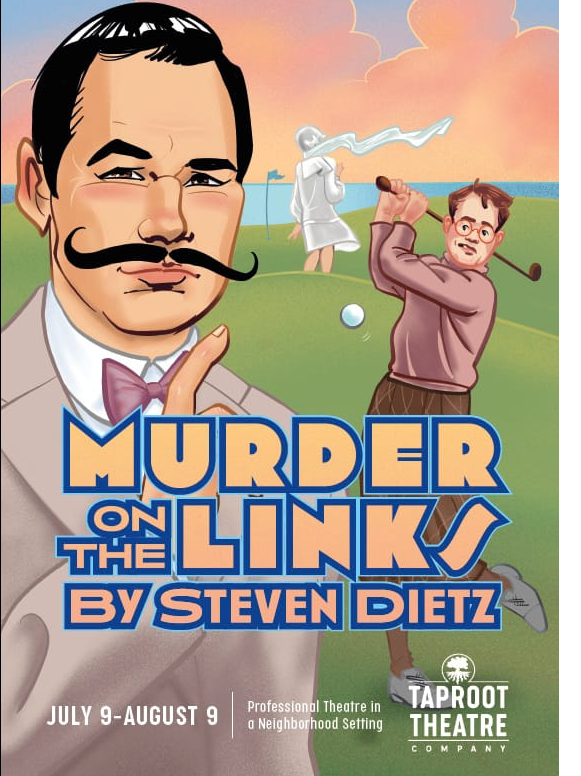
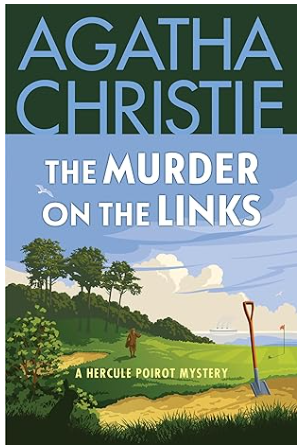
 The Murder on the Links by Agatha Christie, William Morrow Paperback Edition, original publication 1923.

Murder on the Links by Steven Dietz,  Directed by Karen Lund, Taproot Theatre, Extended run through 30 August.

So John, who is Sacnoth and Janice, who is the Bride of Sacnoth, invited me to join them in an expedition in the Greenwood neighborhood for this Hercule Poirot mystery in Taproot's renovated main stage. The new/old digs are well-renovated, and the seating, while still tight, has been improved. In preparation for the play, I actually tracked down a copy of the original story at Page 2 books in Burien. It was an interesting search, in that while a lot of my regular haunts had all manner of Agatha Christie novels, they did not have this one. 

Anyway, long story short, I liked the play better than I liked the book. But I'll get to that. Lemme talk about the book first.

The Murder on the Links is the second Poirot novel. Poirot (for those who never got near PBS in their upbringing) is Agatha Christie's Belgian Detective, with his fastidious nature, distinctive moustache, flashing green eyes, and little grey cells that he uses to navigate through the mysteries. I had powered through a number of Poirot short stories, collected in Poirot Investigates, and he has the talent of targeting some small fact that blows up traditional theories about the case. 

Poirot's assistant and narrator of the tales is Captain Hastings, who is Watson to the Belgian Holmes. He is note quite the dullard of Nigel Bruce in the Sherlock Holmes movies of the 40s, but missteps regularly, concludes erroneously, and is often distracted by beautiful women (Poirot is, of course, immune to all feminine wiles).

So, the novel: Poirot and Hastings are summoned to France by a wealthy Brit named Renauld, who fears for his life because of an unstated "great secret". They arrive on the scene to find Renauld has been murdered, his body found in what would become a bunker in an adjoining golf course (this is the only mention of golf in the book). What follows is a torturous route with continual twists and revelations - hidden histories, changed wills, stolen evidence, secret romances, strange coincidences, exploded alibis, multiple confessions, acrobatic twins, another body, and a rival for Poirot in the form of Surete officer (seriously underused). There is a lot going on, stuffing it all into a relatively short novel. All of this is told with the dry, mannered, clockwork style of Christie, which, for all the murder involved, feels very temperate and bloodless. Having read a lot of Christie recently, I can see why Raymond Chandler really hated her work.

So that's the book, and on reading it I saw it would be a great challenge adapting it to the stage. There are a huge number of characters involved in the novel, including all the suspects, witnesses, and detectives. There is a lot of travel, from England to France with Poirot frequently dropping away from the narrative for some secretive mission in Paris or London. The book's plot turns on itself, with blind alleyways and false leads that are later revealed to be pertinent facts. Oh, and Hastings at one point does something lumpishly stupid and obvious that is then ignored by the author for several chapters. How to handle all that?

Well, writer Dietz does a pretty good job of it, and in addition, makes it a comedy.

Now, Christie lends itself well to comedy, particularly with sometimes overblown characters like Poirot. Check out Miss Marples in the 1960s movies, where the prim, elderly villager is overtaken by Dame Margaret Rutherford's more boisterous portrayal. And Dietz and the actors lean into the implausibility of the original text heavily. The accents are heavy, the actions are frenetic, and the lines are overblown. It actually lends a strong sense of fun to proceedings, and is frankly contagious. Dietz allows Hastings to be the narrator, and to fully narrate, piercing the veil between the fictional world and recognizing it as a play. Janice pointed out a similarity with The 39 Steps, and I heard another patron afterwards make the same comment. So yes, we can put his piece in the same wheelhouse as that one, making the original story a metatextual comment on the fact that this is a play. 

More importantly, the huge cast is cut down to a mere six. Nathan Brackett as a woosterish Hastings, Richard Ngyugen Stoniker (or perhaps understudy Mark Emerson - the moustache is that mesmerizing) is a solid Poirot. Everyone else in the play is portrayed by two men (Tyler Todd Kimmel and Jeff Allen Pierce) and two women (Betsy Mugavero and Claire Marx), which leads to situations where quick changes and transformations are required (and sometimes performed comically on-stage). And the players are in on the joke - this is a performance, and as the players move all the props about on the stage and pull together to make it all make some sort of narrative sense.

And as a play, it works so much better than as a novel. The linearity of moving the action forward makes clear the various plot points and revelations. I did not lose the thread. And even Hastings' bumbling in places makes better sense on the stage than it did on the printed page. Also, the play allows Brackett's Hasting to be more of the romantic hero he sees himself as, with his heart on his sleeve and his desire to protect young (and pretty) young women. And it gives Hasting not only a happy ending, but a lead-in to another Poirot mystery as an Easter Egg. Oh, and a scene actually takes place on a golf course.

All in all, it was an enjoyable way to spend and afternoon, and highly recommended. The cast is frantic and positively acrobatic in their portrayals, and leaves the audience exhausted and delighted. Worth seeing.

More later,

Saturday, December 21, 2024

Theatre: A Very Wooster Holiday

 Happy Christmas, Jeeves by Heidi McElrath and Nathan Kessler-Jeffrey, directed by Karen Lund, based on the stories of PG Wodehouse Taproot Theatre Company, Through December 31

Let's round out this festive season's holiday plays with a Wodehousian romp. The Lovely Bride and I, along with our friends Janice and John, set out for the northern reaches of Seattle for lunch at Saffron Grill in Northgate (Indian/Mediterranean fusion, which was quite good), then doubled back to Greenwood and the Taproot Theatre for Happy Christmas, Jeeves, And it was all quite enjoyable.

Happy Christmas is not based on any one particular Bertie and Jeeves story so much as it is based on all of them. Indeed, one of the criticisms of Wodehouse's stories is their similarity - High-class toff Bertie Wooster gets himself in trouble, and only his sage and unflappable valet Jeeves can extricate him. And while this is true, but it is a little unfair, sort of like saying that The Simpsons have one story, and they just keep telling it different ways for 35 years. So this particular creation, from the pens of McElrath and Kessler-Jeffrey, features all the characters, hallmarks, and tropes of the traditional Bertie/Jeeves stories, mixed together and served as a Christmas Pudding. 

Here's a deal - Bertie would like to do nothing more than spend the holidays alone, curled up with a new book by his favorite author. Such is not to be, of course, because his dreaded Aunt Agatha descends upon him with the demand that he put his hapless cousin Claude on a train to South Africa (spoiler- Claude doesn't go), and then the situation is made worse by Bertie's old chum Bingo Little having fallen in love with a waitress named Mabel, but doesn't know how to get HIS aunt's approval of the cross-social-class match. Add a few cases of mistaken illnesses and an escaped ferret and you culminate in an inspired collection of door-slamming and hallway-chasing. 

And it's a lot of fun. And I should add that for this particular matinee performance, the understudies took over. There was a flurry of addenda slips in the program book, and folk stepping up into the leads. Jon Lutyens emerges as a pitch-perfect Jeeves, all manner and decorum even when armed with a net and a broom. Joe Moore was a delight as Bertie, all loose-limbed, slack-jawed, and goggle-eyed. Moore had been listed as Cousin Claude in the program, but after being promoted, that role was nicely assayed by Giao Nguyen. Kim Morris is a juggernaut-class Aunt Agatha, all sound and fury. William Eames was the endearing and infuriating Bingo Little. Nikki Visel was the very precise and proper (and cougarish) Lady Bittlesham, Bingo's Aunt and author of books on proper etiquette. Mabel was Rachel Guyer-Mafune, and this would be the fourth production I've seen her in at a fourth different theater. She's a hard-working actor.

They're all good. Delightfully so. And the direction was top-notch, dealing with the challenges of a small theater with a thrust stage and flanked on three sides by the patrons. This performance had pacing, and would set up and delivered jokes and humorous situations, with enough breathing room to let the audience catch up. The acting was broad, the action was slapstick, and there resulting confusion completely enjoyable. The audience was enchanted and engaged.

I liked it a lot, so much so that afterwards, I sat down to pen this, since it runs for only one more week (they did extend it over the weekend). This was the best Christmas show (Though Snowed In was nice as well). So if you need something to do in your post-Christmas break, here's a breath of fresh air with a very familiar setting. Happy Christmas to all!

More later, 


Tuesday, September 17, 2024

New Arrivals: The Gen Con Haul

 So, I was invited out to Gen Con back in early August as a Guest of Honor this year in Indy, and despite the Covid, it was pretty darn good.

The official house was 71,000 gamers, all of whom I suspect were on the exhibit floor at the same time as I was. The convention had spread out even more than the last time I attended, which surprised me, and worked into every nook and cranny of the surrounding hotels (and they are building more hotels in Indianapolis, which bodes well for future conventions). I had been invited to sit of several panels for the 50th anniversary of D&D (Here are some videos), and helped out with the Writer's Symposium as well. And I picked up a lot of stuff, including huge blisters on both feet from all the walking around (and Covid).

I will confess I packed a large suitcase, half-empty, just to account for all the things I was intending to bring back. I also sent a copy of Shadowdark to a colleague who asked for it, and it was a good thing, because they sold out of the last of their print run at the con itself. 

OK, so what do we have? 

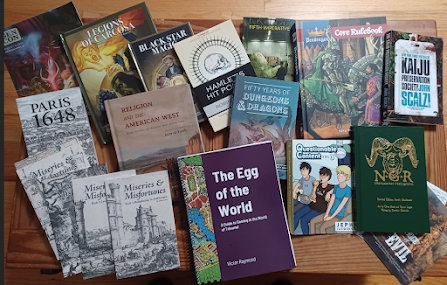
Gen Con Program Booklet by Peter Adkison and many diverse and talented hands, 170-page magazine format. This bears out a call-out because of how much it shows the depth and diversity of Gen Con as it celebrated 50 years of D&D. Stuffed with ads from exhibitors but also showing the maps of all the locations, it covers the history of D&D, the guests of honor (I'm on page 91), the writer's symposium, the costume contest (one of my old D&D group from college is on page 125), and all sorts of subcons and special interest groups. An excellent memento of the convention.

Legions of Carcosa by John Harness, Kira Magrann, Sarah Saltiel and Monica Valentinelli, with Daniel Kwan, Pelgrane Press, 200-page hardbound, 2023, Gen Con, and Black Star Magic,  by Robin D. Laws, Sarah Saltiel, Gareth Ryder-Hanrahan, and Ruth Tillman, Pelgrane Press, 184-page digest-sized hardbound, 2023 Gen Con . Pelgrane's The Yellow King is one of the more intriguing games I have in my collection and one of the more challenging. Its system is a simplified version of their Gumshoe system, which uses condition cards as opposed to more traditional hit points and the like, yet it remains a bit of a mental climb for me. The setting itself is four settings based on the work of Robert Chambers, who in the 1890s created an alternate 1920s with a dictatorship in America with suicide booths in the major cities. The game itself has four separate time periods to it - Paris in the 1890s, during the Continental Wars, and post-war, post-dictatorship US, and a modern era. So all this is background. Legions of Carcosa is a monster book, Black Star Magic is a book of spells. Nice additions, though I know I'll have to do a bit more digging to see how they can be implemented. 

The Fifth Imperative by Robin D. Laws, Pelgrane Press, 192-page softbound digest, 2022, Gen Con  Also from the Pelgrane Press and also dealing with the alternate history of The Yellow King. This one is set in the period following the dictatorship, and involves politics and otherworldly conspiracy. I really like the lateral development and fiction books that Robin D. Laws and Pelgrane put out, and usually don't see enough of them through my standard purchasing venues. So this will likely end up as a "plane book" to be read en route to conventions.  

Hamlet's Hit Points by Robin D. Laws, Gameplaywright Press, 196-page softbound digest, 2010, 2015, Gen Con. This is the third time I have purchased this book. On the two previous occasions, I have recommended it others, loaned it out, and never saw it again. It is an interesting examination and mapping of beats and pacing within narrative stories. For Laws, such beats are instances with specific purposes, be them - Dramatic, Commentary, Anticipation, and the connective tissue of Pipe, and combine to create Hope and/or Fear in the audience. He then uses this analysis to examine Hamlet, Casablanca, and Dr. No, under this lens. It's an interesting approach, and the only thing I can ding it with is the each beat is considered as a single unit - a particularly positive beat gets the same weight as a negative beat, so that the progress of beats is downward, regardless of resolution. But that's just a quibble. I'm glad I got another copy of this. No, you can't borrow it. 

Pendragon Core Rulebook by Greg Stafford, with input from myriad others, Chaosium Inc./Moon Design Publications, 254-page hardback, 2024, Gen Con. I'm a fan of Chaosium's games - I've played a lot of Call of Cthulhu. I've played almost no Runequest (but love the lore). Pendragon falls between those two poles, where I've done a bit as both player and gamemaster. And so a goal of this trip was to pick up the new version (I would have also picked up some Miskatonic Library volumes, if they had any on-hand, just so you know). The latest version is polished and is incredibly readable. The downside is that this is primarily a Player's Guide, with a lot of good information for players. For a GM, it would more of an uphill stroll, and hopefully there is a GM resource in the works. In the mean time, I would still likely spring the Starter Set on my players.

Kaiju Preservation Society by John Scalzi, Tor Books, 266 page Trade paperback, Gen Con. So what's the deal with including all these books here? Well, they were part of the Gen Con swag I returned from Indy with. This volume was a reward for helping out the Writer's Symposium, spending part of an afternoon stuffing swag bags for the attendees. A good group activity. The book itself deals with a slacker taking on a temp job that takes him to another dimension filled with giant monsters. That's about all I know about it right now. Kate's read it on Kindle (I have a hard time concentrating on devices when I have other options to engage with) and says its pretty good. It becomes another plane-trip book. 

Miseries and Misfortunes: Roleplaying in 1648 by Luke Crane, Burning Wheel, six softbound digest volumes for 852-pages total, 2022-2023, Gen Con. This is the sort of thing I love at Gen Con - finding something I had never heard of before, something that is much tougher in this Internet Age. So I was delighted I found the six volumes of this game at the Burning Wheel booth and snapped them up. The gamer takes place in the post-Richelieu, post- Louis XIII era of the Musketeers Cycle, where you had the underaged Louis XIV, the Queen Regent, and a noble revolt known as the Fronde. While it notes its descent from Basic D&D, it has morphed from those early designs into a completely different animal with a lot of different mechanics. The books themselves are 1) a system book for game mechanics, 2) a character creation book (which should be read first so you know what they're talking about in book 1, 3) a book on magic, 4) and expansion to books 1-3, 5) an adventure set in Catalonia, and 6) a MASSIVE book on Paris itself. So yeah, I'm pretty pleased with myself.

Religion in the American West: Belief, Violence, and Resilience from 1800 to Today.  Edited by Jessica Lauren Nelson, University of New Mexico Press, 196-page hardbound, 2023. So at Gen Con, my hosts put me up at the Fairfield, which was one of a collection of interconnected Marriot-branded lodgings. My room faced the Eiteljorg Museum of American Museums and Western Art. And since I had arrived a day early, I actually had the chance to see something in the city where I was. And it is an excellent museum of Native American and European Western art, and I would recommend it just on the basis of that. But the special exhibit was on Religion in the American West, and covered both the stuff most folk know about (The Mormons, the Spanish missions), as well as lot of things that tended to get pushed to the back (Presbyterians and their influence on the Erie Canal, the rivalry between Catholic priests and Protestant ministers among the Native Americans). It was a good exhibit, and I went back on Sunday to get the book (which was half-price since that was the last day of the exhibit). Look forward to reading it. 

Fifty Years of Dungeons & Dragons, Edited by Premeet Sidhu, Marcus Carter, and Jose P. Zagal, the MIT Press, 372-page Trade paperback, 2024, Gen Con. Purchased at the MIT press booth, no less. The 50th anniversary of D&D has encouraged a spurt of commentary and analysis. This volume is a collection of essays from a number of talented individuals. I've been reading this is bits and pieces, and there are parts I find engaging, and those that I give the hairy eyeball and raised eyebrow at. The final collection probably should have had one more pass through it by a well-intentioned grognard or two to catch the nits. One obvious nit? For a document that pushes cultural accuracy in many of its essays, the cover shows two Viking-types fighting what I would guess to be a Lindwyrm. And the Vikings have wings on their helmets. Its a minor thing, but triggers that eye-roll thing. 

The Egg of the World: A Guide to Gaming in the World of Tekumel by Victor Raymond, 256 page ringbound draft, 2022. Gift of the Author. It is well known that I am a fan of Empire of the Petal Throne, but recognize that the very alienness and completeness of the world is a major stumbling block for new players. There's a lot to grok - no only all the strange names and alien creatures, but the non-Western-European concepts of rigid class and clan. The original EPT had 11 pages of backstory for the world at the start, before digging into it properly. So this volume sorts out a lot of this for the referee, hitting the important points of what makes a Tekumel campaign, as well a host of scenarios, adventures, factions and patrons that can be grist for your mill. This is a referee's source material to get your players into EPT without overloading them, and allow them to experience the world as opposed to confronting them with a big data dump. I'm looking forward to seeing this in its final form. 

Questionable Content by Jeph Jacques, TopatoCo Books, 592 page trade paperback, Gen Con. Look to the blogroll to the right, and you'll see QC listed. And I check it out on weekdays. At Gen Con, I hunted down Jacques among the teaming thousands and myriad booths. He had already sold out of Volumes 1 and 2, but I bought Vol 3 and he included a drawing of Hannalore (I have friends who are artists, but it still lifts my heart when someone does that). Anyway, Questionable Content has been around for twenty+ years, and deals with the relationships of Marten and Faye, who were a couple back at the beginning, then broke up and dated others, then broke up with those others a few more times and now are in pretty stable relationships. This is of the era when Hannalore, who grew up on a space station, shows up more, Marten still has a band, and has such things a whether Penelope, the new employee, is really the superhero Pizza Girl and the threat of the the VespAvenger and her transforming robot scooter. The writing is smart, the characters are intelligent, and the strip remains excellent. The strip has evolved as it deals more with robots and SF elements, and there are a host of characters that rotate in and out, sort of like Doonesbury. I really like the strip, and you can rabbit hole through the archives if you don't want a physical copy. So check it out. 

Neoclassical Geek Revival Second Edition Acidic Rulebook (it is acidic instead of basic, get it?), by Zzarchov Kowolski, Neoclassical Games, 170 page hardback digest, Gen Con.  I'd seen mentions of this product elsewhere, and was delighted to see it with a booth (low-tech and high pressure), so I picked up the core book and a couple support products. I expected another OSR-clone hewing close to the original little booklets, but instead discovered that they took the core concepts and headed for the exits, changing them over time to produce something completely unique. The tone of the books are that same jaunty in-your-face attitude of the guy across the gaming table explaining his house rules, but everything has changed dramatically, such that you're learning a completely new game. The part that is most like original D&D is the presence of a GM (mentioned briefly) and the 1st edition tendency to create a new system whenever confronted with a new challenge. It's really impressive. I also picked up Havenvale (16 pages), a tidy little starting area in a mountain valley, and The Price of Evil (32 pages), a way to create haunted houses with a deck of cards. 

Whew! And that's the lot. And more have shown up, but we'll deal with them later. So, more. Later.


Tuesday, May 21, 2024

Play: Holmsien Romp

 Sherlock Holmes and the Precarious Position by Margaret Raether (Based on the stories of Sir Arthur Conan Doyle), Taproot Theatre, through 22 June

The regular theatre seasons are winding down, so, as has happened before, we (the Lovely Bride,  and friends Janice and John, (who best known to the blogosphere as Sacnoth)) set out to Taproot Theatre in Greenwood for a whopping good dose of Sherlock Holmes. The Taproot is a small but feisty acting company is a small but charming theatre. The stage is thrust out, flanked on three sides by audience, with a narrow balcony above with a precipitous view of the stage. The LB notes that despite the close quarters, the seats are still more comfortable than the Arts West.

And the Taproot's performances tends to aim towards the positive, with uplifting stories and classic characters. And by the latter, we're looking at Austin's Pemberley, Wodehouse's Bertie and Jeeves, the occasional Oscar Wilde, and this time out, the Great Detective. 

Holmes has evolved over the years  a width and breadth of his character, and there has been a plethora of portrayals. There have been cerebral Holmes and action-adventure Holmes. There have been young student Holmes and elderly beekeeper Holmes. Functioning sociopaths and drug addicts and cartoon characters. Taproot's current Holmes, played by Calder Jameson Shilling, is a brilliant social maladroit, a positive Homes who worships at the altar of logic and deduction and doesn't care if no one else sees it that way. His Watson, well-played by Nathaniel Tenenbaum, is his social intermedium to the world at large, a good friend who tolerates his companion's eccentricities and explains them to those who might judge Holmes harshly. 

Everyone else - cops, robbers, elderly sisters, clerks, Mrs. Hudson and Inspector Lestrade, are played by David Roby and Ariel Rose, who don a multitude of costumes and accents to populate the rest of London orbiting around the binary star that is Holmes and Watson. Ariel Rose in particular shines, swapping off roles easily, effectively, and charmingly. She got the best role of the bunch, and is up to the task.

And yes, this is a comedy, the characters broad and the humor chuckling. Watson narrates exposition to the audience and gets called upon it by the other characters. Holmes finds his bastion of logic under siege as he talks to two elderly sisters. Mrs. Hudson is frustrated by Holmes' behavior and Lestrade is a bit of a glory hound. Add it all up and you have a bit of light, comic theatre.

The stage itself aids for quick changes and locations. The thrust part of the stage is left open, which reduces the amount of blocked shots from the seats (a problem with theater-in-the-roundish). The backdrop rotates its back wall to quickly transform interior scenes and not get into the way of the actors and play. A nice presentation.

The plot may be familiar to Holmes' fans - a pair of elderly women who run a shop for women's apparel are hired to transcribe the encyclopedia, then mysteriously fired (unpaid). There is also a stolen gemstone involved from a separate case. But its not so much the mystery as the delivery. Fast-paced, witty, barreling through the lanes in a delightful take on the characters.

So. It's a rouser, a romp, a bit of light amusement. A gemstone set in a jewel box setting. A worthwhile bit of theatre for the evening, and in the time it has taken for me to write this up, it has extended it's run. Good show. 

More later


Tuesday, February 06, 2024

Play: Best Frenemies

 Born With Teeth by Liz Duffy Adams, Directed by Mathew Wright, Arts we through 25 February.

This one is bloody brilliant, probably the best I've seen at the Arts West in the post-COVID years.

It's a two-person play. Shakespeare and Marlowe, at the start of Shakespeare's career. Marlowe is the established superstar of the era, and supplements his writing with adventures in spycraft and larceny, trusting to his patron (and his own sense of self-preservation) to keep him from prison and torture. Young Will is an actor by trade, but would rather disappear within his work and not make any waves. Because the Elizabethan England as conjured by Adams is an authoritarian police state, its oppressions covering for "endless wars and bad harvests" with a continual hunt for foreign agents, traitors, and Catholics. 

The characters are the same age, but Marlowe (Michael Monicatti) is more experienced in the world and its double-dealing. Egotistic, talented, and sure-footed, he plays the mentor and the seducer, seducing both for his world of spycraft and sexually. Young Shakespeare (Ricky Spaulding) is in comparison the country mouse, with the family back in the hinterland that he wants to keep fed. For Shakespeare, writing is a way to support his family, for Marlowe writing is a flashy sideline while proving his true worth for his elite masters.

Recently scholars have done the analysis and determined that Marlowe and Shakespeare did team up on what has been previously credited as Shakespeare's first works - Henry VI (parts 1, 2, and 3). They can track which parts are Marlowe's and which parts are Shakespeare's. And that becomes the frame upon which the twain's relationship is based - Marlowe struts, pouts, and tempts, while Shakespeare tries to keep things on a business level, denying his own interest, and worried about repercussions. 

The stages itself is simple and does not get in the way - a diagonal thrust platform dominated by a single large tavern table where the two are supposedly working. It is both constrained, keeping the actors in the same cage, and open, giving them the ability to range and rage around, across, and onto the table itself. Some sight lines at stage left might be obscured, but it is minimalism in the modern theatric sense, and works perfectly.

And it is all fantastic - the actors fully embrace their parts, every line carries several layers of subtext, and every emotion lands. It is an excellent presentation, and well-worth getting out to the wilds of West Seattle (where, I will note, they've changed the parking procedures behind the theater AGAIN) in order to take it in. It is very much modern theatre, all muscle and sinew, intent on challenging the viewer and demanding they keep up. 

Got see it. More later.

Wednesday, September 20, 2023

Book: Damp Squib

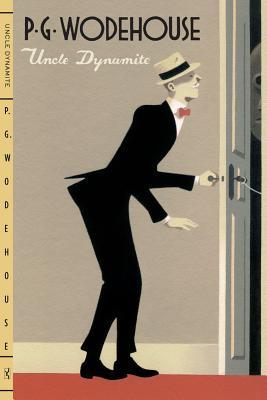
Uncle Dynamite by PG Wodehouse WW Norton & Company, 1948

Provenance: Half-Price Books. This was a whim purchase a few months back, while I was looking for something else. That happens sometimes. OK, that happens a LOT.

Review: It is a well-known fact that I am a big Wodehouse fan, but even I must admit there is greater Wodehouse and just-average Wodehouse. Greater Wodehouse just drips with class-system wackiness, sly banter, and preposterous situations. Wooster and Jeeves stories are the hallmarks of this, but we also see good examples out of Blandings Castle as well. Greater Wodehouse thrives in the interwar years, where makes a fanciful portrayal of a world a short train trip or tram ride from the city hustings of the author and the audience.

Just-average Wodehouse still has the brilliance of language and the twistiness of plots, but it feels like the pilot-light has gone out. And part of it is that Wodehouse created a space in which he could write stories, and those stories in turn have defined his output. Having built his own personal genre, he was now bound by it. He could write gloomy reflections on the intangible nature of the soul, but it probably would not sell in the pages of the Saturday Evening Post

Anyway, the story at hand. Uncle Dynamite is Uncle Fred, a local lord (Frederick Altamont Cornwallis Twistleton , 5th Earl of Ickenham) of WC Fields disposition (though of slenderer build), and notable for drinking, gambling, creating a general nuisance, and getting up in other peoples' business. He uses that last talent for what (he presumes) is good, such as trying to put lovebirds back together and pilfering statuary busts containing gems that a young lady hopes to smuggle into New York without those bothersome tariffs (such Macguffins abound in these stories). Uncle Fred lies effortlessly, takes on false identities, and then imposes additional false identities on others. Uncle Fred is a recurring a number of stories by Wodehouse. If it was reincarnated today, the entire canon would be called the Wodehousiverse, and get five separate shows on Netflix.

The stock characters are here, a commedia dell'arte set in the green and pleasant lands, a day's motorcar drive from the Smoke. Here we find the headstrong young woman, the young man who can't quite figure out how he got engaged, the shy, blundering lunk, the petty tyrant lord of the manor, the long-suffering wife, and the stiff-necked constable. There are mix-ups and false identities and numerous petty burglaries. One of the charms of the book is watching Dudley dig himself out of one obvious prevarication while setting himself up for the next.  

And it works. All the pieces slide into place, one lie leads to another leads to a third effortlessly, and the clueless young man finds himself dancing around exploding revelations. If this was a sitcom, it was a very nice episode.  I would not say that the author is coasting, but I think he has tamped on the brakes a bit too hard. 

This was written after the war, after Wodehouse soiled his reputation by doing light, airy radio broadcasts from a German POW camp. Post-war Wodehouse tends to be nostalgic, pining for an age that no longer exists in a land the author cannot return to. Manor houses, train stations, smuggling diamonds all belong to another era, a black-and-white film of a lost period where serialized stories lived in the glossy magazines. It's good, but not Greater Wodehouse.

But even OK Wodehouse has its moments - this is worst pun I have encountered yet:

"Yes, my dead wife, I am glad to say, continues in the pink. I've just been seeing her off on the boat at Southampton. She is taking a trip to the West Indies."

"Jamaica?"

"No, she went of her own free will."

Try the fish, and remember to tip your waitstaff. More later,

Thursday, September 14, 2023

New Arrivals: Green and Pleasant Lands

A large collection this time, as Kickstarters resolve and I take another quarterly trip to Gabi's Olympic Cards and Comics down in Lacey with Stan! And in the time I've taken to write this up, two more Kickstarters have shown up, so I need to write these up before I am buried by them.

One of the ongoing challenges to Kickstarters is shipping. I grumbled previously how there are now added costs in Kickstarter as everyone tacks shipping on later in the process. And that sadly is part of the modern world. But another component of this is that everyone seems to have a different method of finalizing fulfillment. I've already dropped the ball on a couple Kickstarters where I got the process gumbled up, and am dropping one which requires me to use Paypal (sorry - very untrustworthy platform, would not link it to my bank account). That's more than a pity.

Looking over this season's crop of games, I am struck by how many of them are in England. I have King Arthur's Britain, Queen Victoria's Britain, Mythos Britain and Roman Britain (with a good chunk of Mythos on the side). There are also five projects in the Mythos/Horror vein as well. So I may have a "type" in my gaming purchases. 

Anyway, here's a bunch of games.

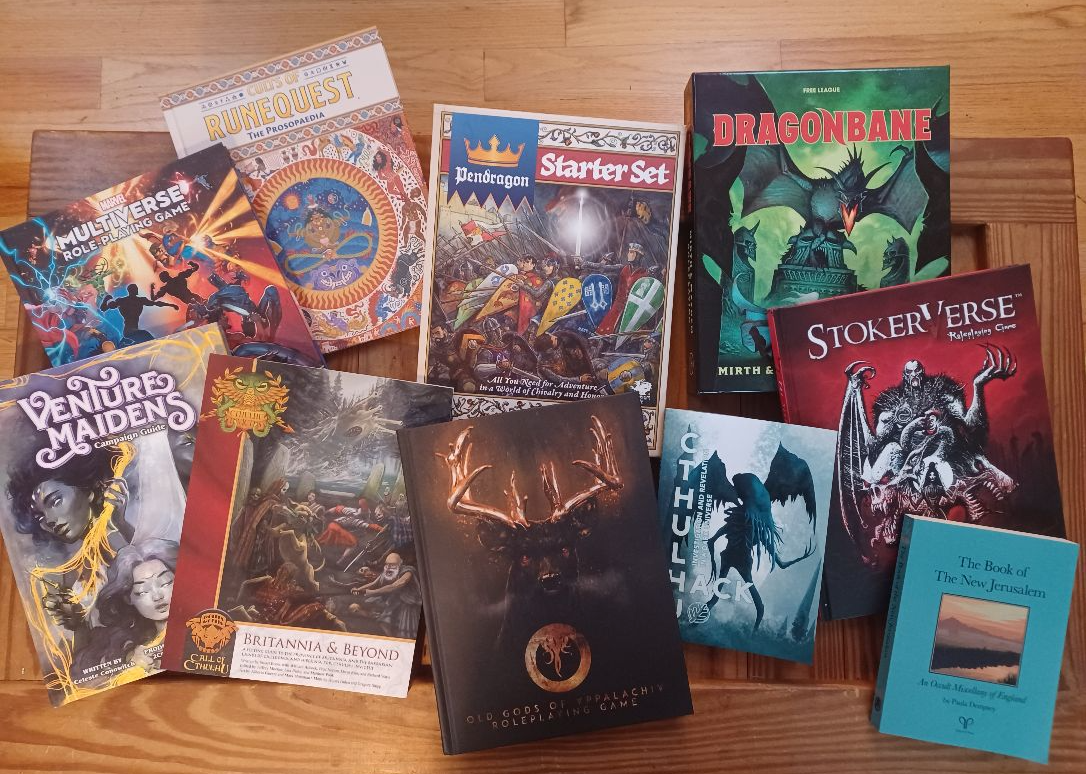
Old Gods of Appalachia Roleplaying Game, by Shanna Germain and others, 416-page hardbound, Deep Nerd Media/Monte Cook Games, 2023. Kickstarter. The game is based on the impressive and award-winging horror podcast of the same name from Cam Collins and Steve Shell. It is set in an alternate Appalachia (the mostly-rural mountains which run between Tennessee and New York State), where dark things dwell in the runs, creeks, and glens. Several colleagues worked on it, including some that have a heritage from that part of the world. The book looks fantastic and the rules are MSG's Cypher system, but backgrounded in favor of the flavor and color. This is one I've been looking forward to, since I am a native of Pittsburgh (A metropolitan anomaly in those mountains), I've hiked some of these regions as a boy scout and as a surveyor, and I still have all my Foxfire books in the basement. Looking forward to digging in.

The Book of The New Jerusalem, An Occult Miscellany of England by Paula Dempsey, 264-page softbound digest, Pelgrane Press, 2022. Olympia Cards and Comics. Call of Cthulhu has always have been heavy on the handouts, which is one of the pluses for the setting. Pelgrane Press's Trail of Cthulhu (similar universe, different mechanics) issues entire BOOKS as support material. This heavy little tome supports their Fearful Symmetries campaign, and in addition is a sequel/prequel to another volume, Book of the Smokes, which involves ANOTHER campaign. I have none of these other works, but find Book of the New Jerusalem to be an excellent tour of rural England in the 1920s, which is filled to the brim with supernatural encounters and adventure hooks for potential GMs (and it was the second encounter of "headless bears" in a single week). How much is pulled from existing folklore and how much is made up for moment, I really don't care - it is pretty darn impressive. 

Cults of Runequest Vol 1:The Prosopaedia by Greg Stafford, Jeff Richard, Dandy Peterson & Katrin Dirim, 152-page hardback, Chaosium Inc, 2023. Olympia Cards and Comics.  Runequest is my favorite RPG that I've never played, and I have been following its projects off and on ever since White Bear/Red Moon. Its cosmology is so peopled and varied that it often leaves me mildly confused (yeah, and I'm the guy behind Manual of the Planes). So this is a welcome start to sorting everything out. It is a simply a listing of all the gods/divines/powers of Glorantha, and is an good overview of the grounds, before they drill down into the various pantheons and portfolios.

Dragonbane: Mirth and Mayhem Roleplaying by Tomas Harenstam and others, Boxed set, Free League. Kickstarter.  Free League Produces some of the best-looking products in the business, and Dragonbane is no exception. This is a good-sized box with 112-page rules, 116-page adventure book, stand-ups, maps, a solitaire adventure, and special dice. The game is a German descendent of an adaption of Chaosium's Magic World (itself an early BRPG product), and I am very interested in knowing more about the intermediate evolutionary steps, as there is a lot here that echoes development in both CoC and D&D over the past 30 years. It bills itself as a "Game of Mirth and Mayhem", though I'm not sure if that is quite on target (It does have sentient ducks, which are likely a heir to early Runequest). But its approach is hardly that of "grimdark" fantasy, and it echoes the early D&D boxed sets with a positive, heroic, and active approach to adventuring. Perhaps I need a new word for this type of play - Brightheart? Shimmerlight?

Pendragon Starter Set, by Greg Stafford, Boxed Set, Chaosium Inc. 2023.  Boxed set.  Olympia Cards and Comics. An excellent introduction to the upcoming Pendragon revision, which I have played, and have enjoyed the support material as well. The thin box is packed with a46-page solo adventure, 66-page rules/setting book, a 50-page adventure, appendices, pre-gen characters, battle cards, and dice, and is an affordable (Thirty dollars, compared to 60-buck hardbacks) entry into the world. It looks like they have tidied up the mechanics of the elder versions, while keeping concepts unique to the game like seasonal play (creating multi-year campaigns) and paired traits. Probably will spring this on my regular group.

Cthulhu Hack by Paul Baldowski,156-page softbound digest, Just Crunch Games, 2023, Kickstarter. The Cthulhu Mythos gets a lot of gaming variants. There is the original CoC, a d20 version, Trail of Cthulhu, and this one, which is a Hack. Hacks are a subgenre in themselves, and tend to shorter, self-contained game, with limited scope, and easier mechanics. This one has built on those base principles, in that it uses the standard abilities as saving throws, adds depletable investigative resources like "Smokes" and "Flashlights", and various die sizes for resolution, similar to Margaret Weis's Cortext system. But to be honest his one leaves me a little off-put, though, in that it arrived with AI art in the credits. Now, the lead (sole) artist is also the art director, they made a donation in kind to an artists fund, and if you're going to make lumpy, unspeakable, uneven-looking creatures, Midjourney fits the bill nicely. Still, it makes me feel uncomfortable, and not in a rugose and squamous way. And yeah, it wasn't mentioned in the original Kickstarter, and (checking) they did address it in the comment section, but it opens up a can of worms for me about artistic responsibility in these purchases, and will affect future purchases from this group. 

Britannia & Beyond: A Setting Guide to the Province of Britannia and the Barbarian Lands of Caledonia and Hibernia for Cthulhu Invictus by Stuart Bloom and others, 142-page softbound, Golden Goblin Press, 2023, Kickstarter. This one has been a little late, for a number of reasons including illness from the guy running the Golden Goblin Press, which is a challenge to all operations large and small (Hope you make a smooth recovery). Britain itself is a effectively a Subgenre of Cthulhu subgenre, and Roman-era Cthulhu is a sub-sub-genre (see projects like Lex Arcana, for example). Golden Goblin picked up the Cthulhu Invictus torch and has been producing excellent material, and in this case takes its OWN tour of supernatural Britain. This can work well with New Jerusalem, I think. It is texturally dense, as most Invictus books are, though the font is a little thin and they've gone from a glossy stock of the original book to a non-gloss stock. Still, well worth the wait. 

Marvel Multiverse Role-Playing Game Core Rulebook by Matt Forbeck, 320-page hardback, Marvel Worldwide, 2023, Midgard Comics. Midgard is my local comics shop, and carries games as well. Like a lot of stores, it manages a large playing space for gaming and runs Magic and D&D games. It's a good place, and the have a new puppy (Miles) but that's not relevant to the current discussion. I talked about the Alpha version of this a few months back, and this is the finished draft. And there is a lot here, and a lot more that can be here. We're talking about 130 characters from the Marvel Universe, and, the way they have defined super-powers (specific applications within broad categories) means there are a dozen different super-powers all gathered within the heading "spider-powers", (including using your webbing to make a glider). And that doesn't cover everything - there will more to come with expansions and adventures. One disappointment is that the hardback lacks an initial adventure, but that should show up soon as well. [Update 9/19 - Ask and ye shall receive, true believer. Here's a free adventure, which is an update of the Playtest adventure. Also Errata and a FAQ.]

StokerVerse Roleplaying Game by Chris McAuley and others, 208 page hardback, Nightfall Games, 2023, Kickstarter. I am spending way too much time in England, apparently. Here we are in London of the 1890s. Gaslight territory. Set in an world evolved out of the classic Bram Stoker novel by the author's great-grandnephew, Dacre, the game features the Famous Monsters of Public Domain - Drac, Frankenstein's Monster, Mr. Hyde, the Invisible Man, all given a unified backstory.  The game uses the "S5S" system using d10s for task resolution. The presentation is solid with a full-color interior that is mostly red. A lot of red.

Venture Maidens by Celeste Conowitch, 224 page hardback, 2C Gaming, 2022, Kickstarter. Good campaign settings come out of long-standing campaigns. Forgotten Realms and Greyhawk are good examples. With the explosion of live-play and podcasts, we have a lot more personal game campaigns that turn into published campaign settings. Tal'Dorei comes to mind, and now Venture Maidens, which blossoms from a "femme-forged podcast." The world has a couple interesting angles, in that it has a more morphic, dynamic cosmology, where the the mortal world is slowly being consumed by the fae lands. In addition, there is a "heroic destiny" mechanic which creates some interesting long-term play effects, which makes sense for social, multi-season adventures. Even without these, the book is crammed with backgrounds, treasures, and beasties, and the production values are at WotC-levels. I picked it up on a whim, and am glad I did.

And that's it for now. Wait, SOMETHING ELSE just showed up on my doorstep? OK, we'll save that for next time.

More later,

Monday, June 05, 2023

Theater: Jeeves Takes Manhattan

Jeeves Takes a Bow Adapted by Margaret Raether from the stories of PG Wodehouse, Directed by Scott Nolte, Through June 17, Taproot Theatre Company

The theater seasons I pay attention to are coming to a close, but Janice Coulter and her husband, Sacnoth, treated us to this production at the Taproot up in Greenwood. north of the city. Our planned lunch place, the Olive & Grape, had changed its opening hours to later in the day, so we had lunch at Razi's, a pizza place that makes nice salads as well, and hunkered down at the Taproot's Jewell Mainstage for an afternoon of Wodehouse. 

The Jewell is, well, a little jewelbox of a performance space, the stage thrust out deeply into the main space and surrounded on three sides by the audience, who are also sprinkled overhead along thin galleries. It brings the audience right on top of the action (such that they warn the patrons not to put their feet on the stage, lest they be trampled), but has the downside that sightlines don't always work, and we were treated to a great deal of "back-of-the-head exposition".  Which is a pity, since the actors were all excellent. 

Long-time readers of this blog know about my enjoyment of Wodehouse's world. The plot of Jeeves Takes a Bow is pillaged from the Bertie and Jeeves canon, along with original material heavily influenced by the genre. Bertie Wooster (Calder Jameson Shilling) and his stalwart valet, Jeeves (Richard Nguyen Sloniker) have decamped from England for New York City, only to discover that Bertie's old pal Binkey (The oil-slicked Miguel Costellano) has been pretending to be Bertie, auditioning for a local theater production, and romancing the female lead, Ruby (Claire Marx). Ruby in turn is trying to elude her overly-protective producer, the wise guy Daniel "Knuckles" McCann (Tyler Matthew Campbell). Also dropped into the mix is strait-laced old girlfriend of Bertie's, Vivian Duckworth (Kelly Karcher) who wants to research the dens of iniquity in NYC, including speakeasies and, of course, the theater.

In other words, it has all the trappings and tropes of a Wodehouse production. New York is a regular venue for his stories, and the plot is a collection of colorful characters, mistaken identities, and travails for Bertie and solutions by Jeeves. The foolish master with the crafty, wise servant has been with use since the Roman Plautus if not before, and Wodehouse expands upon that fine tradition. And the plot in one familiar to fans of Wooster & Jeeves - Bertie gets into a tiff with Jeeves (in this case involving purple socks), then promptly gets himself in a jam which requires Jeeve's help, and Jeeves gets him out of the jam, but in a fashion that embarrasses and chastises Bertie.

Shilling's Bertie a likable mixture of good intentions and self-deprecation - he's aware of his shortcomings and leans into them, which makes him sympathetic as his well-meaning nature gets him more deeply involved in his predicament. Costellano's Binkey helps support Bertie in that Binkey is even more hapless and hopeless than Bertie. Marx's Ruby is pure brass, Karcher's prim Vivian is a delight, and Campbell thunders with just the right amount of threat as Knuckles. 

And through it all, the calm center is Sloniker's Jeeves, always there with a spot-on comment and chilled cocktail ready for delivery. Even in rough-and-tumble New York, Jeeves rises head and shoulders among his compatriots, and is the wise head that everyone recognizes and relies upon.

The lingo is completely 1920's argot, and you might find one or two lines among the Americans that do not reek of the era. The dialogue is fast and furious rolls through the entire stage as the actors throw themselves into the works and across the stage in bringing the page to life.

Kinetic, Frantic, Antic, Manic. Yep, that about sums it up. All in all an afternoon well-spent.

More later,   

Thursday, April 20, 2023

Books: Spies and Lies

 Slow Horses by Mick Herron, Soho Press, 2010

A Legacy of Spies by John Le Carré, Penguin Books, 2017

Provenance: I blame The New Yorker for this one. They had an article on author Mick Herron, talking about how he was an heir to John Le Carré in the genre of spy thrillers. OK, on that note, I went hunting for Herron's first book, and found it at Apparition Books in downtown Renton (who do not have a web site. Sorry). Apparition is a curated bookstore that has a lot of good books in good condition. On completing Slow Horses, I went back to see if they have the second book of the series. They didn't, but did have one of John Le Carré's last works. So I picked that up instead, and used it as my airplane book for the trip the Georgia.

(And yes, I prefer to read books on the plane as opposed to using the tablet. I don't worry about battery life or being distracted by other apps or having to turn it off during takeoffs and landings. And if the book is lost, it is OK - it's a paperback.)

Review: Slow Horses is Smiley's People meets The Office. No, really. The title is a play on Slough House, the nickname of a branch of MI5 that is so remote from the sources of real power in the Ministry that it might as well be in Slough. This is where they put the Joes that screwed up, the ones they can't fire outright. They give put them in the worst, most tedious, most menial jobs in the hopes that they will take the hint and quit. River Cartwright is one of those Joes who apparently screwed up and as a result he works grudgingly with others who have committed sins great and small, under the relatively inert leadership of Jackson Lamb. Their tasks are gruntwork - checking IDs, monitoring BBSes, investigating lapsed visas. They exist in the after-eleven world, where the threat was not communism but religious maniacs. They are prepared for foreign terrorism.

What they are not prepared for is the home-grown type. They also are not prepared for their own bureaucracy, more concerned for turf wars and protecting their own bureaucratic buttocks than in doing their jobs (actually, they feel that protecting their public-funded posteriors IS their job). The mayhem that ensues is mostly self-inflicted, but it is the Slow Horses, and Jackson Lamb in particular, who ultimately triumph. Mostly.

I like the characters and the plot. The author drives me particularly crazy by having the characters learn things which are then not shared with reader. We are frozen out. Someone is about to share some important bit of information and the scene changes. Someone dies - Who? Tell you in about 20 pages as an offhand remark. And the author deliberately misdirects, so that you think one thing when the truth is elsewhere. These literary trick raises tension through this concealment, but it excludes the reader from the journey. That's a personal peeve, but it caused me to roll my eyes a few cycles.

One thing I did like was the sense of place, in the Modern London. William Gibson is one of his books described London as an alternate reality to the States. Things are the same, but also very different. And that alien familiarity may account for some of the popularity of all things British on this side of the pond, from Monty Python to Harry Potter. Things are familiar, but different, a modern fantasy setting of sorts. Herron describes and describes well and sells the setting hard. I know the area that Slough House is located, as the original Grub Street (now Milton Street) is in the area, as I walked that area of London the last time I was there. 

Let me praise with faint damns - It was worthwhile, and I will probably hunt down the next one.

But with all that in mind, I turned to A Legacy of Spies, going to original-flavor spy novelist Le Carré in one of his last books, published seven years after Herron's first, and quite frankly, discover that the original version still has the juice after all that time. Le Carré is the grand old man of spy fiction, defining a lot of the terms used and setting the entire sphere of post-war spycraft as a blatantly amoral game where the greater good outweighed any personal qualms. At its core has been (often) George Smiley, who has been the master web-spinner at the heart of the Circus.

A Legacy of Spies is related to us by Peter Guiman, who has been Smithers to Smiley's Burns in earlier books. Peter has been Smiley's agent, bag-man, and aid-de-camp for years. Pater has been hauled out of retirement in Brittany by the next generation, who is dealing with accusations involving his time at the Circus. Half of the story is Peter talking to the modern lawyers, and half is his memory of what really happened back then.

And Peter lies. But unlike the lies Herron presents, Le Carré takes us hostage within Peter's narration, so that we KNOW he is lying (usually when talking with the lawyers and the modern agents). Peter dodges, he takes refuge in semantics, he seeks to protect Smiley (who may or may not still be alive at this point), he tries to protect the legacy of the dead. As a result, you the reader are let in on what is going on, or at least, what Peter thinks is going on. And to be frank, it feels at the end as if Peter is disassociating completely from reality, and this most unreliable of narrators may be utterly unreliable. 

And its is great stuff. Yeah, knowledge of what has gone before is helpful/recommended (I brushed up against it back when Alec Guinness was playing the role), and the book does a lot to provide connective tissue for a lot of the other series. But Le Carré remains an amazing writer and his work is an engaging as his characters are morally grey. It feels like the wrapping up of loose ends (Le Carré died in 2020, and while this is not his last book, it is the last one featuring Smiley's People). 

So, end result? Herron is perfectly fine if you're willing to be brought along for the ride. Le Carré remains the champion, in part by laying things out exactly, and letting you come to your conclusions.

More later,  

Tuesday, November 15, 2022

Theatre: Scottish Play

 Macbeth By William Shakespeare, Directed by John Langs, Seattle Shakespeare, Center Theatre at Seattle Center, through 20 November 2022

Wow, this was good.

While I appreciate a lot of what is happening in "today's theatre", offering a variety of performance styles and new works, I do really long for some meat-and-potatoes old-time-rock-n-roll type theatrical plays. And you don't get more Original Gangster Playwrite than Willy Shakes.

And there has been a lot of Shakespeare variants and Shakespeare-related works out there, but it takes a lot of effort to strike close to the original source material and make it stick. I've seen about a half-dozen Macbeths in my life, the most recent being one transported to a group of schoolgirls in a vacant lot (which was really good), but this is the real deal, the original flavor version and it is so good. 

Sacnoth and his lovely bride, Janice, were going and invited me along. The venue is in the basement of the Armory in the heart of the Seattle Center (large building between the fountain and the space needle - the one with the food court). The space itself is relatively low-ceilings and intimate, which brings the players right up to the actors. I've been there before, for a performance of Mother Courage from Book-It, which also uses the space. 

You should know the basics of the play by now. Three witches appear to warriors Macbeth and Banquo. They prophesy that Macbeth gets to be king, but Banquo's descendants get to be a lot of kings. Macbeth, along with his wife, choose to speed up the coronation by killing the current King, then turn on Banquo to try to foil the prophesy. That trick doesn't work, Macbeth and his wife go crazy in very different ways, and Macbeth's former allies overthrow the mad king in the name of Banquo's child, who goes on to become the ancestor of many kings of Scotland and James I of England (who just HAPPENED to be King of England when the play was written).

The performers are top notch.   Reginald Andre Jackson is a thoughtful Macbeth, determine to create his own fate, and increasingly losing control. Alexandra Tavares is an excellent Lady MacB. Both their natures are warm, turning to negatives as the full consequences of their actions descend on them. Banquo is gender-swapped, played spot-on by Jonelle Jordan, and that swap works so much better in this male-dominated play. The rest of the company are fine, and we spent part of the intermission checking the credit lists to see what else they had been in locally (another plus for this performance - local talent as opposed to being "thrilled to be in Seattle for the first time." in the credits). 

The direction was excellent, and John Langs chooses to embrace the supernatural fully, moving the play into the half-realm where the mystic meets the real. The witches don't just do their bits and get off, but rather remain as they see their prophesies become true. They evolve to become the Fates/Norns, embodying the destinies of the characters. Many productions banish Banquo from our sight, letting Macbeth react to nothing on the stage. Here Banquo is a guest at the worst dinner party ever, and Macbeth's terror feels earned. Plus, Lady Macbeth's ghost makes a curtain call right before her death is announced (Shakespeare has a tendency to let his female characters die off-stage).  Bringing the supernatural fully onto the stage is one of the things that really grounds this version of Macbeth. It is not one single ghost or haunt or phantasm, but rather an entire world overlapping on our own.

So, this is one to hunt down in the coming weekend and take a look. Seattle Shakespeare does not do a lot of plays each year, but when they do, they are worth it. Check it out.

More later,

Monday, July 25, 2022

Book: The First Mythos

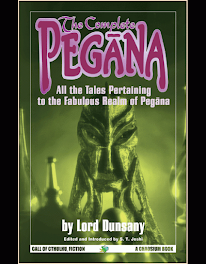
 Gods Of Pegāna by Lord Dunsany, originally published in 1905, Collected and republished by Chaosium in The Complete Pegāna, 1998.

Provenance: Back in the 90s I collected all the Call of Cthulhu Fiction line from Chaosium that I could get my hands on. They were excellent compilations of not only authors contributing to the Cthulhu Mythos but new pieces that expanded out the mythos. One of the books in the collection was The Complete Pegāna, which collects this book with a second novel by Lord Dunsany, Time and the Gods from 1906, and three additional stories from 1919. I'm just going to think about the first published book as a separate entity, and may come back to the others later.

The reason I've  suddenly had an interest in Dunsany comes from discussions with Sacnoth, better known as Dr. John Rateliff. John had written his dissertation on Lord Dunsany, and I've become fascinated by the man and his work as a result. So here goes.

Review: Lord Dunsany is one of the forgotten master of fantasy, invoked but rarely read. Edward John Moreton Drax Plunkett, 18th Baron of Dunsanywas a larger-than-life individual. Nobility, he served in three major wars and was wounded in the Easter Rising. His domain was a castle in Ireland, on the borders of the Pale, which was the English-controlled zone of the island (think of it as a big Green Zone). He ran for Parliament and went on African safaris. He was a master at chess and pistols. Were he alive today (he died in 1957), he would have starred in those Dos Equis beer commercials.

The original Gods was self-published and was well-received, and Dunsany went on to write a number of fantasies, plays, and novels, including The King of Elfland's Daughter, for which he is best -known. But he gets full marks for being one of the first fantasy world-builders with Gods. Unlike previous recordings of legends, folk tales, and faerie stories, Pegana was about the creation and evolution of a imaginary world. 

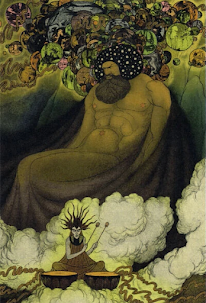
MANA-YOOD-SUSHAI
Pegana as a place was the home of the gods, an Asgardian/Olumpian place apart from the mundane world. It was made by overaarching creator god, MANA-YOOD-SUSHAI, who created the smaller gods, and then went to sleep, lulled by a godly drummer. Those lesser gods in turn created the world, the animals, and humanity. These small gods are demi-urges, creations of a greater creator, and are the one who would be worshipped. For no one worships MANA-YOOD-SUSHAI.

The stories are all incredibly short and literary. Dunsany's language is lyrical and poetic, filled with repeated language and pacing. It has the vibe of the Burton translation of the Tales from the Arabian Nights. Dunsany starts with a description of  MANA-YOOD-SUSHAI, the ultimate creator, who creates smaller gods, then goes to sleep, lulled into slumber by Skarl, his drummer. Dunsany then moves to these small gods - Demiurges who create the world and humanity, then to the extremely localized home gods that make their abode on Earth, and from them to the priests, and to the prophets, and at last to the various kings, before circling back to speak of a very quiet Ragnarok. There is not of expository material here, and much is left hanging (is Skarl the Drummer a small god or something else entirely? Is one set of home gods different from another?), but the language is excellent - it feels good to be read aloud.

Dunsany, interestingly, has a decidedly cynical attitude towards his gods, priest, and kings. His gods fear when MANA-YOOD-SUSHAI will awaken and clear the deck of people, worlds, and small gods. The Priests interpose themselves between man and god and say that only through their organization can their prayers be truly heard (and that keeping those jobs is a priority). And the kings themselves often make remove those priests that get in their way and don't say what it is expected. 

The connection with Lovecraft can be seen in the crafted cosmos with an uncaring overgod - Azathoth is surrounded by his court of demonic pipers much as MANA-YOOD-SUSHAI by his drummer. But Dunsany's smaller gods are much more aware of humanity and use them to play their godly games. The connection to Tolkien, though tempting, feels more tenuous - The professor's approach to creation seems further apart than the Dunsany/Lovecraft version, and is more deeply imbedded in the mythology that was Tolkien's preference. 

Ultimately, Dunsany is remembered as that distant uncle in fantasy's family tree. Important when mentioned, his name invoked among the founders, but otherwise left alone. And the interesting thing is that in creating the first mythos, the first collection of original gods and their stories, he laid the groundwork for the fantasists to come.  

More later, 

Tuesday, March 15, 2022

Theatre: Little Richard

Teenage Dick by Mike Lew, Directed by Malika Oyetimein, Seattle Rep through 3 April.

Lord, let me get through this one without an off-color joke. 

OK, Teenage Dick is one of those "Shakespeare Adjacent" plays you might find at the Oregon Shakespeare Festival. Not the Bard, nor even his verbiage in a new setting, but still related to the Shakespearean canon to that playgoers go in with something that feels like a reference point. 

In this case, Richard III set in a high school. 

Yeah, I know. It has been done. 10 Things I Hate About You. West Side Story.  Heck, the play itself even references Clueless, which was an updated Jane Austen's Emma, for god's sake. It is everything old is new again, filtered through high school melodrama and twitter-based technology.

Except it isn't. Yes, Richard Gloucester is a disabled young man (cerebral palsy), bullied and picked on, and has evolved a nasty attitude that mirrors that of his Shakespearean namesake. And he sets his sites on wresting the senior presidency from pretty boy jock Eddie Ivy (Edward IV), and part of his plan involves going to the big dance with the Eddie's ex-girlfriend, Anne Margaret (Anne Neville). Richard is mentored by off-kilter teacher Elizabeth York (Elizabeth of York), aided by fellow disabled frenemy Barbara Buckingham (Duke of Buckingham), and opposed by christian student Clarissa Duke (Duke of Clarence). The names are familiar, as is the starting point for the play. Here is man who feels himself scorned, who plans for vengeance, pulls out all stops to get it, and ultimately dies for it. His twisted mortal form that hides a black heart.

But. This is set in a high school and the stakes are slightly lower (and in reality more intense) than England's throne. And Richard, unlike the black-hearted villain of Shakespeare's history, actually has serious doubts about what he truly wants as he starts to break out of his self-imposed shell, such that actually, his decisions carry some weight, and we start to wonder - can the blackguard be redeemed?

But this is Shakespeare, and you know the answer to that. Much of the play is Machiavellian Chess with Teenage Richard putting his plans into motion, wallowing in his own cleverness. Then he falls for a dream he did not see coming and, once he makes his resolution, things turn very savage very fast. There is no Earl of Richmond here to carry home the point here, to make better promises for the future. The ultimate damage is self-inflicted. It is very much a tragedy.

The actors are excellent. MacGregor Arney is a transformed Richard, his twisted body turning more controlled and mannered when he turns from his fellow actors to soliloquize to the audience, selling the double-faced nature of Richard's treachery. But Rheanna Atendido is absolutely fantastic in a role (Ann) that, under Shakespeare, was merely a stepping stone for Richard's conquest.  Here playwright Lew gives her the moment she needs to drive Richard's cruelty home, and she kicks everything up several notches in the process. The Rep is pushing the play as satiric, which seems to undersell it. It takes the tropes (both Shakespeare and high school PTSD) and melds it into something stronger than either.

The original play was propaganda, of course. Richard was the last of the York rulers, and succeeded by the first of the Tudors (Richmond becomes Henry VII), of which the then-current ruler Elizabeth I was very much in present tense. So any historical play which blackened the name of the last York King would be well-received in court, and Shakespeare hangs a brace of bodies around Richard's neck. And in the centuries since, there is a lot written on how most of Shakespeare's reporting on the man was invention, or stealing from other sources that were equally skewed. Yet it is the theatrical Richard that survives in our minds, and the source which this play mines.

Teenage Dick succeeds in that it builds from a known base, and takes the discussion in a new direction. Lew internalizes Richard's own struggles even more than Shakespeare does, both broadening and deepening his emotions and reasons. Young Richard is hot garbage in a shirt, but a sympathetic villain none the less. It is a hard thing to pull off, and the play does so admirably. 

More later.


Tuesday, January 11, 2022

Book: A Sudden Case of Death

The Case of the Canterfell Codicil: The First Anty Boisjoly Mystery, by P.J.Fitzsimmons, 2020.

Provenance: A Christmas present I purchased, then entrusted to the Lovely Bride to deliver to me on the day itself (I in turn order clothes that she has specifically noted in catalogs, wrap them and return them to her - it is a system that works). The book was endlessly flogged on Facebook to me, as the Mighty Algorithm had determined my interest in mysteries of the interwar years (of course, if you read this blog, you might determine that as well), and I was curious.

And the book,  apparently self-published, cuts free of the stuff and nonsense of modern publishing process, allowing the tiller of the literary fields to deal direct with the consumer with a severe reduction of middlemen and gatekeepers. A farmer's market for literature! Huzzah the revolution!

The Review: And how was it? Not too bad, but not as strong as it was hyped. The book was oversold, promising a collision of Wodehouse, Sayers, and Christie. A high bar to be sure. The frothiness of Bertie and Jeeves, the eloquence of Peter Wimsey, and the clockwork plotting of a Miss Marples cozy, all compressed within its covers. Demanding such comparisons, however, reminds the reader the the originals, written in the era itself, are well-remembered classics for a reason. My expectations were high, and while the end result was a romp, it does not measure up, and left me a bit disappointed.

Anthony "Anty" Boisjoly (Boo-Juhlay) is residing at his club when a telegram from his old college pal summons him to Canterfell Hall, where the much-disliked Uncle Sebastian has just taken a header out of an upper-story window.  Anty arrives at  Canterfell to find a cross between Blandings Castle and a Poirot-inspired railway trip. Mysteries abound, small and large, starting with a locked room mystery and spiraling out from there.

Anty as a character falls between two chairs. He is neither the cloth-headed Bertie Wooster nor the supreme intellect Lord Peter, but exemplifies traits of both, depending on the situation. So it is hard to get a handle on him as he sometimes lumbers through some scenes, then has flashes of brilliance and glory. If you're going to ape Wodehouse (*cough* The Wyvernspur *cough*), you have to catch his ear for banter, and some of the chat falls more into the Realm of Monty Python and Blackadder than into the era itself.

Also, in presenting Wodehousian descriptions, there is a much of muchness, which makes you appreciate Plum's tact and reserve (there's a line I never expected to write). Every briar patch and weir, every doorknob and newel post, gets an achingly florid string of similes and comparisons. Sort of like being trapped in an esoteric comedy routine from the 80s.  Also, there seems to be a decided lack of synonyms for the word "thatch".  In a similar fashion the mysteries sort of pile up on each other, as EVERYONE has a secret or ten. The locked-room death of Uncle Sebastian, the nature and location of the titular codicil, the disappearing painting, the horrible dinner and excellent breakfast, they just tend to pile up over time. But yes, they all get answered, to some degree, by the end. 

Does Fitzsimmons play fair with the reader? Mostly. Some of the brain blasts that Anty gets are based on previous information that he, the character, does not share with us, the reader, until the time for the reveal (such as how an off-handed complaint from an Police Inspector tells him that a member of Parliament is lurking about). And the cause of the first death is less of a well-executed plan and more of a random roll of the dice. Yet it barrels along merrily to its resolution.

As a self-published work, the book's production values are high. The cover has that slightly tacky plasticized cover which continues to disappoint me, but I am afraid that, publishing-wise, that ship has sailed. The cover is a stylized art deco with a metro-retro font (also in the chapter headings). It coulda stood a map, to be honest, to position various rooms in the manor correctly (which Nine Tailors did), but that is a minor point.

So will it leave the major publishers quaking in their boots? Not really, but that's OK. It is a pleasant enough volume, and I would recommend it above the recent Westlake. If you approach it as a lark and paean to the previous masters, it is fine. But I would be very wary about the ad copy in the future.

More later,