Showing posts with label Rome. Show all posts

Sunday, January 21, 2024

Recent Arrivals: After the Holidays

 It's been a couple months, so let's do an update.

 While I haven't gone that far from home, I have collected up a bunch of new gaming material Some are gifts, some are Kickstarters from various sources, and some are things that I picked up from local brick and mortars. 

I had a flurry of fulfilled Kickstarters this time, as a lot of people tried to get everything shipped before the start of a new year. In addition, I'm seeing a lot of new announcements of coming Kickstarters. The entire Kickstarter process may have settled into a annual rhythm, probably because of tax requirements, for launching and delivering new projects. 

One other thing I've noticed is the lack of signatures in some of these, while others adhere to some multiple of 16 pages. Back in the day at TSR, we were pretty strict on doing printed pages in groups of 16 (the printing press would print large sheets of 8 final pages, front and back, which would be folded into a sixteen page signature). These days I'm seeing all manner of  oddly-numbered sheets. The thing is, so far as I know, the presses still run in 16-page increments, so any additional paper is paid for, then lost. But then, I've been out of the biz for years now. 

Anyway, let's see what we have this time.

Lex Arcana: Mysteries of the Empire II by Giacomo Marchi, Claudio Vergati, Bruno Gattolin, Mauro Longo, Luca Scoz, Steffan Kuppers, and Marzio Morganti, 184-page hardbound, Acheron Games, Kickstarter. I've played Lex Arcana previously, and like what they've done with the subject and the era (X-files in the Roman Empire). This volume is a collection of adventures, including an updating of the Intro adventure that we played earlier, along with a conclusion to the adventures in the core rulebook. Otherwise, it roams through the Empire, from Italy to Ireland to Malta to Syracuse to Greece. The production values are on par with their previous work, and it is nice to have a collection of adventures in my back pocket. 

The Eye of Chentoufi, The Heart of Chentoufi, and The Fate of Chentoufi, for Luke Gygax's World of Okkorim, by Luke Gygax and Matt Everhart, 40-page saddle-stitched book, 48-page saddle-stitched book, and 64- page squarebound book, Gaxx Worx Games, Kickstarter. I'm not a big believer in genetic talent, though the profession of one's parents has a definite influence on one's exposure to a particular business and its workings. So, nurture as opposed to nature. Luke Gygax is Gary's son, and I'll admit there's a little excitement is seeing what he's brought to the table. The adventures grew out of a four-hour one-shot for GaryCon XIII, and had that old-school, self-contained nature to them. It does have tech updates for the modern era - glossy paper, four-color through-out, nice maps, but has that vibe of old-school adventuring. I could run this, and may yet.

If I Were a Lich, Man, Three Jewish games by Lucian Kahn, Small Box containing 36-page saddle-stitched booklet, Deck of 44 cards, and 4 Dreidels, Hit Point Press, Kickstarter. This one is a curiosity, in that it is three Jewish themed RPG adventures involving things like Jewish Liches and vampires at a  Bat Mitsvan. The D&D lich first showed up in the original Monster Manual, storing its soul in an otherwise undefined phylactery. Fine, that trope's been done (1963's Captain Sinbad had the evil wizard keeping his heart in a gem, making him immortal). But phylactery has a wider use as a term for as a telfin of in the Jewish faith, a box worn on the body containing scripture. so that's a little problematic. Kahn, a non-binary Jewish designer, has taken used this as a springboard for one of the adventures involving Jewish liches dealing with a paladin pogrom. That's a good subject and a good exploration, but I don't know if I would run this, if only because, well, I'm not Jewish (see "Thirsty Sword Lesbians" for a similar situation) and it feels a little appropriative. But this is one of those games where I'm glad SOMEONE has done, though. Also, it has a dreidel-based resolution system, which is also cool.

Wingspan European Edition Designed by Elizabeth Hargrace, Stonemaier Games, Boxed Game, Purchased from The Wizard's Keep as a Gift for Kate, purchased from The Wizard's Keep. The original Wingspan was great, and in the tradition of successful board games, inspires expansions. This one adds a bunch of new cards to the mix and few rules tweaks. The Lovely Bride took it out for a spin on our last game day, and seemed to like the result. Want to play it myself, now.

Empire of the Ghouls, by Richard Green, with Wolfgang Baur, Jeff Lee, Chris Lockey, Kelly Pawlik, and Mike Welham, 352-page hardbound book, Kobold Press, Gift from Wolf. I've been rabbit-holing on Midgard for a little while now, and Wolf had an extra deluxe copy in his garage and passed it along to me. I really respect the depth of designer that Richard went to in this, detailing the effective Underdark of Midgard, and going into depth on the society of its ghouls. Sets up a lot of ghoul politics and factions. Nice presentation, with a lot to it. Yeah, hunt it down.

Brindlewood Bay by Jason Cordova, 168-page hardbound book, and Nephews in Peril, by over a dozen talented writers, 200-page hardbound book, The Gauntlet, Kickstarter. I've been waiting for this one for a while, but haven't had the chance to get into it with any depth. It is a "Cozy" RPG where you play little old ladies who are members of the Brindlewood Bay Mystery Book Club, who find themselves involved in solving mysteries. This is Scooby Doo with the Golden Girls, the arcane version of Murder She Wrote, and the old Ms. Marples films starring Margaret Rutherford. Oh, yeah, and there are Cthuloid cultists as well. The mechanics are descended from Powered by the Apocalypse, which means it tends to be rules-light with a lot a player/GM negotiation.. 

All Souls Lost, An Expansion to The Seas are Dreaming of my Death, By Derek Sotake with Jo Kreil 108-page squarebound book,  Derek Sotak, Kickstarter. Another continuation of a game I've played (but not run) and reviewed. I really liked the original version, and this feels a bit like one of the early supplements to the D&D little brown books - some corrections, some new inclusions, and experiments with new rules and classes (like Ship's Dogs, which I think would be a niche market on its own). Plus, we get a visit from one of William Hope Hodgson's other creations - the Great Carnecki. Fun.

Basic Roleplaying Universal Game Engine by Jason Furall and Steve Perrin, 264-page hardback book, Chaosium, Purchase from The Game Shelf. The history for the Chaosium house game system is almost as convoluted and branching at that of D&D. Originally showing up as the system for the original Runequest, it was spun off as an independent system, then as a multigenre Worlds of Wonder box, then expanded for other games like Call of Cthulhu and Pendragon, then used for a bundle of licenses (including Elfquest and Ringworld), then compiled into a master book, and so on (and I'm probably missing a couple steps). This version hews close to its original form of RPGs, and deals with the main problem of such universal systems - handling everything from fantasy to SF to super heroes. So it feels very old-school, all the more so because of the two-color interiors and thick, tan paper stock - it FEELS like a rulebook as opposed to an introduction to a new world. It keeps the Resistance table, which I have some issues with, but that takes us back to the original game as well. The stuff that makes CoC and Pendragon unique (sanity, for the former, and passions, for the latter) are relegated to truncated optional rules. Still, I'm hoping to see this used in the eventual Lords of the Middle Sea. 

Cowboy Bebop Roleplaying Game by Michele Paroli (Game Director) and Davide Milano (Game Design), 272 page hardbound book. Don't Panic Games, Kickstarter. Enjoyed the original anime (which had the best theme music this side of Jonny Quest) and much of the Netflix live action series (which I faded on, not because it wasn't good, I'm just horrible at binging shows). You play as bounty hunters in a futuristic solar system with a cool vibe. Mechanics look like they again, descend from Powered by the Apocalypse, along with the use of "clocks" from Blades in the Dark that track ability/skill/trait checks over time. Nice production values, with most of the art coming from the anime itself. Worth digging into.

Not shown (because of lack of room on the table) is a HEAP of early Pendragon Supplements from noted Tolkien scholar Sacnoth. Sacnoth has been cleaning out his library, game collection, and personal papers with the help of another colleague in the business, and the Good Doctor has been kind enough to pass along some of his material to me. I've always thought that the original Pendragon material was a landmark for handling a very specific genre (Authurian knights) in its era, and these books expand out that universe nicely. Hoping to adapt some them for the upcoming Pendragon revision.

So, yeah. a lot of stuff to work through, and notes from other Kickstarters that they are en route. And when I get another table-full, you'll see them here. 

More later, 

Sunday, February 19, 2023

Game: Imperius Lex

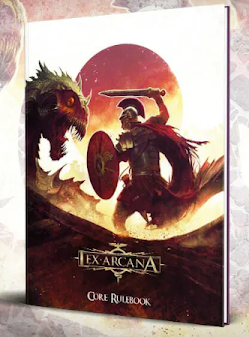
 Lex Arcana: An Empire Without End Core Rulebook by Leonardo Colovini, Dario De Toffoli, Marco Maggi, and Francesco Nepitello, 2019 Quality Games S.r.l.

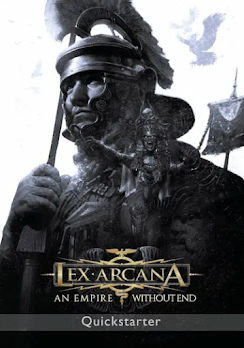
Lex Arcana:  An Empire Without End Quickstarter by Marco Maggi, and Francesco Nepitello, adventure by Giacomo Marchi, 2019 Quality Games S.r.l.

Long-time readers know that I will often talk about newly-arrived games in the Grubbstreet household. Many come in. All are flipped through. Some are read. A few are actually played. When I talk about the new arrivals I don't go into a lot of details and hesitate to call my write-ups reviews. The big reason is that games should be played, and reviewing a game based on the text alone is like reviewing a play based on its script. It can be done and done well (look at the voluminous amount of Shakespeare commentary), but doesn't get the experience of the game itself. Similarly, reviewing a live play is like reviewing a performance, where a lot of elements come into play, but I think it is more honest to take it out for a spin. 

Anyway, this is a review. I had the chance to run my regular Saturday night crew through the Quickstarter, and got a fair idea of both the mechanics and the game world. So here goes.

Lex Arcana is the X-Files in a Roman Empire that never fell. The year is 476 CE in our parlance, which was when the (Western) Roman Empire fell. In this world is is AUC (Year of the City) 1229, and Rome is still chugging along at its maximum empirical extent. This is mainly because a) there are gods, and b) there is divinatory magic that allows Rome to avoid letting things fall apart.

That doesn't mean there are no threats to the empire, and that's where the Player Characters come in. You are custodes (watchmen, guards, agents)  of the Cohors Auxilaria Arcana, which is a special detachment of the Roman Legion, recruited from across the Empire to deal with supernatural dangers. You've been touched by the gods and act as agents of Rome. You may be sent off as the result of a vision, an omen, or a report from the hinterlands, and given wide leeway in dealing with threats to the Empire. 

You have Abilities (Called Virtutes) and Skills (called Peritiea) Ah, that's another thing. Everything is named in Latinate terms, which helps in getting the proper feeling but can create havoc in play. The good news is that most of  skills and abilities make sense to a non-Italian speaker - your coordination ability is Coordinatio, your combat skill is de Bello.  The bad news is they truly need a Pronunciation Guide for the poor semi-literate English-speakers. My dog-latin would make a hound howl, and I am afraid I risked one of Jove's Thunderbolts mangling the language. The game master, by the way, is called a Demiurge. 

Anyway, you have "Dice Points" in your Abilities and Skills, and this is interesting. You can roll any type of dice (d2, d3, d4, d6, d8,etc...) for an ability test up to the maximum number on that dice. So with a Coordinatio of 12, you can roll a d12, or 3d4, or 2d6, or a d10 plus a d2. It is an interesting mechanism. Adding to that is that the dice "explode" (like in Spelljammer's smoke powder rules) - if you get a maximum on your dice (all three d4s come up 4), you roll again and add that to your total. Which sometimes is overkill, since you will likely have made the Difficulty Threshold already. 

Results also come in degrees of success - You can increase damage or get more information if you beat the Difficulty Threshold by a sufficient number. For every three points you get an additional success. In combat, both sides roll their de Bello, and then high score wins damaging the loser (tying rolls do nothing - you are clanging swords at each other). Degrees of success can multiply the damage. Shields can affect whether damage is done, and armor reduces the damage itself.

One nasty bit is that multiple attackers on the same target add their rolls over a single round (tempo). The first attacker makes his de Bello, then that result is added to the next attacker's score and so on. So a mob can really overwhelm a solitary defender (One of the group was hit hard by a number of giggling child-demons and almost got wiped out).

In play, all of the above works out pretty well. As Demiurge, I unleashed this on my regular Saturday night group - 3 or 4 players, which was a nice number, and used the Quickstarter adventure. The Quickstarter has all the basics from the Core Rules, and adds a few wrinkles, like offering a wild card deck of things the player can do to either speed or hinder the plot (Sortes). So here be some spoilers in this discussion, but I will try to make it light.

The group was sent by their local magister into long-conquered Gaul to check out a vision he had. They find a bandit lord who seems to be a lot more charismatic than he has any right to be. He is supposedly a "new Vercingetorix" (yeah, I tripped over that name, though I know it from Asterix et Obelix comics), who was the last great Gaulish chief. In tracking the Bandit Lord to his lair, they discover that the Celtic gods themselves are restless and seeking to mount their own resurrections and rebellion.

And the adventure moved pretty smoothly, with a good combination of action and interaction. There are a lot of random tables for the Celtic gods bedeviling the player characters, and not all of them immediately visible, so I chose results as opposed to rolled them. The story line does have a false branch, in that the heroes can explore the west or the east of the main city(my group, of course, investigated both, setting off ALL the encounters in the process). Regardless of choice, you eventually discover an outpost of the Bandits (same encounter regardless) which in turn leads you to their secret base and potentially a big battle scene (which runs pretty well for such a large number of combatants - my team forced them back into their keep and laid siege, forcing the Bandit Lord's surrender, much like Vercingetorix did). Unfortunately, the way the adventure is written, there is a very small chance the player characters find out WHAT was really going on - why this schmoe got the favor of his gods in the first place.

But all in all, it was a pretty good setup (we're a bit leisurely in our play, so we wrapped it up in about four or five nights). It gave some good challenges for a low-level group. There was a good mix of the prosaic and the fantastic. We had to walk through the combat carefully at first, but it came together naturally. 

The game has elements of traditional (D&D) style RPGs - the call and respond nature, the game master, the use of polyhedrals, to be comfortable, but enough new material (combat system, sortes) to challenge established players. The setting has great potential (I have a number of additional sourcebooks), and gives the players a strong direction of what they need to do (your boss had a bad dream - go check it out). In the Quickstarter, the differences between the classes is a matter of dice points you have, but that expands out in the core ruleset.

Final summary? Worth playing, and worth playing again. A good time was had by all. Just wish I had taken more ranks in dog-latin.

More later.


Monday, March 01, 2021

Plague Books: Rome on the Range

 SPQR: A History of Ancient Rome by Mary Beard, Livewright Publishing, A division of W.W. Norton & Company, 2015

Provenance: This has been my doorstop book for several years now. Bought it at Half-Price up in Redmond on a whim because the author had been publicly quoted somewhere as expert on the subject (she is). I started it, stopped it, started it again, let it occupy my shelf of abandoned books, read it along with ANOTHER book on Rome, finished the other book, abandoned this book again, actually WENT to Italy, picked up this book again, and finished it a year after that. So it has been a long journey. So I have thoughts.

Review: Hey, let's summarize a thousand years of history in a single volume. Yeah, that will be easy! We're talking about the history of Rome from about 753 BC to 212 AD, a point where citizenship is extended to all free inhabitants of the Empire.

What is SPQR? It stands for Senātus Populusque Rōmānus - the Senate and People of Rome. Which is interesting because one of the things about Rome's expansion is that it continued to expand the definition of "People of Rome" throughout its history. As it conquered and absorbed its neighbors, it incorporated them within their political systems. Historically, this was not always the way. The Vikings in Ireland and Russia ruled but didn't have a significant cultural impact on the ruled. The European Powers in America or the ancient Greek colonies in the Med were very much about moving large amounts of their own population in. The Romans swallowed other nations and peoples whole, and eventually elevated them to powers within their own spheres. Not quite equality - the folk in charge were an oligarchy, but even that oligarchy expanded over time. And the people who were already citizens were often against further enfranchisement. But it is an interesting version of colonialism.

Rome's Republic in part fell apart, in part, because of their own success. The Roman plan of absorbing other peoples into their nation "Hey, you're now Roman! And your gods? They're just different versions of our gods! Expansion brought in huge groups, who then had to be mostly managed, both at home and abroad. The advancing legions had to be paid, often with retirement land in the new territories (which was not always appreciated by the original inhabitants). And keeping the mobs happy in Rome? Yeah, that put grain-producing Egypt as the equivalent of Middle-Eastern oil in the geopolitical consideration.  

The distance of time gives us difficulty with original sources when talking about the Roman Republic. Beard opens with Cicero, once a staple in "Western Education", about halfway through the Roman Millennium (63 BCE). Why is Cicero still important to us moderns? Because he was a first-person account (though obviously biased) of the life and times towards the end of the Republic. And we have a lot of his words because he published his speeches, so that copies of the copies of his words have survived down to this day. Other than writers like him, we are pretty much confined to stone as information source - carvings, inscriptions, and the occasional graffiti. Sort of like trying to sort out the American Civil War only through gravestones - doable, but you know it is not the full story.

Even by Cicero's time, Rome has a bunch of conflicting origin stories. The mythical approach stars Romulus and Remus, a Cain and Abel story with a wolf-mother. But there is also Aeneas,who tied the Roman people to the Trojans at a time when they loomed large over the Greeks. There is a semi-historical record of the "Twelve Kings", the bad-old-times before the Republic took hold. And there's the archaeological record, who indicates that the area was originally dominated by the Etruscans,a once-successful and now-mostly-forgotten predecessor nation.

The Romans had an empire before they had a emperor. They did most of their expansion before they hit Julius Caesar and his lot. What Beard makes clear is that while the Romans professed a hatred of monarchs, its Republic was a rough affair, with powerful individuals commanding mobs (and later armies) to influence governance. One particular incident in 133 BCE involved a mob led by a faction of the Roman Priests which attacked a group delivering the votes for the tribunes and killed reformer Tiberius Gracchus with a table leg (not that we moderns would do anything that barbaric). 

The fall of the Republic was a relatively slow, bumpy process. Powerful oligarchs sought more individual power. Power came to reside within different factions of the army, which were then turned against each other. Attempts to consolidate power in the hands of a few trinities collapsed, and out of the continual conflict, a single strong figure emerged who would bring stability. Julius never claimed to be emperor, but quietly sucked up positions of power such that his successor Augustus moved in easily.

But even during the emperors our history is slanted. "Good" emperors were often simply followed by those with personal connections that wanted to declare their predecessors good, while "Bad" emperors were followed by rulers wanting to put some distance between themselves and previous administrations. But when looking at the health of the Empire as a whole, things ran on fairly well regardless of who was in charge. Until it didn't.

Large, engaging, accessible, and readable, SPQR sent me down some passageways and thought processes that I had not considered previously, some obvious and some more refined. SPQR is a great overview of a Rome that neither was built or was destroyed in a day, but rather evolved from one state to another, often as a result of its own growing power, until at last the ability to hold that power crumbled.

More later,