Thursday, November 10, 2022

The Political Desk: Summing Up

So, how did things go?

For Washington State, surprisingly well. The Red Wave/Tide/Tsunami that the media was intoning about failed to materialize to a great degree. The Republicans made some advances on the national scale, which is to be expected in an off-year election, but in Washington State they hit a wall, and actually lost ground. The best news is that it looks like the Election Denier wing of the GOP took the worst hits, and will hopefully be replaced with more reasonable candidates in the future.

Election denial has struck me as a tough sell as far as an election campaign - "These elections are bogus! It's all a fraud! Please vote for me anyway!".

And in a land where a three-percentage point margin is usually considered a landslide and a mandate to govern, a lot of the candidates and measures not only beat the spread, but did so in handy numbers.

In any event, the numbers quoted are as of Thursday night, but it looks like most of them will hold as the late results come in (which tend to trend more liberal in any event). There is only one measure that is "hanging fire" right now, and ironically, it is one about how to vote. 

So. How did things go?

Advisory Vote No. 39 Engrossed Substitute Senate Bill 5974 and Advisory Vote No. 40 Engrossed Substitute House Bill 2076 - Both REPEALED  (by 59%-40% in one, 53-47 in the other). These are Advisory Votes and have no bearing on the bills as passed other than saying we are disappointed in you for doing so. I really think we need to either give these things some teeth, or get them off the ballot entirely.

Charter Amendment No. 1 Even-Numbered Election Years for Certain County Offices - YES, by overwhelming numbers (69-31). As a game designer, I will attempt to run for office/launch an initiative in odd-numbered years, but then I'm just going to cheese the system.  

Proposition No. 1 Conservation Futures Levy - overwhelmingly Approved (68-31), which is nice.

United States Senator - Patty Murray wins handily (57-43). Man, there was a media kerfuffle about how close this was going to be. Turns out that running against King County (where a third of the state's voters live) was not a winning strategy. Go figure.

United States Representative Congressional District No. 9 - Adam Smith (71-29). This was an honest-to-gosh wipe-out, and I've seen nothing in the press about the depth of this wipe-out. 

Secretary of State - Steve Hobbs (49.7-46.7 with 3.6% write-ins). This would have been much closer if not for write-in campaign by the organized GOP in the state, which bled off enough votes to really make a difference. Now the organized state GOP is blaming the media for actually POINTING OUT that the GOP was running their own candidate. Though really, this is a good argument for Ranked Choice Voting and Approval Voting, as it turns out.

Legislative District No. 11 Representative Position 1 - David Hackney (69-31)

Legislative District No. 11 Representative Position 2 - Steve Bergquist  (68-32)

King County Prosecuting Attorney - Leesa Manion (56-44). Oddly, I missed this race in the summary, but I will catch up here.

And on the Stuff I'm Not Voting on(TM)? 

Changing up how Seattle votes for particular offices is actually one of those where the votes are close, and the winner may change after all the votes are counted. Right now, enacting the change is losing by a thin margin (49-51), but may catch up in further voting. BUT if they do change, RCV is smoking the more easily understood Approval Voting (75-25).

And up in the 8th US House race, Kim Schrier is winning handily (52-47) over her Extremist GOP opponent, in a race that everyone said was also going to be a nail-biter. While down in the 11th US House, I am delighted to note that Marie Glusenkamp Perez has shown the election-denying MAGA candidate the door (also 52-47). Yeah, the 11th is considered a conservative district, but it looks like voters will be actually be willing to wait for a reasonable conservative.

And in the 47th State Rep (which includes much of Kent), Claudia Kaufmann is doing well (43-47). Her opposition gave me a robo-call late election day (note: I cannot vote in that race, so next time, just send me the money you would normally spend on such nonsense), where he did himself no favors by endorsing the Republican Senatorial candidate.

And I will note that the same media that embraced the whole "Red Wave" thing are now embracing the "Trump is gornisht, the GOP is in disarray" meme. These were the same outlets that said the Seahawks would be lucky to win three games this year. So yeah, I'm not buying that, either.

And with that, The Political Desk slouches off to the bar to have a few drinks and a good lie-down. See you next election.

More later, 


Wednesday, November 09, 2022

D&D: Relatively Speaking

 It's going to be a little while before all the dust settles and the votes are counted, so The Political Desk is on hold for the moment. In the meantime, I've been going through my LBBs (Little Brown Books for D&D) and thinking about how we played back in the old days (#BackInMyDay, #TrulyOldSchool, #OGDnD, #GetOffMyLawn). And here's a favorite section from the original Men & Magic booklet (Page 13).

Relatives: The referee may allow players to designate one relative of this character to inherit his possessions if for any reason the participant unexpected disappears, with or without "death" being positively established, for a period of one game month, let us say. At this time the relative would inherit the estate of the character, paying a 10% tax on all goods and monies. The relative must start at the lowest level of the class he opts for, but will have the advantage of the inheritance.

    If the character returns, he takes possession of his estate once more (referee's option as to willingness of the relative to give it up) but must pay an additional 10% tax in order to regain his own. Optionally the relative may be allowed to stay on as a non-player character in the service of the player-character. Loyalty of the relative in such circumstance would be at a penalty of from 0 to -6, and he would possibly intrigue to regain control.

    Characters with a relative will lose all their possessions should they disappear and not return before whatever period is designated at establishing death.

Note that at this early stage of the game, the DM is referred to as a "referee". Also note that "taxes" are a part of the game from the start. Also, given the amount of precise legalese in the entry, you KNOW that this had to be the result of a particular situation encountered in a game. 

Just thought it was amusing. More later,


Monday, November 07, 2022

Life in the Time of the Virus: Update

Railroad Train, Edward Hopper - 1908
 At the time of this writing, about 350 people per day are dying of coronavirus. For those morbidly keeping score at home, we lose 251 people/day to drug overdoses, 118/day to car accidents, and 123/day to firearms. So the pandemic keeps inching closer to daily life as "just one more thing" that can kill you around here.

One of the results of this is that Washington State and Seattle are ending the emergency. Which is sort of like an old Doonesbury cartoon where they ended the energy crisis because everyone was used to it by now, so it could hardly be a crisis, eh? We will continue to see hospitalizations and deaths, but they will be at a more manageable level as far as the institutional structure is concerned.

Most of those who are worst affected are, unsurprisingly, those who have eschewed shots in the first place. But a lot of friends and colleague, including the vaccinated, have come down with it and their symptoms have varied from mild and irritating to miserable and lingering. So even with proper vaccines, it remains dangerous.

On a local level, the Lovely Bride got her bivalent shot and seems to have emerged unscathed. I was grumping around for a day or so, but in my case, I triple-shotted a flu shot, COVID shot, and pneumonia shot in one go, which was probably a bad idea. Still, both the LB and I have dodged the viral bullet so far (touch wood).

Masks are still a thing, but in a much more limited sense. Theaters, medical offices, and tai chi are the only places that they seem mandatory. I haven't had to show my vac card for the past six months. so my freedoms have pretty much been intact. It is at most a very limited oppression. I still wear a mask when shopping. though I am in the minority these days. I am fortunate in that masks really don't bother me much (I have a bin of them by the door), and I seem to be able to communicate without too much difficulty (I have very expressive eyebrows).

On the horizon, there seems to be some new wave of variants coming out of Europe, which there has been a limited amount of information. And the flu season is hitting. AND there is a new RSV (Respiratory Syndrome Virus, similar to the common cold) going around. And Monkey Pox. So yeah, I'm still comfortable with a mask.

More later,

Sunday, November 06, 2022

The Political Desk: Bonus Round: Stuff I'm Not Voting On

Why yeah, I'm going to nag you about voting. I expect that most of the readers of this blog (both of them), have already voted, but if not, get out there and vote, and encourage others to do so.

There is stuff I can't vote on around here, primarily because I am not in particular district or community that has those elections. So this a lot of this is distant thunder, and may affect me (and you) eventually.

The big one is a two-part vote up in Seattle that monkeys with how they vote. The current system is that whoever gets the most votes wins. Pretty straightforward, but as the Primaries show, it is a bit of a pain with multiple candidates, and tends to be dominated by the major parties. So the first question is do you want to change the system?

If you do, the next question, do you want the beef  or the fish? I mean, do you want Approval Voting (AV) or Ranked Choice Voting (RCV). Here's the diff:

Approval Voting says you can vote for as many candidates for any office as you want. You like all four Democrats? Vote for 'em. Don't like the incumbent? Vote for everyone except that one person. All the votes have the same weight, so the candidates with the most votes win. Approval Voting has been playtested in a couple locations, though not extensively.

Ranked Choice Voting says you do that, but list them in order. You like the hot educated young professional but will settle for the incumbent but don't care for the climate-denier? Rank them 1, 2, and 3. when the votes are counted, the low guy gets thrown out and the ballots for them look at the second choice and toss those votes onto the higher-ranked candidate. Continue the process until you get to the winner. So if you don't get your first choice, you at least have a shot at getting a decent candidate. RCV has shown up in a number of places, including Alaska, New York City, and the Hugo awards, and has been pretty effective.

Both versions reduce the binary nature of campaigns and removes situations where multiple candidates running who have a particular viewpoint results in that viewpoint getting frozen out. It will likely push voting towards the middle as opposed to opposition camps. It can weaken the power of political parties and promote more independent candidates. That's all good. But it they are admittedly more complicated (knowing how difficult it is to get people to fill in ONE little oval on the ballot). They are intended to be for Seattle's Attorney, Mayor, and City Council, so there will be "hybrid ballots" with two different types of voting on them. And this is proposed for the primaries, which are still "top two". In fact, this type of voting can negate the need for primaries at all (though you'll end up with Goodspaceguy being considered for the general election).

Here's the thing I really want to do. The Secretary of State should call on a brain trust of game designers (hey, he knows a few) and turn them loose on the system with the question "How do we cheese this system?" If anyone knows how to milk exploits out of a set of rules, it will be game designers. Let's run a development cycle or three.

But then, that's not on my ballot. If it were, I'd say No, then swing over to RCV if forced to make a choice. And get rid of primaries entirely, but that's not on the ballot this time.

There are also races that are actually kinda tight, but because of the way they draw boundaries around here, I can't vote in them, either. A few blocks away is Legislative District 11th, a redrawn district that was once traditionally GOP, but last election went Democrat, so they redrew the boundaries to put more red and rural voters into it. Kim Schrier is the incumbent who has done well in her rookie season. Her opponent is Matt Larkin, who definitely on the whackadoodle train - he's just now getting around to saying "Yeah, Biden won" effectively gaslighting his own supporters. Both sides are running attack ads on the tube, the difference being while Larkin's are all about how scary Schrier is (Ominous music, grainy photos, yellow police tape), while ads against Larkin tend to just use voice clips from Larkin's speeches about how this is no time for moderation. So, yeah, there is a difference.

But Larkin's the not the worst GOP Candidate in Washington State. That away goes way to the south, far outside this blog's throw weight. Joe Kent is a newly-arrived carpetbagger looking for an easy grift in a conservative area around Vancouver, Washington. He's got Trump showing up to support him, and ticks all the MAGA boxes. Most recently, the Seattle Times notes that Joe Kent wants to go after those really responsible for Jan. 6 - the FBI. Because attacking the capitol building was a sting operation. So yeah, support his opponent - Marie Glusenkamp Perez. Southern Washington is "Let's Go Brandon" territory, but there are enough sane GOP supporters down there that the race is tight.

Finally, MOST of the city of Kent (but not this household) is in the 47th state legislative district, and actually has a race between two competent, reasonable candidates. Bill Boyce and Claudia Kauffman both come out of the Kent City Council, and have proved to reasonable and responsible grown-ups. This is a choice between two good candidates. I favor Claudia Kauffman because of her positions, it is one of those races where I feel the political responsibility is in safe hands. And I want to point out that there ARE sane Republicans out there. But I still don't like their positions.

In the meantime, if you are in Washington State, or any state that allows early voting. Go Vote, and encourage others to do so as well. 'Cause you have some real loons out there.

More later, 

Sunday, October 30, 2022

Book: Breath of Fresh Air.

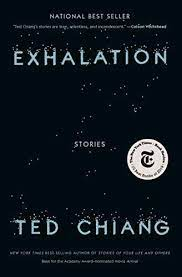
 Exhalation by Ted Chiang, Vintage Books, 2019

Provenance: Elliot Bay Bookstore, which was originally down in Pioneer Square but has moved up to Capitol Hill to occupy part of the old Oddfellows Hall. I was up there to meet a former colleague for dinner, and wanted to stop in and get a different book (which is a different story). 

Review: I was (very briefly) in a writer's group with Ted Chiang. Ted is one of those writers who publishes maybe one story a year, and that story in then nominated or wins various Hugos, Nebulas, and Locus awards. He's really that good. A short story from his previous collection, Stories of Your Life and Others was made into the movie Awakening.

This volume is a collection of tales from since that earlier volume, and is just as fantastic. He creates realistic alien worlds, and then plays within them - The title story involves a robotic race, where the narrator literally trepans himself in order to understand memory. In "Omphalos", he posits a universe where Young Earth Theory is backed up by the facts and evidence."The Truth of Fact, the Truth of Feeling" extends the always-recording lifestyles into creating a perfect history of what really happened. Each is a self-contained world that feels totally reasonable.

Chiang's stories also talk about free will, and the absence of it in a deterministic universe, a lot. in "The Merchant and the Alchemist's Gate" we deal with time travel in a deterministic universe, where the past cannot change because of what has happened, but those that travel into the past have their own reasons for not changing it. In "What's Expected of Us" he introduces a simple device that proves the future is deterministic and unchangeable, that Free Will is an illusion, and what happens to society when that is proved. And in "Anxiety is the Dizziness of Freedom" he posits the idea of a branching multiverse that still puts the question of free will to the test by allowing access between the various branches (quick answer - capitalism and a lot of therapy).

The most frightening story does not involve a robot operating on his own brain in realtime, but "The Lifecycle of Software Objects" that deals with living and thinking digital intelligence and corporate thinking. The meeting of those two I found chilling when I first read it years ago, and it still frightens me to some degree.

Chiang's worlds are deterministic, and he will not bend the rules for the sake of character and story. There are few full happy endings, because the universe doesn't play that way. At best, there is understanding and acceptance for what is to come.

It's a great collection, and if you haven't discovered Ted Chiang, here's your chance. 

More later,


Wednesday, October 26, 2022

The Political Desk - The Jeff Recommends.

OK, we have the ballot before us, looking all the world like one of those standardized tests from Junior High. We fight the panic attack from filling in little dots, and marvel all those unopposed Judge positions. What do we have?

Advisory Vote No. 39 Engrossed Substitute Senate Bill 5974 - Maintained, with the standard kvetches. 

Advisory Vote No. 40 Engrossed Substitute House Bill 2076 - Maintained.

Charter Amendment No. 1 Even-Numbered Election Years for Certain County Offices - No, but you be you.

Proposition No. 1 Conservation Futures Levy - Approved

United States Senator - Patty Murray

United States Representative Congressional District No. 9 - Adam Smith

Secretary of State - Steve Hobbs

Legislative District No,. 11 Representative Position 1 - David Hackney

Legislative District No,. 11 Representative Position 2 - Steve Bergquist

So, get your ballots in by 8 November. There are drop boxes all over, and you can mail it without a stamp if you have it postmarked by 8 November. You can also register to vote up to election day as well. And yeah, we'll be nagging you as we go along. Now we return you to your regularly scheduled book, game, and play reviews. 

More later,

Tuesday, October 25, 2022

The Political Desk - County Position

 The sole position to be filled at the county level is for Prosecuting Attorney. Gee, there would be more talk about if only we moved other county elections to even-numbered years (yeah, that's sarcasm).

The good news it that we're looking at two solid candidates with good experience and different approaches to crime. Jim Ferrell is a former prosecutor and Mayor of Federal Way who favors more law-and-order and incarceration for repeat offenders, and has endorsements from most police unions. Leesa Manion has spent the past 15 years as Chief of Staff for Dan Satterberg, the current King County Prosecutor, favors diversion and mitigation as opposed to incarceration, and has a pack of Democratic party endorsements. Both are serious on crime, just take very different approaches. I'm going to recommend Leesa Manion for the position. But again, we're looking at two impressive resumes here.

And.... that's it for the county level. Since I have the space, here are some anagrams for "Political Desk":

  • Politick Sal
  • Pickle Altoids
  • Politic Daleks
  • Licked Topsail
  • Ellipsoid Tack
  • Dali Stockpile
  • Despotic Kali
  • Callisto Piked
  • Aldi Elk Optics

OK, I'm done. More later,

The Political Desk - State Offices

For the state offices, there is one biggie, along with two good incumbents for our legislature.

 Secretary of State. This position is in charge of our Elections, which has been doing a pretty damned fine job for the past few decades. One big reason for this was Republican Kim Wyman, who left to take a job with the Biden Administration. Gov. Inslee appointed Steve Hobbs to the position to fill out her term (There will be another election in 2024), and he's done well continuing Wyman's professionalism and expanding on it. His opponent is Julie Anderson, who is running as a non-partisan and packs solid experience as Pierce County Auditor. 

This is one of those situations where both candidates are good choices. I support Steve Hobbs for a very personal reason - he's a gamer. He plays TTRPGs, and when he was in the State House, not only supported the small independent game companies in the state, but also hosted sessions to teach other Representatives about role-playing games. I have always said that most of our laws need a good play-test session and development cycle before being enacted, and having someone in charge who knows that is a bonus.

The campaign has been incredibly polite and professional so far, and that is to both candidate's credit. Naturally, it cannot last. The official Republicans, who were shut out in the primary have rallied and chosen Brad Klippert, an "election-skeptic" who lost out in the primary, as a write-in candidate. Write-in candidates are a tough go, mainly because getting the word out is a challenge, and the only promotion I have seen so far has been news reports saying that it is a thing. The end result will likely be that Klippert drains off the not-a-Democrat vote from Anderson, and that Hobbs will take it with a plurality, not a majority.

Down-ballot, Legislative District 11 JUST nicks the corner of Kent that Grubb Street occupies. We have two good incumbents who are rounding out their rookie season with accomplishments, and deserve to keep their jobs. 

Legislative District No,. 11 Representative Position 1 David Hackney has been strong on climate and conservation, and deserves to be returned to office.

Legislative District No,. 11 Representative Position 2. High school teacher Steve Bergquist ran on education issues and has delivered as well. Yeah, let's keep him as well.

That it it for the State level.  Then we bounce back down to the County level for one position. More later, 

Monday, October 24, 2022

The Political Desk - King County Measures

 And the next course is .... More Broccoli! But its a tastier version, smothered in cheese.

Charter Amendment No. 1 Even-Numbered Election Years for Certain County Offices. This amendment to the King County Charter will move elections for King County Executive, Director of Elections, and King County Council members to even number numbered years. Here's the logic - More people vote in even-year elections that in odd-year elections, because there are usually more big-ticket items on the ballot, like Senators, US Reps, and the occasional President. Moving the election of these offices to those years will increase the number of voters, which would is generally thought of as a good thing. Which is basically true.

The Times likes this. The Stranger likes it. I am less sanguine about it.

Here's my thinking. Even though moving to even-year elections would make my job here a tad bit easier, and reduce the guilt of people who don't vote anyway, yearly elections are incremental in nature. That is to say, you are not locked in across the board until the next major election cycle. It also creates a lot of sudden change in  red-tide or blue-tide elections, where everyone (or at least a good chunk) on one side shows up. Finally, it increases the chances of those tidal elections in cases where the candidate at the highest position is so odious, the coat-tails drag everyone else down. I think it makes our voting system more vulnerable. AND those elections that are still in odd years will get even LESS attention. So I'm surprisingly a NO on this. 

I know, I'm one of these crazy mad-scientist-ranked-choice-voting guys, and I'm still unsure about this one. On the other hand:

Proposition No. 1 Conservation Futures Levy, on the other hand, raises funds for urban green spaces and salmon habitats. Hate taxes, but love green space. So I'm with Approved on this one.

More later,  

The Political Desk - Federal Offices

 Now we get to the meat of the situation - the headliners, the main events, the big kahunas. The Federal offices.

United States Senator. Patty Murray has been a strong voice in the Senate for the people in general and the people of Washington State in particular. The Stranger stans her pro-choice stands. The Times compares her to their political heroes Scoop Jackson and Warren Magnuson, She has done a lot in her 30 years, and deserves six more. Her opposition has been bog-standard modern Republican - no political office background, has purged her site of anti-choice language and election denialism, and is coy about her current opinions on those matter. Her campaign has the traditional Republican themes of fear and loathing, and she is running against Seattle, the local media, and coffee shops that are not Starbucks. So yeah, re-elect Patty Murray.

United States Representative Congressional District No. 9 . Like Patty Murray, Adam Smith has been around for a while. He's a member of both progressive and moderate caucuses, and he leans left on domestic matters. As the head of the Armed Services Committee (which is always referred to in print as the powerful Armed Services Committee), he's actually an old-school conservative, in that he wants to get his money's worth when we purchase new weapon systems. On merit alone, he deserves re-election. The Wiley Coyote to his Roadrunner in Doug Basler, talk-show host and Chamber of Commerce chairman who is on his fourth run for the position. So, Adam Smith (and I will put away my Invisible Hand jokes for now).

There are other, closer races, but they aren't on my ballot. Maybe that'll be another entry.

More later,


Sunday, October 23, 2022

The Political Desk - Advisory Votes

 And the current feast of political choice starts out with an amuse-bouche ... broccoli!

Long-time readers know my opinions about Advisory Votes. The product of a semi-failed initiative which requires the state to ask about anything that even hints at an increase of revenue, but does not require them to do anything about it. The scare-language of the proposals makes it little more than a push-poll that lets people who hate taxes vent. So it's the therapy section of the ballot.

That said, it is nice to see a bit of transparency in our state legislature, so there's that. You really want to know what they're up to. We just need to find a better way to do it other than leading the ballot with this lead block of a vote.

Advisory Vote No. 39 Engrossed Substitute Senate Bill 5974 will increase the tax on aircraft fuel from 11 to 18 cents.  Will that cost get passed onto consumers? Probably. But then I have never known any business to drop prices as a result of getting a tax break, a subsidy, or a rate freeze. Vote Maintained. 

Advisory Vote No. 40 Engrossed Substitute House Bill 2076 will put premiums on ride-share operations to provide worker's comp to their gig employees. The ride-sharing companies are good with this. The unions are good with this. Oh yeah, I'm good with this. Vote Maintained.

And that's it - less than usual, but the fact that this sort of thing headlines the ballot may explain why a lot of people don't want to deal voting at all.

More later,

Saturday, October 22, 2022

The Political Desk Returns!

<Cracks knuckles> OK, let's do this.

The ballots have shown up here at Grubb Street for the upcoming general elections in Washington State, and you're going to have to endure a bunch of relatively short recommendations for the next week. Hey, it's a tradition by now.

Let me start off by sending you in the direction OTHER people's recommendations and endorsements. The Seattle Times tends to be pro-business and centerish, and has been piling up their endorsements over time. The Stranger is leftish, hates cars, loves density, and is actually reported on races south of SODO this time, which is nice. Interestingly enough, these two major media outlets have been agreeing on a lot of candidates. Go figure.

There are currently 11 judgeships up on my ballot - State Supreme Court, Court of Appeals, and District Court. All of the candidates in these races are running unopposed. I don't know if that's because we are cool with the idea of checking in the judges every so often and then just renewing their contracts, or we just don't have anyone interested in running against them. In any event, Grubb Street does not endorse in single-candidate elections, other than congratulating to those who get another term. If you happen to have multiple candidates on YOUR ballot, Voting For Judges is a good source of info, though they are still adding to their database at this late date..

Surprisingly, there are no referendums or initiatives on the ballot this year. Further There are also no local offices this time out for my locality. That's cool. I appreciate the break.

Where do we stand here at Grubb Street? We lean politely left. We even verge on our good days towards positively progressive. As such, we will not be consciously endorsing any Republicans this cycle. Now, not all Republicans are the current whackadoodles that show up on FOX and right-wing radio, denying elections, vaccines, and rights for other human beings. But those of the GOP that are not in this broad category don't have any problem support the ones who are. The saying is that Democrats have to fall in love, Republicans have to fall in line. 

Looking at the rest of the local media blogroll,  Crosscut put together a nice overview, the Urbanist talks about a smattering of race related to their city management viewpoint, and the West Seattle Blog talks about the proposed changes to Seattle voting procedures. Progressives are here. Conservation voters are here.  I'll update this entry to keep you in the loop should others chime in.

And, of course, here is the Voters' Guide, in case one hasn't shown up in your mailbox.

 As always, I encourage people to be informed voters - check sources and make the best decision. You may not agree with me, but that's cool. That's why I am not God-King of Cascadia. Yet.

But avoid the whackadoodles. Seriously.

More later, 

Friday, October 21, 2022

Book: Through A Lass, Darkly

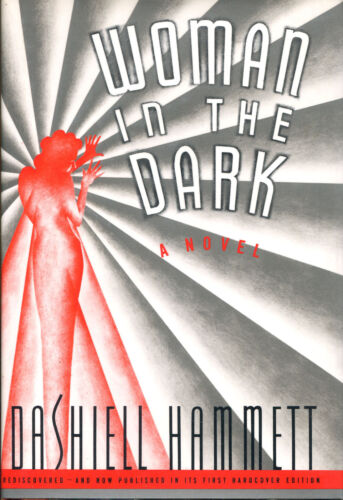
 Woman In The Dark by Dashiell Hammett: A Novel of Dangerous Romance, Originally published 1933, Alfred A Knopf. 1988.

Provenance: Purchase from the Tacoma Book Center. The Book Center is a small bunkerlike building in the shadow of the Tacoma Dome. However, it is a TARDIS, in that once you enter, you find walls upon walls of books, concealed levels and hidden back rooms that seem to go on for much longer than the building itself. The shelves are high, overstuffed, and extremely well-organized. Eventually, once the light rail from Seattle gets down there, the neighborhood will be upgraded to the point that a bookstore like this would no longer be able to afford its space, and it will become a Chipotle or something, but in the meantime, it is a place that I go to find stuff I cannot find elsewhere.

Review: This book is very slight. To call it a novel is to seriously round up, as it was originally a three-part short story published in Liberty magazine in 1933. Tack on an intro by mystery writer Robert B Parker that ties it into Hammett's relationship with Lillian Hellman, bump up the spacing, give it wide margins and a header bar, and ... it's still a very slight book.

The story itself is Hammett distilled down to its basics. It almost feels like a script treatment padded out to a magazine submission. It is seriously a three-act structure. Chase the hero up the tree. Throw rocks at him. Get him down. Brazil, our hero, is in his cottage with his girlfriend when a babe in a tattered dress stumbles in, followed by her politically powerful boyfriend and one of his goons. Fight breaks out, the goons is injured, maybe fatally. Girl and Brazil go on the run because he can't go back to prison, but the powerful guy's people catch up with them. Brazil takes a bullet, looks like the bad guys win, and then we rally and get a rapid (one-page), last-minute denouement. 

It's Hammett at the core - Brazil is a tough former con who has his own code but sticks his neck out for nobody. The babe is the powerful guy's mistress on the run, doing what she must to survive. The cops are corrupt, the little people helpful criminals. The powerful guy? Psychotic but with pull. The writing? Punchy. It could have been a movie in 1933. 

It's lesser Hammett, but still Hammett. Probably exists in some collection of shorts as opposed to a single hardback. A good read, but nothing to go out your way for. Nice a discovery in a used bookstore that is bigger than it seems to be, and that's it.

More later, 

Monday, October 17, 2022

Book: Last Dragon, First Wizard

Slaying the Dragon: A Secret History of Dungeons & Dragons by Ben Riggs, St. Martin's Press, 2022

Provenance: Birthday present, 2022. Read while at the Alderbrook Resort.

Review: This one is going to be a little weird for me. When I reviewed the authoritative works of Jon Peterson on early RPGs - here, here, and here, I could safely dodge out the side door by noting that his history ended before I really showed up on the scene. At best I am that guest-star that shows up in the second mid-credit scene after a Marvel movie. 

Not so here. I am definitely in this book. I was a source for Ben, and continue to be for some of his articles. Some of the stories in this book are mine. I stand behind what I said. They are the "truth" as in "Yep, I said this, mostly."

Those previous histories are origin stories - they start with the Castle & Crusade society and Gary's basement and the Horticulture Hall in Lake Geneva. and move up along the timeline to Gary losing control of the company to Lorraine Williams. Riggs covers that territory to give a base-line, but deals primarily with the Williams years - 1985 through 1997, when she in turn sold the company (through a roundabout manner) to Peter Adkison and Wizards of the Coast. It was a time of Second Edition and Forgotten Realms and best-selling novels and regular layoffs and crises. 

And there are a lot of witnesses and sources. I know my own stories, and I can identify a few of the others Riggs talked to by the tales that are told. And he talked to a lot of people. His history is well-sourced and no one individual's. By the same token, there are a lot stories remembered from 40 years ago, and the speakers (myself included) actually had the JOB of telling stories, so we need to take things with a suitably-sized grain of salt. Riggs recognizes this, and there is a good deal of "Jeff says this, but Flint disagrees with him". And that's a good thing. Our memories often play us false - Steve Winter and I spent an hour one evening trying to figure out the seating chart on the 3rd floor of the Hotel Clair, where the designers and editors were quartered. We couldn't quite put it together.

Also backing up all the anecdotes, Riggs had the numbers. I THINK he had access to the green sheets, which were our sales histories for all the products. They were huge printouts on green and white paper, hence the name green sheets. For a while the designers would get a set every month (and this was until 1989, since I did have the numbers for the Marvel boxed sets at one point). Then they stopped. It looks like Riggs got access to them (or more accurate info) and could track sales (and profitability) of the various products. And often the facts would cross over what the storytellers said.

Riggs is even-handed. Not all the traditional villains in the regular stories are villainous, and not all the heroes heroic in all situations. That's fair as well. 

Reading the book brought back a lot of memories of my time at TSR, not all of them good. There are a lot of stories untold by this volume. Dragon Dice. Dawizard. The Christmas our bonus consisted of a discount coupon on a turkey (not even a turkey, but a discount coupon). Various executives who were let go right after buying a house in the area. And some good things as well. Radio Free Roger. Quote of the Day. Peter, when he took over the company, not only returning the original art to the artists, but also tracking down the original designers of the SPI games he inherited and returned their rights as well. And pranks, like the time when Lorraine stole Design VP Mike Cook's brand new Aerostar (he was very proud of it), loaded it into a truck, and got him down to the loading dock claiming he had to "See what Random House had just returned." The back gate of the truck then dropped to reveal his brand new vehicle.

This is an important book in that it covers the period between the Gygaxian years and the Adkisonian era. Riggs may toss the word "genius" around a bit much (and sometime in my direction) but we did have a fantastic crew of creatives working there at the time, and there are more stories to be told.It is a worthy addition to the behind-the-scenes lore of TSR. And now we need to launch into the WotC years, the history of Magic, and the eventual sale to Hasbro. 

More later,

Wednesday, October 12, 2022

Play: Civics Class

 What the Constitution Means To Me by Heidi Schreck, Directed by Oliver Butler, Seattle REP through 23 October.

Last Sunday, we abolished the Constitution, but more about that later.

What the Constitution Means to Me is sort of a one-person show, but it isn't, really. The initial framework is a series of debates sponsored by the American Legion where young people debated in front of veteran's groups for cash prizes. Playwright Heidi Scheck performed in these debates as a kid, and used the prize money to go to college (state school, thirty years ago). As a result, she developed a deep love with the Constitution, but in the years since realized that it wasn't the the great document that she thought it was, particularly when it dealt with people who were not male, Caucasian, hetero, and land-holding. In this way it is similar to the previous Where We Belong which featured a woman who loved Shakespeare, but realized that the Bard did not love her, or her heritage, back.

But the Legionnaire's debate is just a framework. Cassie Beck as  Heidi soon expands the argument into a deep examination of her own life and the lives of her maternal ancestors. And she comes up with the conclusion that the Constitution is not the protective document of equality that we need it to be. She returns to the debate repeatedly to use it as a jumping off point for other stories from her family's history, and makes the case about the failures of this document over history. Gabriel Marin is the Legionnaire moderator who is supposed to keep the debate on track, but is eventually relegated to muteness by Heidi's experience.

And then the discussion changes. Heidi discards her young persona and speaks as a grown woman, then the actress Beck steps outside the role of Heidi to talk about hers. Then Marin steps out of his role as the moderator to discuss his own experiences. Then we bring Mara Gonzalez Moral, a local high school student, out to debate whether the Constitution itself should be abolished (The debate was excellent, by the way - I never want to get into an argument with Mara Gonzalez Moral). Then a member of the audience was chosen to vote on who won (Abolish, argued by Ms. Moral, carried the day). 

The performances were top-notch, and Beck carries the brunt of the play as Heidi. Marin shines when he steps out of character. Ms. Moral is incredibly sharp and light on her rhetorical feet. The set design is imposing, immobile, and very, very male - the interior of an American Legion hall, the walls lined with the imposing photos of white (overwhelmingly), men (almost exclusively) in uniform. 

So what does the Constitution mean to me? Its not a melting pot or a quilt. Because I view things from my standing as a designer. It is an operating system, and the Bill of Rights is the day one patch. The additional amendments are ongoing updates, which remove exploits (Yeah, black people are people, not property) and nerf bad ideas (I'm looking at you, three-fifths compromise). The performance touches on Jefferson's quote that the Constitution should be rewritten every twenty years, I say that with amendments we can engage in continual updates and improvement without that timetable. We have a solid foundation, we just need to expand on it, and to interpret it to the advantage of all citizens. So I would have voted Keep (but the Abolish arguments were pretty solid).

And here's the thing - we CAN make it worse. Let's go back to "originalist" thinking and restrict the franchise to those who originally held it - not just white, but Northern European White (maybe French, and sure let the Nordic provinces in). Various shades of Protestant. Definitely male. And they have to own property. Renters? Right out. Have a mortgage? Sorry, you don't really own your land - the bank owns it. In fact, the bank gets to vote on your behalf. Corporations are people as far as free speech? They get your vote instead. We can even dress it up like corporate shareholder meetings - you get to vote, but everyone who does not vote has their votes decided by the Board of Directors. Now that paves the way to a cyberpunk universe.

So, back to the play itself. Not your standard play, nor a true one-person monologue. Deeply personal on many levels. Well-done and harrowing in places. Extremely well done. Worth the Sunday afternoon. 

More later, 

Sunday, October 09, 2022

Game Tsundoku

 So during my recent "break" I've picked up a lot of books, fully intending to read them. As a result I about fifty pages in on a half-dozen works of fiction and nonfiction that will either be finished or confined to my shelf of abandoned books. In Japan, this is called tsundoku (apparently - "letting books pile up.")

Ditto games. Between lurking around brick and mortar game stores and Kickstarters fulfilling, I have a new collection of RPG books that have shown up. And many are for games I do not play or will not have any opportunity to play. Most, though, are good reads. 

Oh, and as always, I am commenting on them of first appearance. I read part of them, but in no way do I delve deeply enough to give a full and proper review (I really think you need to play games to really review them). As always, be aware and be warned.

AND, since someone asked, the photo is taken with them displayed on my living room coffee table, which resting atop my living room's hardwood floor. The table (and a lot of the living room furniture) is from a mall store called "This End Up" from 40-some years ago, which specialized in furniture that looked like repurposed shipping crates. I call the style "Early Indestructible".

Let's see what we have. 

Beyond the Ring (Kate Baker, Christine Beard, Jim Cornwell, Crystal Frasier, Steve Kenson, Ian Lemke, Jason Mical, James Semple, and Pete Woodworth, Edited by Josh Vogt and Evan Sass, Green Ronin Publishing, 128 page hardbound) I picked this up at Olympic Cards and Comics down in Lacey. Stan! Brown and I make a road trip down there every three months or so, and this was one of the pieces I picked up. Now, it is highly unlikely that I am going to play a session of The Expanse RPG, but I really, really, like their sourcebooks. They are well-written and well-presented and do a great job pulling me into the universe. This volume moves the story (they're based on the novels as opposed to the TV adaptation) past the point where the galaxy is suddenly opened to human settlement, and the effects thereof. Includes rules for creating your own brave new worlds. Nice job.

Terror of Octobernomicon (Daniel Purcell, Francesca McMahon, Marek Golonka, Helen Yau, Walter Attridge, and William Adcock, edited by Mike Wilson with Lisa Padol, Golden Goblin Press in associating with Shoggoth.net, 112 page softbound) This Kickstarter one was supposed to showcase new talent in conjunction with Shoggoth.net, and I was surprised that it disappoints in comparison with other books from Golden Goblin. Going through the first couple adventures, there are some logic flaws, the art is not up to the quality of previous releases, and it suffers from the "The Curse of Cthulhu" with the maps - the maps don't really match up with the text descriptions. The mythos creatures are new and nice additions to the system, but I'm not sure how they fit in with their adventures.

Wildsea (Felix Isaacs, Mythopoeia Publishing in association with Quillhound Studios, 368 page hardbound) This was a Kickstarter and the final product was pretty impressive-looking. The setup is that the world where plants have gone wild, covering everything with toxic mile-high trees. You are a sailor on a ship that cuts through the top layer of this canopy. The character races that have grown up in this world include humans, cactus-people, and humanoid spider colonies. It has a lot of really wild ideas, and its engine ("Wild Worlds") seems to descend from the Blades in the Dark side of the gaming universe. The book itself is impressive, a hardback in landscape (long-wise) presentation. Yeah, this is one I'm going to cruise through.

Spelljammer Adventures in Space (Christopher Perkins, Wizards of the Coast, three 64-page hardbound books with DM's screen, slipcase) I will fess up - I actually ended up buying a copy at the Mox Boarding House after most of my local stores had sold out. I understand some of the grognard grumbling - the page count is just about the same as the version we did mumble-de-mumble years ago, but the production values are extremely high - three hardbacks and a GM screen in a slip-case. And there is a lot of room for independent designer expansion in the form of the DM's Guild. I was surprised that they did not continue the ship design ideas that they first played with in Ghosts of Saltmarsh hardback, but that's their call. I'm happy with what we did all those years ago, and pleased to see that it has made a bit of a comeback.

Shotguns and Sorcery (Matt and Marty Forbeck, Full Moon Enterprises, 280 page hardbound) This was a Kickstarter, with a nice autograph from the authors, father and son Forbeck. There have been a previous number of incarnations of this project (Cypher System from Monte Cook Games), short stories) and this is the most recent, for 5E. The setting shares the background with games like Lost Citadel - the world is fallen, and all that remains of civilization is one city. Unlike Lost Citadel, it is moved a bit forward in tech (more gunpowder weapons) and sets up a tiered social system - goblins at the lowest levels, a dragon acting as the protector at the top. The game has a lot of noir sensibilities, but the art, title, and sepia-toned cover takes me more in the direction of fantasy western. Looking forward to digging in deeper.

Book of Ebon Tides (Wolfgang Baur, Celeste Conowitch, Kobold Press, 256 page hardbound) This was a gift from one of the authors, and I am delighted by it. I have been tangentially brushing up against the Plane of Shadow for years, as it was the source of many monsters in 1E but never fit in neatly to the established planar arrangements (I ultimately made it a demiplane, which undersells it). The Book of Ebon Tides gives me a LOT to play with - new spells, classes, peoples, godlings, fey courts, shadow roads and lots of opportunities. It links up nicely with Kobold Press's Midgard setting but works for your campaign as well. Adds a lot of depth. This is one I am reading (and probably looting).

Sand and Dust: The Arrakis Sourcebook (Andrew Peregrine, Morphius Entertainment, 152 Page hardbound) The core RPG (Dune, Adventures in the Imperium) swallowed the entire Dune mythos (including the books by Frank's Herbert's son) in one fell swoop. This one drills down on Dune, the planet Arrakis, the desert planet, the home of spice, the most important substance in the universe. The setting talks about other eras, but concentrates mostly on the Harkonian years before the Atreides take over and kick off the first novel. This is a system I will read but never play, but the source material is cool. 

Historica Arcanum: The City of Crescent (Sarp Duyar, Metis Creative, 410 Page hardbound) This was a Kickstarter, and is the sort of thing I really support - cultural RPG products created by people of those particular cultures. In this case, the book is set in a fantasy 1850's Istanbul by a publisher out of Turkey. A good part of it is a major adventure involving a variety of factions and politics, with additional material to fill out the background. The format is A4 (which is taller than American hardbacks), the paper is thick and glossy, and the graphic design is excellent. One thing I wish I did get was a smaller bound-in map of the city itself, which would help with the navigation. A lot of stuff going on in the text, but my favorite part is where they note what they were lying about regarding 1850's Istanbul, in particular the fact that in 1850 Istanbul WAS Constantinople.

And that's it for now, More later when I accumulate another table's worth.

Thursday, October 06, 2022

Play: Odd Couple

 Swimming While Drowning by Emilio Rodriguez. Directed by Roy Arauz, Arts West, through 23 October.

Much to the delight of the people of Seattle, the bridge to West Seattle has opened again, and we can now reach out to that pleasant and distant oasis. With the start of the new season of Arts West, the Lovely Bride and I headed out for dinner at a favorite sushi place and a play. En route, the restaurant called on the LB's cell, and we were told that they had an unexpected plumbing prob and had to cancel service for the evening. We rallied and ended up at a Greek place called Phoenecia where we dined on small plates of lamb, green beans, hummus, and burrata cheese. And then theatre.

The play itself was... OK. A two person one-act, which already doubles the manpower of the Rep's initial outing. The plot is slight - two young teens in a gay homeless shelter quarreling and eventually building a relationship and making themselves better. Angelo (Gabriel FitzPatrick) is perky, newly runaway, sensitive, and a would-be poet. Milia (Broderick Ryans) has been on the streets longer, is toughened up, and for much of the early going just wants to be left alone. The stakes are fairly low, but very personal, and the two come to terms with who they are and where they want to be going.

The actors are fine. FitzPatrick has the greater challenge in that his character is extremely irritating in that persistent, relentlessly perky way. Ryans is more grounded as a character, and his Milia is always reacting to Angelo's continuing attempts at engagement. The two bicker, warm up to each other, sleep, leave, share their past, and eventually make their own choices. Angelo's initial poem, delivered flat and unadorned, grows over time to show the character's own personal growth at the end. The staging is good, isolating the room in the shelter on a small, uneven platform, surrounded by the tables and chairs of a nightclub performance space.

And it was ... OK. It will not really re-align your worldviews. The LB was reminded about real-world people we've known over the years - teens and others who we homeless and troubled, so it touched her. And that's pretty much the baseline for a good experience. 

More later, 

Friday, September 30, 2022

Play: Crossing Borders, Choosing Sides

Where We Belong by Madeline Sayet, Directed by Mei Ann Teo,  Seattle Rep, through October 9th.

One-person plays are good for theaters - limited number of people on stage, one central actor. Pacing is set by the actor. Room to explore in real time. A strong performance carries the entire piece.

One-person plays are terrible for theaters - that one person gets sick, there is no performance. In this case, a recent illness forced us to reschedule about three times (that's on us, by the way - we kept moving it to places where we already had commitments - the REP was more than understanding, and in the end we were in the first row balcony seats). 

However, it was worth the wait. Where We Belong is an extended personal meditation on survival of indigenous people and their culture in a colonizer's world. Sayet is native Mohegan, the tribe that gets noted elsewhere as "Mohican", as in "The Last of...." She is also an expert in Shakespeare and English Literature, and has sought to justify her place in both worlds. 

Her stories are both personal and historic. She tells of growing up and trying to embrace the dominant culture while remaining true to her birthright and birth name. And aptly demonstrates that having a Mohegan medicine woman as your mother puts the traditional Jewish Mothers to shame.  She talks about borders, moving back and forth to England to study, as well as moving back and forth between world. 

She also talks of history - Samson Occam and the founding of Dartmouth College, Mahomet Weyenomon, the tribal leader who sought aid from King George II, and Fidelia Fielding, Flying Bird, the last fluid speaker of the Mohegan Language. And Sayet addresses the sterling example of  colonialism - the British Museum, where the spoils of empire are laid out in glass cases and hidden in dusty storerooms. 

One piece that I did not know, and that struck me as intriguing, was that the Mohegans were once part of a larger tribe, the Pequots. The Pequots chose to resist the English settlers, and part of the tribe chose to instead separate from them, becoming the Mohegans. And this is the very sort of thing that Graeber & Wengrow talk about in The History of Everything - the freedom to separate, to go one's own way when one cannot remain. I found the connection meaningful and supporting Graeber and Wengrow's idea that the native peoples of the Americas created and contributed to the foundation for the European Enlightenment.

Throughout the performance Sayet was engaging, personable and knowledgeable, sarcastic and wise. She prowled the stage, kept hydrated with multiple bottles of water, and controlled both the stage and the room. The stage itself was relatively sparse - bulbs and light tubes from the ceiling, a curved floor resembling the ocean, divided with a strand of piled earth. And a small island that duplicated (I discovered later) the monument to Mohamet in London. The strand, in effect, was a border between worlds, that Sayet has to cross repeatedly.

All in all, an excellent presentation and well worth the wait. Go see it.

More later,


Thursday, September 22, 2022

Another Change in the Life

 The challenge of sharing personal information is that there is an internal pressure to continue to share personal information.

Back here, I mentioned that I had a new job. Now I feel a need to post that I have ANOTHER, ALL-DIFFERENT new job.

I left Amazon for a new position with a small independent operation. Which, to be polite, did not work out. Details of woe and intrigue are only available to those who buy me a beer at a convention. Well, 1d4+1 beers.

In any event, I have spent the past two months looking for a new job. And it was pretty straight-forward, and I found a lot of opportunities, before joining up with the fine folks at Zenimax, working as a senior writer/designer for Elder Scrolls Online (ESO). I am still working from the home-office in Panther Lake, but the bulk of my colleagues are on the East Coast. 

So what did I do in my "time off"? Well, first off, I hesitate to call it time off, since what really happened was that I suddenly gained a new job, which was securing a full-time position. I hit the metaphorical and electronic pavement, renewing old contacts and scanning the linked-in for related positions. I had lunches with a lot of former colleagues. I filled out a lot of forms. I read. I played a lot of games, in particular games for companies that I was interviewing for. For example, I FINALLY uncracked the copy of ESO a colleague (now boss) gave me a couple years back. And that was all good. 

 But also I stopped blogging for a little bit, taking a break from that part of my life as well, though not intentionally. A LOT of blogs have gone by the wayside over the years, and it sometimes feels like I one of those old guys who keeps a short-wave radio in the basement. Some bloggers have graduated into paid accounts, some have moved onto youtube and twitch, and some have just run out of things to say. And that's cool. I think I'm going to stay with it, for a little while, if for no other reason than to bore others with plays, books, and collectable quarters. And the Lovely Bride has heard all my stories. 

So, new deal is that I am working with a company on the East Coast and concentrating on writing. That's good for the moment. I can use some stability for the time being. And if things change again, I will post. Or maybe not this time.

More later, 

Friday, August 26, 2022

Play: Swashbucklers on the High Seas

She Devil of the China Seas by Roger W. Tang, Directed by Kiefer Harrington, Theatre Off Jackson, Through 27 August, 2022

How we got there: The Lovely Bride and I had previously attended a performance of miku and the gods at the Arts West, put together by Pork-Filled Productions, and in the program book there was an ad for an upcoming production, She Devil of the China Seas, which was the story of Ching Shih, the Pirate Queen of China from the early 19th Century. I had brushed up against her story a number of times, and indeed, there was an unpublished character for the Crucible game that was based on her. Anyway, we decided to take in a play at a new venue as a result.

The new venue was at the Theatre Off Jackson, a small performance space in the International District south of downtown. The front of the theater is a bit odd, and it may have been a garage at some point in its history, and has a florist as a storefront. Its current incarnation was a performance space for plays, live shows, and trivia nights. The theater space was actually really good - the stage tucked in the corner, the rising rows of seats with good leg-room, and had about 140 seats (slightly less for this performance, for reasons which would be apparent).

Here is the general tale - Ching Shih (known by many western names) is the "Wife of Ching". Ching was a successful pirate and raider, and upon his death, Ching Shih took over the family business, built up the pirate fleet, raided mercilessly until the Imperial Court bought her off.  

This is not the story of the play. That's what happens later. Instead Ching Shih is named here, as Ye Tse. Her parents are killed by pirates and her younger sister Hei maimed in the attack. She survives as a prostitute before attaining a revelation and deciding to go into the pirate business herself, joining the crew of Ching/Zhang Ngoi. She and Ngoi build a relationship of mutual respect and affection, while Hei gets involved with  Ngoi's son, Zhang Boh.

Oh. And there are gods, an evil sorceresses and a dragon puppet involved as well, so we are not cleaving too too tightly to the original legends.

There is a lot of swordplay, and the actors make full use of the hall, such that the aisle seats are taped off to keep a safe distance from the performers wielding live steel. So there is action happening behind and alongside the audience as well.

In a world of short performances, She Devil is the full-course meal - two and half hours, but the pacing is excellent and moves effortlessly though the plot. There is precious little downtime, and I can't think of a sequence I would pull for timing. Indeed, the direction floods the stage with the ensemble at several points, such that you are not quite sure if you missed something with all the activity going on.

The actors are just excellent. Kristina Ora commands the stage as a cocky, determined Ye Tsi. Anna Saephan is her more vulnerable but studious sister. Van Lang Pham is a perfect Zhang Ngoi, and Aaron Jin delivers as his overly serious son Boh. Eloisa Cardona is a wonderfully malevolent sorceress, who seeks to make Ye Tsi a hero, but one under her control and influence. 

This is an origin story, and is primarily about Ye Tsi's ascendance both to power and to full realization of her personal growth. The story is solid, the lines pop, and the swordplay is in full swashbuckling mode. Its a good play, and deserves a both a wider audience and a sequel.

More later,

Wednesday, August 10, 2022

Books: Well, How Did We Get Here?

 The Dawn of Everything: A New History of Humanity By David Graeber and David Wengrow, Farrar, Straus, and Giroux, 2021

Provenance: This was a Christmas gift from last year, and it has taken me until now (August) to finish it. It was the Big Book of that year, with a lot of properties of the Big Book - it is the size of a brick, it challenges conventional beliefs with a lot of evidence, and has had a lot of articles about it, which is good, because a lot of people are not going to finish the book (I cannot speak for the print copies, but the Kindle versions tell where the readers bailed, and that would be interesting). 

Review: Let's start with the question - how did we end up with so much inequality - states and rulers and classes and control? Conventional wisdom states with a shrug that this is just the way it is, just a a natural and inevitable progression. It is common to blame the discovery of agriculture as the tipping point, which allowed for large concentrations of people (cities) and created the need for people to be in charge to run things (rulers). Two schools of thought emerged from this basic assumption. One is that once we existed in an Eden-like state of nature (Rouseau) and fell from grace when we started running a surplus of basic supplies. The other (Hobbes) is that we've always been a-holes, red in tooth and claw, and farming (and cities that descended from that) just locked us into the process. Regardless of theory, humans themselves had no agency in all this - it is  like a big game of, well, Civilization.

However, what we've been digging up as far as archaeological evidence has undercut these assumptions, and does not support the idea of inevitable "progress". It shows a lot of going back and forth among various types of organization. Our hunter/gatherers were farming, our farmers only farmed part of the year, and a lot of our early cities were suspiciously lacking in palaces, monuments, and other indications of a ruling class. We apparently had large settled social groups in sort of continuous neighborhood, or celebratory locations akin to Burning Man, long before the first king showed up. Graeber and Wengrow flood the field with examples from both hemispheres and from the full span of human history. While they note that a lot of stuff remains to be discovered, I found myself dealing with parts of history that I had only tangential references before, like Harappa, Poverty Point, Chavin Culture, the Gobekli Tepe temple, or the Mammoth houses in Siberia.

The book keys in on three basic freedoms for early culture that are still applicable. One is the freedom to move (to vote with your feet if you don't like a situation) and to have someplace safe to move to, be it asylum or class ties. The second is the freedom to disobey, and early cultures seemed to have leaders only for so long as they are tolerated by the led. Bad leaders get ignored, and even beneficent chiefs and would-be royalty have extremely localized power. The third is to reorganize yourselves into a different social grouping. And the fluid nature of early civilizations is not so much of a rise and fall as an continual change of opportunities and customs. 

Similarly, they define the state (as it eventually becomes) by three levels of control - violence, knowledge, and charismatic politics. The first creates a permanent military, the second a bureaucracy, and the third a justification for supporting the previous two points. There are those early settlements that have one feature but not the other two, and those that have two, but only when you get all three together are we off to races with effective nation-states. 

As someone who builds fantasy worlds for a living, this approach is interesting. Does the Dalelands in the Forgotten Realms facilitate freedom of movement? Does the presence of adventuring party licenses in Cormyr show a State-control version of Violence? Does the presence of an "Adventuring Class" of people itself negate the perils of a permanent, modern state, or does it provide a basis for a temporary hero-culture that lasts the lifetime of the hero?

Further, fantasy world-building has the sense of "Eternal Kingdoms" which have been in place for centuries, while we know that Europe post-Rome and the New World pre-conquest were extremely fluid in their organizations and groups. 

It is a tough book to pick up - 700 pages with copious bibliography and footnotes. But, conversely, it is an easy book to put down. Its style is accessible, and is divided into major sections under sub-headers. This is good because you need some downtime to digest the onslaught of examples and theories in each section. I took to reading a section (or part of one) each night, and STILL walked away from it for a month at a time just to avoid breaking my brain too hard. 

And there are a huge section of footnotes. Some provide further details or alternate takes on the story (1), while others a just a mysterious reference to one of other tomes in the bibliography (2). The end result is that one is flipping back and forth to see if there is something more to tale.

Add to that the fact that, given all the types of civilization under discussion, it is best to keep the Wikipedia open for further research. The tendency to rabbit-hole here is great - finding one reference which takes me to a second, which leads to a third, and then something related, and suddenly I am looking at ABBA lyrics. All this makes for slow going.

What the book does not do is indicate how the State, with its control of violence, knowledge, and politics, became the dominant form in the post-Enlightenment (actually post-Roman Empire) world, and how we can walk away from it, shy of a major catastrophe (and yeah, we've had a handful of them even in this decade showing the inherent vulnerability of such system, but I don't see things changing). That may be for future volumes. The Dawn of Everything shows numerous examples, where we got to this point, then walked away from it (indeed, where the remains of the former nation (Chahokia is used as an example here) is considered anathema, and its lands similar to the Forbidden Zone from Planet of the Apes).

And yeah, there are places in reading this that I felt like an ape confronting a huge orange monolith. Ultimately, this is an excellent volume in that it inspires some deconstruction of the traditional approach to prehistory and early history, proposed in the late 1700s and reinforced with traditional thought today. It looks at potential for what we may discover in the future, and the realization that the arrow of "progress" flies neither straight nor true. 

It is a long road on this book, but worth the trip. More later, 

1) These longer footnote sections (over 90 pages) may provide anecdotal material, or may also offer counter-arguments and then counter-counter-arguments, resulting is more chunks of text, some of it longer than the original mention in the main text. I ended up using one flap of the dust-cover as a bookmark for the book itself, and the back-flap to keep my place among the footnotes. As originally used, dust-covers were only supposed to be used when selling the book, and then discarded. They soon became vectors for selling the book, and later still kept by consumers for ddisplay in their home libraries. Oh, was that anecdotal material?

2) See Hungadunga, Hungadunga, Hungadunga and McCormick, Towards a Maddening Use of Footnotes, op. cit., e.g., i.e., in media res, omg, lol, 1930

Saturday, August 06, 2022

This Just In: Kickstarter Fever

 Large packages have been arriving at Grubb Street, as Kickstarters that have been on the water for several months have finally arrived at the docks and deliveries have been made. Most are late to a minor or major degree, owing to the pandemic, the massive snarl in shipping, and the phases of the moon. For the most part, I'm OK with that - I funded stuff so long ago that I had frankly forgotten, so the arrival feels like a gift from the ghost of my former self. Thanks, past-me. 

Some of these are original games, and some are "line extensions" - modules, sourcebooks, and expansions. As always, these are not so much reviews as notifications - I haven't done enough digging to give a full review to them, so this is all initial responses. Even so, I've got a lot to say about them.

So, what do we have here?

Vaesen: Mythic Britain and Ireland (Graeme Davis, Lead Writer, Johan Egerkrans, Lead Artist, Free League, 156 page hardback) Vaesen: Seasons of Mystery (Gabrielle de Bourg, Tomas Harenstam, Andreas Marklund, Kiku Pukk Harenstam, Writers, Free League, 96 page hardback).  Free League makes great-looking books, often build around existing art - solid hard covers, thick pages, luscious illos. The downside of the original core book was that the text felt slighted in favor of the art and graphic design Both Mythic Britain and Ireland and Seasons of Mystery make up for that with a hefty textural density. Mythic Britain is by long-time game design veteran Graeme Davis, and expands the setting out into the British Isles. Seasons of Mystery are four smaller adventures, which have the investigative nature of a Call of Cthulhu game without the world-threatening and senses-shattering results. Mythic Britain came with a separate map pack which I hesitate to open and then immediately lose all the pages from.

Carbon Grey (Andrew E.C.Gaska, Creative Director/Lead Writer, Magnetic Press, 224 page hardbound). This was a bit of a disappointment. It came with a hardbound collection of the comics it was based on, and, upon review, I hated the comics. Billed as "Diesel Punk", it was WWI politics and intrigue with WWII weapons with a dash of magic, involving anime girls who sever heads and limbs with grand guignol style. I found the comic art jarring and murky, and the story impenetrable in places. The game, on the other hand, concentrates more on the world, using the West End d6 System as a base but concentrating on primarily combat in the game. Came with a bundle of tchotchkes (badges, decals, art prints), which will soon be scattered throughout the home office, to be found years later with the question "what was THIS for?"

Level Up Advanced 5th Edition Adventurer's Guide (30+ listed designers, EN World Publishing, 656 page hardback), Trials and Treasures (20+ designers, EN World Publishing), 370 page hardback), and Monstrous Menagerie (Paul Hughes, Lead Designer. EN World Publishing, 532 page hardback). This was the most massive of the shipments coming in. It is not D&D 5.5, but rather D&D 5E's Pathfinder, in that it takes the original mechanics (ability scores, combat, die conventions), strips away the additional material, and rebuilds the structure entirely. You don't get a new variant of Ranger to stand alongside the previous ones, but a completely new version. I play a Ranger in our 5E campaign, and have to admit that their version is a serious upgrade. The monsters are similarly redesigned, and are close but different - the numbers tweaked, and most information on encounters provided, as opposed to a direct reprint of OGL material. This one feels like the early variants of D&D, where someone pulls at a loose thread for their personal campaign and ends up with a completely different game. It is a massive undertaking, and is effectively like learning a full new edition. It arrived with Memories of Holdenshire, an intro adventure that looks solid and self-contained.

A Shadow in the Downs (Kate Baker, Green Ronin, 36 page softbound). Some projects, even from trusted and reliable professionals, are just snake-bit. Case in point - The Lost Citadel from Green Ronin. Kickstarted in 2017, it was delayed by personal issues, covid issues, shipping challenge issues, and all manner of sundry other issues, such that this introductory adventure is finally showing up five years later. Yet, the Ronins have delivered on their promises, which is greatly appreciated. The Lost Citadel was a "grimdark" setting where the world has fallen, the undead roam the land, and the last bit of civilization is confined to a single city, the Redoubt. The adventure takes place in the city itself and in the underground mazework beneath it. It looks pretty good, and hits all the points that set Lost Citadel apart from others of its subgenre.

Nightfall (Angelo Paluso, Mana Project Studio, 240 page hardback) and Nightfall Bestiary (Angelo Paluso and Andrea Lucca, Mana Project Studio, 168 page hardback). This is also "grimdark" (It says so on the cover), but is written to a larger scale. Darkness from the shadow plane has risen, the sun has gone out (its deity dead/converted), though the moon still provides what light is available. The moon still works without the sun, because, well, magic. It is literally a points of light campaign, with only a few places that not overrun with monsters. Nightfall is Italian, and comes out with a beautiful look for a dark setting. The monster book eschews redoing D&D monsters for more Italian Folklore, though it does list creatures in subcategories (Dragons, Horrors, Witches). This can make for a more cohesive read, make it harder to find what you are looking for as opposed the alphabetizing the entire list. I probably will not play it, but I will read it through. Came with a boatload of Kickstarter-Tchotchkes which are generally useful in play - a DM (Sorry, Nightmaster) screen, Standups, separate map, pregens, and a cute pin.

Cults of Cthulhu (Chris Lackey, Mike Mason, and Friends, Chaosium, 368 page hardback). This was NOT a kickstarter, but rather picked up at the Mox Boarding House where a group of friends were gathering. It's been a book I've been looking forward to, and contains a summary of all the Cthulhu Cult information from various sources, five different versions of the cults through the different play periods, information on creating your own Cthulhu Cult, and some adventures. I'm looking forward to reading it. It does raise the question in my mind of "What is cult, beyond being a religion or organization that the dominant society does not like?"). I had Remarkable Cults in the previous writeup, and there are other cult books out there. The book itself is up to current Chaosium standards, but the spine is making these disturbing creaking noises as I open it.

Lex Arcana: Italia, Land of Ancient Magic and Dark Intrigue, (Francesca Garello and Andrea Angiolino, Quality Games, 260 page hardback) and Dacia and Thracia, Storm at the Empire's Borders (Mauro Longo, Quality Games, 160 page hardback). Lex Arcana is a game set in the 5th Century where Rome, propped up by magic, is threatened but not collapsing. You are part of the special investigations branch of the Cohor Auxiliaria Arcana, the Empire's X-File department, tasked with dealing with the weird, supernatural, and deadly. The game uses original RPG rules (as opposed to 5E offshoots). These two supplements bore down into the Italian peninsula and the territories to the east, respectively. Looks good and involved, though I still have to engage with the the game itself. Only comment I can make is that if you are going to talk about features in the game, put them on your map. Tchotchkes include separate maps of the areas and some cities, and multiple decks of cards with magic items and opponents on them. Looks good.

That's it. I remain impressed by the stuff that comes in from overseas producers, and am delighted to see them appear in English, and yeah, I'm will to wait a bit longer as the entire shipping question clears itself out. Kickstarter has been a boon to overseas game manufacturers and players on this side of the pond. This is good stuff.

More later,

ADDENDUM: Nightfall Bestiary and Cults of Cthulhu both won ENNIE Awards at GENCON. Hard copies of both just arrived here, so I assume they are voting based on PDFs.

Friday, August 05, 2022

The Political Desk: Summarizing the Summer Primary

 So, how did things go?

Well, not bad at all. Big scores for Democrats, centrists, and incumbents. Kinda meh for those further left. Not so much to cheer about for the further right. The two Washington Congressional Representatives who voted to impeach Trump made it through, though primarily because so many pro-Trump candidates on the ballot split all the opposing votes. And there are a couple squeakers that are still hanging fire, but not for stuff on my ballot. The ballyhooed Red Wave sort of petered out before it got out here. For this election at least. 

US Senator: Patty Murphy got 53%, and the approved GOP candidate 33%. Senator Murphy is in a good position for the general election.

US Representative Congressional District No. 9 will be Adam Smith against perennial foe Doug Basler. Adam Smith got 56%, while Basler got 21% The progressive candidate on Smith's left pulled around 14%, which is good but not good enough

In the congressional district right next door, the 8th seemed less swingy than it did two weeks ago. Incumbent Kim Schrier got 48%, Matt Larkin emerged from a crowded field to be the Republican challenger with 17% (despite being unwilling to confirm to The Stranger that Biden won the last election). I expect the GOP loser's voters will just fall in line under the winner, with no hard feelings (despite some really nasty intra-party mailers in the campaign). Still, reading the tea leaves from the primary, Representative Schrier cannot take her foot off the gas for her re-election.

Washington State Secretary of State had a full slate of candidates, but incumbent Steve Hobbs (who plays RPGs) pulled in 40% of the vote. Julie Anderson, running as an independent, is slightly ahead of the Republicans at 13%. So after a long period of SoS being a GOP fief, there are no official Republicans on the ballot. And I think that's a good thing about our "top two" system - Independents are a viable choice, and we are not necessarily locked into a "chosen candidate" from either major party.

Locally, for State Legislative District No 11, Positions 1 and 2, we had two candidates going in and still have two candidates going to the big dance.  In Position 1, I go with David Hackney was over Stephanie Peters, and Steve Berquist was over Jeanette Burrage.

In the district next door (the 47th), the three-way race is still tight for the number two spot. Republican Bill "Not  a Trump Guy" Boyce has the plurality (45%), while the two Democratic Party candidates, Kaur and Kaufmann, are still jockeying for position around the 27% mark.

And that's about it. See you in the fall!

More later,


Monday, August 01, 2022

Theatre: Dragons of Positive Vibes

 Here There Be Dragons: Chasing My Voice by Felicia Loud, Directed by Mathew Wright, Arts West, through 14 August, 2022

Those who follow this space know that I go into plays fairly blind. That's one of the pluses of a season subscription - you  have a dinner date, but you don't exactly know what's on the menu. So what I had here is a name and the meta-knowledge that most of the season so far has been involving myths and monsters. So I am expecting some sort of "teenagers playing D&D kinda Stranger Things" performance.

Yeah. Didn't get that at all. Instead I got a memorable live rap show that pulled the audience out of their seats.

Felicia Loud is a local figure in Seattle music and theatre. She has been on the major stages in town. She has taught. She has performed for about 40 years. She's been on KEXP and KUOW. Most recently she is half of Black Stax, a longstanding local rap group. I knew none of this coming in. What I found out is that she's damned good, with a great voice. She blows onto the stage with a coat of many colors and silver boots and takes no prisoners during the performance. She's admirable backed up by musicians Cydney Johnson and Greg Fields, each with their own rig of drums and synths.

The show itself, a surprisingly quick 90 minutes, opens with part memoir, part lounge act, as she tracks her past, from Texas to Seattle to Lynnwood (where she was "the black kid" in a predominately white class) to the Central District. She talks, she jokes, and she is in an excellent position to judge the differences between black and white popular culture. And she does, bringing the audience in and talking about Garfield High.

(Now, as an aside, places like the Stranger refer to Seattle as being a whiter-than-white city. That's both true and false. Seattle is about 59.5% white, King County 54.2%. Those aren't overwhelming numbers. But it is a less-Black city than a lot of other places (6.8% and 6.5 %), And traditional practices such as redlining have kept the African-American population confined to certain areas. That is changing. The thing is, when the Stranger and others framing it in a binary terms, it erases a wide expanse of other PoC  - Asians, Native Americans, Latinos, and  Pacific Peoples. Anyway, thanks for coming to my TED talk.)

Anyway, the opening half is chatty, bouncy, and folksy. And then we start talking about rap and hiphop, and the potential difference between the two, and she brings in her parter in Black Stax, Jace Ejac, and the party gets really rolling, with the two of them wrap up the show with some killer rhymes and beats. 

This was good. This was great. It engaged me more than Free Style Love Supreme at the start of the Rep season, and had more authenticity that Fannie Mae Hammer. Part of it is the raw positivity of Ms. Loud. Part of it in the venue - Arts West is a small theater without a lot of places to hide (And yeah, she called out a patron that had to make an exit to the bathroom). She asks for engagement and energy from the audience, and she gets it.

And to honest, the audience was typical small theater in Seattle - greyer and paler than your standard rap venue. And that's a pity as well, because this is good stuff, and gives me a good feeling about the life in the Central District at the turn of the last century. Worth sharing, worth attending.

So how was the season in general at the Arts West? Here There Be Dragons was a highpoint, as was Justin Huertas' We've Battled Monsters Before. I thought Alma was solid. I liked the This Girl, though the Lovely Bride disagrees. Miku and the gods was all over the place for me, and Monsters of the American Cinema was sabotaged by its staging. So in general, good marks for the Arts West, and I appreciate them trying new things. I look forward tot he next season.

More later,