Wednesday, September 23, 2009
The Settlers 7
Time moves on, and now Settlers 7, or rather Settlers: Paths to a Kingdom has been announced. I didn't have anything to do with this one, but a friend sent me the link showing off the first advertisement for it. And it is really, really cool. I really like how the Settlers series is going back to its early, more cartoon-like roots in character design and animation, and the cinematic captures the major points of the game - the world-building, the upgrading of structures, the interesting characters, and the fact that combat is a component of the game, not the dominant activity.
I look forward to this release, and point it out to guys in the States, since games like this get buried in the latest FP shooter.
More later,
Monday, April 06, 2026
Recent Additions: A Winter's Tale (Part 1)
As a result of all this, the writeup on this got a bit ... long. I have a lot to say about the new arrivals. AND often something about how I buy and receive games. So this time I'm breaking it into two versions. So buckle up. Here's Part 1.
Blue Planet: Recontact by Jeff Barger and Greg Benage, Biohazard Games and Gallant Knight Games Slipcase with two hardbound books; a 328-page Player's Guide and a 358-page Moderator's Guide, 2024, Kickstarter.
So there's a story here (hey, I warned you). I kickstarted the game and kept up irregularly with their updates over their campaign. One of their updates in early December said that their US deliveries had been complete. I realized I hadn't gotten a copy yet. I checked through the links provided and they said yes, they had shipped it, and yes, UPS had delivered it and yes, here's a picture of it my porch stoop. But I don't remember picking it up and opening it. I assumed porch pirates, and contacted Gallant Knight at the address provided, and they kindly said they'd send me a replacement in January, after they had wrapped up all their deliveries. Which was nice.
Except ...
I HAD received my copy of the game. I got it with some presents I had ordered online for the Lovely Bride for Christmas and without thinking had put it into the closet to be wrapped. Upon discovering that I did have a copy, and it was NOT porch pirates, I contacted Gallant Knight again and told them I was an idiot. And they said, "Don't worry, that stuff happens to us too." But the whole way they handled it was professional, friendly, and, well, nice. Good going, Gallant Knight
Anyway, I LOVED the original Blue Planet from 1997, so I was really looking forward to this one. The original was a testament to hard-SF world-building. Here's the deal - Earth finds a wormhole at the edge of the solar system. It leads to another solar system, which has a habitable world, Poseidon, which is mostly water with a scattering of archipelagos. Settlers are sent out. As they set up shop, the Earth governments collapse under environmental disasters and Poseidon is cut off. Finally, Earth recovers enough to establish recontact. And a slew of new settlers, corporations, and political factions arrive, which puts more stress on the already established human settlers as well as the native life, including what may be intelligent life.
The new version? All that and more. It is a deep dive (that's a pun there) on the world, its natural history, and the various factors. This is mostly about the world-building - the game rules don't show up until page 265 of the Player's Book. The mechanics are straightforward and have a whiff of old school Traveller to them, but the world-building is the star here. It is a really good setting if you hanker for that hard SF style.
Flott's Miscellany Volume Three by Thaddeus Flott, Imaginary Alchemist, by Andrew Devenney, Alisha Forest, Rich Forest, and Bill Spytma, 36-page Pamphlet, Superhero Necromancer, Kickstarter, with fulfillment on Backerkit, 2025.
These have been a series of pamphlet-sized zines dealing with another world under water. In this case, the Rainy City: a ramshackle town that is the last relatively dry spot in the world. It has its own share of refugees, natives, and weirdness.
And it deals with a miscellany of things, which can be neatly looted for other campaigns - beneficial aid societies, gargoyle lore, and the closest thing to an adventure area that I've seen. It is rules-agnostic, which adds to its portability, but, like Blue Planet, it is about the world-building, though on a much reduced scale. It would frankly make a nice home base in a Ravenlofty Domain of Dread.
Downside? The cost of shipping was an additional one-third of the original cost. Yeah, that's turned into a debit on Kickstarters, in particular for 'zines. And after a few of these, it's probably time to gather everything together under one cove, make an editing/development passe and OGL it for the latest edition of your favorite RPG edition - I'd favor a D5.5/Blades teamup.
Forgotten Realms Heroes of Faerun by Jason Tondro et al, Wizards of the Coast, 192-page hardback, 2025, and Forgotten Realms Adventures in Faerun by Jason Tondro et al, Wizards of the Coast, 192-page hardback, 2025, Alt-Cover editions, both purchased from Midgard Comics, Games & More
I picked up the alt-cover versions at my local comic shop, which also hosts RPG and MTG nights. And what attracted me to it was the dynamic style of the covers, which were very different from either the traditional 5/5.5E covers, or the previous art-style covers. I think their art-deco design is cool, though I wouldn't want it on every book they release.
And I should note that I paid for these books, as opposed to getting them from WotC. That's cool, too, and they did give me and Ed Greenwood a thank-you in the credits. But just so you know, I'm predisposed to them, but owe them nothing as far as a review. Oh, and they made serious mention of Alias of Westgate, a character my wife and I created for the novel Azure Bonds (still available in your finer used bookstores).
Anyway, one of the graces and the challenges of the Realms has always been that it is so big and rich. Over the years, there have been a lot of game books, novels, computer games and comics set here, and the task of dealing with it may be daunting for a player or DM. We built a lot of it in 1st and 2nd edition, worked over a bunch of it in 3rd and 4th. In 5th edition, WotC swung the other direction, and kept it mostly confined to the Sword Coast, ignoring the rest, which also frustrated people. This version neatly splits the difference. It talks about the major areas in the Player's Expansion (Heroes of Faerun), and then drills down into a handful of locations in the DM's Expansion (Adventures in Faerun) with different flavors of fantasy. Which is a nice way of providing a lot of options to the player without hitting them with a firehose. It also shows off the Realms as hosting different flavors of fantasy - The Dalelands is your standard setup, Icewind Dale leans towards survival horror (man against nature), Calimshan graces the entire Arabian Nights fantasy, the Moonshaes are celtic and fae, and Baldur's Gate is urban fantasy. All in all, a great tour of the kinds of campaigns you may want to run.
Even with picking a few places in the Realms, there is a lot here. Heroes of the Realms covers how all the races/species fit into the Realms (including the ones that showed up most recently). There are a buncha subclasses. backgrounds, and feats. A good chunk on gods (and there are still a lot of them). Stuff to buy, magic, and factions. Opens a lot of doors and options for the players. The Adventures in the Realms book drills deeper into the subsettings I mentioned above, but also sets up particular settings and frameworks for running adventures there. Plus an overarching meta-adventure, more monsters and magic items unique to the Realms. And advice on how to run the Realms.
And it is really good. One thing I disagree with is their portrayal of the Realms as a higher-level campaign, and its recommendation you start at 3rd-level. I think the Realms is a suitable setting for low-level campaigns that let you grow into your character, and deal with low-level threats, but that's just me..
Riverbank, by Kij Johnson, Open Design/Kobold Press, 192-page hardbound, 2025, Backerkit.
The term "cozy" as a genre first showed up for me in mystery novels. The British countryside. The sleepy little town nestled in the farmland. The occasional murder, but it is always a polite murder, lacking a lot of the unnecessary bloodshed. There's still conflict, but it much more mannered. Agatha Christie gets the nod as the mistress of the Cozy, but it has spread far and wide, and jumped the genres into things like role-playing games.
Riverbank is very much a delightfully cozy RPG (Full disclosure, the designer is a friend and former colleague, the editor is a friend and former colleague, and the publisher is a friend and former colleague - just so you know). All the characters are Animals with a capital A, which sets them apart from the ordinary animals. They wear clothes. They drive vehicles. They pay visits to friends and take tea. They are very British in their outlook, and summon up visions of Winne-the-Pooh, Master Toad, Peter Rabbit, Frodo and Bertie Wooster. They live alongside humanity, and are treated much better than other members of the Empire were in the early 20th Cent.
There is conflict and challenge here, but without combat. You may not have gotten an invite or have to chase down a rare toy or have to suffer the visitation of a horrid relation. The key here is to keep a balanced demeanor, measured by a scale similar to Pendragon. Slip too far in one direction and artistry takes over, and you ignore all else to write an opera. Slip too far in the other and you have the urge to shed you civilized weskit and slacks and make a nest or dig a burrow. There's a variety of Animals to choose from, but all Animals are equal, at least in size, and very hobbitish in their demeanor. Yeah, the early chapters of The Fellowship of the Rings is appropriate here as well, where the lads are crossing the Shire and worried about nothing more than Farmer Maggot's dogs.
The game itself has a couple card decks to handle Betweentimes (actions between adventures) and Hapazardry (random encounters) as well as specialty dice, but neither are required to play the game (they have tables within). And the pieces of these are drifting in piecemeal for fulfillment, such that the card decks showed up after I took the above photo but before I finished this lengthy epistle.
But all in all, it's a nifty hardback, and my only real regret is that I sprung for the deluxe edition, with its stamped gold foil cover, instead of the regular version, as the art by Kathleen Jennings (who is not at this time a friend or former colleague) is spot-on in capturing the spirit of the game. And a very cozy spirit it is.
Dragonlance Legends by Margaret Weis and Tracy Hickman, Random House, 1114-page Hardback, contributors copy from the Author.
This is a collection of the second Dragonlance Trilogy - Time of the Twins, War of the Twins, and Test of the Twins, the twins in question being Caramon and Raistlin. This second trilogy followed hot on the heels of the original Dragonlance Adventures trilogy, and broke away from the map-based flow of the original three and charted its own course. There were no game tie-ins at this point, and it represents where the novels took command of Krynn and its future.
Here are all three books in their glory between one set of covers. In addition, the volume has songs written by Michael Williams, and short essays by some of the original creators, including yours truly. The original stories are now forty (forty!) years old, and it makes me smile to see them available once more.
Epic Tales (Alpha Playtest Rules) by Stan! Stannex Press, 4-page pamphlet, 2025, Gift of the creator.
This is the last entry of part one, and is a very small one, designed by friend, designer, and frequent youtube host Stan! Brown. Epic Tales is very simple RPG. You choose your Occupation (otherwise called Class), Specialty (what you're good at), Weakness (what you might struggle with) and head off to adventure. That's about it - target numbers of difficulty and how much effort you want to put into the roll (from Lazy to Maximum). You have Action Points to jimmy the odds in your favor.
And that's about it. It's a simple, straightforward set of rules. Why do I mention it here? Because I want him to expand it out and get to a copy that he feels comfortable running at conventions. 'Cause I think he has something here. So if you see him at a convention, be sure to ask him about it. Not that I'm being evil and pushy about it at all.
And that draws us to a close on the First Part of the Winter of Too-Much-Content. Stay tuned for part 2
More later,
Thursday, November 29, 2018
Furthermore: Messing with Texas
![]() | ||||
| What most of us know about the Texas Revolution. |
From the history that Mike and I (back in PA) were taught, here's the story of Texas:
American settlers in Texas rebelled against an oppressive Mexican government, with a big fight at the Alamo. They formed their own nation, and nine years later joined the US.
That is true. This is what Mr. Daisey said on the tape:
Americans settled in Texas. Provocateurs from the US government among those settlers agitated for independence, with the support of the US. After they rebelled against the government in Mexico City, the US propped them up, and eventually brought them into the Union. When they entered the Union, the US Army occupied Texas and grabbed a huge amount of additional land, and formented the Mexican-American War.
This is also true, and has incredible echoes with the current situation in the Ukraine. But here's another version:
American settlers moved into Texas with their slaves. The Mexican government was cool with it, but a change in government both reduced the powers of the states of Mexico and banned slavery. Texas and other Mexican states rebelled. Texas gained its independence, but was not recognized by Mexico. When the US admitted Texas into the Union, the US grabbbed a huge amount of additional land. They did not take over Mexico itself in part because they didn't want a huge, Catholic, non-English-speaking, non-slave-holding population threatening their control.
This is also true. I can also give you a bit more including the Republic of the Rio Grande, a Mexican state just south of Texas that ALSO declared its independence but did not get anywhere with it. The history of Mexico is just one more of those empty spots in our history - they show up as opponents (because all wars must have one), but the US influence and meddling gets glossed over (Flash Fact: The word "filibuster" was once applied to American adventurers who were mucking about in Central America, toppling and setting up their own governments - it soon afterwards was applied to congresspeople taking the process of government hostage by refusing to cede the floor.).
But the point is (and I have one) that there is so much history, that the narrative that we choose gets pulled out of bits and pieces that we ourselves select. It is the editor and the storyteller that chooses which parts get left on the cutting room floor. So historical fact provides the raw material, from which we choose our stories. And how our stories get chosen is as important as the stories themselves.
More later,
Saturday, January 01, 2011
New Year's Expansions
I asked the Lovely Bride for a Christmas for a game we could play together. Usually that is my job in the relationship, and we would end up with a nice European board game or something for Playstation 3 (we just finished the Indiana Jones Lego game after a year or two). I discovered that I should NOT leave the LB alone in a game store with such a directive, since she picked up THREE expansions - for Settlers of Catan, Carcasonne, and Alhambra. Plus I had an expansion for Ticket to Ride that I hadn't cracked open yet, so this became a gaming session to play expansions.
Board game expansions are a little wonky, or rather wonkier than RPG expansions. How far do you go with it? Are you looking to create a new experience with well-known features? Are you seeking to extend the experience of the original game? Are you trying to correct weaknesses in the original? Are you trying to make a popular original (which would be one reason to do it in the first place) even more popular? It is sort of like movie sequels, and filled with many of the same perils.
So here's how we did:
Carcasonne: Princess and Dragon. The original Carcasonne is a tilebuilding game with a lot of quirky little rules in it (we tend to play the later Carcasonne: Hunters and Gatherers, which is set in prehistory and is a bit more streamlines). One of the challenges with Carcasonne is that it is like watching someone put together a jigsaw puzzle for most of it. Indeed, the game pulls people together as someone gets a city piece that he can't put anywhere, and people start lobbying for a particular play to help themselves. In addition, the original game had a problem with "mega-farms" - large, sprawling amounts of territory that will tip the game for one player.
The Princess and Dragon expansion is billed as taking the game into fantasy, but actually takes it more into randomness. New tiles bring into play and move around the Dragon piece, which takes pieces (meeples) off the board. The sudden swinginess introduced prevents someone from taking an early lead and holding it, but proceeded to carve a huge swath of empty cities, untended farms, and abandoned cloisters through the center of the map. We went through a phase where the time-honored strategies were suddenly blowing up in our faces, and quickly descended into a giggling mass of disaster. Result: It did make the game more fun by making it less serious. Your well-thought-out play can be overturned by a Dragon rampaging through your home.
Settlers of Catan: Traders and Barbarians. The original Settlers is a classic, the first to hit the beach in the new wave of European Boardgames, and remains an excellent game to teach people who has grown up on Candyland and Monopoly to show that board games don't have to be boring. It is nearly a perfect game in itself, the Platonic ideal, which makes it tough to expand. Traders and Barbarians is a bunch of individual expansions which could encourage repeated play, but the sheer number of them left the gang unwilling to experiment - after one "reminder game" to teach new people, we moved on to other activities. The addition of Fishermen, Camel caravans, and Barbarian raiders looks interesting, but it is toy box that will have to be sifted through.
Ticket to Ride: 1910 Edition. The original Ticket to Ride was brilliant and flawed. A train-building game that was easy to access, its small cards were difficult for the young and the old to shuffle, and its game play (determined through routes pre-selected on cards) tended to funnel everyone through the same corridor of the Mississippi valley, which made for frustrated play and nearly destroyed relationships. 1910 is a patch that works nicely - New decks of reasonably-sized cards, plus a 1910 deck of destination tickets, which concentrated on more east-west lines than north-south lines, making the valley of death less frustrating. Using both original and 1910 cards produces a much more random game where what tickets people had were not as clear.
Alhambra: First Expansion. The original Alhambra is another excellent core game involving tile-building a city, and buying those tiles with four different types of money cards. This expansion creeps around the edges, tweaking the game with small improvements that increase complexity without gumming things up too much. There is now a mechanic to interrupt the game to grab the city piece you really want. There are cards that let you change one type of money card to another. There are bonus cards that make you want one particular piece very, very much. And there are worker's tiles, which can increase in value depending on their adjacent tiles. We added ALL of these, and found that the original game stood up very well, and encouraged people to engage with the game when it was not their turn.
That's the lot of them, for the moment. In general, expansions, like the games themselves, vary in success. Carcasonne created a very different game, while Alhambra's deepened the play experience and Ticket to Ride's patched some issues. I don't make resolutions, but were I to make one to play more games, I would say that I was well on the way to keeping it.
More later.
Tuesday, March 31, 2009
Sheep Go Boom
One thing that is missing in the article is how these more expensive German games first made their initial inroads in America. And that involves another game Magic: The Gathering. Magic was the phenomena before the European Board Game phenomena. The card game was incredibly popular and incredibly collectible, such that early series were worth huge amounts in the aftermarket, both as speculation and in the game (the game has become more balanced over the years, but lacks the excitement of having a rare card in your deck of those early years). A lot of my friends got into Magic, played the heck out of it, then sold their cards are amazing prices to others.
So they had money, they had an interest in games, and suddenly the world of European Board Games, which had poked along for many years (usually with translated rule sets in the box (if you were lucky)) opened its doors to them. AND the European games arrived with its own killer app, Settlers of Catan. And that's how I first learned to play - from early adapters who were getting out of CCGs.
I'd like to say I still have my original set, but I ended up spreading this meme myself in those early years. I would teach someone to play, they would love it, and I would give them the game we were playing (yeah, I'm always recruiting future gamers). It was popular among my family, as my then-young-nieces quickly understood the game and became mavens at it. The heading of this article is a result of one of those games - I don't know how we ended up talking about sheep (probably we had a surplus of them) and one of them coined the phrase "Sheep go boom". Still a family punchline.
The game itself remains a favorite for gaming days and gaming nights with friends. Inevitably, there is a new player. Inevitably, they end up winning or coming darn close in the game. Inevitably, we find someone who is very interested in the game. And since it it easier to get on this side of the pond, I don't have to give away copies anymore.
More later,
Friday, December 28, 2007
Rise of an Empire
I have mentioned here before that I was working on a game with Blue Byte Software in Düsseldorf - Settlers: Rise of an Empire. My contribution has been story, continuity, and cut screen scripts, similar to my work with ArenaNet. The game has been released, and did quite well in Europe, but was much quieter on this side of the Atlantic (where there is a lot more attention to Assassin's Creed, also by parent company UbiSoft).
That's a pity, because I thought the concept was really cool, and I appreciate all the work by the brilliant team, including Benedikt Grindel, Andreas Suika, and Alex Brueggemann (who were my main contacts in a very long-distance work relationship).
But I was surprised to learn that we (meaning the game) had picked up no less than six awards for the German Developer Prize, including "Game of the Year", and, my fave "Best Cutscene Intros". That last one made me particularly happy, since I thought they turned out great (One friend, looking over my shoulder during the development, said he would BUY the game based on the cutscenes).
L to R: Benedikt, Pepe (graphics artist), Andreas, Alex, Ralf Wirsing (director of Ubisoft Germany) and presenter Arne Peters.
Congratulations to the team, and delighted to see that Settlers: Rise of an Empire has gotten its well-deserved props!
More later,
Monday, January 01, 2007
The Lost Week
In reality, I did none of those things. I did end up playing a lot of games, though, which was nice.
Part of it was the timing. Saturday and Sunday were primarily in prep work for the Holiday Dinner, Monday the dinner itself, and Tuesday the cleanup and a general collapse. Wednesday I ended up doing lunch with an old friend who was getting back into World of Warcraft, and much of Wed and Thur were taken up with grinding up my original Tauren Hunter, Thunderchild, to level 42 (Of sufficient level for a mount, but, unforturnately, not enough gold). Thursday night was gaming with friends, Friday and Saturday with other computer games I have been promising to check out, now that I have a new Dell 1710 Behemoth. Sunday we had an open house for gaming, and today I managed to accomplish one thing on my original list - get to the Dead Sea Scroll exhibit at the Pacific Science Center (an odd venue, since the center is an IMAX-and-hand's-on-demonstration kinda place).
So I've been playing a lot of games.
WoW felt like going back to your own highschool, and now that I have been part of creation of these, I can see a lot of seams and rivets holding the thing together that I didn't notice before. A highpoint was finding Landro Luckshot in Booty Bay, a character I created for Upper Deck for their promotion for the licensed card game (If you run into him, he'll offer a bunch of stuff, but only if you can give him the secret code from the cards). But I am looking at story more, now, since its the sort of thing I've been involved in, and I am very aware of the huge amount of "Go Here Kill This" sort of quests that exist as jumbled chapters in a larger tome.
I also waded through most of the tutorial of Oblivion: Elder Scrolls IV, which is interesting, though off-putting in a number of small ways. The looks for most of the characters look like cavemen from those insurance company commercials, with ruddy looks and heavy jaws. The character animation looks a bit off a well, parts of it too animated (the facial muscles look like they are in continual spasm) while others not nearly enough (one of the guards talking to me in first person reminded me of a South Park character for its animation). The background visuals are stunning. Weirdly enough, the use of recognizable name talent (Patrick Stewart as the king who just happens to need your jail cell to escape the palace) actually is more off-putting than inclusive. The fact you immediately recognize the voice pulls you out of the fantasy. I'm not far enough along in the story to give more comments than that.
The voice talent was also an irritation on Civilization IV, though in this case it was another actor I liked, Leonard Nimoy. Civilization has the same "plot" in each version - you start with a settler in the stone age and you are supposed to get to Alpha Centauri. And Civ II did probably the coolest Wonder cinematics ever put together, which the versions since then - III, VI, and Call to Power, have not managed to pull off. In IV, when you get a new tech, you get a quote, which Nimoy reads aloud. I'm not certain on this, but I think it is going to be a feature I am disengaging. Still getting the hang of the differences in the new version, so I can't really comment much beyond look and feel (the stylized battle animations are nice, and the city construction that makes every city on the board look individual looks good).
In non-computer games I ended up playing Clue Mysteries, Betrayal in the House on Horror Hill, Carcasonne, Ticket to Ride, and kibutzed on Settlers of Catan. Clue Mysteries is an attempt to fix some of the challenges of the original game by providing more plot and characterizations and get it away from that murder-thing (in the mystery we we working on, the "crime" was the discharging of an antique pistol, which didn't even graze anybody). Betrayal is an excellent game in the tradition of Pacesetter's old Black Mourn Manor, and breaks the game into two parts - the explore the house phase, followed by the discover the nameless evil phase, where things go horribly, horribly wrong. As an entertainment, it is better than most of the programming on the SciFi channel, but given the huge number of random variables in the game, one side or the other can be overpowering when the nameless evil is revealed.
Ticket to Ride I got for the Lovely Bride, as we both love train games, but this one may be just a bit TOO competitive, as it is easy to keep an opponent out of particular cities through overbuilding (I ran afoul of her when I took the direct route into Dallas - she has since forgiven me - she says). We did, however, addict The Monkey King to the game, though we understand that there is a kinder, gentler European edition that may be better for our needs. Similar in addictive experiences was teaching Ellie, the wife of one of the Lovely Bride's gaming gang regulars, how to play Settlers. She got into it quickly and deeply. It is a nice reminder of how a well-designed game can just suck you in.
Other than all that gaming, not a lot has been accomplished over the past week. The only other thing that has pulled me away from social and computer gaming has been Thomas Pynchon's latest bugsmasher of a tome, Against the Day. I had finally escaped from the wieghty tomes of Stephenson's Baroque Cycle and this monster lands, and it pulls me in immediately (opening sections involve airships, and I'm a sucker for them). So something else is demanding my time.
And all the stuff I needed to do? I will have to get done, but now within the course of my daily life. I just want to warn all those people who are making the New Years Resolution to "Play More Games" that they may be cursed by their desires.
More later,
Thursday, October 23, 2025
The Political Desk: Kent
So, Kent. My home town. We're a community in the Green River valley, South of Seattle tucked between Renton and Auburn. Most of the industry (light) and government are in the valley floor, along with the large mallish Kent Commons, but spilling up both the East and West Hills (Grubb Street is on the East Hill, in the Panther Lake area, which was sucked up by the city more than a decade ago). It's a very diverse community, and ranges from mildly urban through suburban to exurban, particularly as you move towards the growth boundary to the East. The town was originally known to settlers as White River (before that river was diverted to the south), then Titusville (after a local settler), and finally settled on Kent, since it became a major producer of hops, which at the time weren't doing so well in the original Kent, England.
Anyway.
Most of the positions in Kent are unopposed, but there are a few contested races. Here's a quick guide:
City of Kent Council Position No. 2. The incumbent and current president of the council is Satwinder Kaur, who has done a good job and pacts and ton of endorsements, including the mayor and the rest of the council. We've endorsed her before, and she's helped see Kent through a lot of challenges. Her opponent is Neet Grewel, who is running on "Cleaning Up Kent", which is a nice play on her first name (Neet. Clean. Yeah). She says a lot of good and proper things in her Candidate statement, but adds to it support for AI and crypto (which is concerning, but not part of the job she wants) and espouses anti-vac propaganda on her socials (which is concerning and may have an effect on the job she wants). And the Kaur campaign has sent out pictures of her having out at Marlago and hobnobbing with RFK Jr. So, yeah, I'm going with Satwinder Kaur.
City of Kent Council Position No. 6. We're back in the same position of hard, good choices. Sharn Shoker and Andy Song are both at the progressive end of the political spectrum. Shoker is a director of a Seattle-based non-profit, while Song is the present head of the Kent School Board. Both are good, and I recommended Song in the primary. But looking at it again, I'm going to say take a good look at Sharn Shoker for this position.
Kent School District No. 415 Director District No. 4 Teresa Gregory is the incumbent, but only for a little while, but has done a good job so far. Her opponent doesn't even have a web site to make her views widely known. The school district is facing budget cuts because of hacked federal funding, and I think I want Teresa Gregory there to make the decisions.
Kent School District No. 415 Director District No. 5 Laura Williams is a veteran teacher and union leader with a fistful of endorsements and a plan for the future. Her opponent does not have a website, so my only exposure is through her candidate statement, which has some red flags and conservative dog whistles. So, yeah, Laura Williams.
And that's it. Now we sum up. More later,
Monday, April 30, 2007
Cthulhu's Gates
But the interesting part of the dweekend consisted of playing Call of Cthulhu with former-WotCer Charles Ryan, now living in England but over on this side of the pond on business. GMing was Sacnoth, who through great effort found an adventure that we had not all played/read/GMed. And it was pretty good - in addition to Charles and myself, we had representatives from the current WotC Book, Games, and Web departments, so it was old home week.
The adventure used pre-generated characters who were tied into the adventure itself, but they were a scattered group of individuals, some with little or no mythos knowledge, who come together to face horrors from beyond the stars. Over the course of the adventure, many of use discovered that the world was not as we assumed it to be.
And I started to make a list of how one's character passed through in a typical Call of Cthulhu scenario, moving from innocence and ignorance to deadly knowledge. This passage, these stations of the tentacled cross, are pretty common in a lot of scenarios, and where it works, the game seems to work, and where it fails, the game seems to be less grounded. Here's the list I came up with.
Why Do I Care? One of the early challenges for a character is "why ame I here?" If I'm a country vicar who collects stamps, why should I suddenly be involved in a set of mysterious lights over in the old mill? Curiosity can only go so far. In the case of the adventure, my grounded, realistic astronomy professor was dragged in by the disappearance of a lion in the care of my zoologist daughter. Upon resolving that mystery, I was done, but by that time I was comfortable enough with the other players to continue the adventure, but the initial engagement was key.
Who ARE these people? A gathering of random individuals confronted with the strange is one of the challenges of Cthulhu. In the adventure we ran, the pre-gens have connections with each other (often hostile, which threatened group cohesion). In other adventures, it is a Gms challenge to bring people together and keep them together. The "Tatters of the King" adventure I have been running has an odd group of player character (though I have seen odder), but keeping the med student, Texas antiquarian, German test-driver, former occultist, English fop and valet engaged and together has been a challenge.
How do I explain this? When confronted with the first mystery, coming up with a reasonable explanation is a challenge. As a player, I am steeped in cthuloid knowledge and know that I will be fighting eldritch horrors. But my character in the game is my rational scientist, and as such I cannot accept the nameless horrors and must look for other reasons. But there is an eventual point where you use the very language you have been denying and begin the slow slide into the abyss.
Why don't I just walk away/call the authorities? Another challenge point - if it is not your job to explore that sewer, why go down there? After the first brush with danger, why remain in (or worse yet, go back into) the old haunted house. Again, the player needs a good rational to keep him engaged.
Where can I get weapons? For those whose characters already have weapons this becomes: When can I start using weapons? At what point does my knowledge justify breaking and entering? Suddenly seeking out and carrying firepower? Using that firepower? Even if you don't know that the things you are fighting are supernatural, you seek out protection. Some characters (and players) hit this point surprisingly early.
The Monsters Are Real. This is where the psychotic break occurs, where deadly illumination dawns, and is often, though not always, connected with a sudden catastrophic SAN loss on the character's part. (in my case, my scientific professor launched into combat with an eldritch horror, bellowing the secret magic phrase that the crazy professor gave him). This is the graduation moment, when the character fully embrace the reality that the game presents, and from this point forward, you are willing to talk about Mi-Go and ghouls and other monsters. In this passage you are set apart from the safe, real world (noted by the sudden loss of SAN).
And often that's then end of the story, both in canned adventures and in mythos stories. Often because (with small adventures), we're usually on top of the final confrontation and the TPK (total party kill), but even after that the nature of the game changes - you are now part of the new world.
In the same way, all these steps are already taken into account in the "back-story" of Dungeons & Dragons. Everything I've talked about above has already happened before you start your first adventure. You already have your job (your character class) that is built upon the assumption that you fight monsters, are carrying weapons, have a reason for the others to be here (you are all adventurers) and set to some degree apart from the rest of your people.
This may be one more interesting difference between the more popular D&D and the niched-but-praised nature of CoC.
More later,
Wednesday, June 27, 2007
Leave of Absence
I just looked at the journal, and it has been a week since the last posting, and that a snarky political one-shot. Have I grown beyond public displays of my crankiness, or are blogs just too, too 2004?
Truth of the matter is several things. One of them is a heavy day-job schedule as we surge forward on Guild Wars: Eye of the North. Another is work on The Settlers 6. And also there's the fact that the weather has been very, very nice out here of late, and what time I do have free I choose to spend on the back porch, reading the latest translation of The Three Musketeers and drinking a frozen rum punch.
Oh, and incipient alcoholism from all those rum punches. That's been slowing me down as well.
More later,
Wednesday, August 22, 2007
HG:100 Meme
And I thought this would be an opportunity to launch one of those "What X do you Y?" type memes. You know the drill - Copy the following list, and mark them up as follows:
Boldface if "I own this game".
Italics is "I have played this game".
Italic and Bold are "I both own and have played this game"
(Sorry, no bonus points for "I WROTE this game" - now you're just bragging.:))
Hobby Games: The 100 Best
Bruce C. Shelley on Acquire
Nicole Lindroos on Amber Diceless
Ian Livingstone on Amun-Re
Stewart Wieck on Ars Magica
Thomas M. Reid on Axis & Allies
Tracy Hickman on Battle Cry
Philip Reed on BattleTech
Justin Achilli on Blood Bowl
Mike Selinker on Bohnanza
Tom Dalgliesh on Britannia
Greg Stolze on Button Men
Monte Cook on Call of Cthulhu
Steven E. Schend on Carcassonne
Jeff Tidball on Car Wars
Bill Bridges on Champions
Stan! on Circus Maximus
Tom Jolly on Citadels
Steven Savile on Civilization
Bruno Faidutti on Cosmic Encounter
Andrew Looney on Cosmic Wimpout
Skip Williams on Dawn Patrol
Alan R. Moon on Descent
Larry Harris on Diplomacy
Richard Garfield on Dungeons & Dragons
William W. Connors on Dynasty League Baseball
Christian T. Petersen on El Grande
Alessio Cavatore on Empires in Arms
Timothy Brown on Empires of the Middle Ages
Allen Varney on The Extraordinary Adventures of Baron Munchausen
Phil Yates on Fire and Fury
William Jones on Flames of War
Rick Loomis on Fluxx
John Kovalic on Formula Dé
Anthony J. Gallela on The Fury of Dracula
Jesse Scoble on A Game of Thrones
Lou Zocchi on Gettysburg
James Wallis on Ghostbusters
James M. Ward on The Great Khan Game
Gav Thorpe on Hammer of the Scots
Uli Blennemann on Here I Stand
S. Craig Taylor, Jr. on A House Divided
Scott Haring on Illuminati
Dana Lombardy on Johnny Reb
Darren Watts on Junta
Greg Stafford on Kingmaker
Lester Smith on Kremlin
Wolfgang Baur on Legend of the Five Rings
Marc W. Miller on Lensman
Ted S. Raicer on London's Burning
Teeuwynn Woodruff on Lord of the Rings
Mike Breault on Machiavelli
Jordan Weisman on Magic: The Gathering
Steve Kenson on Marvel Super Heroes
Gary Gygax on Metamorphosis Alpha
Greg Costikyan on My Life with Master
John D. Rateliff on Mythos
Chris "Gerry" Klug on Napoleon's Last Battles
John Scott Tynes on Naval War
Erick Wujcik on Ogre
Marc Gascoigne on Once Upon a Time
Mike Bennighof on PanzerBlitz
Steve Jackson on Paranoia
Shannon Appelcline on Pendragon
JD Wiker on Pirate's Cove
Richard H. Berg on Plague!
Martin Wallace on Power Grid
Tom Wham on Puerto Rico
Joseph Miranda on Renaissance of Infantry
James Ernest on RoboRally
Paul Jaquays on RuneQuest
Richard Dansky on The Settlers of Catan
Ken St. Andre on Shadowfist
Steven S. Long on Shadowrun
Peter Corless on Shadows over Camelot
Dale Donovan on Silent Death: The Next Millennium
Matt Forbeck on Space Hulk
Ray Winninger on Squad Leader
Lewis Pulsipher on Stalingrad
Bruce Nesmith on Star Fleet Battles
Steve Winter on The Sword and the Flame
Jeff Grubb on Tales of the Arabian Nights (But of course)
Shane Lacy Hensley on Talisman
Douglas Niles on Terrible Swift Sword
Ed Greenwood on Thurn and Taxis
Mike Fitzgerald on Ticket to Ride
Thomas Lehmann on Tigris & Euphrates
Warren Spector on Tikal
David "Zeb" Cook on Toon
Mike Pondsmith on Traveller
Zev Shlasinger on Twilight Struggle
Kenneth Hite on Unknown Armies
Sandy Petersen on Up Front
R. Hyrum Savage on Vampire: The Eternal Struggle
George Vasilakos on Vampire: The Masquerade
Kevin Wilson on Vinci
R.A. Salvatore on War and Peace
Jack Emmert on Warhammer 40,000
Chris Pramas on The Warlock of Firetop Mountain
Steve Jackson on The Warlord
John Wick on Wiz-War
The interesting thing is not how many of these games I have played, but that I remember the situations where I played them and who I was playing with. I have trouble finding my keys in the morning and I remember games of Diplomacy at TSR, Space Hulk at Tracy's (With the "Batman soundtrack playing in the background), and Formula De in the basement of the old Game Guild hobby shop.
Oh, and there will undoubtedly be cries of "What, they left Fuzzy Bunnies from Heck off the list!" as well as cries of "What, they included Fuzzy Bunnies from Heck on their list!". All I can say is, let the arguments commence. Allez Game-ese!
More later,
Tuesday, January 03, 2012
The Magic Realm of the Talisman
![]() |
| Some from column A ... |
![]() |
| ...some from column B. |
Recall the Talisman rules" Face-up cards must be encountered if they are Enemy cards of its the clearing is "Draw n Cards"; otherwise they may be encountered instead of encountering the location itself.
Monday, May 24, 2010
Terror
The MOHAI is the Museum of History and Industry, tucked into a thin wedge of land between 420 and the Montlake Cut (don't sweat about it, they are moving soon). It is a nice history and tech exhibit, heavy on the settlers and salmon and Fisher Communications, surprisingly light on Boeing, Microsoft, and Amazon. It is the final resting place of the Toe Truck, the Rainier R, and the cougar Eddie Baur shot. Boosterish but at the same time recognizing the racial challenges of the city (removing the Native Americans, Interning Nisei and Issei). Even Madame Damnable gets a passing nod.
But we were there for the Terror in America: The Enemy Within exhibit, a traveling show that will be running until 20 June. Sub-sub-titled 1776 to Today, it more accurately a history of the 20th Century of Terrorism, though it casts its net broadly. It name-checks the Boston Tea Party (which I would put down as vandalism as opposed to terrorism) and the burning of Washington (Done by an invading military force), but despite a large timeline to show the endemic nature of violence in American History, it really gets started with WWI sabotage and rolls forward from there.
And the general feel you get from the exhibits is that, while there were reasons for action (Union violence, Japanese spies, Communist agents), as much damage, if not more, was done through overreaction (Palmer Raids, internment camps, Red scares). In fact, we tend to seek sweeping results when dealing with the Other, and tend to bore down to individual crimes when dealing with groups that wrap themselves in the flag and faith (the Klan and the Militia movements). In the latter, we see the individual leaders being arrested and prosecuted, while entire families and classes of peoples where targeted when those responsible were members of minority groups.
It is pretty dour stuff, that reinforces the idea that we are still wrestling with the problem of balancing protection and basic rights, and all its takes is one action to crystallize the fears into action. Of particular amusement is a Jack Webb-narrated Red Scare film where Joe America wakes up to find the Commies in charge ("We tried to warn you, Dad! Sunday school has been closed by the State"). Interestingly, the film could be almost-effortlessly redubbed to represent our current right-wing radicals as the threat ("We tried to warn you, Dad! Sunday school has been closed for teaching about social justice").
The exhibit runs until June 20, and is worth catching, as is strolling through the rest of the mazelike exhibits (because we don't know what will be where when they move into their new digs). Check it out.
More later,
Friday, May 06, 2016
The (Truly Amazing) Return of No Quarter (Part VII)
Are quarters getting lighter?
I'm starting to wonder if it is simply nostagia, but it feels like the new quarters really weighing less than their earlier non-state-oriented kindred. Are the old quarters heavier? Is it just an illusion with the new ones being shinier? Or is it that the old quarters have all sorts of patina and junk built up on them over the years?
I don't have an accurate scale, but someone out there does. So really, is the reason we don't feel a comfortable jingle in our pockets because there is less metal in our change?
Anyway, on to this year's crop of collectible quarters. For those new to this (and shame on you, it starts way back here and here ), here's the rating system:
Way Cool =A
Not Bad = B
Kinda Lame (also known as Meh) = C
Very Lame = D
Not even vending machines will accept these = E
Let us begin:
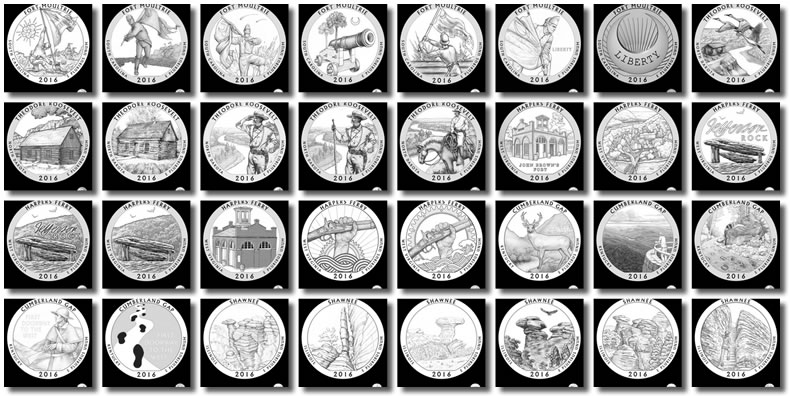
It's a pile of rocks. It's a very nice pile of rocks, as piles of rocks go, but still, it's a pile of rocks. Actually this particular pile of rocks is actually Camel Rock, one of the, um, attractions in Shawnee National Forest on the Ohio River, so far away from the REST of Illinois that it is almost Kentucky.
Kentucky returns the favor of Illinois by choosing a location that's almost out of state as well, on the border with Virginia and North Carolina. But at least they have an excuse here - most the early settlers in Kentucky (those that did not come down the Ohio) came through this gap. This is the path that early pioneers like Daniel Boone (not shown) and Father Guido Sarducci (shown w/o mustache) and their ilk took to get through the Appalachians - looking for a bathroom, hence the inscription "The first doorway to the left, after the den."
Well, you have to give West Virginia its props. Not only are they commemorating an event that predated West Virginia's founding, but one that was one of the kick-off points for the Civil War.
North Dakota has it rough - all the cool stuff (such as it is) is in South Dakota. They could have shown one of the local hoodoos (a local word for "pile of rocks") but instead managed to put together a nice coin that celebrates Teddy Roosevelt. Which, given the fact that he got this whole National Park thing going as a major franchise, makes a modicum of sense. It makes even more sense when you realize that Roosevelt, though a New Yorker, came out here a lot, and the state is littered with statues, parks, and monuments to the man.Teddy spent some time in his 20s out in this neck of the woods, in his early, pre-Rough Rider era, post-mustache but pre-spectacles. The coin shows him on horseback because, you know, what else are they going to show? A pile of rocks? The river (That's the Little Missouri, FYI)? Bison from the state quarter that accidentally got all shot up? All the drilling sites that now surround the park, coupled with whiny notes from the companies griping that can't have THAT land too?
The coin itself is not bad at all. The Little Missouri snakes through the landscape, providing a band of white space and allows us to look down from a vista with Teddy. And and putting him on a high point, on horseback, captures the relative flatness of the land, which actually is a sell point for North Dakota, as it disappears in the badland hills far beyond.
Rating B (Not Bad)
OK, this weird, in that it commemorates something that happened at Fort Sumter, but not the BIG thing that happened at Fort Sumter. There is no Fort Moultrie National ANYTHING, but rather it is wrapped up as a part of Fort Sumter National Monument, and calling the Moultrie piece out as a monument for a coin is kind of like praising Dennis Rodman's basketball career with the Chicago Bulls while Michael Jordan standing RIGHT THERE next to him.What the coin commemorates is this plucky little fort standing up to a naval bombardment by the Brits, protecting Charleston from invasion (for a whole four years before more Brits showed up and took the city anyway). It portrays not a shriner with a Turkish flag but rather a Sergeant WIlliam Jasper returning a home-made flag to the ramparts at the start of the American Revolution. The fort was known as Fort Sullivan back then, but commanded by William Moultrie, who repelled a British Naval force and had time to create the "Moutrie flag" which is shown on the quarter - a blue field with a white moon in the upper left. Actually, cool flag. In any event, the Brits came back and captured the Fort four years later, and renamed it Fort Arbuthnot, and held it until the end of the war.
It's not a bad story, but kind of overshadowed by what happened just next door, where less than a hundred years later separatist forces fired on the United States garrison at Fort Sumter, kicking off the most bitter struggle on American soil (Because, as we know, attacking the US Government was a very, very, very bad idea). Moultrie is very nice and all, but given a choice, which would YOU name the National Monument after? If West Virginia can fess up to a heist film gone horribly wrong, then SoCare can at least say - yeah, this was important to history, even if it was not a particularly shining moment.
The coin itself is ... weird. Look at Jasper's feet, and how the rest of his body is twisted in the opposite direction. If he was using the flag as a bat and trying for a pop fly, maybe that pose would work, but rather it is replacing a flag while under assault by the Brits ... who are ... behind him. It looks like he's leading the attack on the fort, which is not the case.
This is probably the strangest coin I've seen, part for carving, and part for subject matter. There were other design candidates with a lot more promise (Here's a link to a picture of all the prospective candidates - most cases they have chosen the best of their group, though Shawnee coins are resolutely always a pile of rocks),
Rating D (Even subject matter aside, that pose is just weird)
That wraps this year. Next year is four states and the District of Columbia, where Fredrick Douglass gets the moment he missed when he decided to not go hang out with John Brown at Harpers Ferry.
More later,
Thursday, May 24, 2007
Polonium
I'm sure that's a relief to many, but the question of why it would be important that I declare it is a story that I have been witholding from the blogosphere at large.
Back in early November, I was in Germany working with Blue Byte on their game - The Settlers: Rise of an Empire (which is looking real cool, by the way). Flew into Heathrow, smaller plane to Dusseldorf, and then back. Partial story of the trip is here. But about the same time as I was jetting about, former KBG agent Alexander Litvenenko was poisoned by a massive dose of Polonium-210
Time passes, as does Litvenenko. I'm back in Seattle and it is early December, and I get an urgent email from Blue Byte to contact them. The Brits had found trace amounts of PO-210 on four planes, including the one I was on for the Dusseldorf/Heathrow hop. There was no immediate danger, but everyone on board was encouraged to see their physician, just in case. Now.
Oh, joy.
So I call my GP, was told that things were kinda full, explained to them that there was an outside chance of my being radioactive, and was given an immediate appointment. There was a general determinance of my good health (no surprise - in the mean time, the LB and I had the great Thanksgiving disaster, which resulted in us walking four miles uphill in the snow) and a recommendation that I see the staff radiologist. He was in turn interested (I was his first Litvenenko-related case), ran a radiation counter/tricorder/studfinder over me, and declared me OK.
Mind you, Polonium-210 is a heavy particle that can be stopped by clothing or skin. The only prob is if it is injested (which is how Litvinenko got it - through a teapot). Since I didn't lick the pull-down seat tray on that flight, I was pretty sure I was good. Plus the fact that if I had pulled up even a mild dose, I would have showed some definite signs (like keeling over dead) in the month between by fateful flight and the warning.
I was concerned, though, and took it with some gallows humor. And my co-workers were amused. One of them said "The symptoms of Polonium poisoning are similar to those of being stabbed through a curtain." That made me laugh. Even in our darkest hour - Shakespeare humor!
So that's my brush with international espionage. Why didn't I mention it sooner? Well, two days BEFORE I got the call to check myself for radiation poisoning, I was talking to my Mom on the phone, and she was worried (as Moms worried) that the Brits were checking flights and since I was on a flight in Europe, I was at risk. And of course I said that there were a lot of flights in Europe, and it was unlikely I was affected.
And of course I was wrong, but I didn't want to then CALL her back and make her worry, so I resolved to mention it in person when I was back in Pgh this past month, when I could demonstrate I was in good health and ... well, not dead.
And I've been mum on the blog as well, but the sudden meme-tagging made me realize that I haven't shared THIS particular fact. But now I have. So there you have it.
How am I? Not Radioactive! Thank You!
More later,
Friday, September 30, 2022
Play: Crossing Borders, Choosing Sides
One-person plays are good for theaters - limited number of people on stage, one central actor. Pacing is set by the actor. Room to explore in real time. A strong performance carries the entire piece.
One-person plays are terrible for theaters - that one person gets sick, there is no performance. In this case, a recent illness forced us to reschedule about three times (that's on us, by the way - we kept moving it to places where we already had commitments - the REP was more than understanding, and in the end we were in the first row balcony seats).
However, it was worth the wait. Where We Belong is an extended personal meditation on survival of indigenous people and their culture in a colonizer's world. Sayet is native Mohegan, the tribe that gets noted elsewhere as "Mohican", as in "The Last of...." She is also an expert in Shakespeare and English Literature, and has sought to justify her place in both worlds.
Her stories are both personal and historic. She tells of growing up and trying to embrace the dominant culture while remaining true to her birthright and birth name. And aptly demonstrates that having a Mohegan medicine woman as your mother puts the traditional Jewish Mothers to shame. She talks about borders, moving back and forth to England to study, as well as moving back and forth between world.
She also talks of history - Samson Occam and the founding of Dartmouth College, Mahomet Weyenomon, the tribal leader who sought aid from King George II, and Fidelia Fielding, Flying Bird, the last fluid speaker of the Mohegan Language. And Sayet addresses the sterling example of colonialism - the British Museum, where the spoils of empire are laid out in glass cases and hidden in dusty storerooms.
One piece that I did not know, and that struck me as intriguing, was that the Mohegans were once part of a larger tribe, the Pequots. The Pequots chose to resist the English settlers, and part of the tribe chose to instead separate from them, becoming the Mohegans. And this is the very sort of thing that Graeber & Wengrow talk about in The History of Everything - the freedom to separate, to go one's own way when one cannot remain. I found the connection meaningful and supporting Graeber and Wengrow's idea that the native peoples of the Americas created and contributed to the foundation for the European Enlightenment.
Throughout the performance Sayet was engaging, personable and knowledgeable, sarcastic and wise. She prowled the stage, kept hydrated with multiple bottles of water, and controlled both the stage and the room. The stage itself was relatively sparse - bulbs and light tubes from the ceiling, a curved floor resembling the ocean, divided with a strand of piled earth. And a small island that duplicated (I discovered later) the monument to Mohamet in London. The strand, in effect, was a border between worlds, that Sayet has to cross repeatedly.
All in all, an excellent presentation and well worth the wait. Go see it.
More later,
Sunday, August 26, 2007
PAX, Seattle
My official role was a brief bit on one of the two ArenaNet panels. Guild Wars: Eye of the North has its preview this weekend, and goes fully live this Friday. So with the deadlines either dealt with or hanging overhead, we all looked and felt our best as we took the stage (oh, yeah, there's the little matter of stage fright I always get before talking to large groups). And things went really, really, well. The fans were appreciative and excited about the new game, my co-writer Ree, has revealed herself to be a styling goth doombunny at conventions, and we got a lot of good questions and feedback. So we done good.
But that was but a sliver of time, which gave me a chance to watch other members of the team go through the meet and greet (they did nicely as well), and prowl the floor, which had a lot of hobby gamers and former hobby gamers. It was kind of fun to see my past collide with my present in the form of old game designers now working with much younger companies and young companies that remembered the classic old stuff of pen and paper RPGing. It was a Nerdstock, with a lot of coolness.
In particular, I got excited over the coming Penny Arcade adventure game and Pirates of the Burning Sea, which improves graphically every time I see it (and had queues for playing the demoes). Less excited for me was Warhammer, which suprised me, but the graphics and gameplay just didn't get me charged up (maybe I'm just spoiled). EVE Online looked good (and I grafted for a copy of Monte Cook's World o' Darkness), and I got a small Gleemax brain/stress ball. I was a little disappointed that the Ubisoft booth wasn't showing The Settlers (going for action-adventure in Assassin's Creed and Rainbow Six: Vegas instead). Ah, well.
But the place was packed, but not to an intolerable sense. I hear that they will be taking over the entire top floor of the exhibit hall next year. If they can create a command post for the traditional media, I think they would become the next E3, where people go to hear the next big releases.
Oh, and the cats have discovered the Gleemax brain, decided it was a large and juicy mouse, and are now batting it around the dining room.
More later,