Thursday, January 30, 2020

Theatre: Olden Girls

The Revolutionists by Lauren Gunderson, Directed by Kelly Kitchens, Arts West, through 9 February

Olympe de Gouges is a playwright in Revolutionary Paris of 1793. She is visited by Marianne Anglie is a free black woman woman from the San Domingo. She wants Olympe to write pamphlets to help the revolution there. Charolette Corday arrives, an assassin in waiting. She wants Olympe to give her some final words to say after she kills the Jacobin revolutionary Murat. Then Marie-Antoinette shows up looking for a rewrite on her role in history. But Olympe has writer's block.

And there is a fifth woman here, and she is Madame Guillotine. The Terror is in full swing, reaching that tipping point to where anyone, anywhere, could feel her cold sharp kiss. And for women the danger is particularly high.

So, its a comedy. Kind of. The women argue. They joke. They try to help Olympe. They make demands. And for the bulk of the play, it all feels pretty off-balance. The characters feel like they are talking through each other as opposed to each other. the language is modern and so is the cursing. They talk like they know they are characters in a play. And I can't really pin down what this is - Historical? Alt-historical? Meta-theatre? Are these characters or ideals in conflict? Am I entirely inside someone's head? If so, who?

The actors are good. Sunam Ellis  is Olympe de Gouges, a bit too flighty and vain for my tastes, but that's how I feel about writers in plays. Jonelle Jordan is Charolette Corday, the emotional one, and her emotion is murder (She was in Bo-Nita, at the Rep, and can carry herself well on stage).. Hannah Mootz is Marie-Antoinette, the ditsy one that can come up with inadvertent truths. Dedra D. Woods is Marianne Anglie,. who of the four is the voice of reason. Yes, they could have stepped out of a mid-eighties sitcom, and the oddball relationship kinda work most of the time.

But joking about experimental theatre doesn't quite work, even ironically, when it feels like you're doing experimental theatre. Ditto complaining about plays about playwrights when you have a play about playwright. I had a hard time engaging, and as it all muddled in the middle, caught between gears. There were couples dodging out the back door at the intermission. Which was really a pity.

Because in the last 15 minutes, all became clear. All the chatter before is set-up, as they pay off all the odd quartet and characters and resolve everything in something that is really moving and aspiring. When you get it, you get it, and understand why everything feels so disjointed. And you feel sorry for those people who bailed early. Still, it is a bit of chug for a while.I found it ultimately OK, but the journey took a while.

Now, the Honesty In Relationships Act of 1962 demands that I note that this point that the Lovely Bride disagrees with me on this. She thought it was great. She liked the actors, the plot and how it all fit together. She laughed, she cried, she internalized. So this one comes with a healthy and hearty "Your mileage may vary". I gave it a good, solid B. She gave it an A. Go find out for yourself. Don't leave at intermission.

More later,

Tuesday, January 14, 2020

Big Pile of Books: Long Time Ago ....

With this entry I am at the end of big pile of books the end of my desk. In the process, however, in the process I've come across books that I've had lying around, meaning to talk about for some time, and books that I've meant to finish so they earn their place at the end of the desk. But those will be a different kettle of fish (or perhaps multiple kettles).

Defining a Galaxy: Celebrating 30 Years of Roleplaying in a Galaxy Far, Far, Away, by Bill Slavicsek, published by Owen K.C.Stephens/Rogue Genius Games, 2018

Provenance: Gift of the author. Bill Slavicsek was a co-worker at TSR, my boss at Wizards of the Coast, and he and his Lovely Bride, Michelle, come visit every Thanksgiving.

Review: A lot of the attention of  recent "gaming history" has been, naturally, about Dungeons & Dragons, and there are a number of good books out on that subject. This one is on an equally intriguing subject, in that it covers one of the great early licenses in our hobby - the Star Wars RPG from West End Games.

There have been three tabletop RPGs about Star Wars - the West End version in 1987, The Wizards of the Coast version in 2000, and Fantasy Flight version in 2012. I contributed to the WotC version. Bill worked on both the West End and WotC incarnations, and it is the West End version that is very important to how games are developed and how licensed properties are turned in to RPG. In particular, Bill goes into detail on the nature of lateral development.

By 1987, the original trilogy of movies was done. There was talk of more, but no definite plans. There had been a few original novels (a trilogy on Han Solo, A trilogy on Lando, Splinter of the Mind's Eye (since retconned out)), some animated cartoons, and a Christmas Special that had been shown once, then buried. The Marvel comics had a good run but were winding down. West End Games had a lot of stuff from the movies, but very little hard facts about the universe behind it. What was the Kessel Run? Who were all those aliens in the bar? How did the Force work?

This is where West End, and Bill in particular came in, creating the connective tissue and background for the universe. Using what was there to build the support scaffolding for it. In a movie, you can just show a bunch of driods - no one from the audience has the chance to question who they are. Not so in an RPG. The various aliens had names "Hammerhead" and "Squid Head", names used in the toys. Bill christened them Ithorians and Quarrens, and gave them home worlds and characters. In doing so, Bill developed the depth of the universe, not giving you new stuff, but developing the material that was there. Lateral development was a requirement for transitioning between film and the tabletop.

And it stuck. These creations became foundational for the expanding Expanded Universe (now called Legendary. Novels were based on the information presented. The backstories have been accepted as canon. And while changes occurred as new movies and television shows were created this material became core reference for the universe in a variety of media.

And it is kind of cool for Bill to see something that he had created 30 years ago get a name-check in a new project. It is also cool for us to see the process behind the scenes that helped create this expanded universe. Bill's style is open and conversational, a befits a memoir. He's telling stories about his time at West End, and the creative magic that they made there.

Interested? The book can be picked up on Amazon, or here.

More later,

Tuesday, January 07, 2020

Big Pile of Books: Oy, Robot

I have a big pile of books at the end of my desk, and in writing all these up, I realize that I've done this before. Not reviewing this particular pile of books, but of summarizing all my book reviews for a year in one series of posts. I did it in December of 2015, and it will likely be five more years before I try this again.

But let's talk about Murderbots:

All Systems Red by Martha Wells, 2017, Tor Books
Artificial Condition by Martha Wells, 2018, Tor Books
Rogue Protocol by Martha Wells, 2018, Tor Books
Exit Strategy by Martha Wells, 2018, Tor Books

Provenance: The first one of this five-book series (the last one comes out later this year) was highly regarded in a lot of SF sites that I cruise. I tracked it down IRL (a difficult thing, it turned out - everyone had the later books, but not the first one), and agreed it was worthwhile. I asked the Lovely Bride for them as Christmas present last year, and she ordered the other three from Amazon. Philistine.

Review: I have warmed up to novellas. My younger incarnation that devoured SF digest-sized magazines found them large and cumbersome in the face of short stories, while the middle-aged reader-self bought in on the "measuring fantasy by the pound" school, and found them slight. Yet time and again in my dotage I am comfortable with the mid-length form - enough detail to engage, but not too light, and don't mind them at all.

Such is the case of the Murderbot Diaries. If lumped together they may seem a bit repetitive, but as individual stories, they are really quite charming. The murderbot is our narrator, who makes Johannes Cabal look positively sunny in his outlook. Our murderbot is also more competent than Cabal in his job, which is to keep the fleshbags he has been entrusted to protect alive despite their best efforts at self-destruction.

The murderbot is a construct of flesh and metal. It is not a cyborg, in that it did not have a previous life. It is a made, sentient, thing, the flesh grown around the metal plates, its programming tightly bridled by an internal governor. Except the murderbot has bypassed it governor and has free will. Which it wants to use primarily to watch pirated VR shows and do the absolute least amount of work.

The murderbot is geared towards self-preservation, not in a "kill all the humans" sort of way, but in a "lay low and let them ignore me" kinda way. It works, sometimes. And when it doesn't, he is roused to action to protect his assigned humans. He doesn't think much of them. He doesn't think much of most of his universe - Lesser AIs are dullards. More powerful AIs are threats. Corporations, with their ruthless pursuit of the bottom line, he hates.

The humans working with him (who he goes back to help when they're in trouble) don't get it. He's not a pet. He's not an oppressed form of human. He's pretty much sure about what he wants, which is to be left alone. He is a positive, well-rounded, humane, sentient, alien creature who is absolutely NOT fascinated with the humans around him. And that makes him interesting, even appealing.

Four of the five parts of the Murderbot Diaries are out now, and the last one is due sometime this year.

More later,


Monday, January 06, 2020

Big Pile of Books: When in Rome

I have a large pile of books at the end of my desk, accumulated over the course of the year and now demanding reviews. But I'm surprised that I have only one historical non-fiction text among them. That can't be right.


Well, it is, in that much of my nonfiction has been taken up with a single volume: The Mediterranean and the Mediterranean World in the Age of Phillip II, which I will not be talking about here because, well, I am not finished with it. But has been the long-haul book for lengthy trips away from the home base. Instead, let me talk about this one:

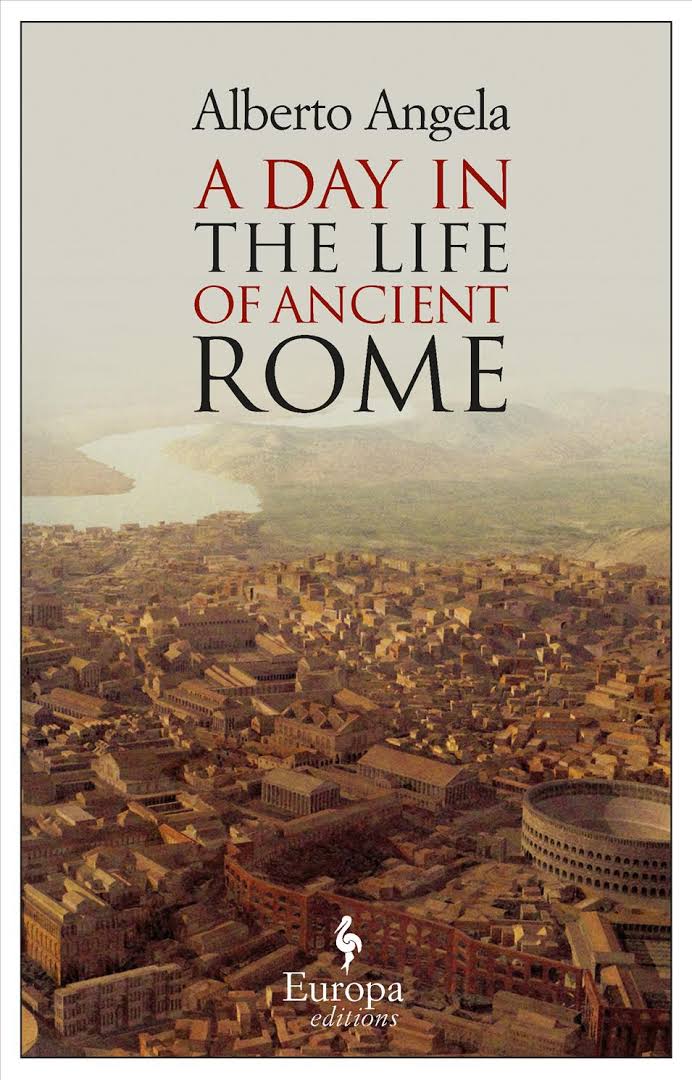
A Day in the Life of Ancient Rome by Alberto Angela, translated from the Italian by Gregory Conti, Europa Editions, 2009

Provenance: I thought I had gotten this text from a friend, but a sticker on the back identifies it clearly as a denizen of Half-Price books, where overstocks go to die. The local Half-Price has carried a lot of good general histories, and this is one. Its appearance feels to me like it more European that Amercian - softbound trade with folding end-flaps, and is pretty substantial.

Review: I started reading this in preparation of running a Cthulhu Invictus game, which is Call of Cthulhu set in the Roman Empire. In addition, I've been reading SPQR by Mary Beard, which gives me larger view of the entire setting (and is really good, but, again, will not review until I finish it, which may be some time).

As a side benefit, after finishing the book, the Lovely Bride and I were invited to Lucca Comics and Games as guests, and spent the week before in Naples/Napoli. So we got to tour Pompeii, Paestum, and Herculaneum with a extremely knowledgeable guide (highly recommended - she's really good) and this book was valuable as preparatory work.

Day in the Life gives me a lot of thought about how to fit in the small bits of life and times for the characters who I may be throwing around in the midst of Romanic Cthulhu adventures.

Here's an obvious one - night is dark but not empty. I know it is a shock, but in our modern times, unless we are way the hell away from everything, we still have some ambient light. Rome didn't/couldn't do that. So they were to a great degree hostages to daylight, and evolved their situations accordingly. Yet the darkness is also a time for deliveries of food and supplies to the city, when the streets are (relatively) empty of the rest of the citizenry.

Another important one - the vast majority of the population were camping. Yep, we know about the layouts of the Roman villas, (And can identify vomitoriums, impluviums, and shrines to house gods on sight), but most of the working class had small tight quarters in tall buildings, which got worse as you went up (the opposite of penthouses in the elevator-assisted modern age). Not a lot of amenities, not a lot of privacy. A lot of rent-paying squatters.

This is obvious stuff when you think about it. Rome had a strong civic and public life in part because of a lack of personal, private space. The did have food kiosks (open-sided restaurants to get a quick meal), and did have running water (the baths, which were social centers for business and schmoozing). Other parts do feel alien, and I need to think about them more when incorporating them into any type of campaign.

The conceit of the book is traveling through a single day, pressing through the city to the a gladiatorial contest and then to a banquet (the laying on couches thing). Angela puts together a nice, solid narrative which carried through the translation. If you want to get a nice general text on Roman life (or what we think Roman life was like), here you go.

More later,

Sunday, January 05, 2020

Big Pile of Books: Lovecrafting

Have I mentioned I have a big pile of books on the end of my desk? Yeah, I have a big pile of books at the end of my desk. Here are some reviews;

Johannes Cabal: the Fear Institute, by Jonathan L. Howard, Thomas Dunne Books, 2011

Provenance: A friend lent me the audio version of Johannes Cabal and the Blustery Day, a collection of short stories featuring a particularly sardonic,erudite, and irritated necromancer who keeps having things get in the way of his quest for eternal life. They were fun, and when I was in New York last year I picked up a copy of The Fear Institute at the Strand (a highly-recommended bookstore, but I will give the edge to Powell's in Portland).

Review: What attracted me to this particular book (as opposed to others in the series) was the fact it was set in Lovecraft's Dreamlands. The Dreamlands were mostly part of Lovecraft's work in poetry, where he is influenced by Lord Dunsany, and is the more fantastic setting of his mythos. A lot of the same players and characters fit in, but it the Dreamlands are more aesthetic than horrific, which causes some interesting interplay between his view of this world and the land of Dreams.

Other authors have played in this space, so it is interesting to see how this other Howard takes it on.

And it's all right. The writing is solid and engaging, and has the proper level of bounce and snap. But I think I like the other authors' take on Lovecraft's fantasy world better. This adventure really doesn't need to be in the Dreamlands, and could be in Oz or the Forgotten Realms save for a couple solid name-checks. Cabal's sardonic commentary applies to fantasy worlds in general as opposed to prying up the underlying nature of Lovecraft's universe. There is a dualogy between Lovecraft's worlds - his Dreamlands tend to more romantic, awe-inspired, and positive, while his mythos works set in our world tend to be more horrific, nihilistic, and terrible. Both settings have living gods, but those gods are more active in the Dreamlands and the characters who toil in their shadows more empowered.

Anyway, the plot. Cabal is hired by a trio of individuals who intend to go to the Dreamlands and defeat Fear, Fear being the worst bane of human civilization. Despite himself, Cabal goes along as the official guide. There are adventures with Zoogs and Men of Leng, and I think he really nails the Men of Leng for the first time that I've read. The amusingly selfish Cabal verges on being heroic because of the nature of the universe he is cast in. Elder gods are confronted. Time paradoxes are invoked. It wraps up with a strong lead into the NEXT volume.

It's OK. Cabal as reluctant hero gets him away from him from merely whining about his state, and reasons are given as things progress. But I don't get the feel of the Dreamlands from this tome in the same fashion as I did the other versions. Howard doesn't add to the mythos (again, with the exception of the Men of Leng), but instead it functions as a mostly-understood backdrop for Cabal's ongoing frustrations with reality, both his own and that of alternate planes.

Its worth a read, and in the proper hands, would be good series on NetFlix. But it remains OK.

More later,

Saturday, January 04, 2020

Big Pile of Books: This Means Woah!

I continue to have a lot of books on my desk. They are mostly fiction, and I am reviewing them in part to get my thoughts down and freeing myself to eventually passing on to others. This one will wait, only because it is part of a series that has yet to conclude:

The Will to Battle by Ada Palmer, TOR books, 2017

Provenance: Purchased at the Elliot Bay book company, which is no longer on Elliot Bay but has moved up to the Cap Hill area. I did not intend to purchase it or review it, this being book three of a four-book set, but I enjoyed the first two very much and took it home and devoured it as well. Spoilers, I should warn, abound.

Review: This is Terra Ignota Book III. Books I and II, which I talk about here, are pretty much one volume were this a trilogy. Book III in this case is the saddle booth. We laid out the world and chased the protagonists up a tree in Books I and II. Book IV we will/may see the resolution. Book III is keeping all the balls in the air and laying the groundwork for the finish (I hope).

The story so far: We are 450 years in the future and the future is falling apart. The utopia that has persisted for a long peace has been revealed to be the result of traffic control assassins who use massive data at their fingertips to identify targets and remove them through "accidents". The population of the earth, broken up into Hives of common interests and philosophies as opposed to nations, are jockeying for position. The young mutant (?) with the ability to modify reality is dead, his chosen toy soldier and heir transformed into Achilles, a warrior in a world that has not seen traditional war for ages. Oh, and God is here. Not our God, but a God supposedly from somewhere else, invited here and incarnated with connections to all the ruling hives. Said visiting God will break apart the world and remake it into something that would not rely on secret assassins to survive. Everyone just needs to surrender and let him do it. And the question of if that is a good thing or not drives the world to brink of war.

And in this we have Mycroft Canner, who I have previously called the Necessary Man, who has contacts with all the factions and the ability to be where he needs to be to record the major decisions. Except Mycroft himself, like the world, is coming apart. The unreliable narrator is even more unreliable, as we see him have conversations with dead comrades, dead philosophers, and oftimes the reader themselves. How trustworthy his observations are remain up in the air.

The book is dense is its style and every character packs a half-dozen other titles and names (thank the gods for Dramatis Persona listing at the front to give one some clues) and it works. Saddle books often are marking time before resolving the issues, but this one has the task of getting a supposedly rational, clear-eyed population geared up for war, with tools they have left rusting for generations. The players don't seem to have the optimisms that has accompanies so many of our "modern" conflicts - the confidence that this will be over by Christmas that evaporates under the thunder of the first artillery strike. But they do seem naive about what this means in a society that become borderless in many ways, where the factions are easily identified by self-chosen uniforms. It will be a war like no other.

And I'm looking forward to it. Having chased this future utopia up a tree, and thrown rocks at it, I am curious if Palmer (and her characters) can then get it down. Will humanity, and its leaders, and its gods and godly visitors, have to shed their cool, thoughtful approaches for the savagery of conflict, a savagery once embraced by Mycroft Canner as being the component of humanity that evaporated over the long enforced peace.

The last bit of the story won't be out until 2021, so it rests here for the moment. I look forward to coming back to the complex, often convoluted world, and see what happens.

More later,


Friday, January 03, 2020

Big Pile of Books: Mysteries

I have a lot of paperback mysteries on my desk. Their slender format (much less than your typical doorstop of a fantasy novel) makes them very portable for plane flights. Also, I've been laid up recently with minor surgery, as a result taking tub baths, and dropping a paperback in the tub is less damaging than submerging your iPad. There were two big categories for mysteries this year:

NERO WOLFE
Gambit by Rex Stout - Bantam Books, originally published in 1962
The Mother Hunt by Rex Stout - Bantam Books, originally published in 1963
The Black Mountain by Rex Stout  - Bantam Books, originally published in 1954
Before Midnight by Rex Stout  - Bantam Books, originally published in 1955
Where There's A Will by Rex Stout - Avon Books, originally published in 1940
Please Pass The Guilt by Rex Stout - Viking Press (Hardback), originally published in 1975
Three At Wolfe's Door (collection) by Rex Stout  - Bantam Books, originally published in 1960
Trouble in Triplicate (collection) by Rex Stout  - Bantam Books, originally published in 1949
Death Times Three (collection) by Rex Stout - Bantam Books, originally published in 1985

Provenance: Various, including a number of used bookstores. Most of the Half-Price breed won't carry something this old and usually worn, but there is a store up in the Cap Hill area, Twice Told Tales, which is well-stocked with cats in abundance, mysteries in general and Nero Wolfe in particular.

Review: I've talked about the Nero Wolfe books before, and am now treating them as a limited resource, to be husbanded and read only when trapped on a plane or in a bathtub. As you can see, I've spent a good chunk of time on planes and in bathtubs this past year. There are only so many original stories lefgt, since the author passed on in 1975, and while they have found another writer to pick up the character, it is not the same (One later-day book I picked up had the first line "It all started at Lilly Rowan's Superbowl party." I can't tell you what the second line was because I put the book back down and called in the HazMat team).

Pretty much everything I said before still holds - the titular Wolfe is a fat (only 10 lbs heavier than I am nowadays), lazy, brilliant detective, kept from a complete state of inertia by his smart, wiseguy, well-grounded assistant, Archie Goodwin (who narrates, so he may be a bit prejudiced in this regard). Clients are usually dictated by the state of the bank balance for keeping their New York brownstone going, or by personal connections with the pair. Wolfe does not tolerate a large number of things - fools, leaving the brownstone, hugs, handshakes, violating his personal time raising orchids, letting a woman stay in the house - and inevitably one of more of those things must be tolerated in the course of the mystery. There are usually dead bodies involved, and there is often an increasing death count as the days progress in the course of a case.

The thing is, the mystery isn't the core of the story. Stout generally plays fair in his mysteries, and gives the reader enough suspicion as to whodunnit and why, but since he traps us in Archie's brain, we often find out when Archie does, but know only that Wolfe is off dealing with other agents and opportunities as we follow Archie around. The mysteries usually wrap within two pages of the end of the books itself -"The Murderer was X. Then we had a perfectly adequate dinner. The end"). That feels a little rushed, but once the murder is solved, there is not much point hanging about.

Except the attraction of these books is the writing as opposed to the clever mechanism of the crime or the brilliant solution. In writing this entry up I had to leaf through them to remind myself WHO the guilty party actually was in many cases. In Archie, Stout has a perfect, engaging, heroic narrator, who manages to charm his way both through the book and with the reader. Wolfe is tolerable only because he comes to us through Archie's lens and with archie's approval. Stout did some additional books with another detective - Tecumseh Fox (yeah, there's a pattern in the names), but they don't land as solidly without Archie's presence.

The collections are akin to the novels, but more concentrated, and reflect the mechanism of delivery for these stories. They appeared in other media (once upon a time, there were weekly print magazines with names like Liberty and The Saturday Evening Post, that would print fiction on pulverized dead trees), but are collected together, usually three to a volume to make up word count. Given their shorter nature, you get a better idea from the start where the tip-off is that indicates the guilty party. But they are still solid.The most recent one on the list, Death Times Three, is posthumous, and contains earlier published drafts that were later changed, expanded, or sent elsewhere, and is a good study for those interested in seeing how stories evolved.

The exception the expected pattern of Nero Wolfe mysteries, the one that tests the rule,is The Black Mountain, which is recommended even if you are not a mystery fan. Here the pair leave New York City, and the United States entirely, to find the killer of the owner of Wolfe's favorite restaurant. The pair's journey takes them to Montenegro, Wolfe's home country, and lacks the cosmopolitan vibe, huge cast of suspects, familiar support characters, and unbreakable personal flaws of the other books. And it does it in a fashion that does not undercut the nature of the characters themselves.

I recommend all of them, but if you're digging up old Wolfe books, be sure to catch The Black Mountain.

But hang on, there's more:

MAIGRET
Maigret on the Riviera by George Simenon, translated by Geoffrey Sainsbury, HBJ Books, originally published in 1940
Maigret Goes Home by George Simenon, translated by Robert Baldick, HBJ Books, originally published in 1931
Maigret and the Reluctant Witness by George Simenon, translated by Daphne Woodward HBJ Books, originally published in 1959

Provenance: Re-gifted from a friend. Will re-gift them in turn.

Review: And sometimes it just doesn't work. Blame the translation, both in culture and in physical text, or the nature of the original source, but the Maigret books did not hold me, and I will be honest, I pressed forward only to see if they took an upturn, but in these three they did not.

Chief Inspector Maigret is a Parisian police detective. His work is mostly procedural. He walks around, talks to people, gathers evidence, and the books end in a confession and usually additional bloodshed. His work takes him into the sordid parts of peoples' lives.  He is overly reflective and introspective, and much of his dialogue is internal and filled with self-doubt. In Riveria he is a fish out of water on the sunny beaches, In Home he returns to his hometown, where few people are left that remember him and he feels like a fish out of water. In Reluctant Witness he is confronted with the fact that he is getting old and police procedures are changing on him and he feels ... well, you know.. In each case he spends much of the books cogitating on how much he does not fit in with his particular case. In fact, in Home, there is the "collection of suspects to reveal the murderer", and Maigret is not even the instigator, but rather a passive witness to the entire proceedings.

It could be a merely a cultural gap - Maigret is a very existential character, trapped in his own thoughts. But the result was a trio of books that, once read, I can let pass out of my life without any further regrets, without even an internal monologue.

More later,

Thursday, January 02, 2020

Big Pile of Books: Spooks

This past year, when I finished a book, I tended to put it on a pile on the end of my desk. Not always, but enough that now I have a lot of books piled up. And since I want to eventually clear off that side of the desk (for, um, more books), I have to either review it, shelve it, and/or give it away. For each book I mention the provenance - how it ended up in my hands.  Because even stories have stories. So here we go.

Summerland by Hannu Rajaniemi, TOR books, 2018

Provenance: The Lovely Bride got me this book in hardback back in 2018, and it sat around for a few months until I got to it this year.  The author had gotten great reviews on The Quantum Thief (which I have not read), and the release of this book came in with that top-echelon push - reviews in the book section of the Seattle Times, mentions on NPR, the works.

Review: There's a lot going on in this book. The easiest way to describe the central conceit is to say that there is an afterlife, and it is British. Or rather the British Empire want to colonize it. When you die, and are properly prepared, you go to another plane made of semi-morphic, mutable material that responds to thought, akin some of the transitive planes in D&D or the the Mists in Guild Wars. The British set themselves up in the ruins of previous inhabitants of this zone and remodeled. In the afterlife, one is neither truly gone nor forgotten - they can communicate with the living, come visit through people willing to be possessed for the purpose, and provide insights, aura-reading, and rapid communications.

And it is all used for spycraft. It is 1938 and Germany is just ... gone, not just defeated in WWI but obliterated spiritually. The Great Powers are England and the Soviet Union, where Lenin never died but instead ascended into a godlike Presence that feeds off the spirits of his own dead. The Brits and Russians are playing their great game over the Spanish Civil War, with the English supporting Francos's Fascists. The British spies are split into rival agencies for the living and the dead. And the Brits have a mole leaking info to the Russians.

Rachel White is a low-level intelligence officer who suffers from the classism and sexism of the British system. She gets a lead on the mole, who is on the afterlife side - The Summer Court of the undead British Intelligence, who are literally spooks. We also get the mole's side of the story, and his actions as the two square off against each other, dealing with their own side's challenges and their personal tragedies in the process. There is a lot of cat-and-mouse as the two together reveal that there is something even nastier going on.

The plot moves swiftly and the characters are well-grounded. For all the things going on at once here, it hangs together. The world of Summerland is filled with familiar faces in different roles - Stalin's here. Lenin is a godlike present. Kim Philby and his comrades check in. The Prime Minister is a roman Ã  clef version of H. G. Wells, which marries neatly the spiritualism and tech of his earlier eras.

There is a lot packed in on this relatively slender volume, and it has a lot of place I would want to back up and understand more about how things work and how we got to this point. Footnotes or annotations would be a plus, but undercut the entire point of the "blink and you'll miss it" writing style. It would be something that Stephen Moffat could turn into a decent series for the BBC. So pay attention, know some of your interwar history, and you will be rewarded.

More later,

Tuesday, December 31, 2019

State of the Blog

Wow, it has been a long time since I talked about the Blog itself. I have been on this for over 15 years now, and still don't have anything worth saying.

The landscape has changed. Blogging is regarded as a bit old-fashioned in the face of newer tech, sort of like the fate of CB Radios and HAM stations. Not quite dead media, but really subdued. Everyone has gone over to the Facebookery and the Tweeter accounts, but I like blogging. It forces me to organize my thoughts a bit better, and to create a meaningful narrative through-line. Facebook is a great place for that one-off bon mot, and I use it that way, along with "hey, look at this link". But that in itself steals some of the utility I used the blog for.

And I use Facebook like I used to use Google+ for increasing the bandwidth for what is here on the blogspace, and that's OK as well. Occasionally something blows up big and I get hundreds of hits, but most of the time it is a fairly comfortable amount of reads and reblogs. I'm really not doing it for the popularity, but for me (though the rest of you are welcome to tag along).

Ditto for the Facebook. It is for me, and have no problem unfollowing problematic people I know IRL and unfriending outright bozos, who are usually strangers. I have a wide variety of people on the Facebook spanning the political spectrum, but have avoided the ones that repost Russian memes and write in all-caps. And as a result, my Facebook is pretty stable and positive - I have not had to bounce anyone for spoiling Rise of Skywalker before I saw it. Thanks, folks.

I miss Google+ by the way. I used it to line up all of the other blogs that I followed, and had a good mix of posting. MeWe isn't doing it nearly enough for me. A friend got me a twitter account (grubbstweet), but I rarely remember to cross-post to it.

My biggest limitation is a lack of spare time. I may have mentioned this elsewhere, but it is about an hour drive to the day job nowadays, and that leaves precious little time to do anything else. I get home, do a few chores, have dinner, crash early, get up early to start the process again. It gets in the way of other things, and when I DO have the chance, I read, play games on the iPad or watch comfort-videos (Great British Baking Show, of course).

And there are things that I have always posted about and will probably continue to post about - collectible quarters, local elections, books, theater. As we move into the presidential election year, there will probably be more of that, though it is a grisly task and most folk know where I lean already. I'd like to do an overview of American Presidential Elections, and how each one was the WORST ELECTION EVER. I'd like to talk about the weird histories of our holidays (I would start on March 1, which SHOULD be the first day of the year). I'd even like to post some actual honest to god gaming content here, but that's unlikely given the rest of my life at the moment.

And that's about it. Happy New Year, folks, and see you around.

More later,


Monday, December 23, 2019

Season's Greetings

A Merry Christmas, a Joyeux Noel, and a Happy, Safe, and Reflective Holiday Season from Grubb Street.

Rest on the Flight into Egypt, 1879
Luc Olivier Merson 

More later,

Monday, December 16, 2019

Free Verse

A found bit of poetry. Picture this being read in a basement coffee bar in front of a brick wall, accompanied by bongos:

Bahamas, Frisco
Celebration, New Mexico
Cure, Boca Raton, Camellia
Las Vegas, New Orleans
Gasparilla
Hawaii
Independence, Quick Lane
Military, Pinstripe
Texas, Holiday, Cheez-It
Camping World
Cotton, Peach, Fiesta
First Responder
Music City, Redbox
Orange, Belk, Sun
Liberty, Arizona
Alamo
Citrus
Outback, Rose, Sugar
Birmingham, Gator
Idaho Potato
Armed Forces, Lending Tree
CFP Championship

Anything is free werse if you throw enough line breaks at it.

More later,

Tuesday, December 10, 2019

Theatre: Roundup Edition

Shout Sister Shout by Cheryl L. West, Created by Randy Johnson & Cheryl L. West, Directed by Randy Johnson, Seattle Repertory Theatre through December 22nd
Head Over Heels The Musical, Conceived and original book by Jeff Whitty, Adapted by James Magruder, Directed by Matthew Wright. Arts West,  Through December 29th.
The Great Moment by Anna Siegler, Directed by Braden Abraham, Seattle Rep through November 17th (yeah, it's closed)
Sunset Baby by Dominique Morisseau, Dire ted by Valerie Curtis-Newton, Arts West through October 20th (Yeah, I've been pushing thing off that long)

I have been busy, and let even the barest minimum of this blog slip - to wit, the Theatre Reviews.

This is perishable fruit, because who wants to read reviews of shows that have long since slipped the surly bonds of matinee performances and moved on?  Yet I'm going to do a bunch of them, just to keep things up to date. And two of them are still playing, until the end of the month.

Shout Sister Shout is still going on, and well worth attending (There, you can skip the rest of the page if you want). It is a bioplay (a biopic for theatre) of the life of Sister Rosetta Thorpe, the Godmother of Rock 'n Roll. A foundational African-American performer, mostly forgotten today, more popular in Europe than in Jim Crow America. I know, it sounds like the play about Nina Simone last year, but it has a heartbeat and a verve all its own.

The entire play encapsulates the life and times of Sister Rosetta Tharpe, played incredibly well by Carrie Compere, The actress goes from child prodigy to elder stateswoman with all stops in between. A gospel singer by upbringing, she wanted to bring the music of the Lord forward to the masses, at the cost of rejection by her own congregations for hanging with the heathens. The play portrays Tharpe as no saint, acceding when she should have stood up, or taking the money when offered, but in the end creates a well-rounded picture of this pioneer. We name check the other performers of the era, from Cab Calloway at the Cotton Club, Dizzy Gilespie, and Little Richard, as the story barrels forward, including her relationship with Marie Knight.

Compere, as Stone, is pretty much fantastic, with a wonderful voice and a great guitar chops (the Little Richard Strut? She did that first). It's common to see a performance built around one great voice, but Shout Sister Shout gives us two. Carol Dennis, as Stone' mother and the pivotal other figure in the story, matches her note for note and hearstring for heartstring.

Performances are great, stagecraft (a scrim decked with white guitars) is excellent, and the music top-notch. Go see it.

Hear Over Heels is also very good, but in a different weight class. Arts West, in a renovated department store in West Seattle, is a smaller, more intimate venue, both in stage space and audience. I expected smaller plays in this space, but it goes all out, with a cast as large as Shout Sister Shout that packs the stage and avoids collisions.

The play itself is a celebration of the Go-Gos. OK, I have trouble separating the Bangles from the Go-Gos, but they had about four recognizable greatest hits, all which get their time (hint for those confused between the two - the Go-Gos got the beat, the Bangles walked like an Egyptian). They merge the music with the Countess of Pembroke's Arcadia, from the 16th century, which is ... quite frankly much MORE confusing and darker than the pared-down plot presented here.

Here's the simple version: The King gets a dire prediction from the Oracle at Delphi, but conceals it from his Queen and schemes to foil the predictions. The shepherd, who is in love with the royal younger daughter, masquerades as an Amazon warrior to be near her. Both King and Queen fall for the Amazon. Plus the older daughter rejects all suitors, and comes to terms with her own love of her maidservant. Yeah, its a lot about sexuality and gender preference, with a huge heaping of misunderstandings, layered with 80s pop. Whackiness evolves with a 9 principles and huge supporting ensemble. Not nearly as deep as Shout, Sister, Shout, but impressive in what it attains.

And the cast is uniformly strong. No standout voices, (OK, back me against a wall and I'd say Ann Cornelius as Queen Gynecia is really good (No, I am NOT making up these names)). Serious packed with wall-to-wall music, light and bouncy, and a feelgood production. Even if they don't play "Hazy Shade of Winter".

Sunset Baby was the first play of the season at Arts West, and fits much more within my expectations. It is a simple play with a single set and three actors. Nina (Aishe Keitaa) is the daughter of civil rights warriors and is Bonnie to her boyfriend's Clyde.  Mom's dead after a disastrous decline, Dad has been in jail for years. Dad is out and wants letters that Mom wrote him but never sent. Nina (again, a call-back to Nina Simone) has become hard-shelled and transactional over the years and has the letters. That's pretty much it.

Sunset Baby is an early work by an author who has done things more notable later works (see also: In The Heights). To be frank it shows - the characters are not speaking to each other as much as they are playing to the audience - their dialogue didactic as opposed to engaged. It is noticeable and a warning for my own writing.

The Great Moment is another earlier work, this time from the author of Photograph 51, which I loved to pieces. Again, it shows weakness in the script and promises of better work to come. She keeps the unmoored in time concept, but applies it to a domestic situation and the ruminations on time and mortality. But the author also breaks the fourth wall with an Ellen DeGeneres sort of perkiness, and is an autobiographical character (maybe not one-to-one, but enough to make one uncomfortable). Not a bad production, but still weaker than normal Rep fare.

There - caught up. Now bring on the next batch!

More later,

Tuesday, November 19, 2019

The Political Desk - Results


As the long-time reader of this blog knows, I wait for a while before reporting on the political results. This is because we have mail-in ballots in Washington State, and Election Day is just the day they stop taking them and start counting them. As a result, early results may be incorrect (late voters in this neck of the woods tend to be younger and more liberal – your own local mileage may vary). Anyway, about after a week things have calmed down a bit.

The news that went national was the city council races next door in Seattle proper. Seattle does have a two party system, though both of them are Democrats. One is a pro-business wing, the other a progressive wing. And there is often an overlap. This year the business end threw a TON of money into its preferred candidates. And the Seattle Times on the day after quickly reassured everyone that it was OK that the Chamber of Commerce's moneyed candidates won only 4 out of the 7 seats that were up. Well, after the rest of the votes were counted, just two seats. And those two were already leading before the big infusion of cash.

Not to say that there wasn’t a good stepping back from positive, progressive policies. A couple state-wide initiatives went more conservative, but that was state-wide. So it is good to know that King County doesn’t control the state, but still, some of these results are going to painful.

Let’s take a look at the damages:


State of Washington, Referendum Measure No. 88
I say let's put a little more fairness in state contracting, the opposition says "affirmative action." Like that's a bad thing. Still, it scared enough Washingtonians to REJECT this. OK, will of the people and all that.

State of Washington, Initiative Measure No. 976
This was the Eyeman Magic Pony Initiative that would cut your car tabs by gutting funding for transportation, and it won! Seattle will celebrate by having the world's slowest parade, twice a day, for the rest of your life. Yay! 

OK, King County, the transportation folk, and a lot of other people are launching a lawsuit against this, but I dunno. We did warn everyone about the repercussions, and now we should be prepared to see them repercussed.  And if anyone knows how to build a bullet-proof initiative, it should be a guy who has put so many of them on the ballot (unless it's not about really changing the law, but rather about scamming wealthy conservative donors, but what's the chances of THAT being the case?).

The governor, on the other hand, has laid out a plan already about where the cutbacks would occur. Were it me, I would cut all the transportation projects in counties where the measure passed, and when they come begging for money for destroyed bridges, suggest they hold a bake sale to raise the funds. But that is why I am not a servant of the people, but rather a loud-mouthed blogger.

All the god-forsaken advisory votes. 
Does it matter? Not to me. Maybe it had an effect on the voters in that, confronted with ALL these options, they just gave up on voting. Now, I would be in favor of this type of democracy if they: A) made it binding, b) made it honest in its descriptions, and c) allowed us to vote on every tax break the state provides to corporations. Just throwing that out there.

State of Washington, Senate Joint Resolution No. 8200 -
This one got approved. OK, I'm good with that. It is one of those little details that actually makes sense to vote on. It's a good thing.

County Measures
King County
    Proposition No. 1 Medic One – Emergency Medical Services Replacement of Existing Levy
Passed handily. Good job on that.


And on to real people running for things:

King County, Director of Elections
    Julie Wise, who also won handily.

Port of Seattle, Commissioner Position No. 2 nonpartisan office
    Sam Cho 
Port of Seattle, Commissioner Position No. 5 nonpartisan office
    Fred Felleman

City of Kent, Council Position No. 1 short and full term nonpartisan office
    Marli Larimer
City of Kent, Council Position No. 3 nonpartisan office
    Les Thomas
City of Kent, Council Position No. 5 nonpartisan office
    Bill Boyce
City of Kent, Council Position No. 7 short and full term nonpartisan office
    Zandria Michaud
Kent School District No. 415, Director District No. 2 nonpartisan office
    Michele Greenwood Bettinger
Soos Creek Water and Sewer District, Commissioner Position No. 2 nonpartisan office
    Alan Eades
Public Hospital District No. 1, Commissioner District No. 2 unexpired 2-year term nonpartisan office
    Jim Griggs
Public Hospital District No. 1, Commissioner District No. 3 nonpartisan office
    Janet Evans
Public Hospital District No. 1, Commissioner Position No. 5 nonpartisan office
    Carol Barber

OK, some of these folks I recommended. None of them did I not specifically recommend. I think they'll all do a good job, and I am enheartened by the increased commitment. The Political Desk will see you next year.

More later,

Monday, October 21, 2019

My (Updated) Schedule in LUCCA

There have been a couple tweaks, so I am reposting it so people don't have to slog through the local politics section. I'm (still) going to be a guest at the Lucca Comics and Games convention at the end of this month. I'm really looking forward to it. Lucca is a medieval walled city NE of Pisa, and every year they close the city gates to traffic and turn the center of the city into a huge comic book and gaming convention. My presence there has been arranged by the fine folks at Mondiversi, and I will be spending time at the their booth. Also, I have written a new tournament adventure specifically for this event, and will be running it there:

Here's my REVISED current schedule:

Wednesday, 30 October
10:00 - 11:00        Opening breakfast with Level UP! fans
14:00 - 18:00        D&D Tournament opening session [Games Pavilion]
18:15 - 19:00        Meet & Greet at the Mondiversi Booth CAR 129

Thursday, 31 October
10:00 - 13:00        Prototype Review Corner [Educational Pavilion]
14:00 - 14:45        Meet & Great at Mondiversi Booth
15:00 - 18:00        Gaming Session [Games Pavililion]
19:30  - ?              Ceremony Night and Gala Dinner [Giglio Opera House]

Friday, 1 November
10:00 - 11:00        Meet & Greet at the Mondiversi Booth        
11:30 - 13:30        Worldbuilding 101 educational workshop [Educational Pavillion]

Saturday, 2 November
10:00 - 10:45         Panel meeting on the History of TSR [Ingillis Hall]
11:00 - 12:00         Meet & Greet at the Mondiversi Booth

Sunday, 3 November
12:00 - 15:00         Game Session [Games Pavillion]
15:30 - 16:30         Meet & Greet at the Mondiversi Booth
18:30 - 19:00         Award Ceremony [Ingellis Hall]
22:30                     Closing Dinner

If you happen to be at Lucca Comics and Games, or by chance just happen to be in Lucca that week, come by and say hi!

More later,