Showing posts with label Science Fiction. Show all posts

Tuesday, July 14, 2026

Book: The Old New Weird

 Three Moments of an Explosion by China Miéville, Del Rey Books, an imprint of Random House, 2016

Provenance: I picked this up at the Page Turner in downtown Kent, when I was looking for a completely different book. And that's the nature of the Page Turner in that sort of thing happens quite often.

Review: OK, I'm a fan of China Miéville, but I haven't read everything that he's written. I started early with Perdido Street Station (published in 2000), and the two other books set in the same world, The Scar and The Iron Council. I enjoyed The City and City and Kraken (which I did not review - I don't review everything here), and really liked (and reviewed) October, a non-fiction book about the Russian Revolution. So I picked up this collection of his short fiction, adding it to the To Be Read pile, and finally getting into it in the past month or so. 

And, to my lack of surprise, I enjoyed it tremendously. There are a LOT of stories here, ranging from widely-published works to stuff that was used as handouts at a exhibition in Liverpool. As a result, though you get a good feeling for how and what Miéville writes over a number of different stories. 

When Miéville first showed up with Perdido Street Station, he quickly got folded into his own subgenre- the New Weird. This was over 25 years ago, so the patina of "new" may have gotten a bit threadbare since then, but there are not a lot of other books that fit neatly into that category. Annihilation by Jeff Vandermeer gets mentioned a bunch as a sister volume, and I could put The City We Became by N. K. Jemisin in that general category. Piranesi could elbow its way in as well with a good argument or two.

But genre is a slippery marketing term - it effectively says: If you liked THAT, you'll like THIS. But it also sets up it own set of walls - This is NOT magical realism. This is NOT urban fantasy. This is not old school or cozy or like a lot of other things you've seen. It is akin to all of that, but it is a thing of its own right. The Old Weird belongs to Clark Ashton Smith and Lovecraft, and it has a good linkage with that as well, but this is a different animal.

So what is Miéville's encampment of the New Weird? Well, it has strange doings - icebergs calving above the skies of London, animated oil rigs. card decks with suits that only appear once in a lifetime, or etchings on bones newly-pulled from cadavers. It has body horror, in addictive parasites to people who put on dead animal heads or medical actors who suddenly present with symptoms for future diseases.  Miévilles brand of the New Weird is very urban (usually) and Londonian (keep your wiki link open for when you hit something idiosyncratic).

Most of all (and I think this applies to the New Weird in general) - it is unexplained. No one steps forward in the story with a reason why animated oil rigs are blundering ashore like kaiju.  Even those seeking the truth discover nothing but dead ends and unsure resolutions. Miéville in his short fiction keeps his focus tight on his protagonists (who are also usually his victims), and they are awash in this unsurity as well. This may be a hallmark of the NW, or at least Miévilles patch of earth within it.

It is interesting and puzzling and amazing and horrible and wonderful. It's worth hunting down and reading.

More later, 

Wednesday, May 27, 2026

Book: Sunny Daze

 Sunward by William Alexander, Saga Press (Simon & Schuster), 2025

Provenance: I sat with the author on a panel at NorWesCon, and was impressed with what he had to say. His book was a nominee for the Phillip K, Dick award, awarded at that convention. So after the panel I went down and purchased a copy from a booth that was selling all the PKD nominees. So this is the writer's version of a three-cushion bank shot as far as selling your book.

Review: Tova Lir is a courier, running private messages and packages through the solar system. As a side gig, she adopts baby bots - AIs which need a physical housing for the first year or so to establish a sense of self. She's independent (one of her moms runs the moon), and not an achiever. She and her latest baby bot encounters another courier's ship, the courier within it dead. The bot is badly damaged. And now she's a target of assassins as she attempts to get her adopted 'bot repaired at the same time as robots as suspected of being responsible for a terrorist action on the moon. Yes, its a lot for a relatively slender book, but it moves along at a brisk clip.

One thing I like about the book is the "whys" - the worldbuilding that is underneath it. Newly-fashioned bots are housed in physical bodies because their intellects can be swept away by the huge amount of data out there (the allegory is to swimming too far out from shore). Couriers are used because all information over the net is public. Civilization is outside Earth because earth's climate is one of continual storms due to climate change. And a cult of humans sends their dead into the sun in great graveyard armadas. It is a weird future, but a well-reasoned one.

It surprises me is that, while SF has a huge number of subgenres, there is nothing for this type of adventure - the Earth off-limits for some reason, and humanity survives in space. John Varley's Eight Worlds stories, Bruce Sterling's Shaper/Mechanist wars, Charles Stross's Accelerando with its Vile Offspring. All of them moved the center of humanity out, not to stars, but to the further planets. I don't know what to call it - Post-Terran SF? Solarpunk? Human Diaspora? Somebody probably has a better name. 

Alexander's language is clear and straight-forward in this weird world. The author comes out of writing books for young people, and it shows in his plotting and presentation. Tova Lit is an engaging, motivated hero who is putting the band back together (in the form of her former adopted 'bots) to save one of their own. 

It's a good story, and no, it didn't win the PKD Award. Still worth checking out.

More later,

Sunday, May 10, 2026

Recent Arrivals: Conventional Wisdom

I'm not a gaming addict! I'm an enthusiast!
 So, in the past few months I've attended not one but two conventions. That's a rarity because I don't like to travel. But I only really had to travel for one of them.

Gary Con in Lake Geneva, Wisconsin is a celebration of the life and works of Gary Gygax, and is situated in the Grand Geneva Lodge on the outskirts of town (formerly the Playboy Resort). It's a great, small, old-school convention, and gives me a chance to see old friends who live in the area and/or attended. I really like it.

NorWesCon in Seatac, by the airport, just across the valley from Grubb Street, is a premiere SF convention. I don't fit as neatly into the SF community as I do into the gaming universe, but if they invite me (and provide parking) I'm happy to show up. Really good panels, good company, and good discussions.

Anyway, as a result of all this, I have another huge honking load of games that I've acquired. Some are convention purchases. Some are things that I've not found elsewhere. Some are gifts. Some are fulfillments of Kickstarters. I'm going to TRY to be brief on this, skimming over them, but here goes (spoilers: I fail in this in a major fashion, do buckle up). Here goes:

Black Flies by Jordan Dube, Goosepoop Games, 52-page saddle stitched booklet, 2026, Kickstarter. So the spouse of a co-worker worked on this one, so when it popped up, I took a chance on it. It is a non-standard format (opens vertically as opposed to horizontally, like a small calendar) and a non-standard game format in that it lacks a "GM" in the traditional sense (it does have a "Facilitator" in that someone has to know the rules). You're a group of cultists working together to immanentize the eschaton (fulfill the bidding of an Elder God) while having your own goals enhanced without letting the other players catching on. I've been in meetings like this.

Elemental Storm Free Adventure by Michael Putlack et al, Roll For Combat, 12-page digest-sized saddle stitched, 2026, Gary Con (Shadowdark booth). The folks at Shadowdark have been OGLing their game in such a fashion that other groups have been making their own materials for the game. This one is from Roll for Combat, which has been doing monster books for Pathfinder and D&D, and has a Kickstarter out with three volumes of critters. This particular pamphlet has a handful of critters from the book and a short adventure. 

Secret of the Skullhead Key by Jon Hage, Sleeping Giant Games, 56-page digest-sized softbound, 2025, Gary Con. Sleeping Giant's Woven Worlds products were wonderfully-presented products, and this is no different. It's a shortish 5E adventure where the heroes search for the aforementioned Skullhead Key. And of course others are looking for it as well. Closes up the adventure by saying it can be used as a prequel to their Hamil's House of Oddities, so think of this as a prequel. There are a couple games I call out for their elegant simplicity in their layout, and this is one of them.

Down Among The Dead by Luke Stratton, Limithron, 146-page digest-sized hardbound, 2025, Gary Con, and Leviathan, Christian Eichhorn, 46-page digest-sized saddle stitched, 2025 Gary Con (Limithron booth). Of the Mork Borg family of games (pronounce Murk Bori, but no one does in North America), Pirate Borg is a favorite. While both the original and this volume are descendants of the original Mork Borg, they lean more towards the informational as opposed to the artistic. It has a lot of the same graphic characteristics as MB (variety of fonts, different page layouts and colors), but does not go overboard. Anyway, Down Among the Dead delves further to the eldritch horror side of the high seas in a William Hope Hodgson way, with Deep Ones, vampire-crewed ships, and Davy Jones Locker (For what happens after you drown). Leviathan treads some of that same territory from a different designer, in a hexcrawl oozing with mythos and the rise of the Kraken God. This one will require a more patient reading, since it embraces the chaotic art graphic nature of Mork Borg (yeah, I'm going to sound like an grognard here, but black on yellow type is a pain for these old eyes). 

Cosmic Dark by Graham Walmsley, Thieves of Time, 192-page digest-sized hardbound, 2025, Kickstarter. Weird horror in space. This was a whim purchase, and it looks real interesting. It forgoes the traditional character creation mini-game, in which  you have to figure out who you are, what your ethos is, and and what trinket you have before moving into the first room of the dungeon. Instead, it throws us In media res, dropping down on an asteroid in a shuttle. What are your skills? Where are you from? What is your relationship to the other character? We're going to fill in over the course of the first adventure as we go along. It's an interesting approach to starting a game. The adventure itself is weird (strange stuff) and SF (other planets) and horror (think Alien exploring the ship before the xenomorph gets loose). Looks very intriguing. 

Dungeon World by Sage LaTorra and Adam Koebel, Burning Wheel, 408-page digest-sized softbound, 20212, NorWesCon (Around the Table booth). So at NorWesCon I sat on a panel on Indie versus Trad games, and it was very good and gave me a lot to think about. And one of the games that came up was Dungeon World, which I then purchased from Around the Table (a Lynnwood shop) in the dealer's area. This one of the early Powered by the Apocalypse games, and it's about time I did a dig into it. The book itself is larger than most of the more recent PbtA games, but that makes sense given the larger scope it seems to entail (lotta spells and creatures).

Tower of Gygax by Diverse Hands, 44-page saddle-stitched book, Gary Con, 2026. Every year at Gary Con, Curtis Cable, Josh Popp, and their posse run a continual game at the end of one of the hallways at the Grand Geneva. Eight players at a time, rotating DMs pulled from experienced game masters and recruited old guys (that's where I come in), a grab-bag full of encounters. And they collect those encounters into a booklet for the DMs to work off of. It's a nice little collection. 

Bayt Al Azif issues 4, 5, and 6, Edited by Jared Smith, 103- to 124 page squarebound magazines, 2022-2025, Amazon. I picked up 1, 2, and 3 a while back. Time passes, and I noticed that three more issues have come out. And these are nice, thick magazines that have articles on mythos subjects (like a tour of the mythos solar system), interviews, histories of the various Cthulhoid publishers, adventures (Pirates, Madrid in the 2nd of May uprising (1808)) and a lot of updates of what the various publishers have been working on since the last issue, which is good for making folk aware of what's out there. The site for the magazine is here.

Madness at Geneva Lake by Luke Gygax and Alyssa Faden, Gygax Ink,68-page squarebound, 2025, Gary Con (Gary Con Merch). Lake Geneva, Wisconsin is a perfect place for Call of Cthulhu and other eldritch horrors. We have sanitariums, old buildings, lake monsters, a nearby observatory, rich people's mansions, sunken steam ships, a statue of a comic-page character near a gazebo, and a former quirky RPG company. I used the town as inspiration for my game of Brindlewood Bay. Gygax and Faden use the sanitariums and the fate of the Lucius Newberry (a steamship that was raised from its watery grave by TSR, but that's another tale). Looking forward to running this one. 

Full Speed Ahead by Larry Larkin, 228 page hardbound, 2020, Lake Geneva Museum. And tied into the previous entry, I picked up a book on all the big lake ships that Lake Geneva hosted over the years. The Lake Geneva Museum is based in the old electric plant at the outlet of the lake into the White River. The museum has a nice display for TSR covering its early history, and a large area of all things Lake Geneva. This sort of local history has a lot of promise for adventures. Oh, right, the book! I love this volume, which goes into detail of the various steamships that made Lake Geneva their home (including the Lucius Newberry) along with profuse illustrations and photos. It would be great source material for a Call of Cthulhu game. Oh, wait, someone has already done that. 

Mystified! by Fleur and Chelsea Sciortino, The Wanderer's Tome, 152-page hardbound, 2025, Kickstarter. This is an expansion for Flabbergasted, one of those favorite games that I may never truly play - a Wodehousian romp of societal foibles and slamming doors. Mystified! takes it in the direction of the cozy mystery, with some more applicable character classes for the genre, as well as a small town and a foreign port of entry. I really like the presentation and art on this, and want to take the mechanics itself out for a spin. 

The Faerie Ring: Along the Twisting Way Campaign Guide, Scott Gable et al, Zombie Sky Press, 334-Hardbound, 2018, NorWesCon (gift of the publisher) Many years ago I wrote a forward for this book, and while I did get a pdf copy, I never got the print copy. Ran into Scott Gable at NorWesCon and he gave me a hard copy. It has taken D&D along time to get around to the Fey Folk - we had a scattering of monsters in 1st edition, then packed them off to Arvandor in the 2nd, Then made Faerie a parallel material plane in 3rd before finally settling on the Feywild as a separate entity in 4th. In this volume we see the Preternatural Planes as a large, encompassing plane with a wide variety of creatures and lords, which are detailed within. The designer mentioned getting back into game design, and, given the strengths of this product, I hope he does. 

Wildspace Magazine Issue 5: It Came from Beyond the Moons, edited by David Shepheard, The Piazza, 80-page saddle stitched magazine, 2026, Gary Con (gift of the publisher). One of things that amazes and delights me are that games and settings I wrote half a billion years ago still have enthusiastic fans who are creating new material. Case in point: Wildspace Magazine for Spelljammer, which has had a lifespan far beyond its life as an official setting. And their creators always manage to get a copy of the latest into my hands at Gary Con (Thanks, folks!). This thick, glossy magazine  has new ships, new crystal spheres, new ways to handle situations in space, and (to my surprise) has an article by DRAGON magazine editor Roger E. Moore on dealing with Fireworlds in a universe of combustible phlogiston. Ah, this is great. 

Coriolis: The Great Dark by Kosta Kostulas, Nils Karlen, and Martin Grip, Free League, 308-page hardbound, 2025, Kickstarter fulfilled at Gary Con, 2025. So I kickstarted this, but I must have missed a memo somewhere, because I never got a copy when it fulfilled. Fortunately, when I was at Gary Con, Free League had a booth and handed over a copy of this and Flowers of Algorab, and ticked my name of the the "too be delivered" list. And let me be clear - Free League produces some of the most beautiful RPG volumes today. And this one, a descendent of an earlier Coriolis product from 200 in-game years before, has more than just a touch of Spelljammer to it, based on a central hub (Ship City instead of the Rock of Bral) and tasks the players with exploring out a hostile and unknown universe. Like I said, beautiful appearance, exciting universe. 

Coriolis: The Flowers of Algorab by Kosta Kostulas, Nils Karlen, and Martin Grip, Boxed setting: 192-page squarebound book,  40-page saddle stitched booklet, Counter shield, 9 map sheets of various types, Counter sheet, 12 dice, card deck, 2025 This is a boxed set adventure for the Coriolis game, sending the explorers out into the wild. The set include cards and customized dice, though regular dice can be used, a thick adventure book, and a summary book for the players. OK, let's see what's in there. 

Mythic Carpathia by Johan Egerkrans and diverse writers, Free League 136-page hardbound, map, Gary Con (Free League Booth), 2025 I mentioned that  Free League makes some beautiful books, right? This is one of them. The initial Vaasen was made for a Scandinavian setting, but this volume sends us across Europe to the Carpathian mountains of Central Europe. So we're talking about vampirs, golems, and Baba Yaga in a campaign based out of  Prague. It looks beautiful and fitting to the era it takes place. My only gripe is that I need a pronunciation guide to wrap my lips around some of the monster names. 

The Sutra of the Pale Leaves: Carcosa Manifest, by Demon Lang, Andrew Logan Montgomery, Jason Sheets, and Yukihiro Terada, Chaosium,192-page hardbound, 2025. This is the second of two-volume set dealing with the King in Yellow invading 1980s Japan. This summarizes the Cthulhu rules in Japan in the earlier book, then launches into 4 additional adventures that can either be run separately or as part of a larger campaign. I don't know if I going to run this one, but it looks nicely meaty (and I have a couple colleagues who spent time in Japan teaching English, so I'd be interested in seeing how their experiences line up).

The Kingdom of Keshanar: Sourcebook for the World of Orthane, Volume 1: Keshanar by David Hadden, Orthane Productions, 512-page hardbound, 2026. This is a heavyweight. I Kickstarted it but got a signed copy early at Gary Con since they had a booth there. This and the Coriolis put my luggage at a scale-tipping 49 lbs. This is a massive tome showcases the Mythical Cairo equivalent with pyramids, sphinx monuments, and floating monoliths. The setting is heavily dominated by its meddling gods, such that NPCs are identified by which god they venerate. It's a major, epic work, and may be ultimate statement on an ancient Egyptian campaign.

Tour De Lovecraft: The Destinations by Kenneth Hite, Atomic Overmind Press, 318-page hardbound, 2021. I purchased this at a booth at NorWesCon that was selling t-shirts and Cthulhian hot sauce. I had picked up the first volume (The Stories) years ago, and what sure that I still had it on my shelves at home. Of course, I no longer had it, so I resolved to pick up another copy the next day, only to discover that it had sold out. Anyway, the book is a incredibly nice journey through the Lovecraftian atlas. Lovecraft has the rep for being a friendless, lonely recluse, but actually he was fairly well-traveled, kept a lively correspondence with other writers, and had an interest in such alien landscapes as Antarctica, the Dreamlands, Ancient Egypt, and Vermont. Hite lines up Lovecraft's journeys with his publication timeline to show how his interests evolved over time. Eminently browsable. Now I have to track down the first volume.

Dice: Fanged Smileys, Gary Con, Black Oak Workshop, Gift of Lester Smith, and Official Gary Con Dice, Gary Con Merch Booth. As a guest, I got a couple tokens to spend at the Gary Con Merch Booth. But no change would be given, so after purchasing the Cthulhu adventure above, I picked up a set of logo dice with the change. The fanged smiley is a trademark of designer Lester Smith, and being Lester, of course, he included a minigame with the dice. Cool beans. 

TSR Alumni Souvenir, put together by Tim (Ollie) Calhoun, Gary Con. One of the highpoints of Gary Con is the TSR Alumni gathering, which is [redacted time] at [redacted location]. A lot of the old TSRites who live in the area show up, including ones that are not attending the convention itself. It's a great chance to connect and reflect with people I worked with 30+ years ago. Ollie had in the past had drink tokens made with poker chips, and not everyone used theirs in order to keep them as souvenirs. So he had a souvenir version made with leftovers from the previous year. Which in my case now rests over my desk, next to my Wizkids Galactus that I worked on and my "Another One of Jim Ward's Many Victims" button. Thanks, Ollie.  

Gary Con XVIII notebook and pen: Because you can always use another lined notebook. 

OK, that's it. I've spent too long going through this, and may have finally hit gaming tsundoku. I have enough books and games to spend several months just going through them and absorbing their rules, examining their potentials and maybe even running a few of them. So I don't need any more games at the mome...

Hang on, there's another delivery at the door. More later,

Saturday, April 11, 2026

Play: Final Frontiers

 Walden by Amy Berryman, Directed by Mathew Wright

When the Lovely Bride and I attend theater at Arts West in West Seattle, we often have dinner at our favorite expensive sushi place, Mashiko. As such we've become semi-regulars, and the staff recognizes us, so much so that they know not to put a cucumber slice in the LB's waterglass. 

And I was talking to one of the staff yesterday, and he asked if we were doing a play that evening. 

"Yes," I replied.

"What's it called?" he asked.

"Walden," I responded.

"It's about Thoreau? he asked.

"I don't know," I admitted, "I go into these things blind."

I was a little embarrassed to admit that I don't usually "prep" for a play, but I'm glad I responded truthfully. Because saying "It's about astronaut sisters in an apocalyptic future" might be both a bit off-putting and misleading.

But that's what it is about. And about family, the past, choices, and the future. 

OK, here's the deal. We're in the not-too-distant-future, and the world is in the grips of an unevenly-distributed apocalypse. News reports tell of mega-tsunamis, climate collapse, millions dead and more turned into refugees. Stella (Porcha Shaw) and Cassie (Marena Kleinpeter) are astronaut/scientists. Stella washed out of the program after some brilliant initial designs. Cassie has spent the past year on the Moon, and is now heading to Mars. After she left the program, Stella retreated inland to a small self-supporting community of EAs (Earth Advocates) who reject the modern technology that is killing the planet. She fell in love with Bryan (Josh Kenji Langager), an EA going through his own pain. And, after some time of silence between the sisters, Cassie comes to visit. 

And that's where we start. Shaw's Stella is both wounded and majestic. Kleinpeter's Cassie is nervous and rational by turns. Their characters are both seeking to understand where their lives are going and what remains of their familial bond. Their past haunts them and the uncertain future yawns before them. And Langager's Bryan is goofy, good-natured, and kindhearted, trying to help but not knowing how. His character is a little bit of brilliant, in that he opposes the technology that Cassie and Stella have embodied, but does so in a positive way. This play could have been polemic, instead it is deeply personal. It's a really good play, backed by excellent performances.

And let me give a shout-out to the set design as well, as the play is set on the deck outside Bryan and Stella's scratch-built cabin, surrounded by plants, backed by stars. Very much an Edenic home. The sound design, with news reports of the collapse outside (never specific, always generalized) contrasts with this peace perfectly.

Science fiction on the stage is tough, because SF is a genre of big ideas and big actions, while the theater always seeks to exceed the edges of the stage. Yet by distilling this down to the personal level, Walden makes it all come alive. And yeah, Thoreau pops up a couple times, both from the sisters' father quoting it, the name of one of Stella's projects, and the very idea of "Living deliberately". This is one that's worth seeing.

And of course, the evening that we saw it was the evening that the four astronauts of the Artemis II mission splashed down off the coast of San Diego. So there's a bit of historical irony in the evening as well.

More later, 

Thursday, April 09, 2026

Recent Additions: A Winter's Tale (Part II)

 All right, then. 

Last time in this space I went on way too long about the games that have accumulated here at Grubb Street over the winter months. The good news is that it gave me a chance to actually pick through the mechanics and learn a bit of the lore (which is something I enjoy doing, whether I play the game itself or not). The bad news is that I ended up getting in way too deep and these writeups got just a bit massive. 

And I'm still not done. So, as they say, FURTHERMORE...

Old Gods of Appalachia Roleplaying Game by Shanna Germain et al, Deep Nerd Media/Monte Cook Games, 424-page hardbound, Deluxe Edition, 2023; Dig Your Own Grave By Shanna Germain, 128-page Hardbound, 2025, All Your Gods are Dead by Shanna Germain et. al. 128-page hardbound, 2025, Backerkit.

So there's a delivery story here as well. I funded the original Old Gods Kickstarter way back when, and while I got the pdfs, never got the Deluxe hardbound U ordered. I sent a note to a friend and former colleague (have you noticed I have a lot of them laying about) who works at Monte Cook Games, and they were gracious enough me a regular copy (Thank you for that). Because I liked the game I more recently funded the two support products they brought out (shown here). And they sent out the two new products, along with the deluxe version of the RPG book I originally ordered. Apparently, I missed a memo on funding for delivery, so the Deluxe edition remained in the queue until I sprung for delivery of the new books. So that worked out. 

In any event, here's why I like the setting: I grew up in the suburbs of Pittsburgh, which made me "Appalachia-adjacent". I spent my summers in college working on a surveying team out in the countryside. I don't consider myself truly Appalachian heritage, but I am as reliable a commentator as, say, the current Vice President, and in many cases a better one.

 In any event, I stand by my early statements on the Old Gods, based on a horror podcast seeped deeply into the hills and hollows of Appalachia, but could expand as far as the bayous of e Sinners and similar films. The game uses MC Game's Cypher System, but takes it into a darker domain. The Deluxe edition is a glossy, classy, version of the original, with gold leaf edges and really nice dust cover, but it is what lies within that makes it special, capturing the folk tales and horrors of the time and place.

Anyway, the expansions. Dig Your Own Grave is pretty much a player's handbook expansion for the game, and adds a lot of stuff players can use more descriptors and foci, some of which lean more to the dark side of the Force. More equipment and options. And an Endless-Quest style background creator to give your character a bit more to worry about.  All Your Gods Are Dead is geared more towards the game master - new optional rules, creatures, artifacts and DM Advice. If you've got the original game, these are great additions to you toolbox.

The Lady Pirates Tarot created by Mustapha, Illustrated by Santiago, Baroque Publishing, Boxed tarot deck and booklet, 2025, Kickstarter. 

This is half a review in that it is half a delivery. Baroque Publishing does tarot decks of a variety of types, and in this case, a collection of female pirates, lusciously illustrated by the artist Santiago. There was supposed to be an RPG with the set, and they're still working on it, but delivered the cards early.

I've used Tarot before in games, and even created a version for the Realms, called the Talis deck (Yes, picked up by Dragonlance - go have fun with it, folks). I tend to use the Tarot personally as a device for reflection as opposed to a prophetic tool. It has helped me concentrate on what's really bothering me and provide some potential direction. And that's more useful that any mystical imbued powers.

The Lady Pirates Tarot is very Waite Ryder, the best-known of the modern tarot decks, strained through the filter of female pirates, real and fictional. Anne Bonny is here in the Major Arcana, along with Grace O'Malley and the wife of Zheng (Zheng Yi Shao), all portrayed in the golden age of piracy, regardless of when they really sailed the seas. The art is top-notch and well-rendered, and creates a interesting melding o the kinda-Medieval Waite-Rider with a piratical bent.

So, it looks good, and while I don't collect Tarot deck, I'm glad I picked this one up. I still want to see the RPG half of this.

Ticket to Ride: Sails and Rails by Alan R. Moon, Days of Wonder, board game, 2019, Christmas Gift. (not shown in the photo - the tabletop was too crowded)

 So there's a challenge with boardgame expansions in that you can eventually get to a tipping point, where expansions to the ruleset overwhelm the base game. This is particularly true of popular games with a strong core mechanic. An example of this is the classic original Cosmic Encounter, which had a really good initial game, expanded it with more alien powers and abilities, and then, well, jumped the shark with things like Moons (the humming moon in particular required all players to hum when it wasn't their turn). The Formula De racing game, on the other hand, expanded nicely not by changing core rules or adding new mechanics, but by adding more tracks to the base game.

Ticket to Ride has done both over its lifespan, adding new boards to build your rails across and adding new rules in its expansions, and it is getting close to that tipping point. In the case of Sails and Rails, it includes a two-sided board for playing the game on a map of the world (cool) and also playing on a more focused board of the Great Lakes (also cool). It expands the game by adding boat counters as well a rail cars, which increases the number of cards, pieces, and decisions that must be made. The end result is that you have four hands to manage - one for rails, one for sails, one for unfilled destinations, and one for finished destinations. And for anyone who has been drawing every turn trying to get the cards they need to finish a particular line, it is literally a handful.

But that's not the piece that can push Ticket to Ride over. In addition, they've added a new mechanic in ports, which have a complicated build cost (two matching color cards of train cars and two matching colors for ships, for four total), restrictions (can only be built on ports that you have a existing line into) and victory benefits (point bennies for each destination line you have going through that particular port. We've played two games, and each time, we needed to explain the rule several times to the table, and still folk were confused. 

Ticket To Ride at this point is a franchise, such that it is getting its own feature film on Netflix (I have no idea how that's going to work). And its gaming reach has moved in radical directions as well. And I will still play this, but the original still beckons to me with its familiarity and the fact that everyone in my gaming group knows the rules. 

Archeterica: The Invitation by Anton Relict, Illustrator Oleksiy Shcherbak, Imago Cult, Boxed set containing 52-page hardbound, 3 16-page saddle-stitched scenario books, Character sheets, scenario handouts, combat map, sheet of wooden standup counters, two six-sided dice in silk bag, 2025, Kickstarter. 

Woo. This entry from Ukraine has a pretty darn amazing presentation - very high quality materials including heavy paper stock, wooden-counters, and a nigh-indestructible box. It refers to itself as a "Game of Genteel Conspiracy" set in a Napoleanesque-era flat world with multiple occultish factions all contending for control. 

The game uses a lot of non-traditional mechanics. You don't have stats in the traditional D&D sense, but rather a collection of background, narrative attributes, talents and burdens, all of which are skewed more to storytelling as opposed to numerical mechanics. Combat is mostly contained to shooting and fencing, and the mechanics are more numerical, and need a lot more attention from this writer than I've been able to bring to bear. Tasks are achieved through a roll of 2d6, but the potential exists to flip the die to their opposite numbers. Damage is more condition-based than a listing of hit points. It is complicated set of mechanics, but not necessarily a complex one. 

Starter Sets are tough, and there are often choices to be made what you leave out and how you maintain the flavor of the game with those parts missing. Archeteria has a lot to it for a starter set, which is good because there is no full rulebook out yet. Their next release has been announced for a Kickstarter with more adventures - there are three currently in the Starter Box to get you started. A lot of the world is unexplained in the box, but they do have a website with a bit more lore. I had to do more than a bit of digging to figure out who these mysterious Outsiders were, for example (no, I'm not telling). 

I really like this type of game, and applaud the fact that they are taking a lot of different approaches to world and mechanics. I would have to clear my decks a LOT to come to grips with everything that is happening here, but applaud the imagination and production values of this, and yeah, want to see more, like a full-fledge ruleset. 

In Liberty's Shadow, for Rivers of London, based on the Novels by Ben Aaronovitch, by Helena Nash, Lynne Hardy, Adam Gauntlett et al, Chaosium, 206-page hardbound, 2024, Gabi's Olympic Cards and Comics.

So every couple months I take a mental health day from work and head (usually with Stan! Brown or Steve Winter) to Lacey Washington, near Olympia, to a Card, Game, and Comic store run by a former WotC person, Gabi. It is in a largish warehouse and has a ton of stuff, and I usually come away with a few new or old volumes. One of those volumes was an expansion for Rivers of London, based on the novels of the same name by Ben Aaronovitch.

 Anyway, I talked about the Rivers of London RPG here, which uses a version of Call of Cthulhu rules adapted to the world of the novels. This edition jumps the pond and deals with RoL adventures in the New World, which is significantly different in that the river spirits are weaker (because of colonialism), and the number of cryptids higher. The US's approach to magic in this world lacks the cohesive overview of the Folly as a unified force of investigation, and as a result the land is awash in various cryptid-hunting factions from a basement at the FBI to competing magical schools and a smattering of independent Scoobies. Sort of the opposite of what you see in Delta Green, where it feels like EVERYONE in the government has their noodly appendages engaged with the Mythos to some degree.

The book itself talks about changes between the two venues, but is dominated by two adventures, one set in Montana and one starting in Montana and moving to LA. It's modern-day (well, 2016 or so), but I kept setting it back about a hundred years, in part because it uses a Call of Cthulhu system, and in part because the cover itself shows what looks like a possessed cable car in San Francisco (yeah, there are still cable cars in Frisco, but I always push them back a buncha decades to a more classic era). Anyway, it is an interesting different flavor to the world, and if you're looking for an expansion area for the game (which I have not run yet), go take a look.

Thousand Suns by James Maliszewski and Richard Iorio II, Rogue Games, 274-page digest-sized softbound, 2008, Gabi's Olympic Cards and Comics 

The other great thing about Gabi's is it depth as far as RPGs. I can find things there that I cannot find elsewhere, from the major hitters down to the indies. It has an excellent backstock of older games. It's great for filling out spots in my collection or finding something new. Or in this case, old. 

James Maliszewski runs the blog Grognardia, which remains one of the best ongoing blogs on game design and pulp fiction that I regularly tag into. Thousand Suns was an early design of his, and he's currently in the process of revising and expanding it. This is the foundation document that he's working off of.

Thousand Suns is very much tied to its roots in "imperial interstellar" SF in the form of Asimov, Heinlein, Niven, Pournelle, and the first of the Dune novels. It shows direct descent in its game mechanics from Traveller, though it has its improvements modifications. It uses a 2d12 system of resolution 2d12 (roll low), plus, it has a non-fatal character generation system that allows you to set the level of expertise of your playgroup and Action Points (karma) as a way of jimmying the die rolls. . The books is very texturally dense, and tries to cover all the potentials of the genre - skills, psionics, starships, and a wide variety of technology. 

As far as specifics to a campaign, this volume concentrates on being generic enough within its genre to allow you run a number of different campaign types, from rebellion against an evil empire, exploration to brave new worlds, or Patrick O'Brien in space militarism, James is currently revising the game and its core setting, and has a Substack updating his progress and is running a Patreon as well. What he's doing is very interesting, and I look forward to the new edition. Go tune in.

And that finishes up the long collection over the winter here at Grubb Street. So I'm good, right? Well, not so fast. Because while writing this up, I went to two recent conventions (Gary Con in Lake Geneva and NorWesCon here in the Seattle area) and picked up STILL MORE games (and had a few new Kickstarters resolve as well. So I have to catch up on those (though I resolve to read less of them and make all these entries shorter - we'll see how THAT works out).

So as a result, More Later,

Monday, April 06, 2026

Recent Additions: A Winter's Tale (Part 1)

This particular edition is long. As in broke into two parts long. Over the winter months, games continued to arrive at Grubb Street. This particular batch has a couple stories attached to the entire delivery process. So you get to hear about them as well as the games themselves. I make no apologies (Well, I do, but not to yinz folk).

Further, because I've had these in-house for so long, I've read a bit more than I normally do for initial impressions, so I have more to say about the guts of the product. I have, as they say, opinions.

As a result of all this, the writeup on this got a bit ... long. I have a lot to say about the new arrivals. AND often something about how I buy and receive games. So this time I'm breaking it into two versions. So buckle up. Here's Part 1.

Blue Planet: Recontact by Jeff Barger and Greg Benage, Biohazard Games and Gallant Knight Games Slipcase with two hardbound books; a 328-page Player's Guide and a 358-page Moderator's Guide, 2024, Kickstarter. 

So there's a story here (hey, I warned you). I kickstarted the game and kept up irregularly with their updates over their campaign. One of their updates in early December said that their US deliveries had been complete. I realized I hadn't gotten a copy yet. I checked through the links provided and they said yes, they had shipped it, and yes, UPS had delivered it and yes, here's a picture of it my porch stoop. But I don't remember picking it up and opening it. I assumed porch pirates, and contacted Gallant Knight at the address provided, and they kindly said they'd send me a replacement in January, after they had wrapped up all their deliveries. Which was nice.

Except ...

I HAD received my copy of the game. I got it with some presents I had ordered online for the Lovely Bride for Christmas and without thinking had put it into the closet to be wrapped. Upon discovering that I did have a copy, and it was NOT porch pirates, I contacted Gallant Knight again and told them I was an idiot. And they said, "Don't worry, that stuff happens to us too." But the whole way they handled it was professional, friendly, and, well, nice. Good going, Gallant Knight

Anyway, I LOVED the original Blue Planet from 1997, so I was really looking forward to this one. The original was a testament to hard-SF world-building. Here's the deal - Earth finds a wormhole at the edge of the solar system. It leads to another solar system, which has a habitable world, Poseidon, which is mostly water with a scattering of archipelagos. Settlers are sent out. As they set up shop, the Earth governments collapse under environmental disasters and Poseidon is cut off. Finally, Earth recovers enough to establish recontact. And a slew of new settlers, corporations, and political factions arrive, which puts more stress on the already established human settlers as well as the native life, including what may be intelligent life. 

The new version? All that and more. It is a deep dive (that's a pun there) on the world, its natural history, and the various factors. This is mostly about the world-building - the game rules don't show up until page 265 of the Player's Book. The mechanics are straightforward and have a whiff of old school Traveller to them, but the world-building is the star here. It is a really good setting if you hanker for that hard SF style. 

Flott's Miscellany Volume Three by Thaddeus Flott, Imaginary Alchemist,  by Andrew Devenney, Alisha Forest, Rich Forest, and Bill Spytma, 36-page Pamphlet, Superhero Necromancer, Kickstarter, with fulfillment on Backerkit, 2025. 

These have been a series of pamphlet-sized zines dealing with another world under water. In this case, the Rainy City: a ramshackle town that is the last relatively dry spot in the world. It has its own share of refugees, natives, and weirdness.

And it deals with a miscellany of things, which can be neatly looted for other campaigns - beneficial aid societies, gargoyle lore, and the closest thing to an adventure area that I've seen. It is rules-agnostic, which adds to its portability, but, like Blue Planet, it is about the world-building, though on a much reduced scale. It would frankly make a nice home base in a Ravenlofty Domain of Dread.

Downside? The cost of shipping was an additional one-third of the original cost. Yeah, that's turned into a debit on Kickstarters, in particular for 'zines. And after a few of these, it's probably time to gather everything together under one cove, make an editing/development passe and OGL it for the latest edition of your favorite RPG edition - I'd favor a D5.5/Blades teamup.

Forgotten Realms Heroes of Faerun by Jason Tondro et al, Wizards of the Coast, 192-page hardback, 2025, and Forgotten Realms Adventures in Faerun by Jason Tondro et al, Wizards of the Coast, 192-page hardback, 2025, Alt-Cover editions, both purchased from Midgard Comics, Games & More

I picked up the alt-cover versions at my local comic shop, which also hosts RPG and MTG nights. And  what attracted me to it was the dynamic style of the covers, which were very different from either the traditional 5/5.5E covers, or the previous art-style covers. I think their art-deco design is cool, though I wouldn't want it on every book they release.

And I should note that I paid for these books, as opposed to getting them from WotC. That's cool, too, and they did give me and Ed Greenwood a thank-you in the credits. But just so you know, I'm predisposed to them, but owe them nothing as far as a review. Oh, and they made serious mention of Alias of Westgate, a character my wife and I created for the novel Azure Bonds (still available in your finer used bookstores).

Anyway, one of the graces and the challenges of the Realms has always been that it is so big and rich. Over the years, there have been a lot of game books, novels, computer games and comics set here, and the task of dealing with it may be daunting for a player or DM. We built a lot of it in 1st and 2nd edition, worked over a bunch of it in 3rd and 4th. In 5th edition, WotC swung the other direction, and kept it mostly confined to the Sword Coast, ignoring the rest, which also frustrated people. This version neatly splits the difference. It talks about the major areas in the Player's Expansion (Heroes of Faerun), and then drills down into a handful of locations in the DM's Expansion (Adventures in Faerun) with different flavors of fantasy. Which is a nice way of providing a lot of options to the player without hitting them with a firehose. It also shows off the Realms as hosting different flavors of fantasy - The Dalelands is your standard setup, Icewind Dale leans towards survival horror (man against nature), Calimshan graces the entire Arabian Nights fantasy, the Moonshaes are celtic and fae, and Baldur's Gate is urban fantasy. All in all, a great tour of the kinds of campaigns you may want to run.

Even with picking a few places in the Realms, there is a lot here. Heroes of the Realms covers how all the races/species fit into the Realms (including the ones that showed up most recently). There are a buncha subclasses. backgrounds, and feats. A good chunk on gods (and there are still a lot of them). Stuff to buy, magic, and factions. Opens a lot of doors and options for the players. The Adventures in the Realms book drills deeper into the subsettings I mentioned above, but also sets up particular settings and frameworks for running adventures there. Plus an overarching meta-adventure, more monsters and magic items unique to the Realms. And advice on how to run the Realms. 

And it is really good. One thing I disagree with is their portrayal of the Realms as a higher-level campaign, and its recommendation you start at 3rd-level. I think the Realms is a suitable setting for low-level campaigns that let you grow into your character, and deal with low-level threats, but that's just me.. 

Riverbank, by Kij Johnson, Open Design/Kobold Press, 192-page hardbound, 2025, Backerkit.

The term "cozy" as a genre first showed up for me in mystery novels. The British countryside. The sleepy little town nestled in the farmland. The occasional murder, but it is always a polite murder, lacking a lot of the unnecessary bloodshed. There's still conflict, but it much more mannered. Agatha Christie gets the nod as the mistress of the Cozy, but it has spread far and wide, and jumped the genres into things like role-playing games. 

Riverbank is very much a delightfully cozy RPG (Full disclosure, the designer is a friend and former colleague, the editor is a friend and former colleague, and the publisher is a friend and former colleague - just so you know). All the characters are Animals with a capital A, which sets them apart from the ordinary animals. They wear clothes. They drive vehicles. They pay visits to friends and take tea. They are very British in their outlook, and summon up visions of Winne-the-Pooh, Master Toad, Peter Rabbit, Frodo and Bertie Wooster.  They live alongside humanity, and are treated much better than other members of the Empire were in the early 20th Cent. 

There is conflict and challenge here, but without combat. You may not have gotten an invite or have to chase down a rare toy or have to suffer the visitation of a horrid relation. The key here is to keep a balanced demeanor, measured by a scale similar to Pendragon. Slip too far in one direction and artistry takes over, and you ignore all else to write an opera. Slip too far in the other and you have the urge to shed you civilized weskit and slacks and make a nest or dig a burrow. There's a variety of Animals to choose from, but all Animals are equal, at least in size, and very hobbitish in their demeanor. Yeah, the early chapters of The Fellowship of the Rings is appropriate here as well, where the lads are crossing the Shire and worried about nothing more than Farmer Maggot's dogs. 

The game itself has a couple card decks to handle Betweentimes (actions between adventures) and Hapazardry (random encounters) as well as specialty dice, but neither are required to play the game (they have tables within). And the pieces of these are drifting in piecemeal for fulfillment, such that the card decks showed up after I took the above photo but before I finished this lengthy epistle. 

But all in all, it's a nifty hardback, and my only real regret is that I sprung for the deluxe edition, with its stamped gold foil cover, instead of the regular version, as the art by Kathleen Jennings (who is not at this time a friend or former colleague) is spot-on in capturing the spirit of the game. And a very cozy spirit it is. 

Dragonlance Legends by Margaret Weis and Tracy Hickman, Random House, 1114-page Hardback, contributors copy from the Author. 

This is a collection of the second Dragonlance Trilogy - Time of the Twins, War of the Twins, and Test of the Twins, the twins in question being Caramon and Raistlin. This second trilogy followed hot on the heels of the original Dragonlance Adventures trilogy, and broke away from the map-based flow of the original three and charted its own course. There were no game tie-ins at this point, and it represents where the novels took command of Krynn and its future. 

Here are all three books in their glory between one set of covers. In addition, the volume has songs written by Michael Williams, and short essays by some of the original creators, including yours truly. The original stories are now forty (forty!) years old, and it makes me smile to see them available once more. 

Epic Tales (Alpha Playtest Rules) by Stan! Stannex Press, 4-page pamphlet,  2025, Gift of the creator.

This is the last entry of part one, and is a very small one, designed by friend, designer, and frequent youtube host Stan! Brown. Epic Tales is very simple RPG. You choose your Occupation (otherwise called Class), Specialty (what you're good at), Weakness (what you might struggle with) and head off to adventure. That's about it - target numbers of difficulty and how much effort you want to put into the roll (from Lazy to Maximum). You have Action Points to jimmy the odds in your favor. 

And that's about it. It's a simple, straightforward set of rules. Why do I mention it here? Because I want him to expand it out and get to a copy that he feels comfortable running at conventions. 'Cause I think he has something here. So if you see him at a convention, be sure to ask him about it. Not that I'm being evil and pushy about it at all.

And that draws us to a close on the First Part of the Winter of Too-Much-Content. Stay tuned for part 2

More later,

Sunday, October 26, 2025

Recent Arrivals: The Odd Lot

 So it has been a while, but new games continue to accumulate here at Grubb Street. Some are Kickstarters, but others are from various stores in the area. And I have to say, it's a good thing. There are more game stores operating in the Puget Sound region now than there were 10 years ago, and I am pleased to see brick-and-mortars even as I take advantage of funding new products in advance. 

Some of these new projects that have shown up push back the standard limits of what is a role-playing game, and reflect the wide diversity found in the hobby. Some cleave closely to one version of D&D or the other, or have that heady whiff of nostalgia to them, while others challenge a lot of basic assumptions and tropes in the play-style. So this is a mix of old and new 

Let' see what's here: 

Elder Mythos Deluxe Edition by Michele Paroli and Marta Palvarini, Mana Project Studios, Boxed RPG containing a 240-page digest-sized hardbound, 2 Card Decks, 9 dice, GM Screen, and 10 scenario maps, 2025, Kickstarter. This is a Lovecraftian game where you play. not a cultist or an investigator, but a Mythos Entity itself, both competing with and collaborating with other (player) Mythos entities. It is listed as using the Year Zero engine, but that is pretty much just using that system's dice pools and a card-based initiative session. As an Elder God, you use your turn to manipulate lesser entities (including mere mortals) in the play field, and to mess up the manipulations of the other players, then describing those manipulations in detail. There is a GM/Eldritch Master who is supposed to corral the whole thing. The game play feels like a brain-storming session where there are no bad ideas, but there are bad ideas. The entities you represent stand outside of time, space, and traditional role-playing tropes. The book itself has variable fonts, white on black printing, and a lack of index to help you navigate. So this one would be a learning experience.  

Pendragon Gamemaster's Handbook by Greg Stafford et. al, Chaosium, 238-page hardbound, 2024, Wizard's Keep Games. I mentioned there's been a rising tide of game stores in the area, and I was happy to see one of the locals, Wizard's Keep Games, carrying a deeper level of Chaosium products. This Gamemaster's book is a toolkit-style of book on diverse subjects, supporting the core book -- court life, religions, and the supernatural, as well as new rules for running large battles, plus a goodly collection of NPCs and creatures. The presentation on parchment-ish paper is as solid and the art styles are appropriate for the period, and should become a browsable book in my collection.. 

Call of Cthulhu The Sutra of Pale Leaves: Twin Suns Rising, by Damon Lang, Andrew Logan Montgomery, Jason Sheets, Yukihiro Trada, et al, Chaosium, 192-page hardbound, 2025, Wizard's Keep Games. The past is another country. Japan is another country. An adventure set in Japan in the go-go eighties (40 years ago) is several countries removed. This particular adventure establishes a new manifestation of the King In Yellow and its infiltration into Japanese society. The book deals with Japanese mythology, manga, and the Yakuza, and sets up for a SECOND volume of adventures, Carcosa Manifest. The primary designers come out of the Sons of Singularity, who did The Sassoon Files, and The Blessed and the Blasphemous, and the design here shows a lot of their approach in the form of flowcharts to guide the adventure and confidants to use as plot hooks to bring the players in. 

Orbital Blues by Sam Sleney (writing) Josh Clark (art) and Zachary Cox (more writing), Soul Muppet Publishing, 206-page digest-sized hardbound, 2021, Mox Boarding House. An impulse buy, as I note that Mox has slowly be growing its RPG selection over the years, and bringing in some more esoteric titles. Orbital Blues has been out a few years. It is a pretty straightforward game system - a character has three stats (Muscle, Grit, and Savvy) and uses d6s to resolve tasks and combat. Its genre is "Space Western", which includes Firefly, Mos Eisley, and in particular Cowboy Bebop. It's a dystopian setting, where the future has passed through the planets and satellite settlements and then moved on, leaving poverty and oppression in its wake. You're outlaws on the fringe of society, trying to make a dishonest credit by smuggling, bounty hunting, and heists. Also picked up a copy of A Starborne Resistance,  a slender 48-page squarebound, which provides a planetary setting of a dying colony ignored and oppressed by a once-mighty Confederacy. The books have that art-book look, in that no two-page spread looks like any others. Lack of an index means you're going to have to remember where you read that particular useful rule. Looks interesting. 

Orders of Inquisition by the RPG Professor, Self-published,  120-page softbound, 2025, Kickstarter. This is the sort of product I enjoy, and one that kickstarter excels at bringing to a wider audience. It takes the traditional tropes of gaming fantasy and turns them on their heads. As opposed to the gods (of all alignments) being player-supporting forces, the gods are distant and cruel, and their agents in the world fanatics. The book rolls through the alignment godheads presenting the negative side of faith, followed by specific orders, new classes, spells, and relics. In general, its crammed with some really nice, non-standard ideas. It would be an excellent addition to the more grimdarkish campaigns.

(And as an aside, I always wanted to develop a Good-aligned cult that believes fanatically that the dead should stay dead. Which is a really good thing when talking about vampires, and a really bad thing when you're talking about your fighter who has just been resurrected.)

Mythic Bastionland by  Christ McDowall, Bastionland Press, 208-page hardbound, 2025, purchase at PAX. This is the weirdest book of a weird lot. It looks great, but you really need to bore into it to understand what is going on. It's a fantasy Pendragonish setting, where you are a knight with powers and a mentor. You travel the land (hex-crawling to create the Realm) and encounter stuff, until you are powerful enough to go to the City and join the Round Table. I think. The presentation is the challenge - a collection of  one-page summarized followed by detailed descriptions of the various knights you can be. It wraps up with a series of dialogues between DM and players which to make some sense of it all.. The is beautiful, the presentation is compact, but it requires a lot of engagement just to wrap your head around. 

Random Jottings 22 Omnibus by Michael Dobson, Canal Press, 202-page softbound, 2025, gift of the author. Mike Dobson was my boss for several years at TSR, and following his tenure there he continued to write histories, books, articles, and commentary. A lot of that can be found here. This is a personal fanzine in which he talks about his travels, Wikipedia, and most relevant to this audience, his time at TSR and other gaming companies, and includes an article in the Comics Journal. Good bits of history. 

The Planar Codex by Cody Faulk et al, Daggerwood Games, 200-page hardbound, 2025, Kickstarter. Coming from my Manual of the Planes background, I always find planar books interesting. And this is a 5E (2014) product and is Great Wheel adjacent, and you'll recognize versions of the Feywild the Nine Hells, the Seven Heavens, and Mechanus (formerly Limbo). That means that they can be supplement old-school and Planescape-style settings, or be used to create a new planar arrangement. The approach is nice and very player-centered - new subclasses for all the original classes, new spells, and new races. My only gripe is that the fiction that headers each section is printed in an italic script font, which makes it slow going for these old eyes. 

The Medieval Fortress by J.E.Kaufman, H.W.Kaufman, Illustrated by Robert M. Jurga, Da Capo Press (Perseus Books Group), 320-page softbound, 2001, from the collection of Sacnoth, but actually purchased from Barnes & Noble in Tukwilla in 2005 (The receipt was being used as a bookmark). OK, NOT a gaming book per se, but the type of book I really like - a comprehensive reference work on medieval fortresses and walled cities. So this is browser's book for me, to be picked up and leafed through, and a reference if I'm doing any serious historical castle design. Good illustrations, though the photos are a bit muddy in black and white.

Draw Steel Heroes Book One: Heroes by Matthew Colville, James Introcaso, Willy Abeel, and Robert Djordjevich,  MCDM Productions, 402-page hardbound, 2025, Kickstarter; Book Two: Monsters, 378-page hardbound. This one demands a LOT more attention that this brief write-up can provide. This is a deeply impressive re-imagining of the D&D-style of game, reconfigured from the ground up, showing origins in 4E in its crunchiness. It is quite specific in its goal - it is about combat encounters, and the rules reflect that at every turn. No base assumption of D&D is left unchallenged - use of 2d10s instead of a d20, you always do SOME damage in combat (the only question is how much), Characteristics are refashioned with a small spread of scores. The archetypical classes are rethought, as well and while recognizable, function in different fashions. Spell are are rethought as abilities. Everything has shorthand box. 

The game is more than combat, but will function best at a table with a battlemap or online, as opposed to everyone in comfortable chairs scattered across the living room. The monster book contains new versions the reliable and recognizable foes, along with high level baddies that do some world-building for us, and rethought alternates for the TMed creatures like the Mind Flayer and the Beholder. There is a lot of lore in the game, but most of it is parked in descriptive text of the character classes and creatures, so it bears a complete reading. My one nit in presentation is that the excellent art for the monsters needs to be labeled, so I know which of four stat blocks on the page is applicable.

In short, Draw Steel is an adventurous reincarnation of the traditional TTRPG, and if you bemoan the lack of crunch in a lot of modern incarnations, this is one to check out. Its the one I'm going to be moving through in the next few weeks. 

And that's it for this bag of stuff, mixed though it be. I really like the spectrum of projects that come out of roleplaying, and while not all of them are my particular pipe of tea, I am glad they're available, and if they strike your fancy, you should hunt them down.

More later,  


Tuesday, July 22, 2025

Recent Arrivals: A Calm Before the Storm

The recent arrivals at Grubb Street ...
So things have been trickling into Grubb Street for the past few months - gifts from friends, kickstarters fulfilling, and the odd store pickup. But I want to gather them all in one place because the Washington State Primary primary ballots have arrived and I feel obligated to slog through this off-off-year election.  So here we go with the fun stuff first. 

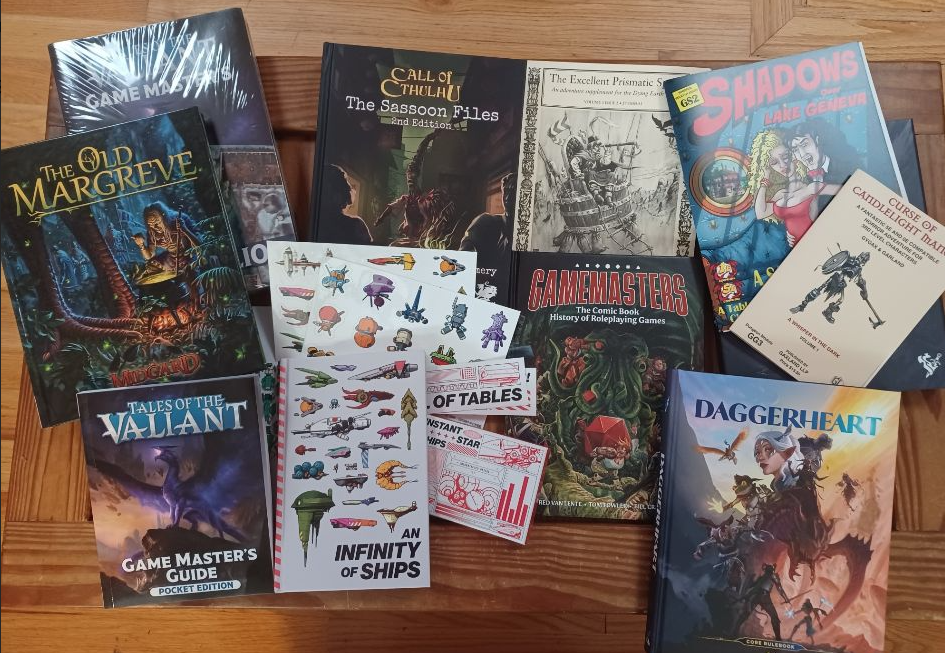
The Sassoon Files 2nd Edition by Jason Sheets, Damon Lang, Andrew Montgomery, and Jesse Covner, Sons of the Singularity 272 page hardbound, 2025. Kickstarter. This is the 2nd Edition, and I should note that the 1st edition had problems seeing print since doing a project about pre-communist China hit some push-back from printing in China. The setting is Shanghai, which is touched on all-too-briefly in the classic Masks of Nyarlathotep and gets a deeper look in The Nyarlathotep Companion. I was the Keeper on a long-running Masks campaign (Which I may someday bore the heck of everyone here by talking about it - unsurprisingly, I have things to say).

But anyway ...

Sassoon Files is really good, and attempts to capture the flavor of Shanghai in the pre-war era. It is at the time where the city is overseen by a bunch of Western powers that broke it up into rival fiefdoms, have native Chinese movements verging on a split between Communists and Nationalists in the wake of the death of Sun Yat-Sen, has a collection of local criminal organizations of varying levels of control, and is in general being a hub of intrigue and adventure in a historical sense. And add new mythos cults, deep ones, ancient mystic relics elevates the entire setting. On the down side, the timing of the adventures overlap with each other and with Masks, so the Keeper may have to do some re-orging to run everything, and while the players can throw in with gangsters or the communists, they always tend to come back to dealing with Victor Sassoon, a wealthy bon vivant with a eye towards protecting the city from Mythos threats. Hence the title.

Daggerheart Core Set by Spenser Stark et. al, Darrington Press, 266-page hardbound, boxed set of 280 cards, 2025, Midgard Comics and Games. This is the most recent of the declared "D&D-Killers" I've encountered over the years, and has an excellent pedigree with the Critical Role folk. The book is colorful, well-organized, and hits all the beats of traditional RPGs, though it adheres to the more free-form Powered by the Apocalypse/Blades in the Dark style of play (I have opinions, but that will wait for another day as well). I'm not sold on the plethora of cards that came with the rules, but that may just from previous experiences, and I'll see how well they fit into the game. So this one is under investigation. I got this from my local friendly comic shop, which has a small section of RPGs and discovered that customers were amazed they had it, since it had sold out in more traditional gaming venues. 

The Excellent Prismatic Spray Volume 1, Issue 2, 72-page squarebound, Pelgrane Press, 2001, from the collection of John Rateliff. John (known the blogosphere as Sacnoth) has been clearing out his collection, mostly on Ebay with the aid of Bill Webb, but occasionally something offers something up to the rest of the gang. This is the 'zine for The Dying Earth RPG, which is in the category of "Great RPGs I've read but will probably never play" - the gaming version of tsunduko. The game and 'zine both emulate the flowery, ornate, robust, superfluous language of Jack Vance's books perfectly, and to be frank, the game deserves to be featured in those podcasts where they talk about games that are no longer published. In addition, this particular volume contains a four-page essay by Gary Gygax on "Jack Vance & the D&D Game".

Curse of Candlelight Manor, by Heidi and Erik Gygax-Garland,  32-page self-covered digest booklet, 2023, Gaxland  Pooduction,  Shadows over Lake Geneva, A Sanguine Horror by Heidi and Erik Gygax-Garland, 32-page saddle-stitched booklet, 2023, both also from the collection of John Rateliff. Heidi is Gary Gygax's daughter, and she and her husband are continuing the family tradition. Curse is a wonderful, short, old-school style adventure written for 5E, and set in a haunted house. Sanguine is usable for both 1E and 5E, and is a modern adventure set in Lake Geneva of 1948, dealing with the old Oak Hill Sanitarium, which is one the site of now Colonial View Condos where I lived in the early 80s. I am really curious if the maps provided are based on the original Sanitarium. Both are volume 2s in a series, so I'm going to have to pick up the first volumes the next time I am at GaryCon.

Gamemasters: The Comic Book History of Roleplaying Games by Fred Van Lente, Tom Fowler, and Bill Crabtree, 112-page hardbound, Clover Press, 2025, Kickstarter. Fred Van Lente has done one of my favorite comic book series, Action Philosophers, so I was very interested in seeing what he did with the more recent history of RPGs. He covers the basics of history (sort of what you'd read in the first Playing at the World, traveling through Chess, miniatures, wargames, and the Braunsteins which birthed modern RPGs, as well as covering the more real-life salacious and scandalous adventures over the years (Dallas Eggbert, the FBI raid on Steve Jackson). But where it excels is when it starts talking about other, non-D&D RPG games, like Call of Cthulhu, West End's Star Wars and (ahem) the original Marvel Super Heroes by myself and Steve Winter. Its pretty good, though I have to note that liberties were taken in presentation (Yes, Lake Geneva had a Playboy Resort, No, there were no Playboy Bunnies at the first GenCon (At least in uniform)), and some of the stories are of the "yeah ... kinda", but its an excellent, entertaining look at our hobby and industry.

An Infinity of Ships by by Adam Good and Jamie Peters, Illustrated by Rob Turpin, 152-page digest hardcover, published by STATIONS, 2025, Kickstarter. I love the art and idea behind this one - the ability to create your own spaceships. But not a formulaic "Here is how many credits the astronavigation unit costs", but a more free-form "Here, roll on a huge number of tables and tell me what you and you players can make of it". It is more inspirational than instructive. The ships themselves range from mechanical to organic to beyond, and the AI ranges from simple servants to godlike commanders. The names are out of IMBanks novels.("for example, "This Could Have Been an Email"). It doesn't try the define the universe that these ships operate in, but in covering all types and options (and running light on operating systems), they portray a radically diverse and chaotic galaxy where there are few known constants. Still, worth hacking about with it. The Kickstarter included stickers, bookmarks, and 115 cards to randomly create ships on the fly.

... and one that arrived after I took the photo.

The Old Margrave by Matthew Corley et. al, 256-page hardbound, Kobold Press, 2025, Tales of the Valiant Game Master's Guide Pocket Edition by Celeste Conowitch et. al. 304-page softbound digest, Kobold Press, Tales of the Valliant Game Master's Map Folio, 6 24" by 36" double-sided maps, gift of the publisher. The Old Margrave is an ancient forest just to the East of Zobeck, the main city of Kobold's Midgard campaign setting. Its a wonderful forest location for adventure, and the book (for 5E and their Tales of the Valiant) has new heritages, lineages, spells, subclasses, and a huge adventure arc set in the forest. Speaking of Tales of the Valiant, the Pocket Edition of the ToV GM's Guide is a digest-sized reprint of the original book, in a handier and portable format. And while my current gaming style (sitting around a living room or online) does not use maps and miniatures, the Map Folio hosts a number of locations (Inn, Gate, Fort, Tower, Villa, Lighthouse) that can be ported into any adventure.

Ticket To Ride Legacy: Legends of the Old West by Rob Daviau, Matt Leacock, and Alan Moon, Big box of a boardgame, Days of Wonder, 2023, Gift from Ed Stark, who was out here visiting for a wedding. The original Ticket To Ride has been a go-to game for our game days on Grubb Street, and a source of contention between the Lovely Bride and the mighty Stan! This version is a Legacy game, which means that as you play it, you modify the game materials that will affect future plays. In this case, you start with the Eastern Seaboard, and work west over time, with specialized rules as you add more pieces to the game. And ultimately you have a finished version for replay. Now we just have to find a regular gaming group to meet up with, since our own gaming groups are different and on different days. Ah, the challenges of game players.

And that's it for this round. Now I settle into the more boring stuff about very local politics. Its cool if you find something else to read. I'll understand. 

More Later, 

Saturday, June 21, 2025

Theatre: What Is This Thing Called Love?

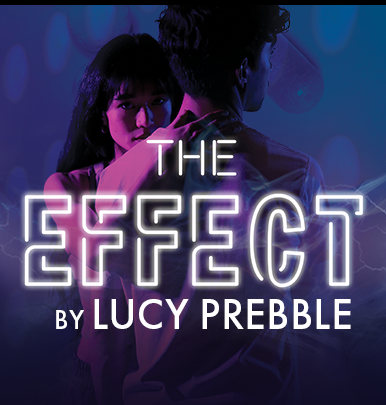
 The Effect by Lucy Prebble, Directed by Mathew Wright, Arts West through July 13

Arts West closes its season with a extremely powerful performance. The Lovely Bride took it in after an excellent Sushi dinner at Mashiko, then settled in for what turned out to be an excellent, amazing, emotional performance. This is one of those plays where I cannot say enough good things about it. 

The Effect deals with the meeting of biology and psychology. Connie (Anna Mulia) and Tristan (Morgan Gwilym Tso) are volunteers for a set of drug trials. The trials are overseen by Dr. Lorna James (Sunam Ellis) under the direction of biochemical entrepreneur Dr. Toby Sealey (Tim Couran, embracing the spirit of Steve Job) 

Tristan is a slacker who has does this before, and is there for the payout - he's flirty and nervous. Connie is a student and treats the drug trials as a personal test - she wants to give the "right answers". The drug itself elevates dopamine levels, which affects, among other things, affects emotions and falling in love.

And yes, things go off the rails quickly. Connie and Tristan fall in love. Maybe its their own doing, or the drugs or their emotions. They don't know, and it is frightening. They have their own challenges which surface in the process as they do not believe they have control of their own decisions. Lorna and Toby have their own emotional wounds driving them forward and affecting the results and what they choose to do with them. Lorna in particular is at the fragile center of the storm. Both couples spiral into anger and argument, and no one knows the truth of the matter. Are Connie and Tristan in love because of the drug or is the drug just affecting their own emotions? Are we all victims of our own biochemistry?

And it all works. The actors are frankly terrific. Their characters are human and relatable. The descent into doubt, desperation, and despair is completely believable. The dialogue is natural and often choreographed, the dancelike move of the actors. There are a lot of big ideas fighting with the big emotions in the play, and the bare-bones set of a simple raised platform, limned by neon lights, gives the actors the space to big it all home. The direction (Mathew Wright, also the Artistic Director of Arts West) fits all the pieces together marvelously. The resolution is ferocious and devastating, to the point that the stunned audience at the end was silenced for a few breaths before thunderously applauding.

It all left me shaken in a way that few plays do.

Arts West had an incredible season. Both The Effect and Covenant were among the best theater I've seen in Seattle this year. Guards at the Taj was heartbreaking, and Athena was very good (the Lovely B loved it). The weakest of the lot, the sequel to last years Snowed In, was still festive in the spirit of the Mickey Rooney/Judy Garland lets-put-on-a-show performances.

They did a fantastic job, and The Effect was the icing on the cake. Go see it. 

More later, 

Sunday, April 06, 2025

Book: An Elegy for Ellison

  The Last Dangerous Visions edited by Harlan Ellison (with J. Michael Stracynski), Blackstone Publishing, 2024

Provenance: Christmas present from the Lovely Bride, purchased off Amazon.

Review: I talked about Harlan Ellison the man back here. Let's talk about his "last work" - The long-promised collection of bleeding edge stories called The Last Dangerous Visions. 

I read the initial Dangerous Visions (published 1967) in hardback in our high school library, and purchased paperback editions of it and its two-volume sequel, Again Dangerous Visions (1972), in college. For a young person who had drifted into SF through the ABC axis (Asimov, Bradbury, Clarke), the subject matter and writing was a bit mind-blowing. It helped codify the American New Wave of Science Fiction, went after a variety of societal taboos, and kicked down the doors of tradition bolts-and-rivets SF.

Then there was a bit of a lapse of about 50 years, and only after Ellison's passing did his executor, J. Michael Stracynski (the Babylon 5 guy), organize the remaining material Ellison had, added a few stories, and finally finished the volume. 

The result is a mixed bag. Some pieces have that urgent, nostalgic, whiff of the originals ("Assignment No. 1" by Stephen Robinett and "A Night at the Opera" by Robert Wissner). Some feel like political tracks that could appear in the Economist ("Hunger" by Max Brooks). Some were utterly frightening ("The Final Pogrom" by Dan Simmons, which combines the holocaust with American Ingenuity, made more poignant by recent events in this country). Some of the best feel like recent, post-Harlan additions. "War Stories" by Edward Bryant, dealing with weaponized sharks, was brilliant in both presentation and subject. "First Sight" by Adrian Tchaikovski mixes the tropes of first contact, alien cultures, and the limits of the senses in a nice little package. But more than a few were "meh" - OK, but not shaking the earth great. And there were short "Intermezzos" by D.M.Rowles that just completely missed the mark. The art (by Tim Kirk) is a wondrous call-back to the earlier volumes, but the Ellisonesque intros (telling you WHY this story and this author are worth your time) are mostly missing. Yes, and there some typos in the text, including the punchline of Ward Moore "Falling from Grace", which needed a bit more typographic love to make the story land.

The longest entry in the book is Stracynski's own introduction/eulogy of Ellison, two parts remembrance of a friend, and two parts why-this-project-is-late. He hits the good parts and bad parts of Ellison in his travel from Terrible Infant to Grey Eminence, and offers some reasons behind his personal actions over the years. But reasons are not a denial of responsibility, and Ellison the man, the writer, and the editor, has to accept responsibility. An afterword talks about earlier incarnations of the book, and seems like an interesting collection of stories in their own right.

And the end result is ... OK. This final volume would neither kick down the doors of traditional SF (which now continues, but no longer dominates, the marketplace), nor wade onto the shores like a Leviathan, sweeping all in its path. My mind is not blown, but then, I'm no longer a teenager, my high school has been completely renovated, and the world turns and moves on. Some of the dystopian futures are all-too-real. Others feel right around the corner.

But it's a suitable memorial to a mercurial talent. Thank you J. Michael. Rest easy, Harlan.

More later,


Thursday, March 13, 2025

Recent Arrivals: Winter Festival

 So, things have been trickling into Grubb Street for the past few months. Some are Kickstarter resolutions, while other a bit of retail therapy.

The current situation is a mess as far as new game offers are concerned. The raw mess that is tariffs and trade wars threatens this entire cottage wing of the industry. We're already paying 20% over the initial investment with increased shipping costs, and it is only going to get worse. In addition to the added cost is the fact that we now have another step in the process - you order, you pay, and then you have to confirm and pay again wherever the wheel of financial fortune shows up. When I worked for Amazon, we obsessed with the idea of reducing the number of clicks needed to get somewhere. We're not doing it here, and it's going to hurt us, badly.

In any event, here are the latest things from the outside world.

Hamil's House of Oddities by Jon and Brynn Hage , Sleeping Giant Games, 304-page hardbound, Kickstarter, and Shadow's Reach by Jon and Brynn Hage  Sleeping Giant Games, 252-page hardbound, Kickstarters. This is one of the more beautiful projects to come across my transom in the past year. The main book (Hamil's) is a 5E adventure, while the Shadow's Reach is campaign, treasure, and monsters/characters. There's not a lot of text on each page, but it has a calm, cozy look to it, and really nice b/w art. This is the sort of thing I look for in Kickstarters - nice, personal products. 

Playing at the World, 2E Volume 1: The Invention of Dungeons & Dragons by Jon Peterson, the MIT Press, 374-page trade softbound, Gabi's Olympic Cards and Comics, Lacy, WA. Hang on, didn't I already get the original Playing at the World? Well, yeah, but that version covered everything, from German Kriegspiels and HGWell's Floor Games to the almost-present day. This is both cut down to the "juicy bits" about D&D itself, and expands in that Peterson has gained access to previously unavailable information. I'm looking forward to a reread (though right now on my reading list I am obsessing over the various colonial struggles in and around what is now Pittsburgh).

Triangle Agency, Normal Briefcase Collection, by Caleb Zane Huett and Sean Ireland, Haunted Table Games, Boxed set containing 300-page hardbound book, 216-page mission book, ring-bound character sheet booklet, dice, 2024, Kickstarter. I don't think I've ever been as intimidated by a game as by this one. It arrived, I opened the "Normal Briefcase" box, found it completely packed, carefully put the components back into the box, and and set it aside for when I could properly examine it. That was about four months ago. Anyway, finally cracking the game, it is pretty impressive, and fairly daunting. It is a corporate supernatural game where you are employed by the Triangle Agency to investigate anomalies. The game runs off four-sided die, but only the 3s matter. The books themselves are laid out as orientation manuals for the new "employees", and are spot-on happy-talk versions you'd find when you start at Amazon. Impressive and a little frightening.

Changed Stars by Patrice Daniel Long, Leland Andercheck, Dieselshot Express, 304-page hardbound, 2023, Kickstarter. This was definite whim purchase, but I'm pretty happy with it. SF set in the future of the Orion Arm, where humanity expanded out, acted like a bunch of militaristic a-holes, lost the war and was transformed into less a-holes. Original system, diverse alien species, lots of cool-looking ships, a very Star Trek Next Generation meets Traveller vibe. Merits a more thorough read-through.

Aetherial Expanse: Setting Guide by Joe Raso (project lead) and James J. Haeck (Story), Ghostfire Games, 294-page hardbound, 2024, Kickstarter. This one has an interesting provenance - it is the campaign setting book for a series of pdf adventures. But it is also another take of D&D IN SPAAAACE, so I'm naturally interested in it. Space in this case is an astral sea dotted by various island nations. They look like they've expanding in how to handle ship movement and combat within the D&D system (though I've been partial to the methodology laid out in Secrets of Saltmarsh, no one else seems to have picked up on it). Ship hit points seem a bit light, but I can do a bit more digging on that.

The Grey Knight by Larry DiTillio, Moon Design Publications, 84-page hardbound, 2024 (original 1986), Gabi's Cards and Comics, Lacey, Washington. I can't say a lot about this one, since a colleague is running the original version of this adventure using original Pendragon rules (character generation was complex for the time). This looks like it has added some additional material and tied it in more tightly with their starter set. The graphic quality is high. But I'll wait until our current campaign wraps before delving too deeply into it.

Arkham by Mike Mason, Keith Herger, Bret Kramer, Chaosium, 268-page hardbound w/ two full-color maps and a facsimile newspaper, 2023, Gabi's Olympic Cards and Comics. Another whim purchase and a good one. Arkham was HPLovecraft's setting for many of his stories. He did a sketch map for it, which was expanded by others (most notably cartoonish Gahan Wilson), each new version adding stuff to it. Chaosium has done several editions of the town, and this one is probably the best yet. Not only does it have a lot of the characters, locations and creatures of the haunted city, but also a lot of good info on how to use all this information and playing characters in the 1920s. Eminently browsable. 

Urban Shadows by Mark Diaz Truman and Marissa Kelly, Magpie games, 320 pages, 2024, Kickstarter. This is 2nd edition of the game, the first being 10 years previous, much like the current D&D. Powered by the Apocalypse, and hews more tightly to all the options presented there than, say, Brindlewood Bay. We have moves, we have play books, we have a lot of player empowerment. Has a heavy scent of the World of Darkness in its urban fantasy with factions as different character ancestries. The interior is very, very purple, but it is an impressive volume, 

Swyvers by Luke Gearing and David Hoskins, Melsonian Arts Council, 96-page hardbound, 2024, Kickstarter. This is an odd and amusing little duck. deep in the alleys of a Londonish fantasy city. Players are thieves and knaves of the worst sort. The rules are light and portable, and the book is filled with random tables. Also, you play blackjack to cast spells. Yeah, this is not too deep, and good for making stuff up as you go. The included adventure involves cheese thieves. Production values are nice and fit the setting well. Worth trying out once or twice. 

Found Worlds by Todd Lockwood, 352-page hardbound, Gift from a Friend. An art book? Here? Sure. Todd Lockwood is a brilliant artist, and an excellent heir to the classic TSR Artdogs. The book covers the full career, but of course the stuff that connects with me is the TSR/WotC material, particularly in crystalizing the look and feel of 3E. Heavy stock, beautiful colors, captures the detail o his art.  

That's if for now. I'll be heading for Gary Con next week in beautiful Lake Geneva Wisconsin, and may have a bit more after that.

More later,