Showing posts with label Tolkien. Show all posts

Saturday, January 25, 2025

Theatre: Jack and Tollers

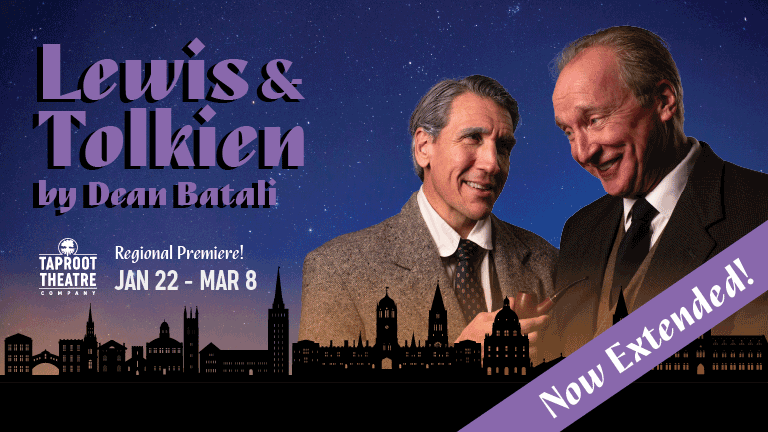
 Lewis & Tolkien by Dean Batali, Directed by Karen Lund, Taproot Theatre, January 22- March 8 

CS Lewis and JRR Tolkien. In the real world, they were compatriots, fellow professors, members of the Inklings writing group, occasional pranksters, and good friends. In the world of fantasy literature, their followers and fans rival the Tupac/Biggie rivalry. I will admit I'm on Team Tolkien, but let me back up a moment for some background before weighing in on the play itself.

The Lovely Bride and I had a busy Saturday, with Tai Chi class in the morning, a light lunch at the Greenwood restaurant Razzi's, then joining up with friends John and Janice for this play. Then we had additional errands (grocery shopping, getting more bird seed and cat litter), before returning home. At our age, that's a big day.

And we got to break in the Isaac Studio Theatre, which is a nice, smaller venue than the main Taproot Stage. I've described Taproot's main theater as a jewel box with a thrust stage and 225 seats. The Isaac is even smaller with 150-some seats laid out in a more traditional manner with a high-rise of comfortable seats looming over a small stage. Perfect venue for a play about two men in a bar. Lewis and Tolkien reunite after many years apart at the Eagle & Child, their favorite pub, to reminisce, reconnect and settle a few old scores. 

Now, my mental image of Tolkien, supported by interviews over the years, is that of a scholarly Hobbit. Brilliant in his chosen field (Middle and Old English), who in his spare time side wrote what would become defining books of British Literature. He sits there in a highbacked chair, smoking a pipe and discussing Beowulf. Not something for dynamic playgoing, I will admit. So I had make some strong mental adjustments for both the Tolkien and Lewis as presented on the stage. 

Jeff Allen Pierce's Tolkien is much more animated. Gruff, grumpy, and defensive. More conservative and Catholic than usually presented. Tolkien and Lewis were both religious, but from his writing, I always put Lewis down as being more hard-core to his faith. Narnia, Perelandra, and the Screwtape Letters all drip with Christianity. Tolkien's works were also extremely moral, but he lacked all the bells and whistles, or rather, the allegory, found in Lewis's works. The play's Tolkien is much more emotional, loud, pedantic, and often loud.

Lewis (Peter Cook), on the other hand, is more aloof, controlled, and professorial. He comes off as the more cerebral of the two, more in command of his emotions. He is more in line with what I think of as a Oxford Don. He comes off as man hurt by the end of their friendship, but has let the years scab over it, while Pierce's Tolkien still grapples with the situation. Of the two, he is the better man.

Both actors are good in their roles, as is Chloe Michele as Veronica, a waitress of the bar, whose character is often referee and audience for their set-too. She pops in regularly both to take the edge off both men, and break up the back-and-forth as they argue. 

The play succeeds when talking about the relationships between two men who have grown apart. The Lovely Bride got it and was moved the by tragedy of their breakup and the hope of restoration. For my part, I had to turn off the part of my brain where I kept comparing the two against my imaginary versions and instead broke them down into component parts - effectively, a priest and a rabbi walk into a bar. And in those terms, it worked.

Also, forgive this pedantic digression, but when you say someone is an apologist, it does not mean in these circumstances that they are sorry for what they may have done. Rather they are offering a reasoned argument for someone. That's unclear in many cases, but the Apology of St. Paul (Acts 22), for example, is not that he's sorry for being a Christian, but a thoughtful explanation of Christianity.  We toss the word around here a bit assuming that the audience would pick it up correctly, but I don't know if that's the case.

Anyway. Was it a worthwhile afternoon? Yep. Did it work as a play? Also yes. Should you go see it? Yes - the Saturday matinee had a full house and has already been extended two weeks. But as history, even as historical fiction, it fails to live up to expectations. And mind you, expectations were high.

More later, 


Thursday, September 05, 2024

New Arrivals: Lull Before the Storm

 I picked up a lot of stuff at Gen Con (including Covid) back in August, but I want to deal with the stuff that came into the household before that. Because there's just so much stuff from Gen Con (including Covid).

There are a lot of independent RPGs in this collection, and one big chunk of D&D history. Let's take the tour:

Troika! Numinous Edition, by Daniel Sell, Melsonian Arts Council, 2023, 138-page Digest-sized softbound, Purchases from Mox Boarding House in Bellevue. I've seen some references to Troika and Troika-related projects elsewhere, but never has a clear line to purchase. So when I saw it a the Mox, I picked it up. And even by Roleplaying Game terms, Its a bit ... strange. Sort of two parts Jack Vance and two parts Doug Adams. Character creations is flavorful, and ranges from giants from a lost empire to trepanned Zoathrops that have abandoned sentience. The rules themselves are relatively straightforward, with a 2d6 to resolve most tasks. The provided adventure is to reach the top floor of a hotel. It is a delightfully weird little oddity that is a shining example of an independent RPG. I'm going to keep my eye out for related projects.

Mork Borg by Pelle Nilsson, Ockult Oktmastare Games/Stockholm Kartell/Free League, 90-page digest hardbound book, 2024, Purchased at The Game Shelf in Kent. Mork Bog (Swedish for Dark Fort, and pronounced Murk Boriy, like that helps) was one of those games that took the indy RPG field by storm a few years ago, winning a host of awards, and spinning off secondarty games right left and center. I had picked up Pirate Borg, and on Steve Winter's recommendation, went after the source. And Wow. The yellows. The horrible, pulsating yellows. Mork Borg is an art game where the presentation attempts to overwhelm that is presented (and sometimes succeeds). The rules are solid, with a very 3E sensibility (4 attributes, 3d6 rolls, but then convert to a table for the ability modifier). The world is serious heavy metal grimdark, and probably one of the most heroic versions of it I've seen.  That part is excellent. Good game, but oh god, the yellows.

Knave Second Edition by Ben Milton, published by Jacob Hurst and Swordfish Ilse, 2024,.80-page digest hardbound book, Kickstarter. This is a nifty little alt-OSR, which put original D&D in the blender, sieved out the crunchy bits, and then simplified those bits. A lot of old rules with altered effects (like Wisdom being used for ranged weapons, or Charisma Bonuses used for initiative checks) and a really nice way to bring encumbrance back on-line (which I'm seeing elsewhere). Milton pulls his inspiration from a lot of previous OSR material, and then credits accordingly. And in doing so, his alterations create an entirely new game system within an established set of expectations. That's nice. Worth checking out.

Deadpool Role-Plays the Marvel Universe, Cullen Bunn and Michael Shelier (Comic), Cullen Bunn and Matt Forbeck (Game adventure and stats). 48-page comic book, 2024, Purchased at Midgard Comics. This was a bit of surprise treat, spotted on the shelves of my Friendly Local Comic Store, And I think this sort of thing is important to get out there. My early Marvel Super Heroes carpet-bombed the hobby market with a lot of short, diverse modules that captured shelf-space and told the players that there was a big world out there to play in. In addition, DRAGON magazine regularly did The Marvel-Phile, which gave the stats for a slew of esoteric characters (Howard the Duck's Iron Man armor, for example). The comic-book format used here has the potential to do the same for the latest iteration of the license. The first 8 pages is a story is where Deadpool puts together a band of lesser-known mercenaries for a job, while the remaining pages is a starter adventure that sets the recruits into action. They need to find out what happened to the other mercenaries and henchmen being kidnapped. Told through Deadpool's voice and mannerisms, it is a light, fun adventure, and a good intro to the system. Marvel would be well-rewarded to do more of this, or even to put game stats in the back of their regular books, instead of a gimmicky QR-Code. Just sayin'.

Musketeers vs. Cthulhu by M. Bill Heron, Nightfall Games Ltd. 112-page Digest hardback 2020, Kickstarter. This is an amusing set of adventures (for 7th Edition Call of Cthulhu) based on a short story by actor Claudia Christian and Chris McAuley, who co-created the Stokerverse, which had its own RPG mentioned here. Set in the time of Louis XIII, the adventures are very sandboxy and setting based, but do not have to follow linearly from one another. The Court of Chaos, ultimately backed by Nyarlathotep, plans the overthrow of the King. Your job? Stop it from happening. The setting includes most of the characters from the first book, as well as such things as deep ones and werewolves. The Kickstarter had a collection of extremely useful maps. Plus the four musketeers as potential PCs. A tidy little package that I could throw my regular CoC crew into.

Moria: Through the Doors of Durin, By Gareth Hanrahan, Free League, 228-page Hardbound book + full-sized map, 2024, Kickstarter. Free League produces some wondrous-looking books, and this one is no exception. Tolkien himself never drew up maps of Moria, so all of this is "lateral development" and non-canonical, but it is so cool-looking. Set in the era of the One Ring RPG between The Hobbit and The Lord of the Rings, it provides a variety of locations within (and nearby) the dwarven mines as the original dungeon delve.

The Making of Original Dungeons & Dragons 1970-1979, Jason Tondo (Project Lead), Wizards of the Coast, 578 Page hardbound book, 2024, Gift from a colleague at Wizards. This is a massive tome that is a wondrous stroll through the original material of D&D. It is an upsized reprint of the first six small booklets of D&D, along with other material. I still have the (worn, coverless) originals downstairs, but these up-sized versions give folk fifty-years-later the idea of what we had as our original Burgess Shale of gaming. More importantly, there are reproductions from gaming 'zines of the pre-D&D 70s, internal correspondence, and most importantly the early drafts and notes on the game before production. All in all, and excellent dive of primary sources for the gaming historian.  

The Wildsea Expansion: Storm and Root, Felix Isaacs and others, Mythworks/Quillworks Studio, 304-page Landscape formatted  hardbound book, 2023, Kickstarter.  The Kickstarter included the scenario One-Armed Scissor,(30 pages) the expansion Ship-Gardens (38 pages), and the scenario Red Right Hand (46 pages), along with sent of six 6-sided "Cthonic Dice" (not shown, arrived at the house after the picture was taken - ah, the vagaries of  Kickstarters). I find Wildsea both interesting and challenging. It is set in a world where toxic vegetation has run wild, and players pilot chainsaw ships through the upper canopy of trees. As such, the world has some similarities to my ancient Storm Front proposal. But it is a complex, alien world, and uses a descendent of the Forged in the Dark and Powered by the Apocalypse systems, which makes it even more of a challenge to this venerable grognard. These expansions push the boundaries back, with both flying craft and submarines (sub-arboreals?), adding a lot more depth (sorry) to the world. In addition, it further helps with adventures and more detailed working. I don't know if I will get a chance to play Wildsea, but I find it fascinating in its creativity.

OK, that's it. Have to delve into the GenCon collection next. Stay tuned. More later. 

Sunday, August 21, 2016

Fifteen Authors

So, there's been a meme rolling around the facebooks about fifteen authors who have influenced your work. And while my name has been dropped a couple times (which is appreciated), I have not yet been tagged. But I do have my list, and am putting it here, since it requires a few more comments than I would want to burden the nets with.  The thing is I wanted to think about authors that influenced me, and note how they did so.

Here we go:

Mark Twain (Samuel Clemens)  is the quintessential American Author, and the first one that left his mark. Read Finn and Sawyer and Yankee in my youth, and devoured as many of his short stories as a man could humanly consume and still leave room for desert (though for the life of me, have never been able to finish The Innocents Abroad). Returned to the books I read as a kid and found so much more there. His satire was biting, and his writing style was natural and colloquial - you imagine him sitting on the front veranda listening to him spin a tale, a thimbleful of brandy untouched on the settee next to you because you don't want to interrupt him by reaching for it.

J. R. R. Tolkien is of course at the foundation stone for any western fantasy author of the past forty years. Grandfather Tolkien distilled the mythology of Northern Europe into stories that epitomized the middle of the Twentieth Cent. Gary Gygax always denied that he was influenced by Tolkien in D&D, and I believe him. But the the other influences he did have were niched or out of print by the time the game arrived and unknown to his market, while Tolkien was not. Plus the fact that the races available to the players (and therefore their first experience with the game) were directly out of the Council of Elrond. From Tolkien we get the epic nature of fantasy, the intensity of world-building, the ensemble as a fantasy trope, and, for good or ill, the idea of fantasy lives in trilogies and is sold by the pound.

Ursula K. Le Guin is my anti-Tolkien. Compact, neatly plotted, and personal, her fiction is stands in comparison with the massive triple-deckers that docked in the bookstore shelves in the 80s and 90s (a few of which I might have penned). Earthsea's first three small books in particular was delightful for what it did not reveal as opposed to what it did - there is worldbuilding here, but it did not get in the way of the characters. Loved Lathe of Heaven but could not get my teeth into Dispossessed.

P. G. Wodehouse should be of no surprise to those who have encountered Giogi Wyvernspur and Tertius Wands. I came upon Wodehouse early in my marriage, at a time before the Fry and Laurie version on the TV, when knowledge of the pair was more limited, and found Woodhouse's banter delightful. The saying is that Wodehouse wrote one story for sixty years, but his plots really were as convoluted as a door-banging French farce, and the raw pressure moving the story forward is incredible. The one to read is Code of the Woosters.

Hunter Thompson probably is a surprise (or not) because of his drug-fueled cynicism and habit of installing himself in his nonfiction. I found him when he was writing for Rolling Stone and I was in college. He is responsible for my use of the word "mojo wire" for any form of electronic communication. Foul-mouthed and observant, his best is Fear and Loathing on the Campaign Trail '72. A cleaned-up version of him (with more than a dash of Chicago columnist Mike Royko) showed up as the protagonist in Liberty's Crusade.

Arthur C. Clarke brought me into SF in junior high. In the Titusville Library, I found a copy of 2001: A Space Odyssey, which started with the line: "Behind every man alive now stands thirty ghosts". (It's wrong, but it's a great opening line). Loved Childhood's End (though it seriously creeped out the Lovely Bride). His short fiction, collected in books like The Wind from the Sun and Tales of the White Hart, is where he is at his best. I love how he could put a stinger in his final line of a story ("If any of you are still white, we can cure you").

Ray Bradbury, on the other hand, is the lyrical master, the wordsmith, the Norman Rockwell taking small-town America to the stars. Martian Chronicles was the one that kept coming back to me, stitched together of  published stories and vignettes to create an interplanetary How the West was Won. He is both comfortable and chilling.

Harlan Ellison is like Clarke in that he is a master of the last line. There was a time when EVERYTHING he wrote was in print and available on the shelves at Von's bookstore in West Lafayette, Indiana. He excelled at short stories, but gains his status here as an editor - I discovered his Dangerous Visions earlier in high school, and had my mind blown by the borders of SF being pushed back. His career has gone from terrible infant to grey eminence, but he has been my favorite sort of writer - a working one.

Dashiell Hammett and Raymond Chandler are a matched set for me, and I will get the two confused. Hammett gave us characters like Sam Spade, Nick and Nora Charles, and the Continental Op (who is a favorite for me). He encapsulated noir, where the hero suffers for doing  justice. Chandler taught me the importance of location as character - his stories of Phil Marlowe made LA (legendary from the Gertrude Stein quote of having no "there there") into a character. Chandler also wrote what is to my mind (and a bunch of other people as well) the best opening paragraph ever:
There was a desert wind blowing that night. It was one of those hot, dry Santa Anas that come down through the mountain passes and curl your hair and make your nerves jump and your skin itch. On nights like that every booze party ends in a fight. Meek little wives feel the edge of the carving knife and study their husbands' necks. Anything can happen. You can even get a full glass of beer at a cocktail lounge. - "Red Wind"
He evokes the setting, but the undercut at the end, the joke, the punchline is what drives it home.

Frank Herbert wrote one of my favorite SF books: Dune, and for that if nothing else he deserves his place on the list. There is so much stuff going on here: Adventure Fiction, Man against Nature, Coming of Age, Strong Female Characters, Court Intrigue, Mysticism, Utopia, Dynastic Revenge, Cultures in Conflict, all wrapped up in an epic tale on a distant planet in the far future. It is what I was shooting at with The Brothers' War - a huge book that did not feel padded. Dune was muscle tissue all the way through. For me, it was a perfect book that could have just stopped there. The sequels were OK (Children of Dune was excellent), but the longer it went, the more of the life was bled out of it, and I never followed up on the authorized postmortem texts. Always the book I pick out from the shelves  on a whim and then find myself fully rereading.

William Gibson is the author I read in hardback. I may know his literary moves by heart these days, but starting with Neuromancer he has charted a course in the future that has looped, by sharded realities, back onto the present. Again, he's a master of the first line, building the world and encapsulating it on the welcome mat. "The sky above the port was the color of television, tuned to a dead channel". Not "a" television, but just television. The rest of the world just follows naturally.

Barbara Tuchman represents for the Non-Fiction-Authors for me, her A Distant Mirror is as meaty as any Tolkienian Appendix. She managed to pull off both common life and political machinations, and influenced my part of Cormyr, a Novel with Ed Greenwood (I wrote the past chapters, he wrote the modern stuff). Daniel Boorstin's The Discoverers and William Manchester's A World Lit Only by Fire also deeply inspired my work and worldbuilding.

George Orwell and Sinclair Lewis round out my fifteen, as they both fit in my mind as "political writers". Animal Farm is Orwell's best to my mind, while I found his Down and Out in Paris and England to be excellent, it arrived late in my own career arc. Lewis's Babbitt I read in high school and keep by my computer just to plunge into a few paragraphs of his pithy observations of 1920's booster-ism and American life. Sort of like the News from Lake Wobegon with more teeth.

There were a lot of near misses. Just recently discovered Nero Wolfe, devouring his work with the passion of a mid-life fling, but cannot call him an influence. Patrick O'Brian's naval stories define the genre, but reading them was something I picked up from Margaret Weis, and except for one short story, that potential influence lies unrealized. Zelazny's Amber Chronicles (the first five, thank you) were just nudged out by Dune. I like Lovecraft yet cannot fully embrace his nihilism. I cannot endorse C. S. Lewis without confessing I never read Narnia. I enjoy both Howard Waldrop and China Mieville but cannot say they have been influential. Bill Burroughs pushes out beyond Hunter Thompson into stranger lands. I will confess that, when left alone in the house, I will pull a copy of Allen Ginsberg's Howl I purchased at City Lights bookstore in SF off the shelf and read it aloud, scaring the cats.

 Of my own ragtag bunch of colleagues and contemporaries, Lester Smith and Rob King's work will be discovered and discussed long after our fantasy realms are forgotten, and Margaret Weis and Tracy Hickman embody Chandler's exhortation to "exceed the limits of a formula". Troy Denning and Doug Niles will be rewarded for their long labor in the literary fields in some retrospective. And in the aforementioned Cormyr, Ed Greenwood did a fly-through of a second-story restaurant in Arabel that has nothing to do with the plot but is just flat-out brilliant. But they are the writers of my time and place, and my considerations of their works are wrapped up with late-night conversations, parties and volleyball games, and drinks at a Lake Geneva bar, their influence more than just words on paper, and that very personal connection takes them off the list (with my apologies).

Those are my fifteen. What are yours?

More later,
Wednesday, December 31, 2014

On Hobbits

It has been a couple weeks now, and a lot of people have talked about it, and our group has weighed in on it, including our resident Tolkien expert, John Rateliff. But be warned - this has spoilers within, great and small, regarding the conclusion of The Hobbit films from Peter Jackson, The Battle of Five Armies. Some you've seen before, elsewhere, from others, but these thoughts a mine and belong to me. And in general, I liked the film.

There, I think I've gotten past the amount that gets cut and filled for other platforms. Let us get down to business.

1) I think it is pretty clear that Movie 2 (Desolation of Smaug) and Movie 3 (Battle of Five Armies) should be viewed as one film. One 6 hour film, where you get to get to break for lunch in the middle of it. You are dropped into the middle of a film - no background, no flashbacks. Smaug is descending on Lake Town and Gandalf is held prisoner by the Necromancer. Boom. There you are. If this is your first Hobbit movie, you'll be more than a might confused. And that's OK, as long as you know what you're getting into. We don't get an expositional character summarizing the story so far or a narration. I'm good for that.

2) By the same token, you do feel like you've come into the films a couple reels in. The pacing is definitely that of the middle part of the movie, that the characters are established, the basic goals and motivations are laid out, and all that results are pulling off the reveals and resolving matters.

3) And to that end, Smaug dies fifteen minutes in. I did mention spoilers, didn't I? Yeah, it fits with the timeline for the book, but after two movies of how powerful Smaug is, he's not even the big bad for this one. Sort of a Boba Fett ending for him. You never get the feeling he lived up to his potential.

4) And speaking of big bads, who IS the bad guy of this film? The Necromancer, who is chased off about half-way through the film? Or the two orc leaders, Sword-Arm-Orc and Orc-with-Metal-Plate-In-His-Head? The sense of greed that turns Thorin against the others?

5) Taking down my copy of the Hobbit, Movie one was about 100 pages, Movie two was 100 pages, and this movie covers the last 50 pages. Yeah, we're looking at padding.

6) And you can see the padding. There are a lot of repeated sequences (Bard rescues his family, Thorin yells at people trying to help him, Bard gives Alfrid a task, and he immediately shirks it). And the battle sequences of "character-facing-certain-destruction-but-suddenly-someone-you-had-forgotten-about-arrives-to-rescue-them" actually get wearing after a while.

7) Let's be frank - most of the movie is the battle, and staging a single battle is tough - a lot of sides, a lot of protagonists. Let's give points for the attempt. But one of the reasons for the frequent swoops into Thorin's mindset and comic relief, and Bard's family is to make it more than just cgi animation of orcs and elves fighting. But it feels weird to have so much of this happening in the midst of battle.

8) The bulk of the film feels like a game of Warhammer miniatures. Part of that is because of some of the visual source material - in the early seventies, Workshop was selling LotR miniatures, and the tall-helmetted, metal skirted elves were part of the look. So yeah, this is part of the Tolkien property but it feels like Workshop. At least the orcs weren't green, but that may be Warcraft thing these days.

9) Yeah, the whole pacing of the battle does feel weird, but remember that Tolkien passed over much of this by keeping the focus tight on Bilbo (and Bilbo unconscious for part of it). We have the dwarves in the mountain. Then the humans reoccupy Dale Town. Then elves show up, surprising both groups. Then the dwarf army shows up, surprising the elf army. Then the goblins show up from underground, surprising all previous groups, then the Gundabad orcs show up to hammer the exhausted allied armies, but THEN the Eagles show up to handle the orcs.

10) But I will admit it makes me amused to see that Radaghast gets the final "And then a new group comes to rescues the others" sequence. He's like the final closed parenthesis.

11) Did it feel like Dale Town got bigger in its architecture as the movie went on? It was ruins, but it seemed to get taller and more impressive over the course of the attack.

12) I've got a new game, called: "What can Legolas ride?" Can he ride a shield down the stairs? Yes he can. Can he ride a manbat of Gundabad? Yes he can. Can he ride a siege troll? Yes he can. Can he ride a disintegrating tower? Yes. Yes he can. Is there anything this elf cannot ride?

13) Oh, and elves are apparently stronger than stone itself. Tauriel takes a battering but survives. Legolas literally smashes apart the tower in his battle. This may be the original source of the problem between elves and dwarves. The dwarves wanted to use the elves as battering rams.

14) Orcs, on the other hand, are 1 minus 1 HD. Bilbo could take them out with a rock. With. A. Rock. But apparently they level up fast.

15) I know this is a minor point, but where the heck did Thorin and company get the battle rams? I know that's a gnat to strain at when, moments before, the dwarven army, driven to the brink by the orcs, suddenly gets rallied by the appearance of twelve reinforcements. But it was a big question in my office.

16) And the entire Dead-Orc-Beneath-The-Ice sequence? Did it remind anyone else of Glenn Close in Fatal Attraction?

17) Tauriel lives through the film, which surprised me at first blush, then made sense. We had Fili and Kili dying from the book, their deaths being a big part of the movie. We needed someone to directly morn them. One of our group mentioned that they could do the "ongoing adventures of Tauriel" as a result, but I think that unlikely.

18) And let me give Jackson points for wrapping things up with one ending. Even with previous movies in the series, I figured it would end two or three times before it did. This one ends when it ends, even if it does have to do a tie-in to the later LOTR. OK, Jackson gets that one.

19) And there was a character named Tosser Grubb in Hobbiton, according to the credits. No relation.

20) And when is all said and done, I think would like more Hobbit in my Hobbit. Bilbo sort of hit his high point in the last film, and is reduced to worrying about Thorin and delivering warnings here. In the book as in the film, he is knocked out a critical moment, so in the novel we don't have to work through all the boring parts of a battle. Of course, we the viewer still get to be a part of the battle in the film.

In the end, I enjoyed it, but it was tied to the fact the I had to rejigger some initial assumptions that were pretty clear at the beginning. This will probably fit better once everything is on DVD or viewable as a single experience, but as a film itself, it was a perfectly fine ending for the series.

More later,

Wednesday, July 22, 2009

Mythopoeic

Good friend John Rateliff, known more often in these pages as Sacnoth* has won a Mythopoeic Award for his magnum opus, The History of the Hobbit, which is divided into two books: Mr. Baggins, and Return to Bag End (Also available as a set with the original The Hobbit).

Here's his announcement and acceptance speech.

Huzzah for Mr. Baggins!

* And yeah, Sacnoth Valley in Eye of the North? That's where the name comes from. Though originally it's from Lord Dunsany.

More later,

Wednesday, September 12, 2007

Important Notice

OK, since I've been depressing the hell out of you folks for a while, here's something to look forward to:

Tuesday • September 25 • 7pm
John D. Rateliff
History of the Hobbit (HOUGHTON MIFFLIN COMPANY)
Reading & Book Signing
University District Store
Join us with Seattle scholar and writer John D. Rateliff to learn a little history of the hairy-footed heroes of a beloved book. The History of the Hobbit is the definitive work on the evolution of J.R.R. Tolkien's classic work of fantasy. The little seen early version of the book—Tolkien's "fireside reads" to his young sons—appear in the boxed set, as do some unpublished maps and illustrations.

John's work, which pretty much is the working definition of magnum opus, was published in the UK in two volumes: Mr. Baggins and Return to Bag End. I can't give a proper review of this tome only because the lovely bride snagged it from me soon upon arrival.

Anyway, John's got a signing!

More later,

Thursday, May 17, 2007

Mr. Baggins

Just a quick note, as I have just returned from Pittsburgh (more on that later). But I was delighted to find that my copy of The History of the Hobbit - Part One: Mr. Baggins by my friend John D. Rateliff has arrived from Amazon-dot-co-dot UK.

Color me delighted.