Showing posts with label Movies. Show all posts

Sunday, July 05, 2026

Book and a Movie: Kick in the Pance

 The Benson Murder Case by S.S. Van Dyne, Charles Scribener's Sons, 1926

The Benson Murder Case, Directed by Frank Tuttle, Paramount Pictures, 1930

Provenance: Picked this up at the Page Turner, Kent's expansive used and new bookstore. It particular book also happened to be of the collection of Sacnoth, who had been cleaning out his shelves over time. He in turn had purchased the book in 1996 in Madison, Wisconsin (he tends to annotate all his books). This book was one of my "waiting books" - read when I'm waiting for an appointment, or for friends to show up at a restaurant. As a result, I may get two or five pages in before I have to put it aside. So the "waiting books" will be carried around for a while in a deep-pocketed jacket before finally getting finished.

As for the movie version, Sacnoth and friends watch old movies on Saturdays when we are not playing Call of Cthulhu, and have gone through all four of the William Powell Vance movies. While the book is the first of the Vance Vance novels, the movie version was the third starring William Powell. 

Reviews: As the first Philo Vance novel, and it is interesting in what it shows and what drops away later in the series, as well as changes made for the movies. Philo Vance is one of the elite dilettante school of detectives (Lord Peter Wimsey beats him out, since he first showed up in 1923 and who, like Vance, has a friend in law enforcement that allows him access to ongoing cases. 

In the case of the book, Vance's bud, District Attorney Markham is approached by an old and respected friend to investigate the death of his brother, who was his partner in a stock firm. The brother was found seated in his chair in his living room, dressed in his smoking jacket, shoeless and without his toupee, shot through the head. There was a large amount of evidence cast about, and the DA and police go through several suspects, all of which get proven innocent in turn by Vance.

Vance rejects such trivialities as facts and evidence and concentrates on the psychological nature of the killer - what sort of person would kill Benson in this matter? He claims to know the murderer from the get-go, but dances about, demonstrating to the DA that the latest prime suspect fails the test for some reason or another. In fact, he seems to delight in proving the agents of law enforcement wrong, all the while concern trolling their predicament. He's a bit arrogant about the whole thing.

The Van Dyne who is the narrator claims that position as being Vance's lawyer, and is only telling the tale now because Vance has retired to Europe. In the book, he serves no purpose as a character but to declare Vance as being brilliant and noting the growing frustration of the DA as Vance shows off one blind alley after another. Vance in this initial book comes off as insufferable, such that the DA (and the reader) just wants to shout "give us the answer, already". He actually becomes more likeable in later novels, but still absolutely sure of himself.

The movie, on the other hand, junks about everything except the title, Vance, and some of the supporting cast. Our invisible narrator did not make the transfer. In addition, the movie version riffs off the recent stock market crash. Benson is confronted with a bunch of clients who have lost money and are fed up with his shenanigans. Benson then retires to his country house and is shot. And it turns out Benson lives right next door to his good friend DA Markham, who brings along Vance to investigate. And one of the suspects says that Vance just got lucky in a previous case and challenges him to find the real culprit.

Which of course, he does. But he does it with a bit more grace than his novel incarnation, and more attention to the little facts and clues. He uses less psychobabble in his  explanations (I swear, the last chapter of the book is filled with his explanation of why the killer HAD to be a certain suspect, in part because women are not cool-headed enough to shoot a man accurately in the head). The movie version really hinges of William Powell's performance, who makes Vance actually likable. You can see the bits and bemused  mannerisms that he will bring to the Thin Man movies (and yeah, he's more likeable there than in the original book version as well).

So yeah, the novel is a time capsule - Vance was incredibly popular in his time, and the line "Philo Vance needs a kick in the pance" from Ogden Nash (of limerick fame) in 1931 just underscores the both the character's popularity and division he presented to readers. The movie version is traditional for its era as well, but a lot easier to swallow and worth hunting down if you're a fan of old pre-code Hollywood.

So yeah, check out the movie if you have a spare afternoon. The book? Only if you have a deep interest.

More later,


Tuesday, November 18, 2025

Books: Seattle Time Capsules

 Seattleness: A Cultural Atlas, by Terra Hatfield, Jenny Kempson, and Natalie Ross, Sasquatch Press (at that time part of Penguin Random House), 2018

Filmlandia! by David Schmader, Sasquatch Books (at the time part of Penguin Random House, but soon to be sold toe Blue Star Press and given its freedom), 2023 

Art In Seattle's Public Spaces by James Rupp and Miguel Edwards, University of Washington Press, 2018

Too High and Too Steep: Reshaping Seattle's Topography by David B Williams, University of Washington Press 2015

The Mushroom Hunters by Langdon Cook, Ballantine Books, 2013 (paperback 2023)

Seattle Noir edited by Curt Colbert, Akashic Books, 2009

Provenance: Various. I believe Seattleness and Art in Seattle's Public Spaces were gifts from the Lovely Bride (Seattleness has a Half-Price Books sticker on it). I found Too High and Too Steep at the Elliot Bay Bookstore when it was in Pioneer Square, The Mushroom Hunters was recommended by colleague Wolfgang Baur, and when I couldn't find it locally, ordered it from Amazon. Seattle Noir was a whim purchase at Barnes & Nobles when I was looking for something else, but it was shelved face-outward and caught my eye. I have no memory of where I found Filmlandia! - it just showed up one day and refused to leave until I read it. 

The Reviews: Books are times capsules. They can't help it. As soon as the last word is written, the final change is made, and the switch thrown and the electricity pumped into the presses, they are frozen in amber. They can be revised, they can be rewritten, but the sheer physicality of the book gives it permanence that no computer file can match. Historical books are trapped not only by their subject matter, but also that they represent the thinking of their times. Even those that want to be current (in PARTICULAR those that want to be current) are stopped at the point when they are finished. 

Anyway,

I've lived in Seattle (OK, a suburb of Seattle) for longer than I've lived anywhere else. I've got my 25-year chip, which allows me to complain about new people moving into the state. But I still have that newcomer's vibe of interest in the area, and picking up what I may have missed before I got here. So I've been accumulating books about Seattle, not out of a passion, but just finding them along the way.

So here are some books about my current home town:

Seattleness: A Cultural Atlas is an infographic book, in that it takes stuff about Seattle and its history and presents it in a variety of graphics - charts, maps, and tables. Some of them are cool. Some of them are obscure, some of them are historical, some of them are time capsules in that they are no longer applicable (listing of pinball parlors in Seattle, most of which are gone).

The infographics are good-looking, but are often more graphic than informative, and you have to do a little digging to understand what they are saying. But, it is immensely browsable, and worth keeping around, even as it slowly moves into the past. 

(They do hit on one subject that always irritated me - they talk for several pages about Shadowrun's Seattle. In the Shadowrun future, a virus transformed a large part of the population into orcs, elves, and dwarves. The orcs took over the Underground. The problem is, the REAL Underground (and Seattle has one), is located beneath Pioneer Square (created when they raised the streets), and FASA put a corporate pyramid on top of it. That's a nit, but in its defense I will point out that FASA, Shadowrun's publisher, was based in Chicago at the time.)

Filmlandia! A Movie Lover's Guide to the Films and Television of Seattle, Portland, and the Great Northwest. has a subtitle that pretty much describes it in full. It is a collection of short bits about productions filmed and/or set in Seattle area and the greater PNW.  Twin Peaks. Northern Exposure. Frasier (though only for one episode), Grey's Anatomy, An Officer and a Gentleman, 10 Things I Hate About You. Even the risible McQ in which John Wayne gets in a car chase up I-5 to South Lake Union, and there's no traffic. David Schmader was a columnist for The Stranger back in the day and does a good job. Yep, with all that old movie lore, it's a time capsule.

Art In Seattle's Public Spaces. Seattle is a land of public art. You're walking along, minding your own business, turn a corner, and BOOM! there's a mural or a statue or an installation right in your line of sight. In part that's because Seattle and King County have a 1 Percent for the Arts ordinance, where 1% of the budget for capital project improvement funds go to art. Nice plan, and it often means you get some monumental artwork (one my favorites is parked outside of Safeco Field, a Tsutakawa piece of a baseball glove with a hole in it. For many years, this was appropriate for the Mariners outfield). 

The book deals with public art in Seattle from SoDo (SOuth of DOwntown) to South Lake Union (now called Amazonia). Lots of pictures, ranging from the big orange Calder stabile in the Olympic Sculpture Garden to the Hammering Man outside the SAM to the Ken Griffey Jr statue outside Safeco. It includes plaques, large installations, and internal pieces within the city's buildings. The presentation is broken up by zones, south to north, and while massive, leaves out a lot of public works not in the city center - like Totten's Changing Form on Queen Anne Hill, Noguchi's Black Sun in Volunteer Park, or Beyer's Waiting for the Interurban in Fremont. 

What makes it a time capsule is that, despite the size of some of these art pieces, they do tend to move around. Pieces are sold, moved, reinstalled. The cover displays Typewriter Eraser, Scale X, which is, well, a gigantic typewriter eraser. Owned by the Paul Allen family, the sculpture was at one time near the Sculpture Park, but moved to Seattle Center, outside the MoPop (Museum of Popular Culture), and was then sold at auction after Allen's death. I cannot find out who bought it or where it went from there. There are similar/duplicate pieces in Washington DC and Las Vegas, but that one was Seattle's.

(Should I ever win the lottery (fat chance), I'd like to create a web site listing all of the publicly-viewable art in Greater Seattle, because I think it deserves it).


Too High and Too Steep: Reshaping Seattle's Topography. Denizens of the Pacific Northwest have a reputation for being love-the-land tree-hugging environmentalists. But we've engaged in a lot of terraforming over the years, making low places higher and high places lower. This books hits the major ones - filling in the tidal flats south of the city, the Montlake Cut which dropped the level of Lake Washington 8 feet, and in particular the Denny Hill Regrade. 

Back at the turn of the previous century, the area north of Seattle's downtown was a large hill, which blocked future expansion and required too many horses to pull wagons up it. The answer from the city fathers was to use sluicing equipment from the gold rush to wash away the hill, load the dirt into barges, and take it out into the sound to dump it. By the time they finished, trucks had replaced horses as transport, and the area became a site of warehouses and used car lots for many decades until Amazon moved into the neighborhood (my first office at Amazon was on the 5th floor of a building on 6th Avenue, and I figure I was still under the original ground level). Williams, who writes a lot about nature in the Northwest, covers a lot of ground (heh) in describing the monumental early efforts that made Seattle what it is today. 

Seattle Noir is one of a series of local mystery novels offered by Akashic set in various cities, ranging from Baghdad to Baltimore and from Lagos to Las Vegas. It is collection of shorts set in the Seattle area, and it cool from the local angle - you've been in that neighborhood, you know what they're talking about, yeah, that feels like Seattle. And Seattle gives itself over to a lot of noir tropes - its power centers moving behind the scenes, its rain-spattered streets and continual gloom (mostly in October and November) creating a continual twilight broken by the neon of business and late-night lights of office workers. It sometimes feels like a city filmed in black and white. Noir town.

For me, though, noir is defined by people making ethical choices and being punished for it. Bogart loses the girl. MacMurray takes the rap. Forget it, Jake, it's Chinatown. What is the morally right choice often goes up against the societal rules. And some of the stories fit that mode. Others, not so much.

Similarly, a lot of good stories are here that are "pure Seattle" - Duwamish tribal rites and Chinatown in the1900s and roadhouses at the city limits. Stories that embrace both our history and our outlook. But there are a few that, while good, you have to to fill in the locational blanks without losing too much of the tale. They're still worth reading, but don't hit the mark as Seattle tales. 

There are a lot of good stories here "The Wrong End of the Gun", "The Taskmasters" and "Blue Sunday" all have that hard-boiled edge. The protagonists are strugglers, the challenges down to earth. Some of the stories could slot in anywhere with a change of street names, but a lot of them feel very Seattlish. Best of that group was "Blood Tide" and "Center of the Universe".

So this is a time capsule in that a lot of the stories take place in that mythical ancient Seattle, But also the way the city has changed from the more recent dotcom boom and conflict between New Seattle and Old, in the evolving conflict since the book was published. It's worth looking at, but not too deeply.

The Mushroom Hunters: A Hidden World of Food, Money and (Mostly Legal) Adventures was written about ten years back, and reflects a Seattle of that age, with a rising food culture situated at the borders of a wilderness. Ten years later, the food culture is more established, and the wilderness pushed back a few more miles. 

The book is about the people in the wild mushroom business - those who go out and harvest them and those who sell them to the restaurants that feature them. These are no white buttons grown in a controlled atmosphere of a former coal mine. These are wilderness mushrooms - morrels and lobsters and chanterelles and white truffles, found in the more undisturbed parts of the PNW, sprouting up at rare times and only under certain conditions. It requires a lot of hiking, watching, getting up at ungodly hours and driving deep into the hinters. It also requires a flexible regard to local laws and trespassing signs. Langdon Cook weaves a tales of the mushrooms and the various people who hunt them out, from bus-loaded tourists on a spree to Vietnamese expats setting up their own claims.

Its only ten years ago, and I can feel the ground has changed. A lot of the restaurants mentioned on the receiving end of the mushroom train are no more, while others remain but have changed ownership. And likely the basics of the mushroom trade have remained, but are buried by more exurban and suburban sprawl. Its a good snapshot of an age and a business out here in Seattle.

And that's it - a whole collection of Seattle books that have popped up. More may show up over time, whether they are our history or are trapped in the amber of the moment that fingers strike the keys and the files are sent to the publishers. All in all, a good collection.

More later, 

Thursday, October 30, 2025

Book and No Movie: On the Rocks

 The Hot Rock by Donald E. Westlake, Grand Central Publishing, previously known as Warner Books, a Division of Hachette Book Group, 1970.

Provenance: Apparition Books, Renton, which has an excellent collection of esoterica, plus solid SF and mystery sections. After discussion of caper films among my Saturday night group which mentioned the movie version, I found this copy, its spine uncracked, on its shelves. 

Review: I've talked about Donald Westlake before in these pages, and how he balances both hard-bitten, hard-boiled protagonists with lighter, more human-sized, comical characters. The Hot Rock is an example of the latter. I was attracted to it because, many years ago, I saw the movie version with Robert Redford and George Segal, and when the subject came up in our group, I kept my eyes out for a copy.

This is the first of the novels featuring John Dortmunder, a very good thief with very poor luck. He goes free from prison and an old buddy picks him up in a stolen car with MD plates. The old buddy, Kelp, has a job for him - stealing a large emerald belonging to an African nation on the behalf of a rival African nation. Dortmunder is uncomfortable with the idea, but lacking a lot of options, throws in with Kelp. 

They put together a team: Dortmunder is the planner. Kelp is the contact. Murch is the driver (who obsesses about driving), Chefwick is the locksmith (who is model train fan), Greenwood is the all-around, the utility outfielder of the group, a hapless romantic. They're all mugs who have had their run of hits and misses, but never a big score. They meet in the back of a bar and plan out the heist from the New York Coliseum. No small thing. The heist works, until it doesn't. Greenwood gets caught with the emerald. 

So now the plan becomes how to get Greenwood out of jail with the emerald. And they do, but they don't. Author and screen critic Robert McKee refers to this as "the gap" which drives character development - the space between character expectations (Greenwood gets the gem) and reality (The cops catch Greenwood). That sets up the next part of the heist (getting Greenwood back) and ratchets up the tension as a result. This happens a number of times - where they succeed until they fail. And as Gilda Radner's character, Rosanne Rosannadanna says, "It's always something."

And so it is. Dortmunder is the pessimist and ready to walk away several times. Kelp is the optimist, and keeps bringing him back into the fold. The risks get bigger with every iteration, as do the resources. The plot bounces along nicely, the characterization is good, and Westlake has an economy of style that plays out incredibly well here.

Anyway, after talking about it in our Saturday night group, we went hunting for the film version from 1972, with Redford, Segal, Paul Sands, and Zero Mostel. And we couldn't find it. Anywhere. Not streaming. Not on Amazon. Not even at the venerable and incredible Scarecrow Video. which is the last local outpost of rentals. In our overheated, overproduced, content-heavy modern times, it is not to be found. I found a Spanish-language version, but that's not the same thing at all. I remember seeing it in the theaters fifty years ago, and seeing it on TV once or twice, but the ground has opened up and swallowed it whole. Would love to know the story of why.

Maybe we have to plan a heist.

More later, 


Wednesday, October 29, 2025

Book and a Movie: Canary In a Coal Mine

 The "Canary" Murder Case by S.S.Van Dine, Fawcett Publications, 1927

The Canary Murder Murder Case, written by S.S. Van Dine, Albert Shelby Lovino, Florence Ryerson, Herman Mankiewicz, directed by Malcom St. Clair, Paramount Pictures, 1929.

Provenance: The novel is from the collection of Sacnoth, who provided a large number of mysteries for my late mother-in-law when she lived with us, and which I have been slowly burrowing through over the years. The book itself became a shop-worn volume tucked in my jacket pocket, to be read at the moments when I was waiting for someone or something else (the rest of you use phones these days, so you understand the principle). Nearing completion of this particular mystery, I inveighed upon my Saturday-Night crew to watch the film version (we had previously watched The Kennel Murder Case, another Philo Vance mystery. 

The Reviews: The "Canary" Murder Case (the original put the name in parenthesis, and I'll use it here to separate it from the film) lived for several months on the best-sellers lists, and was regarded as being a definitive advancement of the genre. Its detective, Philo Vance, was a erudite intellectual dilletante who is good friends with the New York City DA, Markham, and is allowed to tag along on investigations. A Broadway actress is slain in her locked apartment, and all clues point to an interrupted burglary. Vance, who is more concerned with the psychology of the criminals than mere apparent evidence, disagrees with the prima facie appearances. And the fact that all the initial evidence points to a burglar only strengthens his opinion. The crime scene is, in his opinion, "too perfect". 

It turns out that the Canary had numerous suitors and former suitors and a taste for blackmail, and that her apartment building had more visitors that evening than the news stand at Penns Station. Suspects are gathered, solid alibis are established, then shattered, and it all leads up to an unreasonable poker game with Vance, Markham, and the suspects. Vance knows who the killer is after that game, but the evidences shows it impossible. Until in the final pages, Vance discover "how he did it", with a bit of high tech wizardry (for the time) which left me shaking my head. 

The writing is engaging, though I had a hard time putting William Powell (who is Vance in the movie - more about that later) into the mold of Vance of the book. Instead I kept getting Frasier Crane as Vance - he would quote Latin, refer to obscure artists, and noted that he had to dash out to the opera or a Monet showing. Vance of the books is extremely elite and dilettantish. As a result, he also codes gay - his encyclopedic knowledge of art and disdain for the commonplace, his elaborate mode of speaking, his fondness for NYC Clubs, plus his relationships with the other male members of group (Markham, the rougher, doubting Chief Detective Heath, and the narrator) gives off strong gay vibes in the modern age. (Of course, Van Dine himself believed that romance had no place in mysteries, so this may account for some of that attitude).

And then there is the matter of the book's narrator - supposedly Van Dine himself, who is presented as Vance's lawyer and constant companion, but who vanishes as a character whenever Vance has someone else to chat with. Indeed, all of "Van Dine's" conversations with Vance are along the lines of "I tried to convince Philo to tell me what was going on, but he remained tight-lipped".  Narrator "Van Dine" is effusive in his praise of this great detective. And the "Van Dine" of this volume was living with Vance in Manhattan, since his own apartment was being renovated. So yeah, the aura of "more than just friends" hangs heavy over their relationship in a way that those of Holmes/Watson, Wolfe/Goodwin, or Poirot/Hastings does not. 

So, with twenty-some pages to go in the book, and with me confident of whodoneit and having an idea of howhedidit, I sat down with my Saturday night group to watch the movie based on it. And it is pretty bad in movie form. We get that The Canary (The OG Flapper Louise Brooks) is a nasty blackmailer right off the bat, and she vanishes from the film upon her demise. Vance (William Powell) is already on the case, investigating her on the behalf of a local banker, as she was blackmailing his son. The son was innocent and one of the young ingenues with Mary Astor, herself in an early role (and therefore innocent as well). Most of the bits of gathering the suspects were shortened, but it concluded in the same unreasonable poker game where Vance tests the mettle of the suspects. He realizes who the murderer is, but that murderer perishes before they can confess, and Vance must find out the howhedidit on his own (though better than the way he did in the book).

I say it was pretty bad - it was slow, pokey, and there were odd shifts in the filming. The reason for it was that it was originally filmed as a silent movie, and then retrofitted with dialogue and additional scenes afterwards. This was Powell's first appearance as the lead, and his theater training gave him a natural diction and movement that was missing from the silent-scenes filmed earlier (There was a lot of held shots of people looking grim). And Louise Brooks herself refused to participate in the reshoot, so a lot of her lines were dubbed and in many cases her face obscured. 

This is Powell's first gig as a leading actor in the movies, his first talkie, and and an early establishment of his film character as a hero as opposed to a villain. His calmness and comfort really stands out here, and while he does not have the wit and savoir faire of the Thin Man and other roles yet, neither does he come off with Van Dine's eliteness and esoteric nature. He is dapper, mannered, and restrained.

So, the end result - both movie and book are verging on their centennial. They're of their era (The movie in particular has a couple black actors in supportive, comical roles  - yeah, cringeworthy). They are both worth revisiting, though know that you may face disappointments in their resolutions.

More later, 

Sunday, November 17, 2024

Recent Arrivals: GameholeCon Swag

 So a few weeks back I wrapped up my final gaming convention of the year, Gamehole Con, in Madison, Wisconsin. I usually do only one or two conventions a year, but with the 50th anniversary of D&D, I ended up at five of them. For me, that's a lot of travel.

Oh, the name? Well, Gamehole Con is run by an attorney named Alex Kammer. He also owns a restaurant in Middleton called the Free House, built into a historic building. The stairs to the second floor were too steep to use for a restaurant, so it became his gaming group's hang-out - the Game Hole. In it Alex has collected a huge amount of old gaming material, including the original TSR Forgotten Realms map. And he oversees Gamehole Con, which has been in the Alliant Energy Center to the south of the city. It's a really good convention, incredibly well-run. High marks all around.

And one of the things I like about going to conventions is seeing what is out there as far as new games are concerned. While our local game stores are good, they don't always carry the depth and variety I see at conventions, in particular from small publishers. So I tend to go indulge in a bit of shopping therapy. Plus, you're often buying from the publisher and sometimes from the creator, so that's nice. 

Not everything here is from the convention. one is a local purchase and one from a kickstarter. But the bulk are from the convention, so let us start with those:

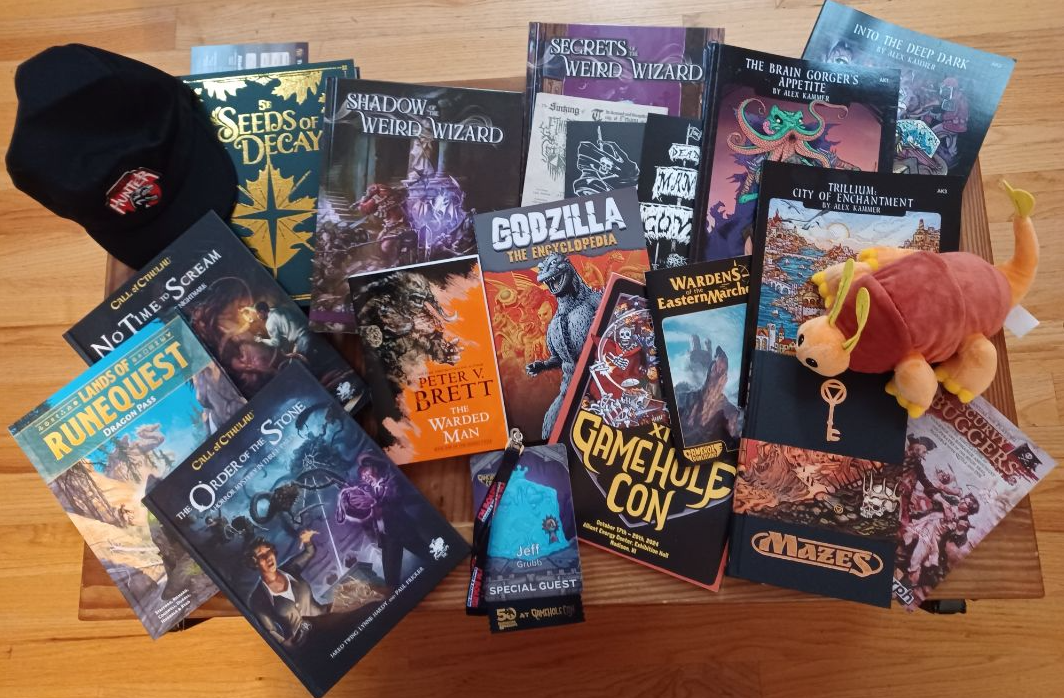
Gamehole Con swag: Program Book and a Rust Monster Plushie  The program book is a spartan and effective twenty pager, with ads from the supporting sponsors, maps of the site, policies, and a list of exhibitors and guests (no bios, which is fine).. The events themselves are online with QR Code, which creates a nice versatility (the site itself is very searchable as well). The plushie is a standard for GHC as well, and a freebie to guests (I still have the Mimic from several years ago). The traditional Monster Manual rust monster is this year's plushie. The Lovely Bride has already named him Palladium. 

[Note from the distant past - when the Rust Monster first appeared in D&D, there was no illo to go with it, so, since it showed up with various oozes, I assumed it was a pile of rust with Cookie Monster googley eyes. We didn't hear about the plastic toy until later.]

Wardens of the Eastern Marches, Alex Kammer with Josh Hoyt and Jason Knutson, Gamehole Publishing, 28 page saddle-stitched digest, 2024. Gamehole Publishing (Yes, connected with the Gamehole con) is launching its own organized play at the convention, and this was a free giveaway. The Eastern Marches are the setting for a bunch of adventures they've published over the years (see next entry). This tidy little booklet gives an overview of the world, as well as the basic ground rules for their organized play. All the information in the book can be found here, but it's nice to have a hard copy.

The Brain Gorger's Appetite by Alex Kammer,  Gamehole Publishing, 40-page softbound, 2016, GHC Purchase. Into the Deep Dark by Alex Kammer, Gamehole Publishing, 46-page softbound, 2017, GHC Purchase, Trillium, City of Enchantment by Alex Kammer, Gamehole Publishing, 62-page softbound, GHC Purchase,  2018 All three of these were published over the years by Gamehole Publishing, and sold at the convention. I meant to pick them up last time I was there, and finally did so this time. The three adventures are part of a larger arc, set in what is now the Eastern Marches (see above), and involve a mind flayer brain gorger named Marlipp. The trilogy starts in the small town of Okney's Hold, journeys into the Underdark Deep Dark, and ends up in the faction-ridden city of Trillium. It's old-school adventures wired up for 5E action. 

Lands of Runequest: Dragon Pass by Jeff Richard, Greg Stafford, and Jason Durall, 190-page hardback, GHC Purchase, Runequest doesn't get as much coverage out here in the local hobby stores, so I'm always glad to see it at conventions. Dragon Pass has its roots Waaaay back in the White Bear, Red Moon board game, and it is a highly diverse chunk of land at the crossroads of Glorantha. Lottsa sentient creatures, factions, and politics rolling around. Dragon Pass probably has the greatest weirdness-per-acre of any location in Glorantha. Nice to see the update.

No Time to Scream by B.W. Holland, Bridgett Jeffries with C.L.Werner  Chaosium, 104-page hardback, 2024, GHC Purchase, Call of Cthulhu shows up in the local stores more often, but hey, I was there at the convention booth and they had a sale. No Time to Scream consists of three straight-forward one night-and-change adventures. Though aimed at novice Keepers/GMs with instructions and advice on how to play, the scenarios work well for pick-up games and (insanely) quiet evenings with more experienced players. Works best with pregens, which are provided and also available as an online download (which makes the assumption that the buyer has access both to a computer and a color printer (having a color printer readily at hand is one of the plus sides of the return-to-office push. That and free pens)).

The Order of the Stone by Jared Twing, Lynne Hardy, and Paul Fricker, Chaosium, 152 page hardback, 2024, GHC Purchase. This one feels like an old-school CoC scenario - three chapters, ancient cult, entrapped eldritch god, world-ending threat, hiking distance from Arkham. At first glance, it looks pretty good, with a collection of Lovecraftian set-pieces - ghost ship, small port town, rural wilderness. It's really good to see Chaosium do new old-style adventures in addition to updating the classics for the new system. Player handouts available online, which still has the challenge of No Time to Scream.

Seeds of Decay by Darryl T. Jones, Splattered Ink Games, 436-page hardbound, 2004, Gift of the Author. A big adventure about tiny heroes. The Dobbers are a diminutive people living in the Alwaysgreen Forest, threatened by an eldritch evil that is spreading like rot. Set up specifically for Dobbers and other tiny-size creatures, its two parts cozy game and two parts heroic horror. This is the deluxe edition (gold-foil on the cover). The author is also the artist, so it is a very good-looking product. The hat on top of it is for an upcoming product A Time-Traveler's Guide to Dinosaur Hunting. Nice hat. 

Mazes by Chris O'Neill, 9th Level Games, 240-page hardbound digest, 2022, GHC Purchase. I mentioned Sentai and Sensibility in an earlier write-up, and I found the core mechanic (a single type of die tied to each character class) intriguing, but buried beneath a pile of setting-specific verbage. So when I discovered the system this was based on at GameHoleCon, I had to buy it. This is a revised edition, and is based on the original fantasy version of the game. It is much deeper than Sentai, and uses a number of interesting new systems. I'm currently digging through it. Its presentation is excellent, and it feels like a solid game. 

Scurvy Buggers by Irene Zelinski, 9th level games, 76-page softbound digest, 2024 GHC purchase from designer. I got this from the designer at the Con, and we chatted. This was a pirate (I'm sorry - PYRATE) version of the game system, and it may be that I was already reading the Mazes game, but the rules went down a lot smoother for me than for Sentai and Sensibility. This is very much Black Sails and Our Flag Means Death with genderfluid pyrates. Zelinski expands the one-type-of-dice per class mechanic to include ship types as well. Neat idea. 

Dead Man's Cove, by Tyler and Luke Stratton, Limithron, 1-page folder scenario, GHC Purchase, Buried in the Bahamas, by Luke Stratton, 22-page saddle-stitched digest, The Sinking of the Cthgan, Limithron, 8panel fold-out scenario, all GHC Purchases. It may occur to many readers that I am a sucker for pirates. Pirate Borg was a definitely superior evolution of the Mork Borg system, reshaped to fit the curves of the golden age of piracy. I have these in pdf from the kickstarter, but I really wanted to get hard copy as well. They are radically different in approach, and reflect very much a "maker" culture of craft where the presentation formats are elastic. I think I can keep them with my core book, which is a challenge when you have so many different physical approaches to the supplements. 

The Warded Man by Peter V. Brett, Del Rey, 592-page trade paperback, gift from the author. I met Peter doing a livestream dungeon adventure on Saturday night, and he gave me a copy of the book. Imagine a world where demons show up every night in a twisted version of the initial day of a Minecraft game. The only thing that keeps them at bay are magical wards, and humanity sort of lies low behind its magical walls in the darkness. The Warded Man is the guy who manages to incorporate and utilized the wards, challenging the demons on their own ground. Yeah, this goes on my TBR pile. 

Shadow of the Weird Wizard by Robert J. Schwalb, Schwalb Entertainment, 288-page hardbound and Secrets of the Weird Wizard by Robert J. Schwalb, Schwalb Entertainment LLC, 296-page hardbound, 2024 Kickstarter. About ten years ago, Rob Schwalb wrote the very excellent Shadow of the Demon Lord. This is an update to the system and a new world for that system. Demon Lord was very grimdark, while Weird Wizard is much more in the heroic mode - still a deadly world, but not a doomed one. Call it Greydark? Without too much digging (and yes, it rewards digging), it advances the design of Demon Lord just as Demon Lord advanced the design of D&D Third and Fourth Edition (and in a case of ironies, Demon Lord showed up around the same time as 5th edition, and Weird Wizard showed up with D24 (Yes, I'm still trying to make that a thing). Secrets is both the campaign setting and monster book, and takes the entire system out for a spin. The thing I can dun them for is that the tables use a light grey typeface that is hard on these old eyes. But a lot is going on here, and I'm going to be spending some time with it.

Godzilla The Encyclopedia by Shinji Nishiakawa, Titan Books, 216-page softbound, purchased at Midgard Comics. I bought of copy of this a while back, gave it to a friend who is a BIG Godzilla fan (we plowed through most of his DVDs from the Showa to Millennium era), then went back and bought a copy for myself. Titan is known primarily for their comic book collections, but this one started as a series of articles and just expanded from there. It's write-up of almost every monster in the Godzilla films, and every version of Godzilla, Missing are those that had an original version elsewhere (Rodan is there, but only appears here for when he first fought Godzilla), and the American versions. The writeups are two-page spreads, beautifully illustrated, that cover both in-world facts as well as design discussions of how the various Godzillas changed over the years. This is an incredibly excellent book if you're a Godzilla/Kaiju fan.

That wraps it for now. And more things have shown up while I was putting this together, but for the moment, more later. 

Wednesday, December 13, 2023

Book: Shaggy Dog

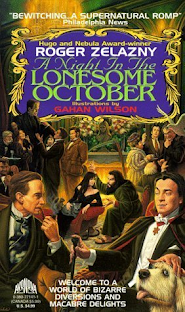
 A Night In The Lonesome October by Roger Zelazny, Illustrations by Gahan Wilson, Avon Books, 1993.

Provenance: My company has a book club that meets every month or two, and we vote on a book to read next. I often don't get a chance to read the assigned work, but A Night In the Lonesome October was an option  this time, and I voted for it, figuring that I had a copy on the paperback shelf downstairs, so there would be no excuse not to reread it.

And then I didn't have a copy downstairs. I had given it away or donated it somewhere in the past thirty years. So I went to my local used bookstore, The Page Turner, where I had last donated some books during COVID, and THEY didn't have a copy (though I picked up a couple China Mieville books I didn't know existed while I was there). Finally, I turned to my colleague Sacnoth, who rose from his chair, went to HIS bookshelf, and immediately plucked off a copy. So I had no reason not to read the book.

Review: I loved Zelazny's Nine Princes In Amber series (the first five), and feel he was a master at the novella format. This one was OK and amusing, a bit of lighter fare. Its chapters stretch out over the month of October, reaching Halloween Night itself. On those occasions when a full moon occurs on Halloween, there is a battle between the Openers and Closers. The Openers wish to bring down the gates of reality and bring the Lovecraftian Old Ones into the world, while the Closers want to keep that from happening. So far, the Closers have won.

Our narrator is Snuff, an enchanted dog who calculates the location of the rite based on where all the Players are based. His master is Jack, as in Jack the Ripper. Spring-heeled Jack is a favorite of SF/Fantasy authors, and such luminaries as Philip Jose Farmer, Fritz Lieber, and Harlan Ellison have used him in the past. This Jack is a Good Guy, a Closer, who keeps various Things in his house, that Snuff carefully guards and keeps contained (the Thing in the Steamer Trunk, the Thing in the Circle, and the Things in the Mirror). Snuff, as the calculating companion of the pair, tries to figure out where the rite is going to be, based on the locations of the the other players, which is made difficult by not knowing who exactly the players are, and if any of them die over the course of the month.

And there are plethora of other players and potential players. Zelazny reaches back to old Universal Horror films than by original source material. There is the Good Doctor and his animated creation, the Great Detective and his assistant, the coffin-sleeping Count, a witch, a Rasputin-like monk, a pair of grave robbers invoking Burke and Hare, and an evil Cthulhu-worshiping clergyman. Each (or most) of the players have their own companions, who Snuff communicates with. The horde of players, potential players, and companions is a bit overwhelming, but I was fortunate in Sacnoth left a bookmark with all the information noted down.

The pacing is interesting in that each chapter is a day in October, leading up the fateful rite at the end of the month. Each night Snuff goes out, gathers information, walks the area (outside London, presumably Victorian-era) and makes his calculations. His frequent frenemy in his travels is Graymalk, the cat familiar of the witch, Jill, who are definitely Openers. A less-hospitable Opener is the Cultist Curate, a worshipper of the old ones (Nyarlathotep gets name-checked), whose companion is a white raven named Tekela (invoking the cries of the albino penguins from Lovecraft's At The Mountains of Madness).

Openers and Closers get along well early on, leading to a graveyard scene where all are gathering materials for the ceremony, and trading body parts they dig up with each other ("Who needs a femur?"). After that, things get darker fast, with bodies falling and trust failing, ending in the rite itself. There is a long evening where cat and dog are sucked into Lovecraft's Dreamlands, with a tour of the entire area. With such a large crew of characters, Zelazny keeps a lot of balls in the air at once, and the finale wraps up all the loose ends.

The book is accented with illustrations by Gahan Wilson, A cartoonist whose blobby, lumpy characters have been found in SF magazines, Playboy, and National Lampoon. Wilson also created the first map of Arkham, Massachusetts, so he has the proper Lovecraftian chops.

Ultimately, this is a shaggy dog story about Snuff, a literal shaggy dog. There is light humor and puns throughout. I know more about old movies and the Cthulhu Mythos now than I did back when I first read it, nearly thirty years ago, and part of the Game for the reader is recognizing who the players are in the greater horror canon. It is a good book to read, a chapter a day, through October, preferably with a cup of hot tea laced with whiskey. 

More later, 


Saturday, September 23, 2023

Play: Bromance

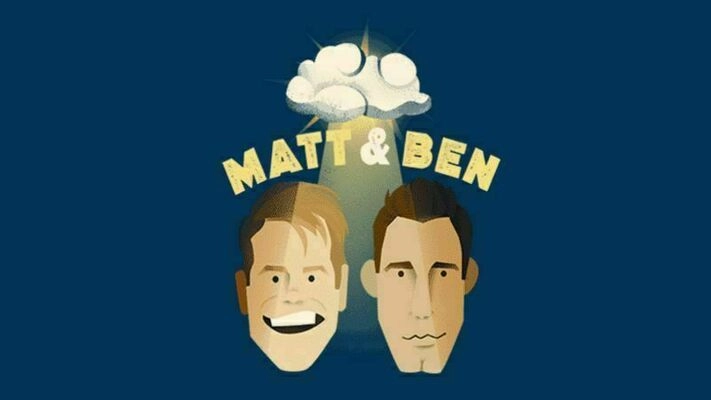
 Matt & Ben by Mindy Kaling & Brenda Withers, Directed by Zenaida Rose Smith, Arts West through October 1, 2023

The play season has begun for us in West Seattle. Actually, it begun two weeks ago - we usually catch opening night but misplaced the online tickets in a file folder, so we showed up to the theater two weeks late, but did get a great dinner at Mashiko almost-next-door-to-the-theater (and who remembered us from previous times - so I guess we're regulars now). 

The story about how the movie Good Will Hunting came to be is covered in detail in the Wikipedia article. This isn't that story. It's nowhere NEAR that story. Instead this is a story about how buddies Matt Damon and Ben Affleck, struggling slacker actors, suddenly had the copy of their future masterwork literally drop into their laps, and the stresses that promise of future success puts on their friendship. They are a nineties oddish-couple. Matt is the plotter, achievement-driven and control freak. Ben is the pantser, goofy sidekick, and good luck charm. They argue about stupid things. They are visited by famous spirits. They screw up, fight each other, reconcile, and are ultimately rewarded with the Best Original Screenplay Oscar. Feel good story.

And it did not work for us (yeah, the Lovely Bride agrees with me on this one - usually we get a split decision when one of us doesn't like something). Maybe its the fact that she and I have been collaborators IRL, or simply that neither one of us saw Good Will Hunting, despite its many awards. Maybe the only idea I had of Matt & Ben's personal chemistry was their turn in Kevin Smith's Dogma. Maybe we're just, you know, OLD. But the play felt unmoored (shifting between story-telling and living in the events) and at the same time predictable (a lot of sequences ending in someone saying they will leave, but not leaving). It was OK, but simply OK.

The actors, though, were really, really good. Nabilah Ahmed was an excellent Matt, recognizing his tendency to overcontrol but not able to handle when things are not organized his way. Jacquelyn Miedema has a tougher row to hoe in the goofy sidekick Ben, the lesser of the two. Matt is the brains, Ben is the heart, and the play needed the chance to show that more. Both of the characters are goofs, and the physical comedy as they fly around the cluttered apartment set are the highpoints of the play. Miedema also creates a slinky Gwyneth Paltrow and Nabilah a world-weary JD Salanger, ghosts of future and past who visit the two. The actors? Just fine.

Ultimately, this was average. I made my peace early on in the performance that this was not going to be a play about writing the movie, and Matt & Ben were at best caricatures of Damon and Affleck. But with all that stripped away, the core relationship was kinda light, and barely sustained its 90 minute run time. 

More later, 

Saturday, June 11, 2022

Theatre: The Bigger Boat

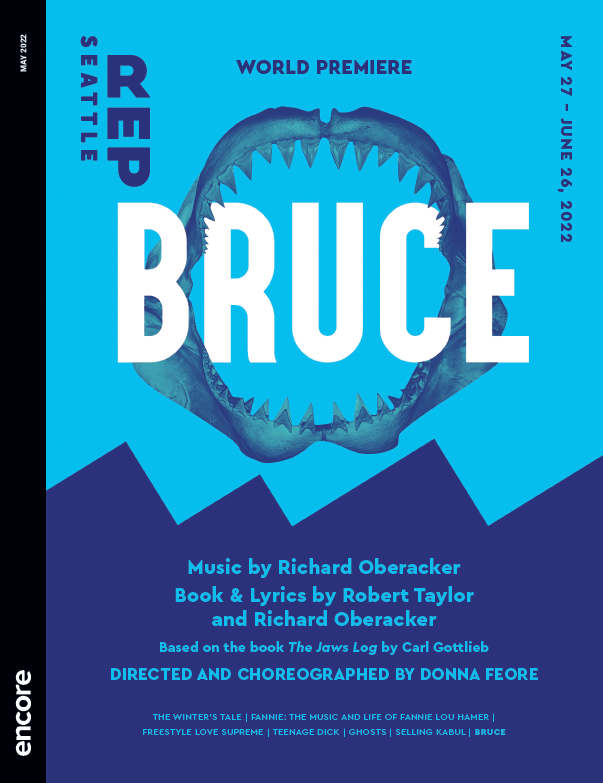
Bruce, Music by Richard Oberacker, Book & Lyrics by Robert Taylor and Richard Oberacker, Based on the book The Jaws Log by Carl Gottlieb, Directed and Choreographed by Donna Feore. 

Spoilers: I loved this, and strongly recommend that others go see it. Fair warning: The Lovely Bride did not, but we will get to that.

Long ago, musicals would show up on Broadway, then turn into films in Hollywood. Now the opposite is true - Intellectual Properties arrive from films and TV shows and are turned into comfortable songfests in NYC, then tour the nation in road companies. And this particular project goes even further - it is a musical based on a book about a movie about a book. So I will admit I was a little cautious going into this one.

And I enjoyed myself tremendously. I thought it was great. This is one of those performances I want to heartily recommend to others. Five years ago, I got to see Come From Away at the REP before it got big and was floored by the production. Bruce had the same effect on me. It a musical about the making of one of the first big modern Hollywood blockbusters. And you should go see it.

It is about the making of Jaws, and Bruce is the name for the infamous, problematic, mechanical shark that almost sunk the entire production. A young film-maker off his first modest success gets the nod to bring a best-seller about a killer shark to the big screen. At that time the best-seller was not yet published, and did not even have a final title. This was the first of many hurdles in the process.

And the show is all about the process. Putting together the initial team, casting, planning to record in a real ocean, finding the set location. The first chunk of the musical is laid out on a three-by three vertical grid, where the various component parts are spinning and people are contacted, recruited, convinced to come together. Like Jake and Elwood Blues, they are going to put the band together. Like Judy Garland and Micky Rooney, they're going to put on a show. About a shark.

And then they go to the island itself - Martha's Vineyard, and as with every plan, it disintegrates upon first contact with the greater reality. Problems with locals. Problems with scripts. Problems with the weather.  Problems with the actors. And most of all, problems with the mechanical shark that fails spectacularly and repeatedly, forcing the team to shoot around it. In the process, they succeeded with the shadow of the knife as opposed to the knife itself.

The cast is fantastic here - strong-voiced and solid, top to bottom. Jarrod Spector is an idealized Steven Spielberg at the start of his career. Ramzi Khalaf is a pugnaceous, insecure Richard (Ricky) Dreyfus. Hans Alwies is a drunken veteran Robert Shaw who acts the diva right up to the Indianapolis scene, where he disappears into Quint's character. Beth Devries is Lorraine Gary, whose character in the movie gets sidelined by the three male stars but here is a supportive foundation. Geoff Packard is the production company's Dad-figure as Roy Scheider. But it is the people behind the scenes, Alexandria J Henderson (as talent director Shari Rhodes) and E. Faye Butler (as film editor Verna Fields) that are fantastic, even if their real-life counterparts of that era were much paler. Top to bottom, everyone was brilliant. Heck, they even have you rooting for the producers (Eric Ankrim as Richard Zanuck and Timothy McCuen Piggee as David Brown).

How much of the story is ultimately true? Don't care. This musical actually hit me where I live and work. I have spend much of career as a corporate creative, working with teams of talented people, sometimes but not always in a leadership position, and the things found here ring true to me. I have done casting, I have been in the room where the deals are made, I know the chaos that often results in looking like we had it all planned. In many ways, this play gave me the reverse of PTSD - it was joyous and my eyes were wet by the end of it (It might have been the smoke, but hey, its Hollywood). And to honest (and a little cynical), while the actually making of the film involved a lot of plucky young professions working against long odds and nasty conditions, the original book got a huge promotion from Doubleday and the movie itself had a major ton of promotion, licenses, and distribution.  Don't care. It really hit me.

I even marveled at the set design. I have an allergy to "gizmo plays" that have flying sets and sliding furnishings and multiple levels of production to fill vertical space. But the Hollywood Squares initial set-up actually WORKED, and when everyone decamps to the island, that set splits apart to reveal a wider, more open world, and I was completely taken in. It was Dorothy stepping into Oz. 

The Lovely Bride did not care for it. In fact, she used the word "deplorable". And the big reason was that for her is did not work as a musical. I think that's a fair cop. A lot of the tropes you get from a Broadway Musical are missing = There is the "Statement of Purpose" song at the beginning, but there is not a lot of toe-tapping memorable melodies here. There is no catchy little comedy number or showstopper solo or big production number right before the intermission (heck, there isn't even an intermission). She felt it was closer to opera, and she doesn't care much for opera. But I liked it. I would buy the CD (Do they still do CDs?)

And, to be fair, would it have the same effect as it had on someone my age as on someone who had never seen the movie it was based on, or knew anything about the stories that have grown up around it? I dunno, go find someone who doesn't know about the film that traumatized a generation about swimming in the ocean. I can wait.

Summary on Bruce? Let me oversell it. I think it is great. I think this was a tonic for everyone who is involved in creating things in the real world. It made me want to return to projects that have been abeyance for a while, and return to my daily creative task with new vigor. 

So yeah, I think you should go see it. 

More later,

Sunday, February 06, 2022

Theatre: They Did The Mash

Monsters of the American Cinema by Christian St. Croix Directed by Lamar Legend, Arts West, through 20 February

Let me not bury the lede on this; The Lovely Bride loved this play. I did not care much for it. Yes, our marriage will sustain such a bitter disagreement.

Let me tell you what The LB liked about it. The actors were excellent, the characters felt real, and the story was poignant. Lamar Legend (also the director) is Remy, a 30(mumble) gay black man who runs a drive-in in the deeper-red part of San Diego County. He got the drive-in from his late husband. He also got a white, straight step-son, in the process - Pup (Alexander Kilian). And the two have a great relationship, bound together both by their love of monster movies and the ghost of their deceased spouse and father. Legend brings out all of Remy's mother-henning and protectiveness, while Kilian get's Pup's gangly teenagehood and affability as well as his haunting nightmares. But when there is a gay-bullying incident at a homecoming dance, Remy has to face up that Pup is growing up, and not in the best possible way.

All of the above is true. So what's my problem?

It's all in the delivery. The set design, of the interior of their trailer, including the roof where they watch monster movies on the big screen has too many blocking sight lines for the seats. One of the climactic scenes of Pup crawling about on the floor would be more poignant if the sink hadn't been blocking the view. The final scene, on the roof of the trailer, might as well have been on radio. There may have been great acting involved (and no doubt there was), but I didn't see it. 

Theatre in the round often demands a sparsity of props and the ability to play to all angles easily. We've Battled Monsters Before did this. The wood-frame of the trailer basically forced the actors to the perimeter and held them there, so they played to a fraction of the small audience at a time. 

But wait, their's more. Protracted blackouts between scenes for minor set changes broke up the flow. The pacing of the play itself was a collection of present-action, monologues, memories, and nightmares, and telling which one was currently running and how it fits into the larger story was difficult. Putting the audience off-balance is not a bad thing, but too much of it became frustrating. 

The worst of it was that, during the play, I started thinking about what would fix this. That's a terrible thing, and something I do while watching movies too much (which is why you don't see a lot of movie reviews here). Probably a more traditional stage design, pushing the stage back into the north seats would provide better sightlines (I know they've done that before). But the point is, I should not be trying to implement change when the play is in motion. It is not quite as bad (or as visible) as falling asleep in a performance, but still bad in view of what is happening on stage. 

And that's frustrating, because what the Lovely Bride said was right. Legend and Kilian have a great chemistry together, and both created characters that were very human in their mix of strengths, passions, and flaws. But their expression of their personal baggage was blocked, like the sight lines, by the amount of structural baggage dominating the stage.

More later, 

Monday, December 27, 2021

Ten Movies

 So, talking about other things, I considered what my favorite ten movies were. And I had to think about I would mean as "favorite". There are movies that a really like, and would recommend to others, but probably not watch again. They were a great experience - blockbusters, indie films, but they were one-and-done for me.

And there are "films" where you want to take apart how the plot is unspooled, how the shots were taken, how they got that take, or sought out that emotion. Films can be analyzed. Movies are just embraced.

And then there are the films that I will watch. Every time. Channel hopping or random streaming, coming in on the middle of them, and I will hang on until the end credits. I know the lines. I know how they end. I know the stories behind them. But these are movies that I will WATCH again and again. This is what I'm talking about.

Not all of these are great movies. Not all of them have "worn" well since their release. Some of them are a bit cringe. Many of them lack deeper meaning. A lot of them bunch up in my teen aged years. Some are even in Black and White. But I will watch them. Every. Damn. Time.

Here are ten movies:

The Thin Man (1934)

The Maltese Falcon (1941)

The Longest Day (1962)

It's a Mad, Mad, Mad, Mad World (1963)

The Great Race (1965)

The War Wagon (1968)

Ice Station Zebra (1968)

2001: A Space Odyssey (1968)

Star Wars (1977)

Big Trouble in Little China (1986)

So what are YOUR Ten?

More later,


Monday, April 27, 2020

Plague Books: La La Land

Be Cool by Elmore Leonard, William Morrow 1994

Provenance: I dunno. The book itself showed up on the bookshelf I reserve for paperbacks.  It has as a bookmark a receipt from the Tacoma Book Center, a mecca of used books in the shadow of the Tacoma Dome. It has a sticker on the back saying it was from Port Book & News in Port Angeles, but even that may be a remainder. In any event, it has been on my paperback shelf, which I have been looking at in my downstairs home office every day. And the trade paperback size and blue steel cover kept taunting me as I was working.

Yes, I judged a book by the cover. That's the point. That's why they have covers.

Review: Look. I'm going to be careful taking on Elmore Leonard. The guy was writing since the 50s, passed on only seven years ago, and a LOT of his books have been turned into movies. New York Times bestseller. So, successful. Lemme walk carefully because, spoilers, I didn't care much for the book.

Mind you, I didn't read the previous book, Get Shorty, nor have I seen either of the movies based on the books. So I walk in without knowing much about our protagonist, Chili Palmer, former sorta-mobster and loan shark who has gotten into movie production. His first movie was a success. His second was a bomb. So he's looking for a new idea. And he's doing lunch with another former sorta-mobster who is now in the record business, and the former sorta-mobster is shot down right before his eyes. And Chili's first thought is - hey, this is a great idea for a movie.

Like I said, I don't know Chili. This is the first time I've encountered him. But I don't particularly like him. This is one of the thing which impresses me about Rex Stout's Nero Wolfe stories (oh, wow, here he goes again about Nero Wolfe). Regardless of the story, you get an idea right up front of who Nero and Archie are, and what their relationship is. And you have a reason to root for Archie, our narrator. In other words, any Nero Wolfe story could be your first Nero Wolfe story. I don't get that break here, so Chili and I get off to a rough start.

To use an Hollywood reference, there's a book out called Save the Cat. It is a short book that for a while was (and maybe still is) gospel in screenwriting. One of the things that it stresses as a "must" is that, in the first few minutes of the movie, you have to give the reader some reason to root for your protagonist. He is kind to a little old lady, fixes someone's tire, or, yes, saves the cat. So Chili meets a former sorta-mobster turned record producer, heads for the men's room, and on his return sees the former sorta-mobster gunned down. And his first thought is how he can turn this into a movie.

As I said: Rough start.

Another bit in the book is the idea that everyone in LA wants to be in a movie about their lives. I am not a LA native. I go down every so often for recording sessions for computer games, which keeps me in the general vicinity of Burbank and the old Bob Hope airport. I don't hate LA or love it. I am more LA-Adjacent. But I haven't met anyone yet who does the whole "you should do a movie about my life" thing. But I like Leonard's LA. It feels relatively comfortable. So that's a good thing.

So Chili gets into the record business, and stuff just starts happening. He discovers a hot new talent. He becomes her manager. He gets her to put her old band from Texas back together. He comes home one night and finds a dead body sitting at his desk. He makes friends with a homicide detective who, surprise, wants to see a movie about his life. Homicide detective is now Chili's new best friend, despite the fact Chili is a witness/suspect in two murders. Chili encounters a gay Samoan bodyguard that sounds suspiciously like Dwayne "The Rock" Johnson, and who is (surprise) played by Dwayne "the Rock" Johnson in the movie version. And then Aerosmith shows up.

You know, it sounds sillier than Leonard lays it out to be, but no sillier than most things that end up in LA's fictional universe. At the end of it all, Chili Palmer is a hustler, flying by the seat of his pants, making up lies on the spur of the moment and not getting called on it. He's got some tight situations but he never pays for his crimes, or realizes fully what he's done. He's not amazingly likeable, and remains an external force in LA, not really part of the entertainment world, but just an opportunist who sees it as he most recent grift.

Leonard is famous for saying, "If it sounds like writing, I rewrite it." And while I agree with the idea that language should sound realistic and natural, clarity has to ultimately rule. There are chunks here that feel like they were written during the Great Punctuation Shortage of 1993, and I had to take a couple runs at a few sentences to determine who is talking about what.

Be Cool is OK fiction. Not great, just OK. Like Chili Palmer, the book is not likeable enough to really pull me onto its side, but entertaining and engaging enough to work. Leonard's writing ethos is akin to some other authors I know - "If you do something wrong long enough, it becomes a personal style". Like LA itself, I can't muster up the emotion to hate it or love it. So I guess I'm Be Cool adjacent.

And now I can take that book off my shelf, so its blue steel cover doesn't distract me anymore.

More later,

Tuesday, January 14, 2020

Big Pile of Books: Long Time Ago ....

With this entry I am at the end of big pile of books the end of my desk. In the process, however, in the process I've come across books that I've had lying around, meaning to talk about for some time, and books that I've meant to finish so they earn their place at the end of the desk. But those will be a different kettle of fish (or perhaps multiple kettles).

Defining a Galaxy: Celebrating 30 Years of Roleplaying in a Galaxy Far, Far, Away, by Bill Slavicsek, published by Owen K.C.Stephens/Rogue Genius Games, 2018

Provenance: Gift of the author. Bill Slavicsek was a co-worker at TSR, my boss at Wizards of the Coast, and he and his Lovely Bride, Michelle, come visit every Thanksgiving.

Review: A lot of the attention of  recent "gaming history" has been, naturally, about Dungeons & Dragons, and there are a number of good books out on that subject. This one is on an equally intriguing subject, in that it covers one of the great early licenses in our hobby - the Star Wars RPG from West End Games.

There have been three tabletop RPGs about Star Wars - the West End version in 1987, The Wizards of the Coast version in 2000, and Fantasy Flight version in 2012. I contributed to the WotC version. Bill worked on both the West End and WotC incarnations, and it is the West End version that is very important to how games are developed and how licensed properties are turned in to RPG. In particular, Bill goes into detail on the nature of lateral development.

By 1987, the original trilogy of movies was done. There was talk of more, but no definite plans. There had been a few original novels (a trilogy on Han Solo, A trilogy on Lando, Splinter of the Mind's Eye (since retconned out)), some animated cartoons, and a Christmas Special that had been shown once, then buried. The Marvel comics had a good run but were winding down. West End Games had a lot of stuff from the movies, but very little hard facts about the universe behind it. What was the Kessel Run? Who were all those aliens in the bar? How did the Force work?

This is where West End, and Bill in particular came in, creating the connective tissue and background for the universe. Using what was there to build the support scaffolding for it. In a movie, you can just show a bunch of driods - no one from the audience has the chance to question who they are. Not so in an RPG. The various aliens had names "Hammerhead" and "Squid Head", names used in the toys. Bill christened them Ithorians and Quarrens, and gave them home worlds and characters. In doing so, Bill developed the depth of the universe, not giving you new stuff, but developing the material that was there. Lateral development was a requirement for transitioning between film and the tabletop.

And it stuck. These creations became foundational for the expanding Expanded Universe (now called Legendary. Novels were based on the information presented. The backstories have been accepted as canon. And while changes occurred as new movies and television shows were created this material became core reference for the universe in a variety of media.

And it is kind of cool for Bill to see something that he had created 30 years ago get a name-check in a new project. It is also cool for us to see the process behind the scenes that helped create this expanded universe. Bill's style is open and conversational, a befits a memoir. He's telling stories about his time at West End, and the creative magic that they made there.

Interested? The book can be picked up on Amazon, or here.

More later,

Monday, July 16, 2018

Book: Looking At You, Kid

We'll Always Have Casablanca: The Life, Legend, and Afterlife of Hollywood's Most Beloved Movie by Noah Isenberg W.W.Norton & Co. Copyright 2017

The Provenance: Christmas present. The Lovely Bride was listening to Public Radio and they were talking about it, and since I am a fan of the movie (though, oddly, I rank it below The Maltese Falcon), she got me a copy. Started in on it that week, made a good head of steam, then bogged down around the discussions with the censors. The book lay fallow, and risked being added to my shelf of abandoned books, but I picked it up again and polished it off, in bits and bobs, over the next week.

The Review: This is one of the great classic movies. If you haven't seen it (a state that would leave me shocked, simply shocked) you need to take the opportunity to do so. If nothing else, you'll get all the references that everyone else is using.

The book itself doesn't really talk about the movie so much as talks around the movie. Originating in the play "Everyone Comes to Rick's", the story was first and foremost a political play by Murray Burnett and and Joan Alison, based on their experiences getting out of pre-war Europe and smuggling a good chunk of the family treasures with them. Purchased but unproduced, it went west to Hollywood, where it was swallowed by the industrial Hollywood movie machine.

It busts some myths as well. Ronald Reagan was never seriously considered in Bogart's role. It originally lived as a play, though unproduced in part because of the problematic love story (Ilsa sleeps with Rick for the letters of transit). It wasn't a scrappy little success story - the script was purchased for a record amount by Warner. Yes, the original had a ending (Rick shoots Strasser and gets arrested), though getting there in the movie went through many hands. This last bit is a good tour through the studio system, where the script, once sold, gets numerous revisions from various writers with different strengths (comedy, romance, adventure), creating the multi-threaded narrative that creates the foundation for its publication. In fact, Casablanca reveals the success of the studio system in creating film. And it was a hit from the start, its release timing with the Allies taking Casablanca itself, the news reports putting that North African city in the forefront of American thoughts.

And it talks extensively about Paris as a replacement for coitus, for the affair between Rick and Ilsa, a married woman (though the film goes to great lengths to point out that she assumed he was dead at the time, it was a change for modern movie morals of the time). Inspector Renault's sexual preferences (very young, very pretty, and very much in need) bubble up to the surface more subtlety in the movie than in the play.

But the book has some gaps as well. While it goes deeply in the bios of the players (the bulk of the actors were themselves European refugees), it does not get deeply into the production schedule - when the shots were taken and where. It does recommend another book, The Usual Suspects by Aljean Harmetz, for such details, but sadly that is not the book I'm reading. And it is a bit silent on the awards that popped up immediately in its wake (Casablanca took three Oscars - Picture, Director, and Adapted Screenplay - no small feat - How did that happen?).

And most importantly, the struggle that We'll Always Have... keys in on is the flak that the Warners took in making this movie in the first place. In the wake of the war, we think we were always a country unified against the fascist threat, but such was not the case. Most movie companies soft-pedaled the Third Reich, since most still had business there in an increasingly hostile environment. And yeah, Jack Warner was hauled into a Congressional Hearing where he was peppered with questions about why he was being so anti-German (at this time, there were more Germans living in Milwaukee than in Berlin). It is one of those things that echo in the modern day - as Twain said, History doesn't repeat itself, but it often rhymes.

Ultimately, however, we get the suburbs of Casablanca, but never fully get into the city itself, much less to Rick's Cafe Americain. It remains a mirage on the horizon, with travelers telling us the tale of the city and its legendary waters.

Heck, go watch the film.

More later,

Sunday, March 20, 2016

Films: SIFF SFF SFF

11th Annual Science Fiction & Fantasy Short Film Festival, Cinerama Theatre, Seattle.

So yesterday Stan and I went down to the Cinerama in Seattle (not too far from where I work) to spend about five hours watching short science fiction films. This would be the Science Fiction & Fantasy Short Film Festival, presented by the EMP and SIFF (Seattle International Film Festival).So yeah, it is the SFF SFF presented by SIFF.

The reason for us going was that a friend from WOTC, Cindi Rice, was a producer on one of these pieces. She wasn't go to make the showing, but knew that the director, Reed Shusterman, was going to make it, and had some extra tickets. Hence, Cinerama theatre, Saturday afternoon for about five hours, encompassing 19 films.

Their film is Goblin Queen, and (spoilers) was my fave of the group. The setup is pure Disney Channel - teenage girl finds magic amulet that transports her to a fantasy universe. What makes it cool is that it does not follow the girl, but rather her mother - a bit of a control freak, who is dealing with her daughter disappearing at a moment's notice. And then when things from the OTHER universe comes spilling into ours, things get wild. Goblin Queen is well-written and well-acted, but what really makes it a fave is that it works without a huge amount of special effects. Tightly-packed and concise, kept to the small house in the real world, it worked its magic without a lot of post-production (Indeed, in the after-movie interviews, the directors who made it to the festival complained that their films were two days to shoot, two years to get the post-production right).

One thing I also liked about Goblin Queen was the sense of resolution to the film. A lot of the short films shown are demos, teasers, trailers, or proof-of-concepts for potential larger films. The problem is that if they don't resolve the story, they leave the viewer hanging. There was a lot of that in the festival - Aden (winner of the Judges Prize and the Douglas Trumbull Award for Visual Effects) was an extremely well-done, well-conceived, well-executed chase sequence between an agent of unknown origins and child's mechanized imaginary friend, but it was the first ten minutes of an unfinished movie. The Garden, a tale of humanity integrated into AIs is excellent but also felt like it strained to be a full feature. Mis-Drop, a take on a green soldier going into battle, would be a great first five minutes of a video game. The Red Thunder WOULD be the first five minutes of a Disney Channel show where a teenage girl borrows her mom's car and discovers her mom's secret.

All this is well and good (and make no mistake, these are short films that if they grow up to long films, I would watch), but all left me with more questions than answers.

Then there are the WTFs - In Bionic Girl a scientist creates an big-headed android duplicate who replaces her and sends her to hell (There's a lot of singing. In french). Disco Inferno starts with Hammer-Film virgin sacrifice and ends with an office party and has a lot of weirdness in between. Tristes Deserts (A Robot's Tale) was described on Twitter as a Daft Punk video, and involves a white robot with an Elizabethan neck ruff fighting an ebony octopus. And poodles. There are poodles involved.

OK, but what else did I LIKE? Frost, a tale of arctic hunter scavenging in a sleeping city was extremely evocative. The No Look Dunk was cute and short and played with time travel just as long as it had to. Juliet links sex doll robots with iPhones in news clips and commercials.

And The Brain Hack. Serious seizure warning on this one. No, not kidding. This one took the Audience Award, was an excellent, subversive, knowing film that built suspense mercilessly in a film about a refining images to stimulating the "god" center of the brain. Its very good, and got me seriously creeped out, and would not be out of place at the HPLovecraft film festival.

All in all? Good. If you get a chance to see these films (and some are on YouTube or Vimeo from the links above, while others get attached to other films in showing), hunt them down.

More later

Tuesday, August 25, 2015

The Gaming News

GenCon, and its lingering con crud have passed (and for most people I noticed, it was a delayed con crud, moving in two days or even a week after the event), so let me catch up on stuff in gaming.

Let me start with the toughest news first. Gaming legend Jim Ward (Metamorphosis Alpha, Gamma World, my boss for many, many years at TSR) has been in the hospital for the past way too long for a diabetic ulcer on his foot. He's not doing particularly well, but is most worried about losing time on various projects he's involved in. A GoFundMe Account has been set up to help offset his medical costs. Cards and letters also appreciated, and he can be found at:
       St. Lukes
       Select
       James Ward
       Floor 4 28B
      2900 Oklahoma Ave
      Milwaukee, WI 53125

We're all pulling for you, Jim.

The big news that hit right at the end of the convention was an agreement clearing the way for a D&D Movie. The short version: Warner Brothers wants to make a D&D with Hasbro's permission, but has been blocked by Sweetpea Productions, who claims the rights (Though, like all things, it is complicated). The settlement puts Sweetpea as an exec producer (and probably more - we aren't partial to those dealings) and clears Warner to do the movie.

Now, this news, and the mention that it will be set in the Realms, has kicked off a flurry of speculation about a Drizzt movie, or an Elminster movie, or even (yes, in some parts) an Azure Bonds movie, but the best thing to look forward to is a good movie with a good story. The Marvel franchise has not slavishly wed itself to its original books, but instead did films that captured the flavor and magic of the IP without having to lockstep into previous continuity. Have fun, guys.

Speaking of Elminster, his creator, Ed Greenwood, has teamed up with Gabrielle Harbowy to edit the Women in Practical Armor short story collection. Their Kickstarter already made their numbers, but check em out anyway.

Also news out of GenCon was the change of ownership of the venerable Chaosium, home to Glorantha and the Call of Cthulhu games. This is all tied together, because the guys at Rising Moon, who delivered the glorious Guide to Glorantha coffee table tomes are now running things, and Elder Gods Greg Stafford and Sandy Petersen are retreating to the background once more. More information here.

In the wake of Gencon, this popped up on Vice of all places. It's a paen to the wonderful weirdness that is D&D. Author Zak S created the award-winning A Red and Pleasant Land, and his thoughts on the game evoke the writing style of Harlan Ellison when the man was doing essays as a regular column.

Over on the computer game side, there is this about writing for games. I have tales of my own, but you're going to have to buy me a beer. The article includes a link to this twine game (sort of a newfangled Choose-Your-Own-Adventure) called The Writer Will Do Something.

Also on the net is your chance to check out Chaldea: War Room. Chaldea was the home campaign of Peter Adkison (you know, WotC and, um, GenCon) and Peter has been polishing up his chops as a film-maker. War Room in the first of his videos.

And finally, a video that turned up a few weeks back from the Guild Wars: Nightfall game in 2006. Originally put together for the deluxe edition, I don't know if it ever shipped with the game, but instead made its way to the net years later. There are a lot of interviews with the old gang (myself included), and all I can say is ... we all look so YOUNG in it.

More later.


Wednesday, December 31, 2014

On Hobbits

It has been a couple weeks now, and a lot of people have talked about it, and our group has weighed in on it, including our resident Tolkien expert, John Rateliff. But be warned - this has spoilers within, great and small, regarding the conclusion of The Hobbit films from Peter Jackson, The Battle of Five Armies. Some you've seen before, elsewhere, from others, but these thoughts a mine and belong to me. And in general, I liked the film.

There, I think I've gotten past the amount that gets cut and filled for other platforms. Let us get down to business.

1) I think it is pretty clear that Movie 2 (Desolation of Smaug) and Movie 3 (Battle of Five Armies) should be viewed as one film. One 6 hour film, where you get to get to break for lunch in the middle of it. You are dropped into the middle of a film - no background, no flashbacks. Smaug is descending on Lake Town and Gandalf is held prisoner by the Necromancer. Boom. There you are. If this is your first Hobbit movie, you'll be more than a might confused. And that's OK, as long as you know what you're getting into. We don't get an expositional character summarizing the story so far or a narration. I'm good for that.

2) By the same token, you do feel like you've come into the films a couple reels in. The pacing is definitely that of the middle part of the movie, that the characters are established, the basic goals and motivations are laid out, and all that results are pulling off the reveals and resolving matters.

3) And to that end, Smaug dies fifteen minutes in. I did mention spoilers, didn't I? Yeah, it fits with the timeline for the book, but after two movies of how powerful Smaug is, he's not even the big bad for this one. Sort of a Boba Fett ending for him. You never get the feeling he lived up to his potential.

4) And speaking of big bads, who IS the bad guy of this film? The Necromancer, who is chased off about half-way through the film? Or the two orc leaders, Sword-Arm-Orc and Orc-with-Metal-Plate-In-His-Head? The sense of greed that turns Thorin against the others?

5) Taking down my copy of the Hobbit, Movie one was about 100 pages, Movie two was 100 pages, and this movie covers the last 50 pages. Yeah, we're looking at padding.

6) And you can see the padding. There are a lot of repeated sequences (Bard rescues his family, Thorin yells at people trying to help him, Bard gives Alfrid a task, and he immediately shirks it). And the battle sequences of "character-facing-certain-destruction-but-suddenly-someone-you-had-forgotten-about-arrives-to-rescue-them" actually get wearing after a while.

7) Let's be frank - most of the movie is the battle, and staging a single battle is tough - a lot of sides, a lot of protagonists. Let's give points for the attempt. But one of the reasons for the frequent swoops into Thorin's mindset and comic relief, and Bard's family is to make it more than just cgi animation of orcs and elves fighting. But it feels weird to have so much of this happening in the midst of battle.

8) The bulk of the film feels like a game of Warhammer miniatures. Part of that is because of some of the visual source material - in the early seventies, Workshop was selling LotR miniatures, and the tall-helmetted, metal skirted elves were part of the look. So yeah, this is part of the Tolkien property but it feels like Workshop. At least the orcs weren't green, but that may be Warcraft thing these days.

9) Yeah, the whole pacing of the battle does feel weird, but remember that Tolkien passed over much of this by keeping the focus tight on Bilbo (and Bilbo unconscious for part of it). We have the dwarves in the mountain. Then the humans reoccupy Dale Town. Then elves show up, surprising both groups. Then the dwarf army shows up, surprising the elf army. Then the goblins show up from underground, surprising all previous groups, then the Gundabad orcs show up to hammer the exhausted allied armies, but THEN the Eagles show up to handle the orcs.

10) But I will admit it makes me amused to see that Radaghast gets the final "And then a new group comes to rescues the others" sequence. He's like the final closed parenthesis.

11) Did it feel like Dale Town got bigger in its architecture as the movie went on? It was ruins, but it seemed to get taller and more impressive over the course of the attack.

12) I've got a new game, called: "What can Legolas ride?" Can he ride a shield down the stairs? Yes he can. Can he ride a manbat of Gundabad? Yes he can. Can he ride a siege troll? Yes he can. Can he ride a disintegrating tower? Yes. Yes he can. Is there anything this elf cannot ride?

13) Oh, and elves are apparently stronger than stone itself. Tauriel takes a battering but survives. Legolas literally smashes apart the tower in his battle. This may be the original source of the problem between elves and dwarves. The dwarves wanted to use the elves as battering rams.

14) Orcs, on the other hand, are 1 minus 1 HD. Bilbo could take them out with a rock. With. A. Rock. But apparently they level up fast.

15) I know this is a minor point, but where the heck did Thorin and company get the battle rams? I know that's a gnat to strain at when, moments before, the dwarven army, driven to the brink by the orcs, suddenly gets rallied by the appearance of twelve reinforcements. But it was a big question in my office.

16) And the entire Dead-Orc-Beneath-The-Ice sequence? Did it remind anyone else of Glenn Close in Fatal Attraction?

17) Tauriel lives through the film, which surprised me at first blush, then made sense. We had Fili and Kili dying from the book, their deaths being a big part of the movie. We needed someone to directly morn them. One of our group mentioned that they could do the "ongoing adventures of Tauriel" as a result, but I think that unlikely.

18) And let me give Jackson points for wrapping things up with one ending. Even with previous movies in the series, I figured it would end two or three times before it did. This one ends when it ends, even if it does have to do a tie-in to the later LOTR. OK, Jackson gets that one.

19) And there was a character named Tosser Grubb in Hobbiton, according to the credits. No relation.

20) And when is all said and done, I think would like more Hobbit in my Hobbit. Bilbo sort of hit his high point in the last film, and is reduced to worrying about Thorin and delivering warnings here. In the book as in the film, he is knocked out a critical moment, so in the novel we don't have to work through all the boring parts of a battle. Of course, we the viewer still get to be a part of the battle in the film.

In the end, I enjoyed it, but it was tied to the fact the I had to rejigger some initial assumptions that were pretty clear at the beginning. This will probably fit better once everything is on DVD or viewable as a single experience, but as a film itself, it was a perfectly fine ending for the series.

More later,