Showing posts with label Mysteries. Show all posts

Sunday, July 05, 2026

Book and a Movie: Kick in the Pance

 The Benson Murder Case by S.S. Van Dyne, Charles Scribener's Sons, 1926

The Benson Murder Case, Directed by Frank Tuttle, Paramount Pictures, 1930

Provenance: Picked this up at the Page Turner, Kent's expansive used and new bookstore. It particular book also happened to be of the collection of Sacnoth, who had been cleaning out his shelves over time. He in turn had purchased the book in 1996 in Madison, Wisconsin (he tends to annotate all his books). This book was one of my "waiting books" - read when I'm waiting for an appointment, or for friends to show up at a restaurant. As a result, I may get two or five pages in before I have to put it aside. So the "waiting books" will be carried around for a while in a deep-pocketed jacket before finally getting finished.

As for the movie version, Sacnoth and friends watch old movies on Saturdays when we are not playing Call of Cthulhu, and have gone through all four of the William Powell Vance movies. While the book is the first of the Vance Vance novels, the movie version was the third starring William Powell. 

Reviews: As the first Philo Vance novel, and it is interesting in what it shows and what drops away later in the series, as well as changes made for the movies. Philo Vance is one of the elite dilettante school of detectives (Lord Peter Wimsey beats him out, since he first showed up in 1923 and who, like Vance, has a friend in law enforcement that allows him access to ongoing cases. 

In the case of the book, Vance's bud, District Attorney Markham is approached by an old and respected friend to investigate the death of his brother, who was his partner in a stock firm. The brother was found seated in his chair in his living room, dressed in his smoking jacket, shoeless and without his toupee, shot through the head. There was a large amount of evidence cast about, and the DA and police go through several suspects, all of which get proven innocent in turn by Vance.

Vance rejects such trivialities as facts and evidence and concentrates on the psychological nature of the killer - what sort of person would kill Benson in this matter? He claims to know the murderer from the get-go, but dances about, demonstrating to the DA that the latest prime suspect fails the test for some reason or another. In fact, he seems to delight in proving the agents of law enforcement wrong, all the while concern trolling their predicament. He's a bit arrogant about the whole thing.

The Van Dyne who is the narrator claims that position as being Vance's lawyer, and is only telling the tale now because Vance has retired to Europe. In the book, he serves no purpose as a character but to declare Vance as being brilliant and noting the growing frustration of the DA as Vance shows off one blind alley after another. Vance in this initial book comes off as insufferable, such that the DA (and the reader) just wants to shout "give us the answer, already". He actually becomes more likeable in later novels, but still absolutely sure of himself.

The movie, on the other hand, junks about everything except the title, Vance, and some of the supporting cast. Our invisible narrator did not make the transfer. In addition, the movie version riffs off the recent stock market crash. Benson is confronted with a bunch of clients who have lost money and are fed up with his shenanigans. Benson then retires to his country house and is shot. And it turns out Benson lives right next door to his good friend DA Markham, who brings along Vance to investigate. And one of the suspects says that Vance just got lucky in a previous case and challenges him to find the real culprit.

Which of course, he does. But he does it with a bit more grace than his novel incarnation, and more attention to the little facts and clues. He uses less psychobabble in his  explanations (I swear, the last chapter of the book is filled with his explanation of why the killer HAD to be a certain suspect, in part because women are not cool-headed enough to shoot a man accurately in the head). The movie version really hinges of William Powell's performance, who makes Vance actually likable. You can see the bits and bemused  mannerisms that he will bring to the Thin Man movies (and yeah, he's more likeable there than in the original book version as well).

So yeah, the novel is a time capsule - Vance was incredibly popular in his time, and the line "Philo Vance needs a kick in the pance" from Ogden Nash (of limerick fame) in 1931 just underscores the both the character's popularity and division he presented to readers. The movie version is traditional for its era as well, but a lot easier to swallow and worth hunting down if you're a fan of old pre-code Hollywood.

So yeah, check out the movie if you have a spare afternoon. The book? Only if you have a deep interest.

More later,


Sunday, June 21, 2026

Book: Dreams of a Strange House

 Strange Houses by Uketsu, translated by Jim Rion, HarperVia, an imprint of HarperCollins Publishers, 2025, original Japanese 2021.

Provenance: Browsers Bookshop in Olympia. A nice, well-staffed bookstore in downtown Olympia. Purchased on a whim, in part because the front cover had a house blueprint on the front with Japanese icons on it.

Review: Long ago, before I became a author, game designer, and general worldbuilder, I was a civil engineer. And as a result, I have always had a fascination with buildings and how they work and grow over time. In particular, I find blueprints and floor plans interesting, in what they say about the house and people who live there.

Strange Houses is set in modern Japan. The narrator, an author of macabre fiction is approached by a friend who is homebuying with his spouse. And they found a excellent modern house, but there was just something off-base about it. And they sent the floor plans to the author, who quickly noticed some things that were off-kilter. He brought in an architect friend and together the two start unspooling a mystery, which quickly turns disturbing and horrific. 

The book produces the house plans, as well as other house plans as the story unfolds, along with family trees and timelines. And these are presented in the running text as well, allowing the reader to discover the evidence as the author does.  Now, I read a lot of old detective novels from the 20s and 30s, and in such venerable tomes by Christie and Van Dine, they provide floor plans as well. In fact, putting a map or house diagram on the back of paperback editions was a thing back there. So that's not much of a surprise, but what the book does is that was they learn more about the house(s) they make changes to the house plans to reveal new ideas. 

So there are clues in the house plans, which is cool, and I noticed most of them before the two investigators spelled them out in text. But, I also noticed stuff that they left uncommented-upon. In the plans, there is one large room on the second floor without any exterior windows. OK, that's odd (though my first thought was to ask if there was a skylight). But (and this is the weirdness they don't address) there also is one toilet on the floor, and you'd have to pass through the windowless room to get there. It is a little strange that the investigators that are looking really, really hard at the house don't call it out. 

I've mentioned this before in my comments on various Call of Cthulhu products, where the maps don't line up with the text, or have their own discrepancies,  like chimneys that are prominent on the first floor and disappear on the upper floors, or locations of kitchens and bathrooms that would be logistical nightmare regarding the pipes. So I'm sensitized to such things, and in this case seeing stuff that the (real) author would prefer me to miss. And if fact, at the time I wrote it off as simply "Well, they lay out houses differently in Japan", but I went to the trouble of looking up Tokyo floor plans (thank you, Internet), and nope, the ones here look like they make no sense.

In any event, the investigators make some immediate assumptions, which turn out to be mostly true, but the logic leaps are a bit much. And then they find a second house, where the family had previously lived, which also had some odd features. And then there's the family house, of more traditional design, which had its own sense of weirdnesses.

And all of this is presented in drawings and conversations between the investigators, and interviews with various people. It is all presented as evidence, in a fairly bloodless fashion (though there is blood in many of the descriptions and conclusions). In this way it feels a lot like Lovecraft's "The Call of Cthulhu", where nothing really happens to the narrator as he goes through the files of his deceased uncle and comes to a chilling conclusion. Same here, though there are more questions than answers in the final tally.

The clinical approach of the investigators left me cold, and the fact that things are (maybe) not wrapped up neatly bothered me. The (real) author is a mystery figure whose photograph is a black robe and a white mask (very Studio Ghibli). The books (there are more in this style) are huge in Japan. I want to say that it is the cultural differences that ultimately frustrated me, but I think the translation is on-target.

It is ultimately a case that I bring too much to the book. I know too much about a subject and it brought me in conflict with the reality presented in the novel. And the ultimate loose ends and unreliable testimonies frustrate me, particularly in comparison with the venerable "The Call of Cthulhu". Strange Houses is a short, compact read (given all the house plan illos), but I can't really recommend this even to friends who have spent time in Japan. It was a misfire, though apparently a very successful one.

More later,


Thursday, October 30, 2025

Book and No Movie: On the Rocks

 The Hot Rock by Donald E. Westlake, Grand Central Publishing, previously known as Warner Books, a Division of Hachette Book Group, 1970.

Provenance: Apparition Books, Renton, which has an excellent collection of esoterica, plus solid SF and mystery sections. After discussion of caper films among my Saturday night group which mentioned the movie version, I found this copy, its spine uncracked, on its shelves. 

Review: I've talked about Donald Westlake before in these pages, and how he balances both hard-bitten, hard-boiled protagonists with lighter, more human-sized, comical characters. The Hot Rock is an example of the latter. I was attracted to it because, many years ago, I saw the movie version with Robert Redford and George Segal, and when the subject came up in our group, I kept my eyes out for a copy.

This is the first of the novels featuring John Dortmunder, a very good thief with very poor luck. He goes free from prison and an old buddy picks him up in a stolen car with MD plates. The old buddy, Kelp, has a job for him - stealing a large emerald belonging to an African nation on the behalf of a rival African nation. Dortmunder is uncomfortable with the idea, but lacking a lot of options, throws in with Kelp. 

They put together a team: Dortmunder is the planner. Kelp is the contact. Murch is the driver (who obsesses about driving), Chefwick is the locksmith (who is model train fan), Greenwood is the all-around, the utility outfielder of the group, a hapless romantic. They're all mugs who have had their run of hits and misses, but never a big score. They meet in the back of a bar and plan out the heist from the New York Coliseum. No small thing. The heist works, until it doesn't. Greenwood gets caught with the emerald. 

So now the plan becomes how to get Greenwood out of jail with the emerald. And they do, but they don't. Author and screen critic Robert McKee refers to this as "the gap" which drives character development - the space between character expectations (Greenwood gets the gem) and reality (The cops catch Greenwood). That sets up the next part of the heist (getting Greenwood back) and ratchets up the tension as a result. This happens a number of times - where they succeed until they fail. And as Gilda Radner's character, Rosanne Rosannadanna says, "It's always something."

And so it is. Dortmunder is the pessimist and ready to walk away several times. Kelp is the optimist, and keeps bringing him back into the fold. The risks get bigger with every iteration, as do the resources. The plot bounces along nicely, the characterization is good, and Westlake has an economy of style that plays out incredibly well here.

Anyway, after talking about it in our Saturday night group, we went hunting for the film version from 1972, with Redford, Segal, Paul Sands, and Zero Mostel. And we couldn't find it. Anywhere. Not streaming. Not on Amazon. Not even at the venerable and incredible Scarecrow Video. which is the last local outpost of rentals. In our overheated, overproduced, content-heavy modern times, it is not to be found. I found a Spanish-language version, but that's not the same thing at all. I remember seeing it in the theaters fifty years ago, and seeing it on TV once or twice, but the ground has opened up and swallowed it whole. Would love to know the story of why.

Maybe we have to plan a heist.

More later, 


Wednesday, October 29, 2025

Book and a Movie: Canary In a Coal Mine

 The "Canary" Murder Case by S.S.Van Dine, Fawcett Publications, 1927

The Canary Murder Murder Case, written by S.S. Van Dine, Albert Shelby Lovino, Florence Ryerson, Herman Mankiewicz, directed by Malcom St. Clair, Paramount Pictures, 1929.

Provenance: The novel is from the collection of Sacnoth, who provided a large number of mysteries for my late mother-in-law when she lived with us, and which I have been slowly burrowing through over the years. The book itself became a shop-worn volume tucked in my jacket pocket, to be read at the moments when I was waiting for someone or something else (the rest of you use phones these days, so you understand the principle). Nearing completion of this particular mystery, I inveighed upon my Saturday-Night crew to watch the film version (we had previously watched The Kennel Murder Case, another Philo Vance mystery. 

The Reviews: The "Canary" Murder Case (the original put the name in parenthesis, and I'll use it here to separate it from the film) lived for several months on the best-sellers lists, and was regarded as being a definitive advancement of the genre. Its detective, Philo Vance, was a erudite intellectual dilletante who is good friends with the New York City DA, Markham, and is allowed to tag along on investigations. A Broadway actress is slain in her locked apartment, and all clues point to an interrupted burglary. Vance, who is more concerned with the psychology of the criminals than mere apparent evidence, disagrees with the prima facie appearances. And the fact that all the initial evidence points to a burglar only strengthens his opinion. The crime scene is, in his opinion, "too perfect". 

It turns out that the Canary had numerous suitors and former suitors and a taste for blackmail, and that her apartment building had more visitors that evening than the news stand at Penns Station. Suspects are gathered, solid alibis are established, then shattered, and it all leads up to an unreasonable poker game with Vance, Markham, and the suspects. Vance knows who the killer is after that game, but the evidences shows it impossible. Until in the final pages, Vance discover "how he did it", with a bit of high tech wizardry (for the time) which left me shaking my head. 

The writing is engaging, though I had a hard time putting William Powell (who is Vance in the movie - more about that later) into the mold of Vance of the book. Instead I kept getting Frasier Crane as Vance - he would quote Latin, refer to obscure artists, and noted that he had to dash out to the opera or a Monet showing. Vance of the books is extremely elite and dilettantish. As a result, he also codes gay - his encyclopedic knowledge of art and disdain for the commonplace, his elaborate mode of speaking, his fondness for NYC Clubs, plus his relationships with the other male members of group (Markham, the rougher, doubting Chief Detective Heath, and the narrator) gives off strong gay vibes in the modern age. (Of course, Van Dine himself believed that romance had no place in mysteries, so this may account for some of that attitude).

And then there is the matter of the book's narrator - supposedly Van Dine himself, who is presented as Vance's lawyer and constant companion, but who vanishes as a character whenever Vance has someone else to chat with. Indeed, all of "Van Dine's" conversations with Vance are along the lines of "I tried to convince Philo to tell me what was going on, but he remained tight-lipped".  Narrator "Van Dine" is effusive in his praise of this great detective. And the "Van Dine" of this volume was living with Vance in Manhattan, since his own apartment was being renovated. So yeah, the aura of "more than just friends" hangs heavy over their relationship in a way that those of Holmes/Watson, Wolfe/Goodwin, or Poirot/Hastings does not. 

So, with twenty-some pages to go in the book, and with me confident of whodoneit and having an idea of howhedidit, I sat down with my Saturday night group to watch the movie based on it. And it is pretty bad in movie form. We get that The Canary (The OG Flapper Louise Brooks) is a nasty blackmailer right off the bat, and she vanishes from the film upon her demise. Vance (William Powell) is already on the case, investigating her on the behalf of a local banker, as she was blackmailing his son. The son was innocent and one of the young ingenues with Mary Astor, herself in an early role (and therefore innocent as well). Most of the bits of gathering the suspects were shortened, but it concluded in the same unreasonable poker game where Vance tests the mettle of the suspects. He realizes who the murderer is, but that murderer perishes before they can confess, and Vance must find out the howhedidit on his own (though better than the way he did in the book).

I say it was pretty bad - it was slow, pokey, and there were odd shifts in the filming. The reason for it was that it was originally filmed as a silent movie, and then retrofitted with dialogue and additional scenes afterwards. This was Powell's first appearance as the lead, and his theater training gave him a natural diction and movement that was missing from the silent-scenes filmed earlier (There was a lot of held shots of people looking grim). And Louise Brooks herself refused to participate in the reshoot, so a lot of her lines were dubbed and in many cases her face obscured. 

This is Powell's first gig as a leading actor in the movies, his first talkie, and and an early establishment of his film character as a hero as opposed to a villain. His calmness and comfort really stands out here, and while he does not have the wit and savoir faire of the Thin Man and other roles yet, neither does he come off with Van Dine's eliteness and esoteric nature. He is dapper, mannered, and restrained.

So, the end result - both movie and book are verging on their centennial. They're of their era (The movie in particular has a couple black actors in supportive, comical roles  - yeah, cringeworthy). They are both worth revisiting, though know that you may face disappointments in their resolutions.

More later, 

Sunday, September 07, 2025

Theatre: Prop(er) Comedy

 The Play That Goes Wrong by Henry Lewis, Henry Shields, and Jonathan Sayer, directed by Damaso Rodriquez, Seattle Rep through 28 September.

Many years ago, in the pre-Covid times, I went to London on business for Amazon. And I has a free day and wandered the city, primarily hunting out bookstores. And there was a kiosk with plays currently running in the East End. One was the Cursed Child Harry Potter play, but the one that caught my eye was The Play That Goes Wrong. In the end, I decided to hunt down bookstores, but I always wondered about it.

Well, at last that particular crow comes home to roost with the Seattle Repertory opening their season with their production of the play. It is light. It is frothy. and it is hilarious.

People in theatre love plays about theatre, and anyone with more than a tacit background in theatre recognizes everything that go wrong in a performance. Muffed lines, mis-pronunciations, missed cues, malfunctioning props. And here everything that can go wrong does go wrong, in a non-stop cavalcade of blunders, malaprops, and accidents. The action and errors come in hard and fast here, and the audience (which included more than the normal amount of kids this time) rolled with it.

The concept is that the Comley Polytechnic Drama Society is staging a production of The Murder at Haversham Hall, a 1920s mysteryThe Drama Society a small but spunky group of amateur thespians, and their reach exceeds their grasp. Combined with a deathtrap of a stage, the groundwork is laid for continual challenges to the production. The actors (Cassi Q. Kohl, Chip Sherman (previous in Fat Ham), Darius Pierce, Ian Bond, Setareki, Darragh Kennan (early in a Sherlock Holmes play at the Rep), Chis Murray, and Ashly Song) are all very good with verbal and physical humor, which they need to be, as the ongoing disasters pitch them from one side of the stage to the other, and leaves everything in shambles.

The Rep has always been an organization that excels at their technical production, and the company does not disappoint in making a play where the technical issues threaten to consume the staff. Sound cues go off at the wrong time, doors refuse to function properly, props fall from the walls, people miss their marks, but through it all the players manage to push forward in that "Show Must Go On", straining to maintain the lines they have to speak and the reality of the stage grows weirder and weirder.  It was a lot of fun.

We had out own bit of minor challenges as well. We initially sat in the wrong aisle (hey, it was the first show of the season), and left a half-consumed bottle of modestly expensive wine behind at dinner (I ended up walking four blocks back to retrieve it, and the staff at Toulouse Petit Kitchen were more than kind in finding it). And I was intent on finding the Lovely Bride's late mother's seat in the theater. After her passing, we sponsored a seat in the theater for Nardi Novak, who was in a couple movies and TV shows as we as being active in the Pittsburgh theater scene. I tried to find the seat location before the show, but the info desk had no clue, but said they would look it up for the Intermission. Low and behold, at Intermission, they came up with the seat number, CC12 on the balcony level (On the far left as you face it from the stage). I had to politely ask the occupant of that seat to vacant temporarily as I got this shot, and scurried back to my seat for the curtain of the second act. 

Anyway, 

The Play That Goes Wrong does everything right, and is a very pleasant way of spending a Sunday afternoon. Yeah, the Rep will delve back into more serious matter, but this was a delight.

More later, 


Sunday, July 20, 2025

A Book and a Play: Golf Outing

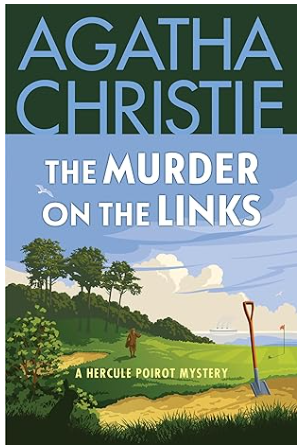
 The Murder on the Links by Agatha Christie, William Morrow Paperback Edition, original publication 1923.

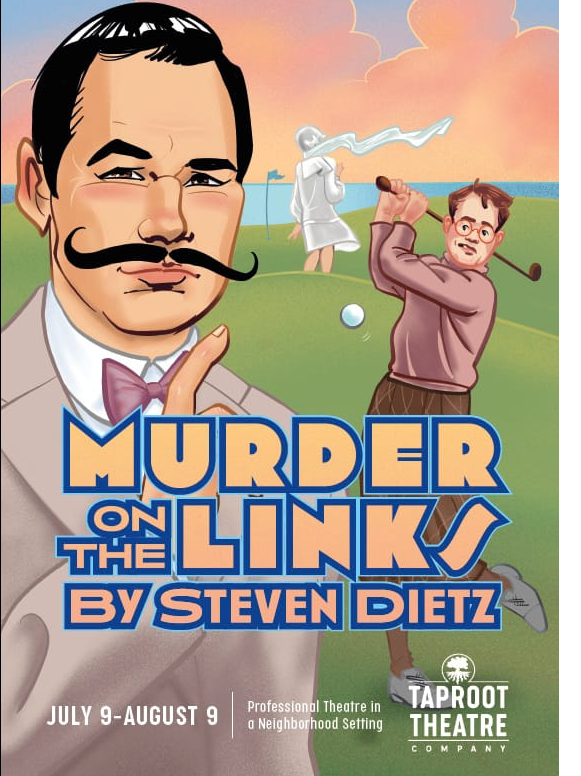
Murder on the Links by Steven Dietz,  Directed by Karen Lund, Taproot Theatre, Extended run through 30 August.

So John, who is Sacnoth and Janice, who is the Bride of Sacnoth, invited me to join them in an expedition in the Greenwood neighborhood for this Hercule Poirot mystery in Taproot's renovated main stage. The new/old digs are well-renovated, and the seating, while still tight, has been improved. In preparation for the play, I actually tracked down a copy of the original story at Page 2 books in Burien. It was an interesting search, in that while a lot of my regular haunts had all manner of Agatha Christie novels, they did not have this one. 

Anyway, long story short, I liked the play better than I liked the book. But I'll get to that. Lemme talk about the book first.

The Murder on the Links is the second Poirot novel. Poirot (for those who never got near PBS in their upbringing) is Agatha Christie's Belgian Detective, with his fastidious nature, distinctive moustache, flashing green eyes, and little grey cells that he uses to navigate through the mysteries. I had powered through a number of Poirot short stories, collected in Poirot Investigates, and he has the talent of targeting some small fact that blows up traditional theories about the case. 

Poirot's assistant and narrator of the tales is Captain Hastings, who is Watson to the Belgian Holmes. He is note quite the dullard of Nigel Bruce in the Sherlock Holmes movies of the 40s, but missteps regularly, concludes erroneously, and is often distracted by beautiful women (Poirot is, of course, immune to all feminine wiles).

So, the novel: Poirot and Hastings are summoned to France by a wealthy Brit named Renauld, who fears for his life because of an unstated "great secret". They arrive on the scene to find Renauld has been murdered, his body found in what would become a bunker in an adjoining golf course (this is the only mention of golf in the book). What follows is a torturous route with continual twists and revelations - hidden histories, changed wills, stolen evidence, secret romances, strange coincidences, exploded alibis, multiple confessions, acrobatic twins, another body, and a rival for Poirot in the form of Surete officer (seriously underused). There is a lot going on, stuffing it all into a relatively short novel. All of this is told with the dry, mannered, clockwork style of Christie, which, for all the murder involved, feels very temperate and bloodless. Having read a lot of Christie recently, I can see why Raymond Chandler really hated her work.

So that's the book, and on reading it I saw it would be a great challenge adapting it to the stage. There are a huge number of characters involved in the novel, including all the suspects, witnesses, and detectives. There is a lot of travel, from England to France with Poirot frequently dropping away from the narrative for some secretive mission in Paris or London. The book's plot turns on itself, with blind alleyways and false leads that are later revealed to be pertinent facts. Oh, and Hastings at one point does something lumpishly stupid and obvious that is then ignored by the author for several chapters. How to handle all that?

Well, writer Dietz does a pretty good job of it, and in addition, makes it a comedy.

Now, Christie lends itself well to comedy, particularly with sometimes overblown characters like Poirot. Check out Miss Marples in the 1960s movies, where the prim, elderly villager is overtaken by Dame Margaret Rutherford's more boisterous portrayal. And Dietz and the actors lean into the implausibility of the original text heavily. The accents are heavy, the actions are frenetic, and the lines are overblown. It actually lends a strong sense of fun to proceedings, and is frankly contagious. Dietz allows Hastings to be the narrator, and to fully narrate, piercing the veil between the fictional world and recognizing it as a play. Janice pointed out a similarity with The 39 Steps, and I heard another patron afterwards make the same comment. So yes, we can put his piece in the same wheelhouse as that one, making the original story a metatextual comment on the fact that this is a play. 

More importantly, the huge cast is cut down to a mere six. Nathan Brackett as a woosterish Hastings, Richard Ngyugen Stoniker (or perhaps understudy Mark Emerson - the moustache is that mesmerizing) is a solid Poirot. Everyone else in the play is portrayed by two men (Tyler Todd Kimmel and Jeff Allen Pierce) and two women (Betsy Mugavero and Claire Marx), which leads to situations where quick changes and transformations are required (and sometimes performed comically on-stage). And the players are in on the joke - this is a performance, and as the players move all the props about on the stage and pull together to make it all make some sort of narrative sense.

And as a play, it works so much better than as a novel. The linearity of moving the action forward makes clear the various plot points and revelations. I did not lose the thread. And even Hastings' bumbling in places makes better sense on the stage than it did on the printed page. Also, the play allows Brackett's Hasting to be more of the romantic hero he sees himself as, with his heart on his sleeve and his desire to protect young (and pretty) young women. And it gives Hasting not only a happy ending, but a lead-in to another Poirot mystery as an Easter Egg. Oh, and a scene actually takes place on a golf course.

All in all, it was an enjoyable way to spend and afternoon, and highly recommended. The cast is frantic and positively acrobatic in their portrayals, and leaves the audience exhausted and delighted. Worth seeing.

More later,

Thursday, December 05, 2024

The Big Pile of Books: Plane Books

A Right To Die by Rex Stout. Bantam Books, originally published in 1964. 
Too Many Clients by Rex Stout, Bantam Books, originally published in 1960
And Four To Go By Rex Stout, Bantam Books, originally published in 1958
Fade to Black by Robert Goldsborough, Bantam Books, originally published in 1990
The High Window by Raymond Chandler, Vintage Crime originally published in 1942
Pickup on Noon Street by Raymond Chandler, Ballantine Books, originally published in 1952
Playback by Raymond Chandler, Ballantine Books, originally published in 1958
The Mysterious Affair at Styles by Agatha Christie, Arcturus Books, originally published in 1920 

So I've been doing a lot of air travel this year, and when I travel, I bring along paperback mysteries. They are small, portable, you don't have to turn them off when landing or worry if the batteries are low. I usually get them at used bookstores, so if you lose them, you're out a few bucks.

And there's something I've noticed that I haven't seen anyone else comment about - the demise of the mass market paperback. I've been in a couple big chains, and the stubby pocket-sized mass-market paperback has been almost completely replaced with the larger-size trade paperback. The only mass-markets I'm finding (even in grocery stores, is the aisle next to the greeting cards) are by established authors and part of larger series that have been running in that format for years. Even a couple of the entries here are trade-sized reprints, purchased while on the road. Is this change-over really a thing? Are we losing the traditional mass market paperback of our youths?

Anyway.

These mass-market mysteries are also relatively short, unlike the doorstop fantasy books of the last several decades. That works out as well, since I can finish a book in one hop from Seattle to Milwaukee, or a round-trip to LA. 

I still tend to favor Nero Wolfe mysteries, if you haven't noticed, but I am getting towards the end of the Rex Stout canon, and have actually bought the same book twice under different covers because I was unsure if I have read it or not. I've even engaged with Stout's estate-approved successor. So I'm doing a bit more experimentation, this time with some Raymond Chandler I had never encountered before, and dabbling with Agatha Christie. 

Anyway, here are some recent additions

A Right To Die - Usually, Wolfe's world exists in a 7-year bubble. When we first meet Archie and Nero in the 30's, they've been together about 7 years. In the fifties, they've been together about 7 years. But now we are in the 60's and suddenly we get a direct call-back to an episode in the 30's. Back in 1938, Wolfe cracks the case in Too Many Cooks by appealing to the better nature of a group of African-American waiters. Now, one of those former waiters shows up at his door, quoting the speech that Wolfe had made that night. His problem is that his son is engaged to a white girl, and he wants to find out what's wrong with her. And then, of course, the white girl turns up dead. I mentioned that Wolfe's world is predominately white, but this is one of the times that Stout touches on racism.

Too Many Clients - This is Stout's sex mystery (amusing since the back cover of the paperback edition has a promotion for Everything You Wanted to Know About Sex* (But were afraid to ask). Much as A Right To Die delved into race relations, Too Many Clients deals with a high-level exec maintaining a sex-den in Spanish Harlem, where he um, entertains young women. When the exec turns up dead, Wolfe starts gaining client after client who wants to know who did it (and confirm that it wasn't them). The sex is polite, gentile, and mainly confined to the erotic art on the sex-den's walls. And since Archie Goodwin, our narrator, is a gentlemen, it doesn't get much further than a passing glance. Very much of its age.

And Four To Go - This is collection of Stout's shorter works, which originally saw print in glossy magazines like Look and The Saturday Evening Post (both long-gone as regular periodicals). This collection deals with a murders set around the holidays - A Christmas Party poisoning, an Easter parade shooting, a Fourth of July picnic stabbing. Each with a host of suspects and motives and a solid reason for the relatively inert Nero to get involved. Also was a fourth story that was an alternate version of a story that appeared elsewhere, with only the age of a female character changed. Interesting and a pity that such few avenues for this type of fiction now exist.

Fade to Black - Robert Goldsborough is the appointed heir (by Stout's estate) to carry on the stories of Nero and Archie. And it's all right - I can't really fault it. All the pieces are there - the brownstone, the orchids, the gourmet meals, the dicey relationship with the cops. But is does feel a little off, oddly because Stout's stories were always in the moment when they were written. Wolfe is always reading some recently-published volume, and the New York of the era is drivable. Fade to Black hews to that rule as well, but it feels weird once we get into later decades. The first line is "The whole business started at Lilly Rowan's Superbowl party", which just feels odd to me. The mystery involves dueling add agencies and stolen ideas, and there is a body, of course. It's not bad, but we are looking at a different place and time.

(As an addition, this volume was publishing in 1990, and the evolution of the mass-market paperback is clear from the earlier books of the 60's. It is a mass-market, but the margins are wider, and the leading (the white space between the lines) is larger. The book itself has more pages and is thicker, though I doubt there are more words. Paper in this later era was apparently cheaper, allowing the book to swell and take up more space on the bookshelf).

The High Window - This was purchased in Missoula Montana at Shakespeare's, a bookstore across the river from the hotel where MisCon was being help. I had finished Murder at the ABA and wanted to get a book for the return trip. I had read most of the "big" Raymond Chandler (The Little Sister, The Big Sleep, The Long Goodbye), and wanted to dig into the ones I had not heard of before (or had not been turned into movies). In The High Window, Phillip Marlowe is hired by an upper-class client to recover a rare coin. . Almost immediately hoods start leaning on him and dead bodies start piling up. Two things stay with me as I read through these - one is how Chandler managed to turn LA into a character, an impressive thing for a town that legendarily has "no there there". Chandler here is dealing with the upper crust and the roots they've set down in the more sordid parts of LA

(And by the way, this the trade version of the book, reprinted in the 1992, and can be compared against the earlier mass markets. Thinner, taller, but also wider margins and leading. And a higher price tag, even taking into account inflation). 

Playback -  One other theme that haunts Chandler's pages is broken women - those who have been traumatized as a foundation for their actions. You notice it after reading a few of them. In The High Window it was timid secretary Merle Davis. In The Long Goodbye it was Linda Loring. In this case it is Betty Manning (with a host of other names) who is on the run to California. Detective Phil Marlowe is hired to shadow her, then switches sides and becomes her defender in a cluster of lies and betrayals. The part of LA that Chandler defines here is Enclave Culture - those wealthy colonies along the coast where the old money retires, the young money wants to be included, and the help staff can't afford to live within the town boundaries. That part is the most interesting feature, along with Marlowe's internal monologues.

Pickup on Noon Street - This is a collection of shorts originally written for pulps like Black Mask. There's no Marlowe here, but rather characters named Dalmas and Carmady, both of which have their own internal code that Chandler relies on. LA is here as well, but seedier, seamier sides, which means a lot of hoods and guns, troubled women, and bodies on the floor. I picked up the book at Half-Price, and it came with its own little mystery - a polaroid used as a bookmark of what could be a shoreline or a distant mountain range in the distance, with a non-descript skyscraper along one side. 

The Mysterious Affair at Styles - The first Agatha Christie novel, and the first Poirot, this feels like a bloodless affair in the wake of Chandlers continual callousness and Stout's colorful domesticity. It is the classic Manor Mystery where the suspects are all in the house the night of the murder and everyone has a motive somewhere along the line. Christie wanted to write a mystery where she plays fair, and gives all the clues needed to solve the puzzle, but the passage of a hundred years made this reader sail past the pertinent clue in identifying the murderer. Yet it has a clockwork logic to it and a very British reserve that contrasts with the other books described in this post. The character with the most personality is narrator Hastings - Poirot's expository sidekick in the style of Doctor Watson and Archie Goodwin - who falls for one of the suspects. This particular edition was another trade paperback, nicely presented and large-formatted. 

And that's it for the Plane Books of 2024. The thing that strikes me in this mystery reading is the frame holding the mystery is sometimes more engaging that the mystery itself. Dorothy Sayers has a very political in her writing. Stout (and his successor) takes New York City and turns it into a cozy place for the occasional killing. Chandler reveals the LA outside his window, and Christie gives a tour of the upstairs/downstairs life in the interwar years. The books are centered on the mystery, but what makes them successful is what they're really about.

And I'm looking at stocking up for next year's trips. There will be fewer of them, but they will still be there.

More later.


Tuesday, June 04, 2024

Book: A Conventional Murder

 Murder at the ABA by Isaac Asimov, Fawcett Crest paperback edition, 1976

Provenance: Half-Price books down in Tukwilla, picked up before a trip to the MisCon convention in Missoula, Montana. When I fly, I tend to read old paperbacks. They are small, light, and, if forgotten on the airplane, easily replaced. They also, I believe, are slowly going extinct, replaced in the first-run bookstores with larger trade paperbacks. So there is a whiff of nostalgia and slowly decaying pulp about them. I like 'em.

This particular volume belonged to a John Braschler, and had as a bookmark a ticket to see Doctor Strange in 3D at the Pacific Science Center on 11/19/2016. Add to that a bookmark from Half-Price, and a sticker from SKS Props, another guest of the convention, given to me by owner Steve on the plane trip back from Missoula, Montana, so the physical book has its own history.

It is kind of strange, reading a book about a murder at a convention over Memorial Day weekend, while I was traveling to and from a convention over Memorial Day weekend. Such is life.

But what about the book? Well, I didn't care for it much, but decided to bull through it (and then write about it). Another advantage of old spinner-rack paperbacks. Even if you don't like 'em, you can still power through them.

Review: Isaac Asimov is known primarily for his SF and nonfiction science, but wrote mysteries as well. His best-known were about the Black Widower Club, where a bunch of writers gather for dinner, are presented with a  mystery, cast about options and opinions, then have the waiter solve it for them (usually the mystery revolves around someone mis-hearing or misunderstanding something). And in this case, Asimov was hired by Doubleday to write a full mystery novel set at the American Bookseller's Association, which was held in 1975 in New York City (he never identifies the city in the book, but Asimov says he attended the 1975 convention to pick up local color). 

And I attended ABAs and ALAs (American Library Association) about a decade later, when they had reached their apex such that the attending editors would bring along their assistant editors as sherpas to carry out all the free books offered. And Asimov gets the ambience and panels and celebrities and hurley-burley pretty correct. 

Supposedly Asimov based his main character, Darius Just, on fellow writer Harlan Ellison (who he dedicates the book to). And it's a pity that he didn't use more Ellison, who carved his own trail through SF as a brilliant writer, a complete mensch, and a raging pain in the butt, all at the same time. Darius Just is simply a height-deficient midlist writer, successful with a bad movie adaptation, as was Ellison in the mid-70s. That portrayal lacks the fire, irritation, ego, and lyrical verbal swagger of the original version's public persona, even in those days. Asimov's Ellison-clone is a wan, fatalistic figure who believes in the immovability of fate in addition to his own personal culpability in that fate. That's a shame.

Oh, OK, the plot. Darius Just is a semi-popular midlist writer asked to do an interview at the ABA by a friend. Also at the convention is Giles Devore, who Just mentored. Devore's first novel was a huge hit. Devore has become a complete jerk, his infantile obsessive-compulsive nature offending all around him. Just finds him dead in the bathtub and we're off to the races. And because Devore is so obsessive-compulsive, Just suspects murder.

And to be honest it plods a bit.  Mind you, Asimov's fiction tends towards the bloodless - people talking and thinking as opposed to people doing. And that style is evident here as Just rolls through suspects and prospects throughout the book. Asimov takes his time getting to the point - we are about a third through the book before the deserving victim finally croaks.

In addition, the book is filled with liberated 70s sexism, that Playboy-era mindset where equality meant that women had the right to have sex with you. Darius Just comes off a horndog, and Asimov (who writes himself into the novel, working on a book called Murder at the ABA - very meta) self-identifies as a lecherous flirt (and is praised for it). Add to that the fact that almost every female character in the book is described is sexual terms (bustlines and body-shape are a major factor here). And victim Devore has his own personal kinks. The end result is, as kids today say, cringe. 

The mystery is mechanically OK. I tagged the murderer early on, primarily in terms of the book's pacing (non-important suspects drop away from the narrative, but the true murderer keeps popping up). I also tweaked to the key clue. But I missed the full rationalization for the crime, in part because writing technology has changed from the mid-seventies.

Ultimately, the book comes off as dated and my eyes rolled many times in the reading - Stan! was traveling with me, and noted that I would read a few pages, then close the book and look into the middle distance for a short time before returning to the text. It's not great Asimov, but more on the level of his other mysteries. I would've liked to see Harlan Ellison as a main character as opposed to this dry-veined doppelganger. He'd have been an interesting detective.

More later, 

Thursday, April 20, 2023

Books: Spies and Lies

 Slow Horses by Mick Herron, Soho Press, 2010

A Legacy of Spies by John Le Carré, Penguin Books, 2017

Provenance: I blame The New Yorker for this one. They had an article on author Mick Herron, talking about how he was an heir to John Le Carré in the genre of spy thrillers. OK, on that note, I went hunting for Herron's first book, and found it at Apparition Books in downtown Renton (who do not have a web site. Sorry). Apparition is a curated bookstore that has a lot of good books in good condition. On completing Slow Horses, I went back to see if they have the second book of the series. They didn't, but did have one of John Le Carré's last works. So I picked that up instead, and used it as my airplane book for the trip the Georgia.

(And yes, I prefer to read books on the plane as opposed to using the tablet. I don't worry about battery life or being distracted by other apps or having to turn it off during takeoffs and landings. And if the book is lost, it is OK - it's a paperback.)

Review: Slow Horses is Smiley's People meets The Office. No, really. The title is a play on Slough House, the nickname of a branch of MI5 that is so remote from the sources of real power in the Ministry that it might as well be in Slough. This is where they put the Joes that screwed up, the ones they can't fire outright. They give put them in the worst, most tedious, most menial jobs in the hopes that they will take the hint and quit. River Cartwright is one of those Joes who apparently screwed up and as a result he works grudgingly with others who have committed sins great and small, under the relatively inert leadership of Jackson Lamb. Their tasks are gruntwork - checking IDs, monitoring BBSes, investigating lapsed visas. They exist in the after-eleven world, where the threat was not communism but religious maniacs. They are prepared for foreign terrorism.

What they are not prepared for is the home-grown type. They also are not prepared for their own bureaucracy, more concerned for turf wars and protecting their own bureaucratic buttocks than in doing their jobs (actually, they feel that protecting their public-funded posteriors IS their job). The mayhem that ensues is mostly self-inflicted, but it is the Slow Horses, and Jackson Lamb in particular, who ultimately triumph. Mostly.

I like the characters and the plot. The author drives me particularly crazy by having the characters learn things which are then not shared with reader. We are frozen out. Someone is about to share some important bit of information and the scene changes. Someone dies - Who? Tell you in about 20 pages as an offhand remark. And the author deliberately misdirects, so that you think one thing when the truth is elsewhere. These literary trick raises tension through this concealment, but it excludes the reader from the journey. That's a personal peeve, but it caused me to roll my eyes a few cycles.

One thing I did like was the sense of place, in the Modern London. William Gibson is one of his books described London as an alternate reality to the States. Things are the same, but also very different. And that alien familiarity may account for some of the popularity of all things British on this side of the pond, from Monty Python to Harry Potter. Things are familiar, but different, a modern fantasy setting of sorts. Herron describes and describes well and sells the setting hard. I know the area that Slough House is located, as the original Grub Street (now Milton Street) is in the area, as I walked that area of London the last time I was there. 

Let me praise with faint damns - It was worthwhile, and I will probably hunt down the next one.

But with all that in mind, I turned to A Legacy of Spies, going to original-flavor spy novelist Le Carré in one of his last books, published seven years after Herron's first, and quite frankly, discover that the original version still has the juice after all that time. Le Carré is the grand old man of spy fiction, defining a lot of the terms used and setting the entire sphere of post-war spycraft as a blatantly amoral game where the greater good outweighed any personal qualms. At its core has been (often) George Smiley, who has been the master web-spinner at the heart of the Circus.

A Legacy of Spies is related to us by Peter Guiman, who has been Smithers to Smiley's Burns in earlier books. Peter has been Smiley's agent, bag-man, and aid-de-camp for years. Pater has been hauled out of retirement in Brittany by the next generation, who is dealing with accusations involving his time at the Circus. Half of the story is Peter talking to the modern lawyers, and half is his memory of what really happened back then.

And Peter lies. But unlike the lies Herron presents, Le Carré takes us hostage within Peter's narration, so that we KNOW he is lying (usually when talking with the lawyers and the modern agents). Peter dodges, he takes refuge in semantics, he seeks to protect Smiley (who may or may not still be alive at this point), he tries to protect the legacy of the dead. As a result, you the reader are let in on what is going on, or at least, what Peter thinks is going on. And to be frank, it feels at the end as if Peter is disassociating completely from reality, and this most unreliable of narrators may be utterly unreliable. 

And its is great stuff. Yeah, knowledge of what has gone before is helpful/recommended (I brushed up against it back when Alec Guinness was playing the role), and the book does a lot to provide connective tissue for a lot of the other series. But Le Carré remains an amazing writer and his work is an engaging as his characters are morally grey. It feels like the wrapping up of loose ends (Le Carré died in 2020, and while this is not his last book, it is the last one featuring Smiley's People). 

So, end result? Herron is perfectly fine if you're willing to be brought along for the ride. Le Carré remains the champion, in part by laying things out exactly, and letting you come to your conclusions.

More later,  

Saturday, March 11, 2023

Book: Planet of Women

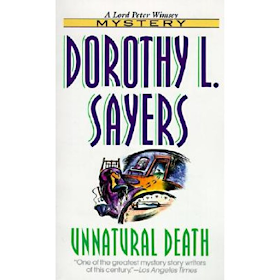
 Unnatural Death by Dorothy L. Sayers HarperPaperbacks,  Original copyright 1927

Provenance: The Crazy Book Lady, a used bookstore in Acworth, Georgia. I wanted to pick up a back-up book when I was down there (you readers know what I mean - a book for just in case I finished the book I was reading). The shop is in a small mall off the main road, noted only by a simple sign declaring "Books", and also handles U-Haul rentals. Could not find the next Mick Herron book, and did not feel like another LaCarre, but did stumble across a Sayers that I had not yet read.

Review: Let me digress immediately. I always found the Bogart version of the Big Sleep (1947) interesting for many reasons, and one of them is the power of women in the film. Bogart is Phil Marlowe is at the center, sure, and we also have the old General's two daughters (Lauren Bacall and Martha Vickers, who throw themselves at Marlowe) but also the chief villainess (Agnes Lowzier, who does not), and Dorothy Malone as the bookstore owner who looks beautiful without her glasses. And a female cabbie (Joy Barlowe) for a short bit. And what struck me at the time was that Bogart/Marlowe just pops into the cab without giving the fact it was driven by a woman a second thought. It is a movie, though with a male lead spends most of his time interacting with women.

And that is the same vibe I got from Unnatural Death. Yes, Sayers did a great women-centric book in Gaudy Night, and some day I may even talk about it. But the plot of Unnatural Death is controlled by its women, and Lord Peter Wimsey and his buddy Inspector Parker are often secondary and reactive to their actions. I fact, most of the men come off as second-best - they are there where their positions of power, banned to women, are needed (doctors, lawyers, law enforcement), but are come off the worse for wear (haughty, pedantic, and/or fools).

Let me lay out the plot in brief. This is the most murder-mystery-like of the Lord Peter books in that it obeys a lot of traditional tropes. By this point in his career Lord Peter has established himself as an effective consulting detective, making mysteries and murder his habit. A discussion of "perfect murders" that no one even considers a crime occurs, boosted by a chance encounter at a restaurant, which puts him on the case. An old woman dies. She has cancer, but her demise is still sudden. She has stated that her Grand-Niece inherits all, but refuses to make a will. And there is enough little weirdnesses around the situation that Lord Peter, with Parker in tow, investigates. 

And part of that investigation is assigning a female operative to the deceased's home town. Miss Climpson is a proper, dedicated, older, single woman with a High Anglican background and a rational mind. Peter puts her in town so she can ask questions that a man would not get proper answers about. And she falls in with the gossipy small-town lift of the community and shows herself to be every proper bit an investigator (by the way, she apparently predates Miss Marples by a couple years, though she is late to the field of Lady Detectives in general). The end of the book  is a cascade of her convincing herself to put herself in harms' way while Wimsey and Parker are still sorting out threads.

And there is a lot of queer-coding going on here. Many of the women have no declared use for men and are pretty happy with that - they are fish without bicycles. And a number of them have better relationships with other women. The elderly deceased had a healthy and active relationship with a suspect's grandmother (who was (coding) an expert horsewoman). Peter's chief suspect leaves town with a younger woman, intent on purchasing a egg farm far away from any of the people they know. The phrase "equal of any man" is invoked a couple times, and always making the male speaker look like a fool. For a book almost a hundred years old, there are lot of signposts out there, and the question arises if there it was as obvious back then as it is now.

The murder itself (and yes, there was an initial murder - if fact, several over the course of the book) ages less well. The method of dispatch is obvious to our modern eyes, since we have seen it played through so many times in popular media since (along with questions of how effective it would actually be in the real world). Wimsey pieces together the clues with glacial slowness, complete with a moment of "Ah! I had forgotten about this one piece of then-public information" that provides a motivation as to why the old woman had to die RIGHT NOW as opposed to letter nature (and cancer) take its course.

All in all, it is Sayers, and as such has a richness and depth of Interwar Britain. In this case, the sudden downturn of the male population in the years after the war, and the challenges and opportunities that presented to women. As always, worthwhile.

More later, 


Friday, October 21, 2022

Book: Through A Lass, Darkly

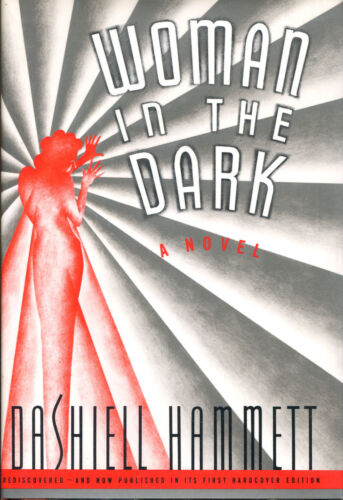
 Woman In The Dark by Dashiell Hammett: A Novel of Dangerous Romance, Originally published 1933, Alfred A Knopf. 1988.

Provenance: Purchase from the Tacoma Book Center. The Book Center is a small bunkerlike building in the shadow of the Tacoma Dome. However, it is a TARDIS, in that once you enter, you find walls upon walls of books, concealed levels and hidden back rooms that seem to go on for much longer than the building itself. The shelves are high, overstuffed, and extremely well-organized. Eventually, once the light rail from Seattle gets down there, the neighborhood will be upgraded to the point that a bookstore like this would no longer be able to afford its space, and it will become a Chipotle or something, but in the meantime, it is a place that I go to find stuff I cannot find elsewhere.

Review: This book is very slight. To call it a novel is to seriously round up, as it was originally a three-part short story published in Liberty magazine in 1933. Tack on an intro by mystery writer Robert B Parker that ties it into Hammett's relationship with Lillian Hellman, bump up the spacing, give it wide margins and a header bar, and ... it's still a very slight book.

The story itself is Hammett distilled down to its basics. It almost feels like a script treatment padded out to a magazine submission. It is seriously a three-act structure. Chase the hero up the tree. Throw rocks at him. Get him down. Brazil, our hero, is in his cottage with his girlfriend when a babe in a tattered dress stumbles in, followed by her politically powerful boyfriend and one of his goons. Fight breaks out, the goons is injured, maybe fatally. Girl and Brazil go on the run because he can't go back to prison, but the powerful guy's people catch up with them. Brazil takes a bullet, looks like the bad guys win, and then we rally and get a rapid (one-page), last-minute denouement. 

It's Hammett at the core - Brazil is a tough former con who has his own code but sticks his neck out for nobody. The babe is the powerful guy's mistress on the run, doing what she must to survive. The cops are corrupt, the little people helpful criminals. The powerful guy? Psychotic but with pull. The writing? Punchy. It could have been a movie in 1933. 

It's lesser Hammett, but still Hammett. Probably exists in some collection of shorts as opposed to a single hardback. A good read, but nothing to go out your way for. Nice a discovery in a used bookstore that is bigger than it seems to be, and that's it.

More later, 

Tuesday, January 11, 2022

Book: A Sudden Case of Death

The Case of the Canterfell Codicil: The First Anty Boisjoly Mystery, by P.J.Fitzsimmons, 2020.

Provenance: A Christmas present I purchased, then entrusted to the Lovely Bride to deliver to me on the day itself (I in turn order clothes that she has specifically noted in catalogs, wrap them and return them to her - it is a system that works). The book was endlessly flogged on Facebook to me, as the Mighty Algorithm had determined my interest in mysteries of the interwar years (of course, if you read this blog, you might determine that as well), and I was curious.

And the book,  apparently self-published, cuts free of the stuff and nonsense of modern publishing process, allowing the tiller of the literary fields to deal direct with the consumer with a severe reduction of middlemen and gatekeepers. A farmer's market for literature! Huzzah the revolution!

The Review: And how was it? Not too bad, but not as strong as it was hyped. The book was oversold, promising a collision of Wodehouse, Sayers, and Christie. A high bar to be sure. The frothiness of Bertie and Jeeves, the eloquence of Peter Wimsey, and the clockwork plotting of a Miss Marples cozy, all compressed within its covers. Demanding such comparisons, however, reminds the reader the the originals, written in the era itself, are well-remembered classics for a reason. My expectations were high, and while the end result was a romp, it does not measure up, and left me a bit disappointed.

Anthony "Anty" Boisjoly (Boo-Juhlay) is residing at his club when a telegram from his old college pal summons him to Canterfell Hall, where the much-disliked Uncle Sebastian has just taken a header out of an upper-story window.  Anty arrives at  Canterfell to find a cross between Blandings Castle and a Poirot-inspired railway trip. Mysteries abound, small and large, starting with a locked room mystery and spiraling out from there.

Anty as a character falls between two chairs. He is neither the cloth-headed Bertie Wooster nor the supreme intellect Lord Peter, but exemplifies traits of both, depending on the situation. So it is hard to get a handle on him as he sometimes lumbers through some scenes, then has flashes of brilliance and glory. If you're going to ape Wodehouse (*cough* The Wyvernspur *cough*), you have to catch his ear for banter, and some of the chat falls more into the Realm of Monty Python and Blackadder than into the era itself.

Also, in presenting Wodehousian descriptions, there is a much of muchness, which makes you appreciate Plum's tact and reserve (there's a line I never expected to write). Every briar patch and weir, every doorknob and newel post, gets an achingly florid string of similes and comparisons. Sort of like being trapped in an esoteric comedy routine from the 80s.  Also, there seems to be a decided lack of synonyms for the word "thatch".  In a similar fashion the mysteries sort of pile up on each other, as EVERYONE has a secret or ten. The locked-room death of Uncle Sebastian, the nature and location of the titular codicil, the disappearing painting, the horrible dinner and excellent breakfast, they just tend to pile up over time. But yes, they all get answered, to some degree, by the end. 

Does Fitzsimmons play fair with the reader? Mostly. Some of the brain blasts that Anty gets are based on previous information that he, the character, does not share with us, the reader, until the time for the reveal (such as how an off-handed complaint from an Police Inspector tells him that a member of Parliament is lurking about). And the cause of the first death is less of a well-executed plan and more of a random roll of the dice. Yet it barrels along merrily to its resolution.

As a self-published work, the book's production values are high. The cover has that slightly tacky plasticized cover which continues to disappoint me, but I am afraid that, publishing-wise, that ship has sailed. The cover is a stylized art deco with a metro-retro font (also in the chapter headings). It coulda stood a map, to be honest, to position various rooms in the manor correctly (which Nine Tailors did), but that is a minor point.

So will it leave the major publishers quaking in their boots? Not really, but that's OK. It is a pleasant enough volume, and I would recommend it above the recent Westlake. If you approach it as a lark and paean to the previous masters, it is fine. But I would be very wary about the ad copy in the future.

More later,


Thursday, December 16, 2021

Book: Jail Break


Help, I'm Being Held Prisoner By Donald E. Westlake, Titan Books, original publication 1974

Provenance: Half-Price Books. When I am in a used bookstore, I check the mysteries to see if there are any Rex Stouts I am missing. In the same area of the alphabet I found this Donald Westlake in trade paperback format.

Review: So, Donald Westlake is an incredibly accomplished author, and wrote the original Parker novels. He also wrote the novel The Hot Rock, which became the film of the same name with a screenplay by William Goldman, starring Robert Redford, George Segal, Paul Sands, and Zero Mostel. Funny movie. So if you want funny crime stories, Westlake has you covered. And the original publication of this book falls hard on the heels of The Hot Rock movie, so there was probably a demand of funny crime stories.

And it is a prison fantasy, in that it takes place in a prison, but is scripted in a way that breaks your sense of reality if you think about it too hard. 

The unfortunately-named Harold Künt (with an umlat - it just gets worse the longer you look at it) is inveterate and uncontrollable practical joker whose latest stunt on the Long Island Expressway gets him sent up the river for a short stint. He falls in with a band of tough guys who have tunneled out of the prison, but they are not planning an escape. Instead they leave the prison, commit a few crimes, go out to dinner, take in a movie, then come back for roll-call. Harold accidentally and easily crashes the party, and after some deliberation, the tough guys take him in because they have a big plan - they are going to knock over not one, but two banks in the town the prison is located in, then come back to prison because that's the last place anyone would think to look for criminals.

And we're ignoring stuff like, you know, fingerprints. Like I said, let's park reality at the door for this one.

Its a fun, light read. Harold is a nervous wreck, trying to keep himself from committing any more practical jokes, plus keeping the gang's secrets, plus dealing with someone else pulling practical jokes and him taking the blame, plus trying to keep the gang from finding out that he is NOT a tough guy, plus desperately trying to keep the gang from robbing the banks. So most of the book consists of him going to greater and greater lengths to keep all the balls in the air. Sort of French farce, with a lot of door slamming, but the doors have bars on them in this case. 

I have to call out the Paul Mann cover of this one, only because, in the tradition of hard-boiled mysteries, it conveys the theme while misrepresenting what is going on inside the covers. The protagonist is a broad-chested he-man dressed up in classic hamburglar stripes (he is not, and the book is set in a period of Folsom prison denims). The babe is all legs and bare;y-buttoned men's shirt (there is a love interest, but not as dolled up) with an obligatory gun - It is something something off the old Carter Brown covers by Robert McGinnis. 

So, it is a fun book, and a nice break from change ringing in the fens of East Anglia, but not one to hunt down. 

More later,

Friday, December 03, 2021

Book: Whom the Bell Tolls

Mass Market Paperback The Nine Tailors Book

The Nine Tailors by Dorothy L. Sayers, Harcourt Brace Jovanovich, 1934

Provenance: Picked up at Page Turner Books down in Kent, took with me as an airline read.

Review: I've said before that Dorothy Sayers mysteries are about other things, which just happen to have a mystery, a murder, and a detective mixed in. Murder Must Advertise gets into the weeds with advertising and office culture. Unpleasantness at the Bellona Club deals with men's clubs and the casual damage from the war. The Nine Tailors is a mystery that involves deep discussions of  bellringers and water management in the fens of East Anglia. The full title is The Nine Tailors: Changes Rung on an Old Theme In Two Short Touches and Two Full Peals.

And I'll be honest, the book put me to sleep on the trip back from Florida. I don't sleep on planes as a rule, but it put me under for a good two hours.

That's not bad in any way, shape or form - if there is anyone who can write about bellringing and East Anglian fens, Sayers is the person to do so. But there is a lot of text to be waded through, and much of it steams of a writer showing off their research.

So here's the general gist of it. Lord Peter Wimsey and his manservant Bunter get into a car accident near the village of Fenchurch St. Paul. They are taken in at the local vicarage, and Lord Peter lends a hand with a nine-hour ringing session of the church bells for the New Year. He stays for the funeral of the Lady of the local manor. He returns a few months later for the funeral of the Lord of the local manor, but when they open up the Lady's grave to inter the Lord's body, there is another unexpected body in the grave.

There are more tropes here than in an episode of Murder She Wrote. The befuddled minister. The town fool who speaks in riddles. The old-timer who remembers everything. The busybody who is incensed about the placement of the mourning wreaths. The young heir with the grumpy uncle. The well-meaning souls who cover up for those they think guilty. The key piece of evidence destroyed by someone washing up. The body where it shouldn't be. The missing emeralds. Add to that clues which are in code using the script of campanology and the ever-present threat of flooding in the fens, and there is a lot going on here.

Lord Peter does his detective thing, but he almost feels incidental. He doesn't have much of a character arc for himself in this one other than to hunt down clues and make deductions. He's not in his native clime, but adapts well, people like him, no one is really working against him. He sort of Mary Poppins his way into the lives of those at Fenchurch St. Paul. By this time (9 books in), Wimsy's personality is pretty much crystalized, but his reaction to a sudden flood (which gives him the final piece of the puzzle) still feels overwrought and unexpected. 

Oh, and the nine tailors of the title are not about men making suits, but about the nine tolls of the bells to commemorate the death of a man.  There is a lot of jargon within the book, particularly about bellringing (more exactly, change ringing), and it is easy to lost in the Stedman's Trebles and the Grandsire Triples..

Mind, Sayers can write, and she writes up a storm. Her writing is eloquent and literate. If you are forced, through circumstance or at gunpoint, to read a mystery featuring bellringing and water management in the East Anglian marshlands, this is as good as you're going to get. This volume has a reputation as being one of her best, and if you love it, you love it utterly, and if you hate it, it is one of the worst. I would not make this a first read for the series or the character, but it stands well of its own right.

More later,

Sunday, August 22, 2021

Book: Body of Evidence

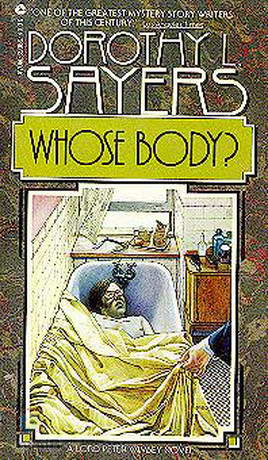
Whose Body? by Dorothy Sayers, Avon Books, 1923

Provenance: The volume has an embossed stamp "Library of Janice Kae Coulter" on the first two pages. Ms. Coulter is the spouse of fellow blogger Sacnoth. I do not know whether I plucked this volume from their collection before it went to the Page Turner, or purchased it there for two bucks and change (I suspect the latter). 

Review: This was one of the Books on a Plane, but I found I had too much to say about it to just stack it up against all the Rex Stouts, so it gets its own blog post. This post deals with meta fiction, introducing characters, why Raymond Chandler may have really hated Sayers' work, and anti-Semitism. Buckle up.

Here's the precis: London after the Great War. A wealthy Jewish financier goes missing. A dead body is found naked in a bathtub.The body is not the financier's, but there is a surface similarity between the two.The police assume initially assume the bathtub body IS the financier. Lord Peter, brought in by his mother because she knows the person whose tub the body was found in, knows better. 

This is the first appearance of Lord Peter Death Bredon Wimsey, and he springs onto the stage (mostly) fully formed. He had solved a previous (unrecorded) case of missing emeralds, and so already had contacts with the police as a helpful meddler whose societal privilege gives him access denied to the hoi palloi. He also has a "kit" that Batman would approve of - his cane is a measuring stick and has a concealed blade and his monocle is really a magnifying lens/ He has a dutiful manservant who is a camera buff. Lord Peter saunters in fully prepared to get involved. 

While he does so, Lord Peter also talks about detective stories in a very meta way. "Were this a detective story..." the line starts, and then mentions and discards some trope from the fictions. Sayers denies some of them and plays with others - for example, witnesses never remember what really happened on a date two months ago, and the proceeds, with almost casual conversation, to show Lord Peer wheedling the information he needs out of a witness without the witness realizing it. Yet Sayers herself embraces a lot of other detective tropes - the incompetent police inspector, the blind alleys, and the dutiful details of inquest and exhumation.

But when Lord Peter solves the case, something happens. He finds the solution, but in the process suffers a nervous breakdown because the solution challenges a lot of his privilege. His recognition shakes him to the core and unleashes his PTSD from the Great War. In game terms, he blows his San check and has to go have a lie-down for a couple days. This is VERY not in keeping with traditional mysteries, in that the protagonist can get angry, vengeance, shot up, physically damaged, but never suffers a mental collapse (Stout has Wolfe occasionally go into a "Fugue state" when stymied, which feels like little more than writer's block).  This is so different from the muscular American detective stories, that I can see why Chandler didn't like Sayer's work much, though he chalks it up to being "boring".. We know beans about the personal history of his Continental Op - Lord Peter has wounds deeper than most of the other characters cans see. 

In doing the research for this review, I came across accusations of the author's antisemitism, and this book is used as evidence both for and against. On the "for" side we have the missing financier being Jewish, and one of the positive figures, Peter's mother, going into a "Very good people" sort of speech which hauls out a lot of differences between the Jewish community and God's Own Anglicans. On the other hand, the missing financier is practically lionized for his kindness and modest living (no Shylock, he), and one of Peter's archtypical upper class friends, practically fresh from the Drones club, talks about wanting to marry the victim's daughter and convert to the faith. And there a servant who is pretty deplorable in his statements, but he is held up as being a low character who is drinking Lord Peter's best brandy. The challenge is, does, in talking about an "othered" portion of the population, does that make you vulnerable to engaging in the same forms of prejudice? Is reporting prejudice the same as perpetuating it?

The meta research here on Sayers does me no good as well. Sayers' long-time companion was Jewish, she notes that the financier was one of the few good characters in the book, and in an early draft Lord Peter recognizes immediately that the body in the tub cannot be the financier because it was circumcised (which would be kinda obvious and make the police look EVEN dumber). On the other hand, Sayers developed into a Christian apologist of CS Lewis stripe, and the work she is proud of is a translation of Dante (which features heavily in the opening chapter of this volume).

Ultimately, I am going to render a Scottish verdict of "Not Proven" on this one, but there may be some reference of her endorsing the Elders of Zion out there without me realizing. it. I do remain committed to the idea that Sayers does not write detective novels so much as novels which feature a detective. And I will stand behind that one.

More later,

Monday, August 16, 2021

Books on a Plane

Three Witnesses by Rex Stout, Bantam, 1955

Not Quite Dead Enough by Rex Stout, Bantam,  1944

Plot It Yourself by Rex Stout, Bantam, 1959

And Be A Villain by Rex Stout Bantam, 1948

Provenance: Various. I pick up books from used bookstores - The Page Turner in Kent. The Tacoma Book Center near the Dome. Twice Sold Tales up on Capitol Hill. And I am always hunting down more of Rex Stout's stories of Nero Wolfe. The books were popular on first release, and there have been several waves of re-release since then (including reprints from the 80's marked "As Seen On TV").  Eventually I will run out of them. But not yet.

Reviews: When I travel, I tend to bring paperback mysteries to read. There are a couple reasons for this. They don't wear down batteries. They don't have to be turned off or stowed when taking off or landing. And if dropped or lost, they represent a lost investment of a couple dollars. About a month ago, I made two trips to Pittsburgh, and as a result took a fist-full of books with me.

So, warning, there are spoilers for books that have been in print for decades. 

Three Witnesses - Rex Stout mysteries come in two main formats - book length, and magazine length. When published in book form, the publisher tends to put three of short stories together, and, unfortunately, they use the word "three" and its synonyms in the titles repeatedly (Three at Wolfe's Door, Three Doors to Death, Death Times Three), so I'm never quite sure if I have read this before. Usually I can get ahead of the game with the short stories and figure out "whodunnit", while the novels tend to lose me sometimes. This is in part because in the shortened format, both memory and awareness of what sticks out as wrong is more obvious in the short versions.

And, one of the things that makes Nero Wolfe mysteries work is the background. Archie will crack wise, Nero will be pompous. Inspector Kramer will bluster. The household will eat well. It is comfortable.

The mysteries in Three Witnesses are pretty good, but "To Die Like a Dog" is probably the best. A dog follows Archie home from a murder scene. While Wolfe is usually a bundle of hostility, it turns out he likes dogs. The dog's presence makes perfect. sense, and at the end, the dog has settled into the household. But as far I can tell, the dog is never seen again in another story, which is a pity.

Not Quite Dead Enough consists of two war year stories. In the first, Archie cobbles together a mystery to help recruit Wolfe into the War Effort. In the second, linked with that, an experimental grenade goes off in an military office downtown. The first is actually something I would call "lesser Wolfe", since Archie gets foxed and his oftimes girlfriend, Lilly Rowan, gets unusually possessive. The second sees Wolfe returning to a form not seen since Fer-De-Lance, the first Wolfe novel, where he metes out his own justice outside the system. Interesting for a completest like me.

To Be A Villain and Plot It Yourself are interesting in that I got to the whodunnit, but not by normal course of events. Rather, the murderers act in a way that makes little sense if they are merely a suspect or potential victim, but makes sense if they are the murderer. 

Plot It Yourself involves the book industry, and the relationships between authors and publishers. Wolfe is hired by a group of publishers and authors who are being hit with a plagiarism scam. Not that other authors are stealing their work, but rather these other authors are coming forward claiming that the published authors stole their stuff. And they offer proof in the form of manuscripts and letters that show up in the published authors files from before publication. Its a good book in that it covers a variety of author types, and the perils of working for a committee.

And Be A Villain has a nice initial curve-ball - Nero Wolfe goes looking for a gig, in order to cover his tax bill (Wolfe has a long list of things he does not want to do, which the stories inevitably make him do). He  offers his services to a radio personality who has a guest poisoned on the air. Sudden death, relatively small number of suspects. Again, I got to my lead suspect not through evidence, but through character reactions to the crime. Further, the crime itself (and its followup) calls for a relatively thin window of opportunity, and can go horribly awry. I still like the writing in both cases, and the characters, but the mystery at the core feels a little weak.

This series has become my popcorn, my easy reading. The stuff I will take on a plane and not have any other greater purpose. There's one more, which I am still thinking about writing up. More later,

Wednesday, June 02, 2021

Plague Books: Comfortable Robot

Fugitive Telemetry by Martha Wells,Tordotcom Books,2021

Provenance: Well of course I'm going to read the new Murderbot book. I've come onboard for this snappy series, and have stayed with it. Apparently, the book itself has branched, so now we have Murderbot novels, as well as shorter Murderbot novellas, which are the Diaries. In any event, when this one showed up I ordered it from Amazon in hardback along with two Shakespeare DVDs (King Lear with James Earl Jones and Much Ado About Nothing with Sam Waterston) to present to the Lovely Bride after tax season ended on 15 April. Then they pushed back the deadline a month (which, and this may surprise you, did not endear the IRS to all the tax preparers), so it was mid-May before I gave them to her. And she promptly devoured this one. Then I got to read it.

Review: Over in the Mystery genre they have what they call a "cozy". There are number of related definitions of it, but is usually involves an amateur detective, usually female, usually grudgingly accepted by the professional force, who accidentally discovers murder most foul, but in general has a low threat level and well-known surroundings and a supporting cast. Miss Marples and Jessica Fletcher are the best-known embodiments of the "cozy." Hardboiled writers like Chandler and Hammett HATED the cozy branch of their genre. But in the genre, a cozy is a comfortable read.

Fugitive Telemetry verges on the cozy. It stars our sarcastic friend, the Murderbot, and we are treated to their inner thoughts, which normally involving thinking about how stupid the humans are around them, and if they just spent five minutes not trying to get themselves killed, they could get back to watching pirated space adventure soap operas on their feeds. We are five books in (six counting a novel), and Murderbot (SecBot to everyone else, because, you know, identifying yourself as a Murderbot make fragile, squishy humans a little panicked), is no longer quite as bitingly sardonic, but comes off as cranky, verging on grumpy.

They also digress within their digression, and their personal asides have asides. Which as a writing style is rather contagious. Fortunately, I am resist to such influences (mostly).

Anyway, 

Fugitive Telemetry is a mystery novel at its heart, in which the talented amateur gets involved, despite their better judgement. A body is found in a hallway of Preservation Station, the entry port for Murderbot's new home planet. Who it is, who dunnit, and how it got there are all unknown. Murderbot is asked by their friend/sponsor to check it out, because it might be connected with the evil corporation that wants their friend/sponsor and all of her poly/research family dead. 

And grumbling, Murderbot agrees, having to deal with the head of security, who in no way is going to let Murderbot get access to all their mainframes, which would make the job a lot easier. Murderbot brings a lot to the table both with their hacking abilities and their basic assumption that humans at not the brightest tools in orbit. Murderbot's status as an artificial construct makes certain avenues of investigation (like talking to other constructs) blazingly obvious and overlooked by the more organic investigators.

Mysteries in SF (and in Fantasy as well) are difficult in that the author and the reader do not share the same baseline knowledge, and you have to explain the world without tipping your hand that this is why you explaining it. Or why this particular clue is a clue and not part of the world as people know it. In the Mystery genre, people have a basic assumption of how things work - the role of the police, the nature of evidence, how cars and guns work, general history, that sort of thing. In SF, you have to do a lot of groundwork to deal with the fact you are on a space station spinning in a vacuum with a number of different classes of man-made sentients running around (robots, AIs ships, SecBots, and the like), and and how that ultimately affects the story.

And it all works. Murderbot gets stuff wrong, makes bad assumptions, and goes down some blind allies before understanding what is really going on. And it feels ... comfortable. There a no dark bits of their past revealed, no major conspiracies, no serious revelations for the character. It almost feels like the pilot for a series on Netflix, where the Outsider installs themselves as the specialist that Station Security brings in for big cases. So Murderbot doesn't have to deal with the paperwork, just with the cool stuff.

And it makes for a comfortable read. Not quite a cozy, but you can see it from there.

More later,