Showing posts with label Art. Show all posts

Tuesday, November 18, 2025

Books: Seattle Time Capsules

 Seattleness: A Cultural Atlas, by Terra Hatfield, Jenny Kempson, and Natalie Ross, Sasquatch Press (at that time part of Penguin Random House), 2018

Filmlandia! by David Schmader, Sasquatch Books (at the time part of Penguin Random House, but soon to be sold toe Blue Star Press and given its freedom), 2023 

Art In Seattle's Public Spaces by James Rupp and Miguel Edwards, University of Washington Press, 2018

Too High and Too Steep: Reshaping Seattle's Topography by David B Williams, University of Washington Press 2015

The Mushroom Hunters by Langdon Cook, Ballantine Books, 2013 (paperback 2023)

Seattle Noir edited by Curt Colbert, Akashic Books, 2009

Provenance: Various. I believe Seattleness and Art in Seattle's Public Spaces were gifts from the Lovely Bride (Seattleness has a Half-Price Books sticker on it). I found Too High and Too Steep at the Elliot Bay Bookstore when it was in Pioneer Square, The Mushroom Hunters was recommended by colleague Wolfgang Baur, and when I couldn't find it locally, ordered it from Amazon. Seattle Noir was a whim purchase at Barnes & Nobles when I was looking for something else, but it was shelved face-outward and caught my eye. I have no memory of where I found Filmlandia! - it just showed up one day and refused to leave until I read it. 

The Reviews: Books are times capsules. They can't help it. As soon as the last word is written, the final change is made, and the switch thrown and the electricity pumped into the presses, they are frozen in amber. They can be revised, they can be rewritten, but the sheer physicality of the book gives it permanence that no computer file can match. Historical books are trapped not only by their subject matter, but also that they represent the thinking of their times. Even those that want to be current (in PARTICULAR those that want to be current) are stopped at the point when they are finished. 

Anyway,

I've lived in Seattle (OK, a suburb of Seattle) for longer than I've lived anywhere else. I've got my 25-year chip, which allows me to complain about new people moving into the state. But I still have that newcomer's vibe of interest in the area, and picking up what I may have missed before I got here. So I've been accumulating books about Seattle, not out of a passion, but just finding them along the way.

So here are some books about my current home town:

Seattleness: A Cultural Atlas is an infographic book, in that it takes stuff about Seattle and its history and presents it in a variety of graphics - charts, maps, and tables. Some of them are cool. Some of them are obscure, some of them are historical, some of them are time capsules in that they are no longer applicable (listing of pinball parlors in Seattle, most of which are gone).

The infographics are good-looking, but are often more graphic than informative, and you have to do a little digging to understand what they are saying. But, it is immensely browsable, and worth keeping around, even as it slowly moves into the past. 

(They do hit on one subject that always irritated me - they talk for several pages about Shadowrun's Seattle. In the Shadowrun future, a virus transformed a large part of the population into orcs, elves, and dwarves. The orcs took over the Underground. The problem is, the REAL Underground (and Seattle has one), is located beneath Pioneer Square (created when they raised the streets), and FASA put a corporate pyramid on top of it. That's a nit, but in its defense I will point out that FASA, Shadowrun's publisher, was based in Chicago at the time.)

Filmlandia! A Movie Lover's Guide to the Films and Television of Seattle, Portland, and the Great Northwest. has a subtitle that pretty much describes it in full. It is a collection of short bits about productions filmed and/or set in Seattle area and the greater PNW.  Twin Peaks. Northern Exposure. Frasier (though only for one episode), Grey's Anatomy, An Officer and a Gentleman, 10 Things I Hate About You. Even the risible McQ in which John Wayne gets in a car chase up I-5 to South Lake Union, and there's no traffic. David Schmader was a columnist for The Stranger back in the day and does a good job. Yep, with all that old movie lore, it's a time capsule.

Art In Seattle's Public Spaces. Seattle is a land of public art. You're walking along, minding your own business, turn a corner, and BOOM! there's a mural or a statue or an installation right in your line of sight. In part that's because Seattle and King County have a 1 Percent for the Arts ordinance, where 1% of the budget for capital project improvement funds go to art. Nice plan, and it often means you get some monumental artwork (one my favorites is parked outside of Safeco Field, a Tsutakawa piece of a baseball glove with a hole in it. For many years, this was appropriate for the Mariners outfield). 

The book deals with public art in Seattle from SoDo (SOuth of DOwntown) to South Lake Union (now called Amazonia). Lots of pictures, ranging from the big orange Calder stabile in the Olympic Sculpture Garden to the Hammering Man outside the SAM to the Ken Griffey Jr statue outside Safeco. It includes plaques, large installations, and internal pieces within the city's buildings. The presentation is broken up by zones, south to north, and while massive, leaves out a lot of public works not in the city center - like Totten's Changing Form on Queen Anne Hill, Noguchi's Black Sun in Volunteer Park, or Beyer's Waiting for the Interurban in Fremont. 

What makes it a time capsule is that, despite the size of some of these art pieces, they do tend to move around. Pieces are sold, moved, reinstalled. The cover displays Typewriter Eraser, Scale X, which is, well, a gigantic typewriter eraser. Owned by the Paul Allen family, the sculpture was at one time near the Sculpture Park, but moved to Seattle Center, outside the MoPop (Museum of Popular Culture), and was then sold at auction after Allen's death. I cannot find out who bought it or where it went from there. There are similar/duplicate pieces in Washington DC and Las Vegas, but that one was Seattle's.

(Should I ever win the lottery (fat chance), I'd like to create a web site listing all of the publicly-viewable art in Greater Seattle, because I think it deserves it).


Too High and Too Steep: Reshaping Seattle's Topography. Denizens of the Pacific Northwest have a reputation for being love-the-land tree-hugging environmentalists. But we've engaged in a lot of terraforming over the years, making low places higher and high places lower. This books hits the major ones - filling in the tidal flats south of the city, the Montlake Cut which dropped the level of Lake Washington 8 feet, and in particular the Denny Hill Regrade. 

Back at the turn of the previous century, the area north of Seattle's downtown was a large hill, which blocked future expansion and required too many horses to pull wagons up it. The answer from the city fathers was to use sluicing equipment from the gold rush to wash away the hill, load the dirt into barges, and take it out into the sound to dump it. By the time they finished, trucks had replaced horses as transport, and the area became a site of warehouses and used car lots for many decades until Amazon moved into the neighborhood (my first office at Amazon was on the 5th floor of a building on 6th Avenue, and I figure I was still under the original ground level). Williams, who writes a lot about nature in the Northwest, covers a lot of ground (heh) in describing the monumental early efforts that made Seattle what it is today. 

Seattle Noir is one of a series of local mystery novels offered by Akashic set in various cities, ranging from Baghdad to Baltimore and from Lagos to Las Vegas. It is collection of shorts set in the Seattle area, and it cool from the local angle - you've been in that neighborhood, you know what they're talking about, yeah, that feels like Seattle. And Seattle gives itself over to a lot of noir tropes - its power centers moving behind the scenes, its rain-spattered streets and continual gloom (mostly in October and November) creating a continual twilight broken by the neon of business and late-night lights of office workers. It sometimes feels like a city filmed in black and white. Noir town.

For me, though, noir is defined by people making ethical choices and being punished for it. Bogart loses the girl. MacMurray takes the rap. Forget it, Jake, it's Chinatown. What is the morally right choice often goes up against the societal rules. And some of the stories fit that mode. Others, not so much.

Similarly, a lot of good stories are here that are "pure Seattle" - Duwamish tribal rites and Chinatown in the1900s and roadhouses at the city limits. Stories that embrace both our history and our outlook. But there are a few that, while good, you have to to fill in the locational blanks without losing too much of the tale. They're still worth reading, but don't hit the mark as Seattle tales. 

There are a lot of good stories here "The Wrong End of the Gun", "The Taskmasters" and "Blue Sunday" all have that hard-boiled edge. The protagonists are strugglers, the challenges down to earth. Some of the stories could slot in anywhere with a change of street names, but a lot of them feel very Seattlish. Best of that group was "Blood Tide" and "Center of the Universe".

So this is a time capsule in that a lot of the stories take place in that mythical ancient Seattle, But also the way the city has changed from the more recent dotcom boom and conflict between New Seattle and Old, in the evolving conflict since the book was published. It's worth looking at, but not too deeply.

The Mushroom Hunters: A Hidden World of Food, Money and (Mostly Legal) Adventures was written about ten years back, and reflects a Seattle of that age, with a rising food culture situated at the borders of a wilderness. Ten years later, the food culture is more established, and the wilderness pushed back a few more miles. 

The book is about the people in the wild mushroom business - those who go out and harvest them and those who sell them to the restaurants that feature them. These are no white buttons grown in a controlled atmosphere of a former coal mine. These are wilderness mushrooms - morrels and lobsters and chanterelles and white truffles, found in the more undisturbed parts of the PNW, sprouting up at rare times and only under certain conditions. It requires a lot of hiking, watching, getting up at ungodly hours and driving deep into the hinters. It also requires a flexible regard to local laws and trespassing signs. Langdon Cook weaves a tales of the mushrooms and the various people who hunt them out, from bus-loaded tourists on a spree to Vietnamese expats setting up their own claims.

Its only ten years ago, and I can feel the ground has changed. A lot of the restaurants mentioned on the receiving end of the mushroom train are no more, while others remain but have changed ownership. And likely the basics of the mushroom trade have remained, but are buried by more exurban and suburban sprawl. Its a good snapshot of an age and a business out here in Seattle.

And that's it - a whole collection of Seattle books that have popped up. More may show up over time, whether they are our history or are trapped in the amber of the moment that fingers strike the keys and the files are sent to the publishers. All in all, a good collection.

More later, 

Tuesday, March 19, 2024

Recent Arrival: Special Edition

Other gaming products have shown up at Grubb Street, and they will eventually get their own write-ups, but this one just showed up, and I feel it is important enough to merit its own separate blog entry.

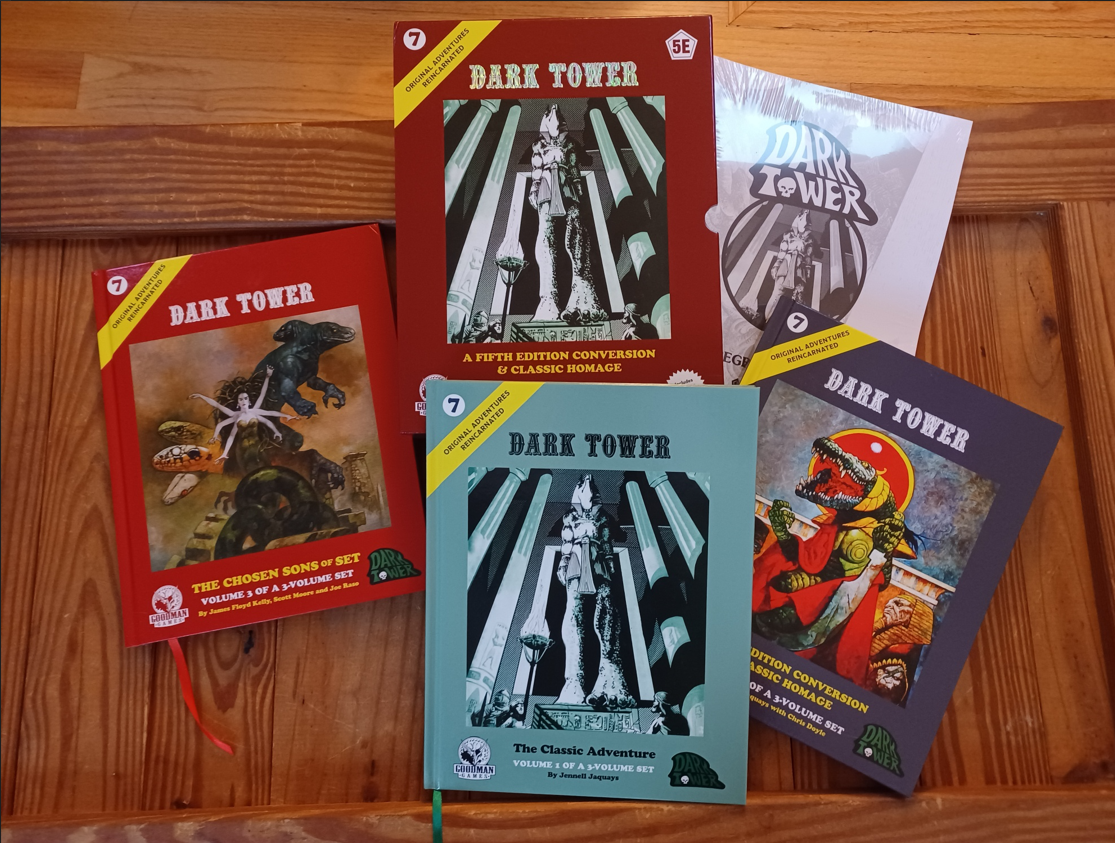
Dark Tower by Jennell Jaquays  and others, Goodman Games, Goodman Games, 2024, consisting of a 96-page hardback, a 316-page hardback, a 164 page hardback, additional handouts, slipcased, Kickstarter.

Jennell Jaquays (1956-2024) was an artist and designer of  tabletop and computer games. She was brilliant at all these things. I had an opportunity to work with her when she joined TSR as an artist, producing the covers for the Mystara revision,  as well as a beautiful piece of a wounded Nautiloid for Spelljammer, and she further immortalized me on the cover of a D&D product - Temple, Tower, and Tomb. She passed on in January of this year. Her work spanned numerous companies, some of which she founded, and she was there when the dawn first broke over the horizon of RPGs with Dark Tower. 

Dark Tower was originally produced by Judges Guild, and was a 70-page adventure dealing with a secretive cult of Set that had taken over a small community. The adventure consisted of that small town (called Mitra's Fist), and an extensive dungeon beneath it, filled with traps and creatures. The tower of the title is underground. But what established itself over other adventure models of its era was its non-linear design. There were multiple entrances, multiple passages between levels, and across levels between two sunken towers. This type of design has since been giving many names, but I'm comfortable with Jaqaysing as its nom du design.

Jaquays produces interesting adventures that veer away from standard approaches. For a linear dungeon design (good for tournaments), you move directly from room to room, and from encounter to encounter. One entrance (usually) and one exit from each encounter. There may be nests and complexes, but the assumption is that you cleaned out one room or section before moving forward. Everyone has the same experience. In as Jaquays-styled dungeon, there are multiple ways up and down and across, and there is no guarantee that the adventurers will hit everything. The original Ravenloft would pull off the same trick years later, but Dark Tower was first, and set a high bar.

Jaquaysing does have some challenges. A linear dungeon works for linear storytelling. You can feed the player characters information over time. Under a  non-linear dungeon, encounters and clues may be missed entirely, so creating a strong story sense can be a challenge to the DM. In Dark Tower, the players slowly piece together what is going on, and may not engage with the entire story, depending on their choices.

In addition, in this form of dungeon, adventurers can quickly find themselves in over their heads, particularly if the dungeon levels are set for different character levels John "Sacnoth" Rateliff ran us through it in preparation of his essay (which is included in the deluxe edition), and I ended our experience suddenly when I accidentally used the door from a Robe of Useful Items to open a passage into the high-level final boss fight room. OK, maybe it wasn't totally the dungeon design's fault, but it did have the potential to go casters-up and then did.

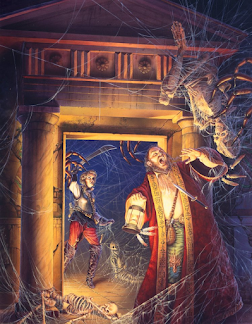
The cover of Temple, Tower & Tomb.
I'm the one screaming.
The new edition, from Goodman Games, is a slip-cased beauty. Goodman has been revising classic modules of the previous eras, updated from modern systems. The re-released the original in a thin hardback, including a number of essays (from Sacnoth, Grognardia and others). For those who have not seen how things were presented at the dawn of time from people other than TSR, take a look.

Volume 2, by Chris Doyle, is a massive translation of the original adventure in 5th Edition D&D (though the game is not directly referred to as such). The text has expanded, and the appendices are almost twice the size of the original, But it brings the classic adventure forward for more modern audiences. Plus there is more on the overworld around Dark Tower. 

Book 3 by a number of folk, is a continuation of the story at the post-12th level, continuing the themes of Mitra versus Set through a number of smaller dungeons. There is definitely a feeling "But wait, there's more" going on here, but it is all begun with Dark Tower, which remains the centerpiece of the project.

This is a Goodman Games production, which means it has old-school black and white interiors and there are numerous player handouts and character sheets (also part of the Kickstarter). The art is solid and evokes the rough edges of the earlier editions of D&D and maps look good and complete (the originals were pretty spiffy as well). The combined projects both show where we have been in design, and where we have grown, and are playable in either configuration.

In short, they did well by Jennell, and the revised, updated, and expanded Dark Tower is as challenging and engaging as the original was. It is an excellent testament to her contributions in RPGs. 

More later, 

Wednesday, December 13, 2023

Book: Shaggy Dog

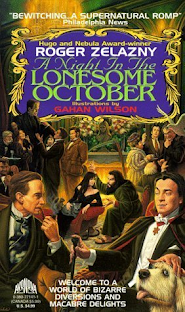
 A Night In The Lonesome October by Roger Zelazny, Illustrations by Gahan Wilson, Avon Books, 1993.

Provenance: My company has a book club that meets every month or two, and we vote on a book to read next. I often don't get a chance to read the assigned work, but A Night In the Lonesome October was an option  this time, and I voted for it, figuring that I had a copy on the paperback shelf downstairs, so there would be no excuse not to reread it.

And then I didn't have a copy downstairs. I had given it away or donated it somewhere in the past thirty years. So I went to my local used bookstore, The Page Turner, where I had last donated some books during COVID, and THEY didn't have a copy (though I picked up a couple China Mieville books I didn't know existed while I was there). Finally, I turned to my colleague Sacnoth, who rose from his chair, went to HIS bookshelf, and immediately plucked off a copy. So I had no reason not to read the book.

Review: I loved Zelazny's Nine Princes In Amber series (the first five), and feel he was a master at the novella format. This one was OK and amusing, a bit of lighter fare. Its chapters stretch out over the month of October, reaching Halloween Night itself. On those occasions when a full moon occurs on Halloween, there is a battle between the Openers and Closers. The Openers wish to bring down the gates of reality and bring the Lovecraftian Old Ones into the world, while the Closers want to keep that from happening. So far, the Closers have won.

Our narrator is Snuff, an enchanted dog who calculates the location of the rite based on where all the Players are based. His master is Jack, as in Jack the Ripper. Spring-heeled Jack is a favorite of SF/Fantasy authors, and such luminaries as Philip Jose Farmer, Fritz Lieber, and Harlan Ellison have used him in the past. This Jack is a Good Guy, a Closer, who keeps various Things in his house, that Snuff carefully guards and keeps contained (the Thing in the Steamer Trunk, the Thing in the Circle, and the Things in the Mirror). Snuff, as the calculating companion of the pair, tries to figure out where the rite is going to be, based on the locations of the the other players, which is made difficult by not knowing who exactly the players are, and if any of them die over the course of the month.

And there are plethora of other players and potential players. Zelazny reaches back to old Universal Horror films than by original source material. There is the Good Doctor and his animated creation, the Great Detective and his assistant, the coffin-sleeping Count, a witch, a Rasputin-like monk, a pair of grave robbers invoking Burke and Hare, and an evil Cthulhu-worshiping clergyman. Each (or most) of the players have their own companions, who Snuff communicates with. The horde of players, potential players, and companions is a bit overwhelming, but I was fortunate in Sacnoth left a bookmark with all the information noted down.

The pacing is interesting in that each chapter is a day in October, leading up the fateful rite at the end of the month. Each night Snuff goes out, gathers information, walks the area (outside London, presumably Victorian-era) and makes his calculations. His frequent frenemy in his travels is Graymalk, the cat familiar of the witch, Jill, who are definitely Openers. A less-hospitable Opener is the Cultist Curate, a worshipper of the old ones (Nyarlathotep gets name-checked), whose companion is a white raven named Tekela (invoking the cries of the albino penguins from Lovecraft's At The Mountains of Madness).

Openers and Closers get along well early on, leading to a graveyard scene where all are gathering materials for the ceremony, and trading body parts they dig up with each other ("Who needs a femur?"). After that, things get darker fast, with bodies falling and trust failing, ending in the rite itself. There is a long evening where cat and dog are sucked into Lovecraft's Dreamlands, with a tour of the entire area. With such a large crew of characters, Zelazny keeps a lot of balls in the air at once, and the finale wraps up all the loose ends.

The book is accented with illustrations by Gahan Wilson, A cartoonist whose blobby, lumpy characters have been found in SF magazines, Playboy, and National Lampoon. Wilson also created the first map of Arkham, Massachusetts, so he has the proper Lovecraftian chops.

Ultimately, this is a shaggy dog story about Snuff, a literal shaggy dog. There is light humor and puns throughout. I know more about old movies and the Cthulhu Mythos now than I did back when I first read it, nearly thirty years ago, and part of the Game for the reader is recognizing who the players are in the greater horror canon. It is a good book to read, a chapter a day, through October, preferably with a cup of hot tea laced with whiskey. 

More later, 


Thursday, March 02, 2023

No Quarter: Next Gen II

We've been talking about the design of recent collectable quarters from the US Mint for some time. We've done States. and we've done National Parks. And most recently I've started in on the American Women series, which commemorates famous woman over the course of US History.

Now in the many years of these programs, I have to admit that the carving qualities and depth of design has improved dramatically, so there's less to mock here than I would prefer. And while that's a good thing from the design aspect, it is less so from the entertainment element. Let that be so. I will persevere. So you get a little more history lesson these times out

Oh, and by the way, the Anna May Wong quarter from last year really improved this old movie star's visibility, which says in part why these quarters are a good this. Anyway, here's the ratings: 

Way Cool =A
Not Bad = B
Just Average (also known as Meh) = C
Kinda Lame = D
So Bad the Designer Should Go Home and Think About What They Did + E

Bessie Coleman(1892-1926)

Bessie Coleman was the first female African American pilot, as well as the first female Native American pilot. Her male predecessors are apparently up for debate, but include Emory Malick and Eugene J. Bullard. Coleman herself had to go to France to learn how to fly (America being non-too-receptive to minorities OR women in the air), and returned to do demonstrations in America and to speak. She died (as a passenger) in an air crash in 1926

The coin itself is … OK. It shows Ms. Coleman reaching up to adjust her flight goggles, which is a good pose, but due to the limitations on the coin itself, her right arm and hand do not look clear, and I had to expand the image to figure out what was going on over there. Still, it is good take on the three-quarters view we've seen on other quarters. The plane in the background is, I believe, a Curtiss Jenny (Curtiss JN) which was used to train most of the US WWI pilots and was used in the post-war years by barnstormers and mail flyers, among others. Where the coin works best is in the "right stuff" style for the name (and when she got her pilot's license). OK, but a bit muddled and lumpy in her flight suit.

Rating: C

Edith Kanaka'ole (1913-1979)

Edith Keona Kanaka'ole was a teacher, chanter, and dancer, and was responsible for the preservation and blossoming of Hawai'ian culture over the middle decades of the past century. She assisted in the development of Hawaiian language programs, and taught ethnobiology, language, and Polynesian history. She helped stem to the tide of extinction of Hawaiian culture and language.

The coin itself is pretty good, melding Ms. Manaka'ole with the land itself. She looks a little grim and stoic, though other photos I've found seems to be warmer. The inscription at the bottom translates as "Granting the Wisdom", which is a pretty fair estimation of her legacy. I think her name is going to get lost in her hair/landscape, but moving the various text around the coin is a good call. I don't remember the "cents" sign showing up since coins a hundred years ago, but it works here. 

 Rating: B

Eleanor Roosevelt (1884-1962)

If you're going to do a series on important American women, of COURSE you're going to do Anna Eleanor Roosevelt. She is the most notable and effective activist First Lady since Dolley Madison evacuated the White House, and she set the bar for all presidential spouses since then. Her work during the war is commendable and is exceeded only by her later work with UN and the Universal Declaration of Human Rights. She ALREADY has a coin, though it is one of the Presidential Spouses $10 series that never saw circulation, and she, apart from all the other first ladies, has her own statue in her husband's memorial in Washington DC.

All that said, which justifies her in "Wikipedia Notability" terms and merits her being on more than one coin, this is not a great coin. It captures the main elements of Ms. Roosevelt's political career (The globe, justice), but it is cluttered as a result, with a lot of text on it, and some of it will be lost in the folds of her blouse, much as for the previous Edith Kanaka'ole coin. Breaking the border of the globe with her head and hat does a lot to elevate it beyond the traditional portature, but I think it's a bit cluttered. 

 Rating: B

Jovita Idar (1885-1946)

Jovita Idar Vivero is one of the entries here I had to dig down to get to. A journalist and campaigner for Mexican-American rights, Ms. Idar ran newspapers in Texas and fought for less fortunate Chicanos and women. I am always in favor of currency that features writers, reporters, and editors, and Ms. Idar was all three.

I like this coin. A lot. One of the challenges of these quarters is that there is so much boilerplate text that HAS to go on them (United States of America, E Pluribus Unum, Denomination), plus necessary text of identification and often achievements, that the results can be cluttered. This design moves all of that text, and more, onto Ms. Idar's blouse, in effect wrapping her with her own achievements. It also leaves some impressive white space on both sides. And the portraiture itself is very impressive - portraits on these coins are a challenge to avoid the dead-eye stare that plagues, say, the Presidential Dollars, but here it pulls it off. Impressive and a welcome change from the traditional presentation.

Rating: A

Maria Tallchief (1915-2013)

Maria Tallchief was the first American prima ballerina. Not the first Native American prima ballerina nor the first prima ballerina of color. The first American prima ballerina. Now, ballet is one of those subjects that I am particularly and enthusiastically weak on, but I recognize the importance of the achievement, and doing the digging on the wiki, am deeply impressed with her accomplishments. 

The coin, though, does not do her justice. The pose is supposed to represent a grand jete (a mid-air leg splitting leap for us muggles) but comes off as static. Her headpiece (I am guessing here) comes from Stravinsky's The Firebird, but looks incidental and does not contribute to the sense of motion at all. Good points for framing her in the spotlight, and for including her Osage name ("Two Standards", or "Two Worlds") on the coin as well. It is perfectly serviceable, but I think it is missing the sense of motion that a ballerina demands. 

Rating: C

That's it for the second round - tune in next year for five more. Last year's Anna May Wong coin has made it into circulation and looks great, so keep checking your change.

More later,

Saturday, November 26, 2022

Shulz Centennial


Oh, Good Grief.

Psychiatric Help 5 Cents. Fussbudget. Slugs. Rats! Security Blanket. Kite-Eating Tree. Great Pumpkin. Sweet Baboo. Snicker-Snacks. Blockhead. Joe Shlabotnik. Round-Headed Kid. Supertime Dance. Sidney or the Bush. Cat Next Door. Beethoven. World War One Flying Ace. Sopwith Camel. Red Baron. Vincent Van Gogh. Joe Cool. Vulture. Miss Othmar. Lazy Eye. It Was a Dark and Stormy Night. The Six Bunny-Wunnies. I Got a Rock. Don't Call Me Sir. Naturally Curly Hair. Woodstock. 

Good Old Charlie Brown.

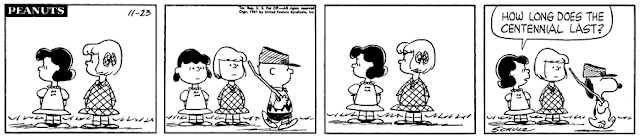
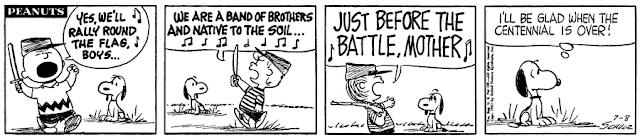
This weekend marks the 100th Birthday of Charles Shulz, creator of Peanuts. Peanuts was a touchstone for much of my generation and and for generations before and after us. It was incredibly popular, expanding from the daily and Sunday strips to movies, TV shows, comic books, records, songs and Broadway shows. Even its huxtering brought attention to Dolly Madison Cakes and Met Life. Its Christmas Special is one of the wonders of its age. 

A lot of people (in particular other cartoonists) are commemorating the centennial, but I just want to note how much of our childhood language was influenced by his comic strips. Words, history, and situations have taken on an extended life in our memories after being incorporated into his strips. The kids were kids, but they were very smart, generally well-informed kids.  Snoopy had an incredibly detailed alternate life, ranging from the coolest guy on campus to being a lawyer to an astronaut to captaining the Starship Enterprise. All of this formed a common ground for our generation, a shared experience told in four panels per day, with color versions in the Sunday paper. 

Shulz passed on in 2000, the day after his last comic strip was published. Yet his reprinted strips are still often the most amusing thing on the comic pages, and reach far beyond the nostalgia of our youth. Charles Shulz was one of the most influential writers of the later 20th Cent. He just did it while drawing the pictures as well.


More later, 

Thursday, December 23, 2021

Season's Greetings

 Wishing you a safe, sane, and secure Holiday Season.

Art by Eyvind Earle

More later, 

Saturday, October 31, 2020

Plague Books: Stark Sixties

Richard Stark's Parker:The Hunter, Adapted and Illustrated by Darwyn Cooke, IDW Publishing, 2009

Richard Stark's Parker: The Outfit, Adapted and Illustrated by Darwyn Cooke, IDW Publishing, 2010

Richard Stark's Parker: The Score, Adapted and Illustrated by Darwyn Cooke, IDW Publishing, 2012

Richard Stark's Parker: Slayground, Adapted and Illustrated by Darwyn Cooke, IDW Publishing, 2013

Provenance: Loaned from Stan! Brown.

Review: Real good. Lemme give you the backstory.

Author Donald Westlake wrote under a wide variety of pen names to match his various styles and markets, and one of the most successful was Richard Stark, who penned a long-running series about Parker (no other name given, may not even be his real name), a successful career criminal. Parker specializes in large scale heists, then lives well off the proceeds for a few months, until the bank account drops and he goes back for another score. He ties not to kill innocents (there is a lot of knocking people on the head and tying them up), but needless to say, he ends up killing a lot of not-so-innocents. The books have been wildly popular and turned into various movies over the years.

Artist Darwyn Cooke, who passed on in 2016, has a distinctive and unique style. I always connect him with New Frontier, a DC series from 2004 but set in DC's "Silver Age" of the early 60's. In both instances he has a clean, open style and an incredibly dynamic handle on action. When Stan! lent me the books, I did not expect to see how much he translated the novels into wordless action sequences where every beat landed and carried the reader from one panel to the next.

Back to Parker of the moment. He's the guy you're rooting for, in part because the people he is up against are so much worse. He's ice-cold and callous on the job so he can relax later. In his stories, Parker is on the job, and then gets betrayed, and then gets revenge. That's the basic plot of  both The Hunter (the first of the books by Stark) and The Outfit. When I read The Hunter, it tickled a memory of an old movie with Lee Marvin and Angie Dickenson.. Point Blank. And yep, it is based on the novel. 

 In many ways, Parker is kinfolk to the Continental Op, who lives on the other side of the lawful divide. Parker lives in that twilight world of crime, where everyone is a little bit crooked, and a lot of the crooks don't even think of what they do is criminal. Maybe they drop off a briefcase. Maybe they make a call. Maybe they wait by the track for someone to make a call. They are cogs in the greater machine. They don't do well, but they get by.

And then someone gets greedy, or stupid, or crazy and it all goes to hell. In The Hunter, one of Parker's confederates betrays the rest of the crew and leaves Parker for dead - he gets revenge. In The Outfit, someone sells Parker out to help himself, and Parker brings down the entire organization on the other side. In The Score, Parker puts together a crew of people on a chancy job against a mining operation in a box canyon. In Slayground, an armored car job goes casters up and Parker is trapped in an shut-down amusement park as gunmen hunt him. Slayground also has a short backup story - The 7th, which collapses an entire novel down into a double-handful of pages without losing much of the plot. 

And Cooke is brilliant in the art. His command of the medium is perfect as wordless panels show as opposed to tell. He works with the black and white medium with its long shadows and silhouettes and makes it sing. And he gets down into the weeds of the procedure of the crimes and counter-crimes and he explains it all, summarizing the challenges and opportunities, laying out how things are supposed to go and how Parker crashes the party. His character's best weapons are knowledge and understanding of the human condition - he can kill without remorse but also knows how to calm down his targets.

Cooke also situates the work squarely in the 60s, with Esso stations and road maps and cars with big fins, Tiki decor and night clubs and risque matchbook covers. Angular clothing for the men and soft tight-fitting curves for the women. This is lightyears away from New Frontier in its darkness and brutality, but has that same openness of line and sense of hope that the Kennedy era spawned. 

Cooke passed on in 2016, so there will only be these four volumes, but that will be enough. It is strong enough to make me look for the old Stark novels themselves when I can get into the used book stores again. Or even dig up a Lee Marvin movie.

More later, 


Tuesday, October 16, 2018

A Week In Books

It does not rain but it pours.
It has been an interesting and thoughtful week, in that three beautiful sets of books arrived at Grubb Street. But I don't think my reaction is the same as most other people, but I highly recommend all of them. Here's the picture of the haul:

In the middle is the Prince Valiant Storytelling game, and beneath it the adventure book. Both are beautiful books, illustrated with Hal Foster art that takes me back to the comic section of the Sunday Pittsburgh Post-Gazette. The game itself is simple and sweet, and the Episode Book has contributions from an all-star squadron of creative talent (yours truly among the gang).

Yet, these books are bitter-sweet for me. First off, Stewart Wieck, who was putting them together in the first place, passed on (his brother Steve, finished the work). Then, the day after the books arrived, I learned of the passing of Greg Stafford, the original designer of this game, White Bear and Red Moon, and Pendragon, and creator of the fantasy world Glorantha.  I don't have any great Stafford stories - we chatted at the occasional convention but our paths did not cross that much. Still, one more of the original gangsters of gaming has passed on, and we are all lessened for it.

Soon afterwards Cthulhu Invictus (on the right, with coins and a decal) showed up at my door, a Kickstarter from Golden Goblin Press. And on first blush the book is SO textually dense. I remember picking the Chaosium Invictus back in the day and noting the wide margins and large leading (something Chaosium is not alone of doing - check out some TSR products of the age). This version is heavily packed, the script-like font running nearly to the edge of the page. Golden Goblin does some of the best material in this new golden age of Lovecraftian gaming, and I am slowly making my way through it.

And with it comes a sense of both opportunity and obligation. My gang has talked off and on about doing some adventures set in the Roman Empire, and this may just push me over. But that becomes one more thing to work on. If I get around to it I will post.

And on the right, the big powerhouses are two different editions of Art & Arcana, which showed up Saturday morning. Several months ago the authors came over to the house, where they took some pictures of the original art I have on the wall, and and listened politely as I blathered on about told stories of the old TSR.

I haven't dug in too deeply, but the final project is absolutely beautiful.Old guard gamers will remember the Art of Dragon books - this is SOOOO much better. Larger, heavier, glossier, meatier, amazing. Here's the visual history of Dungeons & Dragons. The deluxe edition is boxed, has some separate art (suitable for framing) and a photostat of the original Tomb of Horrors when it was an adventure run at GenCon 1975. I did not know this existed. It looks it it was originally typed on mimeograph paper, but I can't be sure.

And it feels like going through a old high school yearbook, and each picture reminds me of something else that happened in those bygone days. I've leafed through it, and said "Ah, that reminds me of a story ..." and there is a lot of me and the other greats of the Bronze Age of TSR, plus great stuff from the giants that came before us and the brilliant creators who came after.

So. Sadness, Opportunity, Nostalgia. Not what I normally get in the mail.

Check out all three.

More later,


Friday, August 03, 2018

The Gaming News

Ah, GenCon weekend. Not going this year, but when I do go, I hunt down the small companies that I have never heard of before and check out their projects. These days, with the Internets and the Amazons, the throw-weight of smaller companies is a lot greater, but the chance to actually physically check out the product before purchase has a thrill. Also, the person you're buying it from may just be the designer.

Yet with GenCon there has been a sudden wave of activities on the Kickstarters and elsewhere for new products, many of which by people I know and some of which I have actually supported. Let's take a look.

First off, Let me start off with a Humble Bundle. Humble Bundles are collections of electronic media (games, pdfs, e-books) that are offered a low, low price (though you can make it higher and get more). The proceeds go to good causes. In this case the causes are Girls Make Games and Girls Who Code, both of which work to expand gender diversity in pretty male-overwhelmed areas. The books are a huge selection of books on game design, some of which I own, and some of which I have contributed to. AND this particular bundle has new, just published material by Mike Selinker.

If you're also looking for more books about games, take a gander at Your Best Game Ever from our friends at Monte Cook Games. It not rules for playing a game, but advice on how to use those rules for, well, your best game ever. Usable both by new players and old, YBGE is already blowing up in funding. Plus, if you want rules with your tools, they are offering the revised Cypher System Rulebook, which is MCG's "universal" system. Check it out.

Also in Kickstarter (and blowing up even bigger) is The Expanse RPG. I got into The Expanse from the Lovely Bride - she tends to Tivo entire seasons and binge-watch, and my attention is collateral damage (I would walk into the room, sit down, and then cross-examine her at the commercial breaks). It's a great TV show, but it is based on books (no, really, books. With words and letters and chapter and everything). And The Expanse RPG is based on those books. It uses Green Ronin's AGE system, but sounds like it has a couple neat tweaks to it.

Also on the Kickstarter is Demon City, by Zak Smith. Call it experimental gestalt weird fantasy. Call it millennial urban horror. I really liked both the presentation and the content of Red and Pleasant Land (Alice's adventures in a D&D universe - better than the old Through the Magic Mirror), and Maze of the Blue Medusa (which neatly juggles a bunch of different subplots into one major adventure). Both readable and playable. So I expect to like this as well.

Staying with Kickstarter, but moving into the past, Steve Jackson is bringing back The Fantasy Trip, which was one of those foundational games back in the early days of D&D/ Originally micro-games with paper chips and maps, it was a hex-based combat game that simply recapitulated the nature of fantasy combat. At a time when D&D options were just starting to sprout up, it took the dungeon to the boardgame long, long before 4th Edition. I think I still have a copy or two in the basement. This looks like a faithful recreation of the original, more of an update than a complete revision.

And ALSO from Kickstarter AND with a healthy whiff of updated nostalgia, we have Over the Edge, which back in the day was a brilliant combo of mechanics and world-building. Imagine D&D if Hunter Thompson had teamed up with Gygax and Arneson, and if Bill Burroughs replaced Edgar Rice Burroughs in Appendix N. Unlike The Fantasy Trip, this is an all-new edition set on the island nation of Al Amarja, and I want to see what they've done with it.

Fine, you want some games that are already finished and available? Do you have IOs on your tablet or phone? Take a look at the Cthulhu Chronicles, which gives you solitaire adventures in the Mythos/ There are both transposed Call of Cthulhu adventures (Alone against the Flames) and original material here. The first three sanity-shattering adventures for the day are free! The classic nature of the old choose-your-own-adventure books with modern-age technology! Indulge your Lovecraftian desires!

And since I'm still talking about games, how about some fanzines? I would mention both Warlock #6 (from Kobold Press) which deals with the City of Brass and The Excellent Traveling Volume #8, a wonderful Empire of the Petal Throne 'zine. The mere fact I have articles in both of them has nothing to do with my hearty recommendation.

And finally, let me mention Dungeons & Dragons Art and Arcana: A Visual History, which is NOT out yet, will prove to be the ultimate source for art in the golden age of TSR. The authors are recognized masters in reporting the history of D&D, and, I am have been informed, the book will include several pieces of art from the Private Collection at Grubb Street. I'm really looking forward to this!

And with that, the Gaming News wraps up. More later,


Thursday, March 15, 2018

Shelf of Abandoned Books Revisited

A long, long time ago, I wrote up a list of abandoned books on my bedside bookshelf. I had a growing pile of stuff "I was reading" and the Lovely Bride got me bookshelf to reduce the clutter. Now I have a bookshelf of stuff I've been meaning to get back to AND a pile of books by the bedside.

But over a dozen years later, what IS on the bookshelf? Why are they still there? Where did they come from? Why did I stop reading them?

Here's the current list (not counting RPG books, which drift in and out much faster).

The Riverside Shakespeare - This one is always on my shelf, though it did not get a mention last time on my write-up. Purchased for a college class back in the 70s, it is a heavy volume of onion-skin paper, and is my go-to for Shakespeare references. Last went to it for the origin of "Too Soon The Lightning".

The Lacuna by Barbara Kingsolver -  This replaced The Poisonwood Bible as the Kingsolver I keep on the shelf (the PB went to the Lovely Bride's sister). Dealing with pre-war Mexican art and politics, it should be a book I'm reading. It isn't.

The Sparrow by Mary Doria Russell-  A tough read, an underground classic in SF, ignored by a lot of fans despite its SFian tropes (rockets! cybernetics! first contact!). It contains two narratives - one of the preparation to get there, and one, where the sole surviving member of the team (a priest) comes back broken and in disgrace. Oddly, I set it aside right after the first crewman dies on planet, and never came back.

Prologue to War - 1805-1812 by Bradford Perkins - Mostly first person accounts of the War of 1812 (which is one more area of history I pay attention to). Has a complete signature of the book missing, and remains on the shelf as a reminder to me to find another copy.

Alpha Beta by John Man - A short book on the history of the alphabet. I love the subject, but never deeply engaged with it.

Littlest Shoggoth by STAN! - This is from the illustrious STAN! It is not abandoned, it merely found this place to rest of the moment. Check it out here.

Shakespeare of London by Machette Chute - A thick paperback that I tend to bring with me on long trips or going to Ashland Oregon, then ignoring for a while and bringing it back. When I'm reading it, I find it interesting, but then it slides down to be my third-choice book.

Brotherhood of the Road by Michael Chabon - Historic swashbuckling adventure novel from the author who did Wonder Boys and The Sitka Detective Agency. Two Jewish bandits from different backgrounds act as bodyguards for the outcast heir to the Khazar throne. Set it down over a discussion about elephants and left it there. Strong Fafhrd and Grey Mouser overtones.

This Side of Paradise/ The Beautiful and the Damned by F Scott Fitzgerald. Picked it up in the wake of The Great Gatsby. Found it to be a bit more of a challenge.

Anything Goes by Luc McGee
Only Yesterday by Fredereick Lewis Allen
Babbits & Bohemians by Elizabeth Stevenson
1920: the Year of Six Presidents by David Pietrusza
Time Capsule - 1923, 1925 from Time Magazine
American Shelter by Lester Walker
The Twenties - Fords, Flappers, & Fanatics edited by George E. Mowry
- This entire collection is part of my "Appendix N for the 1920s". Books I use when I'm thinking about Call of Cthulhu campaigns. Of the lot, Only Yesterday is by far the best, and highly recommended, while the Year of Six Presidents is a bit of a letdown, not the least of which because one of the presidents involved (Teddy Roosevelt) died in 1919. American Shelter is a collection of house plans, which includes the eras I'm looking at, and the Time Capsules are summaries of those years from Time Magazine.Most recent addition is the Fords, Flappers, and Fanatics, a collection of first-person reports presented to me by a friend who knows I collect this stuff (Thanks, Steve!)

MFA vs NYC, edited by Chad Harbach. This is an interesting one. Chad Harbach wrote an essay in which he separates American Literary Tradition into an academic (Masters of Fine Arts) and a commercial (based out of New York City publishing) camps. An interesting idea, and he collected a bunch of other essays discussing it. Purchased the book at a Writer's Conference here in Seattle, but have not finished it (stopped early at the essay describing the first Writer's Retreats as CIA conspiracies).

Nostromo by Joseph Conrad - The oldest book in my shelf of abandonables. I've been reading it for 20 years, yet I don't think I've gotten past the fourth chapter. Have taken it on numerous trips, including to Europe, with no success. Picked it up shortly after the BBC adaptation of the book in 1996, and now cannot remember how THAT ended either. Part of my challenge is that the book is filled with informative footnotes/end notes, which I am continually referring to, which breaks up any head of steam I've made.

The Water Knife by  Paolo Bacigalupi - The Windup Girl was an awesome book, and I recommend it. I am waiting to be in so good and hopeful a mood that I feel like I need a depressing environmental disaster (in this case the death of the Colorado River) to bring me back to earth.

American Visions by Robert Hughes - Another regular on my shelf - actually finished but remains as a reference (most often in connection with the art of the 20s (like the Appendix N books above)). By the guy that wrote The Farthest Shore about the founding of Australia. This one is a history of American art.

1493 by Charles C Mann - Picked it up at a Half-Price on a whim. Deals with the Columbian Exchange (all the species that jumped continents after the opening of the New World). Deals with Pacific Trade as well. Got two chapters in, questioned a statement presented as fact, and put it down.

Vanished Kingdoms by Norman Davies - By the author of Europe (Another comprehensive doorstop of a book that I have yet to finish, having bailed around the time of Carthage), this book I saw in a British edition when I was in Paris (at Shakespeare's), but did not purchase, thinking I could get it in the states. Discovered I was wrong. The LB ordered it from Amazon.UK. It talks about the plasticity of nations, and how they tend to ebb, flow, and disappear entirely. Stuff you don't think about like the Two Burgundies, now buried under a sediment of France, Germany, and the Low Countries. Interesting presentation with an anecdote, a meaty chunk of history, and a personal travelogue. Stopped around the disintegration of the former Soviet Union.

The Mediterranean and the Mediterranean World in the Age of Philip II, Volume 1 by Fernand Braudel - This would be my desert island book (with its Volume 2, which I also have downstairs). A fan recommended it when I was on vacation in Ashland, and I found both copies at a used bookstore there. Braudel starts with the question "why did Spain, which owned half the world, go broke?" In the process, Braudel encompasses the entire Mediterranean as a series of small seas guided by the same overarching forces. Sort of like reading Harry Seldon's papers on his galactic empire in the Foundation series. Whenever I engage with it, I feel richer. And yet, it remains unfinished. I guess I need a desert island.

The Ghost Pirates and Other Stories by William Hope Hodgson. - A friend recommended the author, and I picked it up at Half-Price. Hodgson is a very, very slow burn. His Ghost Pirates is a tale of a sailing ship where people die in gruesome fashions, and after the initial shock, the crewmen return to (almost) normal. Still have to finish that one.

The Illiad by Homer - A friend was getting rid of his, and I picked it up. Read it in bits and pieces.

Songs of the Dying Earth edited by GRR Martin and Gardner Dozois - I came late to Jack Vance's Dying Earth series and enjoyed it, and Martin/Dozois's heavy collection of short stories is an apt paean to the earlier material. The fact that Vance's stories had three different types (more traditional-but -still weird Turjan stories), more humorous Cugel and all-powerful but generally useless Rhialto. The short stories, from a variety of talented authors, also run the gammut. Bogged down in the middle of a Tanith Lee story, to my surprise, and have yet to pick it back up.

The Chomsky Reader by Noam Chomsky - Like his counter-intuitive analysis and incendiary wordplay, but read it when I am over-anxious and need to sleep.

The Castle Explorer's Guide by Frank Bottomley - Inherited it from someone. It is just there from some point where I needed to reference a castle mentioned in another book, and never left.

In the Beginning by Allister McGrath - Book on the writing of the King James version of the Bible. Never begun.

Fevre Dream by George R R Martin - Picked up from a friend. Vampires and riverboats. About five chapters in, set it aside for other works, have not yet come back. Actually one of the more recent additions to the shelf. Mighty fine writing, just have not yet returned.

The Sea and Civilization by Lincoln Paine - An overview of history with the sea. Got it after a glowing recommendation in the Seattle Times. Should be like the Branaul but is not. Part of my trouble is that Paine briefly glances off a subject before plowing onto the next one (wait, this one-paragraph discussion of pre-Columbian West Coast sea peoples - please tell me more!). So I usually get two pages before pulling out the iPad to access the Wikipedia.

The Maltese Falcon by Dashiel Hammet. - Recently watched both the 1931 and 1941 movie versions (which rate their own discussion). Tried to round out the trifecta by reading the original text again. Can't do it without hearing Bogart's voice.

Will any of these be finished? Will they still be her in 13 years? Come back 2031 and find out!

More later,

Tuesday, January 19, 2016

Play: The Demolished Man

Disgraced by Ayad Akhtar, directed by Kimberly Senior, Seattle Rep, Through 31 January.

While the Seahawks have ended their football hopes for the year, the REP continues with one of the strongest seasons I have seen for years. The most recent addition is the dark one-act Disgraced, which takes the theatrical trope of the dinner party and pulls it off.

Amir (Bernard White) is what Tom Wolfe would call a Master of the Universe. He is a corporate lawyer in Manhattan who can get Knicks tickets and whose name appears every so often in the Times. He has a stylish Manhattan apartment and an adoring wife Emily (Nisi Sturgis), an artist with a chance at a breakout show. That show is put together by Isaac (J Anthony Crane) whose wife Jory (Zakiya Young) works with Amir at the law firm. They have dinner together.

But Amir has misrepresented himself. He is an apostate Muslim who rejects his faith and heritage to embrace the American ideals of achievement. He has changed his name and lets his co-workers think of him as an Indian, not a Pakistani. He is convinced that, should he be thought of as a Muslim, his world will fall apart.

And he's right. Starting with a favor for his more devout and political nephew (Behzad Dabu), Amir's life spirals out of control, culminating in an explosive dinner party with Isaac and Jory where deeper secrets are revealed and lives are sabotaged.

The Portrait of Juan de Paleja by
Diego Velazquez figures in all this as well.
Amir's story is about race, religion, and heritage. But it is also about infidelity, social climbing, opportunities and art. The two sets of themes cannot be separated, and Akhtar does a fantastic job conjoining them. This is a troubling, unsettling play, and brilliant for it. Political without being polemic, it cricles the subjects and takes stabs from all sides. It is a play which does no hold still long enough to deliver a message one way or another and demands thought and consideration.

The actors are amazing. None of the characters are pure or innocent, all are packing their own betrayals and secrets which contribute to the destruction of Amir's public facade and private pride. The actors balance that public and private face expertly, creating characters with a sense of story and history.

There is mention of Moors early on, which evokes Othello, but this is an Othello with an internalized Iago acting towards his destruction. Amir has more in common with Eddie from A View from The Bridge, where his self-image, pride, and rejection of his heritage sows the seeds of his own fall from grace.

I have railed in this space about dinner-party plays, which take place in a relatively compact space and time and where everyone is nice and proper at the beginning and engaging in cannibalism by the end. And I often think that thing swould be better is someone just left the room, but that never happens. Akhtar stretches out the time frame with several scenes leading to the disastrous dinner, and DOES allow the character the freedom to get out of the room as opposed to immediately turning back on each other in another round of backbiting. In doing so he deepens the reality of the world, allows secrets to come out, and show that the characters are not just rats in a physical box, though they may be trapped in a metaphorical box of their own making.

I'm still working my way through this, which is always a good sign for a play. The play has gotten raves and rightly slow as disturbing and thoughtful theatre. Worth seeing.

More later,


Thursday, December 31, 2015

My Year in Books: Ant Farm

[This year, I was curious about what I was reading, so when I finished a book I put it on an ever-growing pile by my desk. This is the last one in the series.]

Le Livre Des Fourmis (The Book of Ants) by Robin D. Laws, Pelgrane Press, 2014.
Provenance: Purchased at GenCon from Robin D. Laws, who also gave his autograph with the note: Vive la Revolution Surrealiste!

I don't review game products here. Wait, let me back up and clarify that on two points. I don't review game products that I have not actually played. Reviewing a game based on the printed word is sort of like reviewing a play by reading the script - it doesn't tell the full story. There are numerous reviews of adventures that I have run for our Call of Cthulhu group. The other clarification is that I promote other people's games without fear, particularly if they've just released something. For me to delay a review due to my slow reading habits should not stand in the way of you finding out about cool and new stuff.

Anyway, this is bit of fiction in that it ties into a recently published adventure setting called Bookhounds of Paris, which uses the Trail of Cthulhu game system. I've played Trail of Cthulhu, though have not run it (the amazing Steve Winter was the GM), and don't have the game product that might illuminate this further. But it stands on its own as a nicely weird merger of the Cthulhu Mythos (in particular the Dreamlands) with the avant garde artists of the interwar period.

The volume is presented as a diary (in the form that CoC players know well) by Henri Salem, a supposedly minor player in the artistic politics in Paris between the wars. He hangs with Andre Breton, Jacques Vache, Pablo Picasso, Max Ernst, and Salvador Dali (yeah, keep your Wikipedia open - I knew about half these guys before I started in on the work). They are a cliquish and diverse group, continually squabbling and factionalizing as they try to move forward (or backwards, or sidewards) the cause of Surrealism and thereby change the world. In the midst of this Salem's bunch discovers how to access the Dreamlands.

The Dreamlands were a Lovecraftian creation, a setting for many stories and in particular poems. Expanded and explored over the years in stories and games by other hands, they have their own parrallel existence. The surrealistic movement of the 20s and 30s worked to break down the walls between the conscious and unconscious nature of man, between dreams and reality. They considered what they were doing a form of enlightenment, a philosopher of which its art was considered mere artifact, by-product of the process of awakening and overturning the world. They are perfect candidates for exploring the Dreamlands.

The cool thing is, that in discovering the Dreamlands, the surrealists begin to change them. As opposed to a traditional fantasy domain, these Dreamlands are more fluid, responding the power of the dreamers themselves. So the Surrealists do change the world, only not the one they are thinking of.

I really like this for this effect, and by Laws way of threading the reality of the movement and its petty politics in with the arcane and mystical. Being Lovecraftian, things end badly for those involved, as it does in the real world for many of the participants. The book is an engaging, twisted melding of two great flavors, and now I suppose I must hunt down the game product to see what they did with it there.

More later,


Wednesday, December 23, 2015

Happy Holidays

A Merry Christmas and a safe and happy holiday season to all from Grubb Street.
"Rest on the Flight into Egypt" by Luc Olivier Merson, Museum of Fine Arts, Boston

More later,

Friday, November 20, 2015

Art Cars at the SAM

Inopportune: A Car Cascade
The Seattle Art Museum lobby has for years been dominated by a car explosion. Inopportune: Stage One by Cai Guo Qiang is a series of nine white Ford Tauruses (Tauri?). They are lined up, the first one with all four wheels on the ground, followed by the next seven spiraling through the air, with streams of white bulbs exploding in all directions as the cars tumble end over end, and the last Ford at rest. I've always liked it, and never understood the hate for it, a dislike that bubbles up now that they are finally going to remove that installation after nine years.

As I said, I like it. I liked it when it was part of the museum before its expansion, and I liked it after the museum expansion, when they moved the initial car to the second floor balcony. I've always seen the series of vehicles not as an explosion or a horrible accident, but rather as a threat of danger with a happy ending. I see the cars as a narrative flow, that starts with it going off the balcony, then spiraling through the air (the explosions can just as easily be emotion) but at last coming to rest, unharmed, in the same position as it initially was. It is a car crash. But it also an graphic display of an argument, emotions in all directions, before returning to its base state.

I'm not much a fan of "found object art", which seeks to elevate traditional ready-made object to important art worth considering either seriously or ironically. So just parking a white Ford Taurus in a lobby does nothing for me. However, the creation of a narrative with the cascading Fords, filled with light, then returned to their mundane look really does work for me. It takes the object and gives it additional artistic value and narrative flow.

I'm also a bit suspicious of "installation art" where an entire room or domain within a museum is dedicated to a single work, as if the only way to engage with the work is to clear everything else out of the way. This is the logical antipode of the old, old (old) days, when artwork was jammed cheek by jowl against the wall, creating the pigmented equivalent of having a wall of TVs all on at once. Room-dominating single-item installations smacks of pretense to me, and is more at home with office lobbies than museum space. And perhaps the fact that piece itself is suspended over the entrance lobby makes me more accommodating than if it claimed a full vault of valuable real estate elsewhere.

In any event, yeah, the cars of Inopportune are coming down, and I for one will miss them.

More later,


Friday, March 21, 2014

Film: Art Project

Tim's Vermeer, Directed by Teller

Yeah, I know. I seem to be nothing but reviews at the moment. I suppose that this is because I am in a
review sort of mood. Plus the fact that my life is otherwise rather boring at the moment, though it is boring in a good way. Getting stuff done, hanging out with people, playing games, reading. Boring can be very good sometimes.

And in this case last week I decided on a weeknight (gasp!) to go a movie (Gasp!) by myself (GASP!) up in the U-District (meh). In this case, it was a tidy little film of the type that I didn't want to drag friends out to - Tim's Vermeer, about a guy who paints himself a Vermeer.

The Music Lesson by Vermeer
And the film was playing at the Sundance theater, and the last time I had been to that building it was for the Firefly sneak peak, so we're talking, what, nine years or so? Yeah, I'm not one for much repeat business. But I do note that the theater has been upgraded to a high-end, comfortable-chair, over-21-so-we-can-serve-alcohol venue. I arrived early, and as a result spent about an hour upstairs in the lounge by the gas fireplace, eating a pizza, nursing a cuba libre, and reading Wodehouse's Code of the Woosters. So I was pretty relaxed even before the movie.

Ah, right, the movie. Tim Jenison is successful inventor and founder of NewTek, which did Video Toaster and Lighwave 3D. Creative, ingenious, and having both time to pursue his ideas as well money to aid in any pursuit he takes an interest in. And he decides to paint a Vermeer.

And he's not forging a Vermeer, but rather using the Vermeer (The Music Lesson) as a model in an attempt to figure out Vermeer's technique. Vermeer is best known for his photo-realistic style and his soft, almost golden light. How did he capture these effects on the canvas? Jenison, an avowed non-artist, seeks to duplicate it.

The artist David Hockney put forward the theory in his Secret Knowledge (2001) that the more realistic painters of the 16th and 17th century achieved their results by use of increased technology and research in optics and lenses. Indeed, my book of Vermeer prints from 1997 makes mention of the camera obscura as a technique, a simple device that consists of a dark room with a hole in an end. The reflected light present the image of the outside world in a ghostly, inverted image.

What Jenison has done is take these theories down to the ground level and examines the possible applications of this technology. First he fits the aperture of the camera obscura with a lens to sharpen the image. Then, he ingeniously uses a small mirror to duplicate the images, one line at a time. There is no sketchwork, no underpainting. merely duplication. He is coloring the image he sees at the edge of the mirror onto the canvas. Finally (as he discovers during the course of the film), he replaced the blank wall the image is focused on with a convex mirror to sharpen the image further. It is an optical three-bank shot that allows him to photocopy the image by hand.

There's more to it than that, of course. He could have taken a reproduction of The Music Lesson and copied it directly in this fashion. Instead, he recreated the scene in the picture and then painted that in order to confirm that the distortions visible in the final product are the result of the methodology. Which means he created a studio with a northern exposure, had the costumes shown in the painting made, built the furniture, tracked down suitable pottery and musical instruments, and built a virginal (an early harpsichord). He ground his own lenses and mixed his own paints in the manner noted. And then, having done all that, started to paint, a long and detailed process of painting what he saw and matching the color along the mirror's edge.

The movie is that journey, of Jenison's attempt not just to reproduce, but to get it right. To create a proof-of-concept that this was a legitimate "lost technology" that could have been used by painters of the era. And the presentation captures and holds the attention. Jenison himself comes across as reasonable, engaged, and down-to-earth. He is balanced by Penn Jillette's narration (Teller directs), which provides the level of excitement bombast necessary to declare, yeah, this is a big deal.

Vermeer himself is a bit of mystery here throughout - there is record of his birth (I think - his father carries a different surname), and of his entering the Guild of Saint Luke, the painter's guild in the Low Countries, but no record of his apprenticeship in Delph. That may just mean  he spent his apprenticeship elsewhere, as those were more portable days. And while he was made the head of the Guild, he did not found a school or train others to follow in his style. At the time, he did not enjoy the popularity of the Dutch Masters of the era, and while his work was rediscovered in the 19th century, in my research I keep seeing the teeth-grating definition that he was a "provincial" artist of "genre" works.

I any event, a good film, and one that you should get out to see, or to at least queue up for the Netflix release.

More later,


Tuesday, November 12, 2013

Meanwhile, Last Night

Left to Right: Becky, Jennell, Stan!, Lorelei, Rob, John, Me, Will, Dave, Scott. Picture by Bruce Cordell.
This photo is from a gathering of my writer's group, the Alliterates, at our habitual watering hole. Bruce Cordell took the photo (he would have been sitting between me and Stan! (who's back is to the camera). Steve Winter, who is also a member, was off camera to the right, but this was the group for the evening. I've put it up on other social networks, but I just want to talk about the composition.

But what I like about this photo is how evocative and well-lit the scene is, making it look almost like an oil painting. We have already talked about the comparison with the Last Supper. The center of the picture, over Rob, John, and Lorelei, is the best-lit and the center of the work. Bruce took this at a moment when we talking in one relatively big group (due to the size, throughout the evening, we had three or four conversations going at the same time). The figures are naturally posed because most of us didn't realize Bruce was taking a photo (except maybe Lorelei, with her arms folded). I don't remember what we were talking about, though I always use my my hands when making a point, and the sight-line was between me and Jennell. The background is well-lit, but other-worldly, its color palate separated from the muted hues inside the bar.

It is rare when a random photo creates this sense of story and a uniformity of feel. It looks like Lorelei, Rob, and John are sitting in judgement as Jennell and I make some arcane points. It was a passing moment, but captured. No one is caught off-guard or looking dorky as a result. It is one of those chance things that just works.

And that's pretty cool. More later,