Showing posts with label Music. Show all posts

Saturday, December 13, 2025

Theatre: Woman, Waiting

Penelope, based on the writings in the Odyssey by Homer, Music, Lyrics & Arrangements by Alex Bechtel, Book by Alex Bechtel, Grace McLean, and Eva Steinmetz, Directed by Kelly Kitchens, Arts West, through December 19.

A second musical in a mere matter of days, but Penelope serves other ends than the big-ticket Come From Away. It is small, intimate, and personal, a one-woman performance based on Penelope, wife of Odysseus. Penelope is the one left behind when Odysseus goes off, first to war, then on his adventurous perambulations to get back home. Homer presents her as the prize at the end of the journey, but she is also just as cunning as her husband. Most notable is her putting off her would-be suitors by weaving her mourning shroud in the day, and unraveling it again in the evening. But she is all that and more. 

Chelsea LeValley is Penelope, and Penelope waits. She worries, fusses, prays, runs the city, bats away the oafish suitors, rages, raises a son, longs for her lost mate, and sustains. LeValley pulls it all off not only with an incredibly strong voice but through her physical actions - weaving, prostrating herself before the gods, and ranging from angry challenges to residing in the single chair in the center of the stage, a small table with a decanter of whiskey and a single glass. LeValley is one of the most gifted singers I've heard at the Arts West, which regularly does musical shows, and she dominates her material and her character's emotions.

She is literally backed up by on-stage musicians at the back of the stage, dressed in black, that serve as the Greek (of course) chorus and the voice of the goddess when she confronts the deities that have denied her news of her husband. Consisting of violin (Amanda Spires), Viola (Lauren Hall), Cello (Kumiko Chiba) and Drums (Mitchell Beck), and led by Music Director/Artistic Director Matthew Wright on the keyboards, they are ever-present and but reserved, letting LeValley take command of the proceedings. 

The songs themselves are clear, emotional and emotive. They have a folk-pop quality to them that verges on country, and LaValley's delivery feels grounded and midwestern. Accessible. She rolls through her emotions and uncertainties in every song, as she makes her way to her own fulfillment. The songs vary through the spectrum of emotions, an LaValley delivers every note perfectly. 

Penelope's domain is a raised circular stage in the center of the room, with stairs leading off at the third-points. The theatre put small tables around it, creating a cabaret feel as LeValley descends and wanders among the audience. There's a problem there, in that the tables (and their occupants) blocked the front rows of the audience, a lot. A small woman sitting next to me was totally stage-blocked by a very tall man at a table in front of her. I offered the woman my seat and clambered over the back of the seats to a higher, empty perch (The Lovely Bride, seated next to my original position, had a perfect seat, front row center with no one in front of her). 

The stage was relatively bare, giving LaValley the space she uses to the fullest, the musicians lined against a backdrop that both reminded me of a Maxfield Parish print and a Jeff Easley underpainting. Her gown matched the rich copperish browns of the backdrop, signifying it as Penelope's land. Before the performance, there is the audio of the waves crashing on the rocks beneath Penelope's home, reminding us both of the proximity of her husband and his distance. 

The plot does not follow the plot of the Odyssey save in its initial situation - this is Penelope's story, not her husband's. She is no prize to be won, but rather her own fully-formed character. Her story is about the emptiness of loneliness and the unknown fate of a loved one. It reminded of me when I have, twice now, left the Lovely Bride to join a company far away from her, leaving her to manage everything behind me as I went off to new adventures. Kate loved the performance, and I liked it a lot.

Penelope is about a woman, waiting, but also about a woman, sustaining, and discovering her inner strength against the fates and the gods and the emptiness in her bed and her life. Well worth attending.

More later, 

Sunday, August 17, 2025

Cup of Crimson Wonder

I got into Dungeons & Dragons in the late 70s at college. At that time, I was listening to a lot of progressive rock, which was a broad category which included bands like Yes, ELP, Pink Floyd, and in particular Jethro Tull. Tull had done albums like Aqualung, Warchild, Minstrel in the Gallery, and Thick as a Brick (one sone over two sides of an LP - you really should take the time to give it a listen). And in 1977 they released Songs from the Wood, which was the first of a series of "Folk Rock" albums. And I listened to it a lot, and it influenced my some of my writing, world-building, and game design.

And one of the songs was "Cup of Wonder", which leaned heavy on medieval mystical themes with a lot of synthesizer. And as one does, I wrote up the cup described of the song as a D&D magical item. 

(Now, looking back at the song, there was a LOT I missed at the time - namely, that the song was very much a "Hey, let's go out into the wheatfield and have sex" sort of song, and that a lot of the mystic references had earthier meanings and feminine euphemisms. )

But anyway,

I wrote the first cup description in 1977 in the wake of the album's release, but never really found the place to unleash it on my players. I considered it as a "Miscellaneous Magic" item, which was sort of a catch-all category for things that didn't really fit in one of the other columns. Now, by 1976 Eldritch Wizardry had come out and we had already started to talk about Artifacts and Relics as vastly powerful magic items with powers and malevolent effects unknown to the players. Below, I've revised my notes to fit the formatting and font of the original little brown box books of original D&D:


MISCELLANEOUS MAGIC

Cup of Wonders: This golden chalice can create a Healing potion that can repair one six-sided die, plus one, (2-7) points of damage, once per day. Once per week it can create a draught that will Neutralize Poison. The draughts must be imbibed directly from the cup to be effective.


It was a pretty straight-forward description of the item. Given the brutal nature of early D&D (your party's cleric did not even get a Cure Light Wounds spell until 2nd level), this was a suitable item to help the group survive. I put it in my random magic tables, but I never really found the opportunity to put into my player's hands. 

A few years later, I found my original notes, and upgraded the Cup of Wonders to full artifact status. Both Eldritch Wizardry and the 1st Edition AD&D Dungeon Master's Guide left the abilities lines blank to let the DM fill in what he could, choosing from a master list, but I made those choices for my versions of the items. Here's what I ended up with: 

TABLE (III.E3) SPECIAL

Cup of Crimson Wonder: This ornate chalice of beaten red-gold with silver filigree of forest creatures was brought from the Isles of the Furthest West by the Green Man as a gift to the Great Druid at the founding of his order. The Green Man often rescinds this gift for his personal use, and abandons it when he has completed his tasks. Upon speaking the Green Man’s name, the cup fills with blood, which then grants the positive effects of this item. In the hands of the Great Druid or one of the three Archdruids the cup may cast Resurrection once per day without having to rest and are immune to the Cup’s major and minor malevolent effects. Druid initiates of lower levels and non-druids may use the following powers/effects when possessing the cup:

4 × I: Create food and water – 1 time/day  

 Cure light wounds – 7 times/week  

 Know alignment when held and ordered – 1 time/day  

 Possessor immune to disease

2 × II: Heal – 1 time/day  

  Regenerate 2 h.p./turn (but not if killed)

2 × III: Possessor’s hair turns white  

   Saving throws versus magic are at -1

1 × IV: User takes double damage from steel and iron weapons.

1 × IV: Summon 1 of each type of elemental, 16 hit dice each, no need for control – 1 time/week 

There is a lot more going on here than in the first draft, in that I'm adding a lot of abilities and keying in on giving the druids something unique and cool as well. There's more background color for the AD&D versions, something that will increase as we go along, and is sort of a "shadow worldbuilding" in that it hints at larger things with the campaign world. I kept to the list provided at the time, with the exception of the Major Malevolent Effect (Table IV), which I felt was to overpowering, but instead grabbed something that would fit with its Druidic attempt.

Looking through the changes from the original D&D magic item to a 1st Edition AD&D artifact, I'm kind of curious to see how the design would change, and weather it would come closer to the original song or stray off into the fields and forest on its own. I'll take a look at later editions, and if it works out, I'll post here. Otherwise...

More later,

Saturday, July 01, 2023

Theatre: Turned to 11

 Hedwig and the Angry Inch Text by John Cameron Mitchell, Music and Lyrics by Stephen Trask, Directed by Eddie Dehai, Arts West, through 23 July.

Let me give you the bad news first - The sound volumes were a problem. Punk rock levels within a small venue. As a result, both the Lovely Bride and I lost a lot of the words to this musical. Which is a problem, if you expect the lyrics in a musical to help define the characters and move forward the plot. 

And it is a pity, since actors are excellent and their voices are both strong and powerful. Nicholas Japaul Bernard captures Hedwig's talent, ego, and anger in every motion, while Kataka Corn is stellar as suffering husband Yitzhak. Michael B. Maine fills out the trio on stage running multimedia and boards, acting both as quiet support and counterpoint to the leads. 

Here's the plot. Hedwig escapes East Germany by marrying a US Army officer, but to do so, must undergo gender-reassignment surgery, which is badly botched. A year later the marriage breaks up, stranding Hedwig in Kansas. Hedwig rebuilds a life as a singer, teams up with another man who goes onto greatness without her, and marries Yitzak on a European tour. 

And Hedwig is a jerk. Hedwig treats Yitzak as Hedwig had been treated, reducing Yitzak to a Renfield-like supporter, denied their own agenda as Hedwig sings, sashays, and rages their way into a total breakdown. Bernard as Hedwig quips their way through their personal history as their anger within them grows to the final psychotic break. Bernard's music and performance leans more to Tina Turner than David Bowie, and their jokes and asides lean heavily on Seattle references for the local crowd. Corn as Yitzak has the more powerful voice, ultimately, but that's part of the point of the musical. The live band has been replaced with multimedia, which is at its best when it supports and counterpoints the play as opposing to dominating it. 

Ultimately?  Great performances dealing with a limited space. The musical evokes such now-classic era rock operas like Tommy and Rocky Horror Show. The passion is in competition with sheer volume. And that sheer volume sometimes overwhelms and leave the audience battered as opposed to comprehending. It is a good production, but be warned.

More later, 

Saturday, May 20, 2023

Play: Trolling for Talent

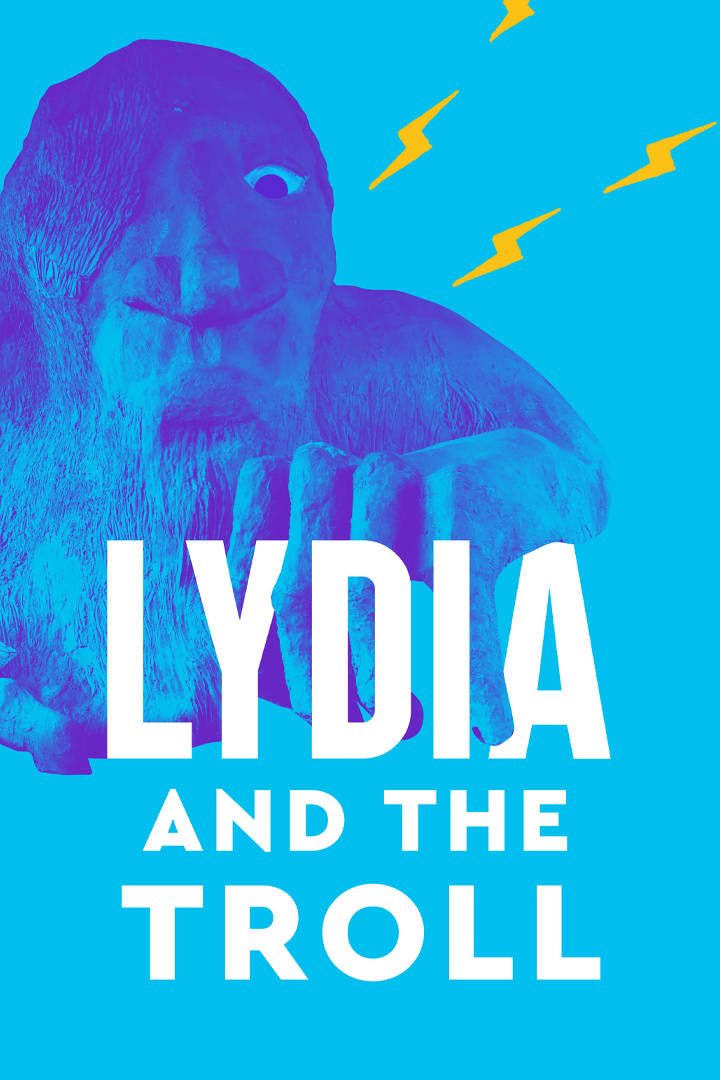
Lydia and the Troll - Book, Music & Lyrics by Justin Huertas, Additional Music and Music Production by Steven Tran, Co-Created and Directed by Ameenah Kaplan. The Freemont Troll (shown right) was designed and built in 1990 by Steve Badanes, Will Martin, Donna Walter, and Ross Whitehead. 

This one had a lengthy journey to the stage. It was part of the Seattle Rep season about four years ago, then pushed back to the following season, then COVID, and finally is making its way back to the stage. And it was worth the wait. 

Sarah Russell is Lydia - songwriter, podcaster, lapsed alcoholic, and would-be producer, on the verge of her big break - a record deal and a tour. All she has to do is write one more original song for the Judges at an audition in 24 hours. And she's hit a writer's block. She meets Jane (Janet Krupin), who is a fan, supporter, and is absolutely sure of Lydia's talent. 

Jane is also a troll. A real troll. In her original monstrous form she will turn to stone in sunlight, so she achieves immortality in 20-year chunks by crawling inside the skin of talented targets and letting them pay the price while she exploits their creativity. And she's got a deadline as well - find a new host or revert to her monstrous nature. And Lydia is her target. 

Russel's Lydia is a jangle of self-doubt and insecurity, an easy target. Krupin's Jane is a manic pixie troll,  happy in her own devilishness and effective in her temptations. The third member of the group is Pete (Adam Standley), Lydia's nerdish, needy boyfriend (nerdy down to the Amazon ID tag on his belt) who thinks himself as the hero but instead is the sidekick (and sometimes collateral damage). All three are strong, dynamic actors and singers, and while overmiked in places, are more than up to the challenges of the musical. 

Yes, it's a musical. The book and music is by Justin Huertas, who has become a local theatre landmark, the up-and-coming creative whose works have been rooted in the Pacific Northwest. Lizard Boy, previously at the Rep, was Seattle mutant super-heroes. We've Battled Monsters Before at the ArtsWest dealt with Filipino legend but set in the Seattle area. The Last Octopus Wrestling Champion, also at the ArtsWest took its lead from a PNW sport of ages past. And yeah, the Lovely Bride and I like his stuff. He lives in the "True Musical" genre (an argument our local group of friends has had a number of times) in that his stories are told through song as opposed to being supplemented by song (The argument is kinda involved, and has spanned numerous dinners). And yeah, we know his tropes and how he puts a song together. And it remains really, really good. 

Oh, yeah, there are puppets. The Lovely Bride HATES puppets in stage productions, but even she had to admit these were very good. Puppeteers Guy Garrison and Sophia Franzella  do a fantastic job with the puppetry, mostly shadow puppets on movable screens to handle transformations, secret appearances, and chase scenes. Yeah, there's a climactic chase scene between troll and Volkwagon, which ends up beneath the Aurora Bridge. And if you're a Seattle native, you know why that's important. Garrisona nd Franzella also fill in with bit parts as well, but the heart remains with Lydia, Pete, and Jane the Troll.

Lydia and the Troll took a long time to get to the stage, and it was totally worth it. It is an excellent capstone for a Rep season that was mostly hits and only a few weak spots. It is good to see the Rep recovering from the COVID desert and building a strong season. But if you're a local, yeah, you should go see this one.

More later, 

Sunday, November 27, 2022

Theatre: Dueling Carols, Part 1

 Q Brothers Christmas Carol, a musical by Q Brothers Collective, Directed by Daniel Cruz. Arts West through  December 23rd

Ah, the Holiday Season in the Theatre, when the standard, go-to, feel-good performance pieces pulls from a writer who died 150 years ago, and whose work has nestled the Victorian Era firmly into our Christmas Spirit. I speak of  Charles Dickena and A Christmas Carol. Both Arts West and the Seattle Rep are doing versions this year, so I (and you) are subjected to dueling Carols.

The story itself has incredibly plasticity over the years. I have encountered the original version, along with musical versions, deconstructed versions, back-stage comedy versions, innumerable TV show episodes, and all manner in between. It has been performed by Albert Phinney, George C Scott, Bill Murray, Patrick Stewart, Scrooge McDuck, Tim Curry Michael Caine (with the Muppets), and Mr. Magoo. The Oregon Shakespeare Festival is running version where the Christmas Spirits are played by the Marx Brothers. And here we have a hip-hop version of this timeless classic. 

Hang on, don't click away from here in fear. These are friendly spirits,  filled with good cheer, and this actually is a really good presentation of the story.

You all know the drill on this - everyone knows the drill. Ebeneezer Scrooge is wealthy rat fink who is visited by three spirits on Christmas Eve and from the lessons of the Past, Present, and Future, chooses to become less of a rat fink. It breaks down into pretty manageable chunks. We see Scrooge as a rat, then he gets a heads-up from his dead partner Marley that he is about to be ghosted, then we ratchet through the ghosts and end up with Scrooge so relieved by his change of heart that he makes people worry about his mental health. 

And yeah, this is hip-hop, all the way through. We are in the modern era, and this Scrooge is a former math nerd who turned to his capitalistic dark side. Marley is Bob, not Jacob. Christmas Past is Run DMCish with bucket hat and chunky chains, Christmas present echoes cooking-show era Snoop Dog, and the  spirits of Christmas Future invokes  the dance troupe Jabberwock. You don't need to know the history of the art form to enjoy it all as its sprawls out with hep beats and solid rhymes. Yeah, it is hip hop hooked to an ancient carriage, or perhaps a venerable vehicle with fresh horses, but it works.

We caught it on opening night, which had a late curtain and the program only available with a QR code. The house was friends, families, and financial supporters of the theater, and could be literally assumed to be "friendly". Yet the actors earned their many applauses, and bounced through the proceedings with a contagious energy that you can't help to embrace.

Christopher Kehoe Is Scrooge and portrays him in that white-boy-forced-to-be-funky dance moves when he cuts loose. The rest of the talented team (Dre Anderson, Jerik Fernandez, and Lola Rei Fukushima, who I will now think of as a "regular" for Arts West) get the good stuff, shimmering through proceedings as the ghosts, Marley's family, old friends, and encounters, often playing a couple parts simultaneously. The silliness gets contagious, and the performances are solid.

And they play it, for the most part, pretty straight. Scrooge talks to a sack of money he carries around and replaces "Bah Humbug" with "Chris-my-ASS-mis" as a tag line, and there is some Swiftian hints of cannibalism in the Marley household, but for the most part the really nail the beat, both narrative and musically.

I was going to wait for the Seattle Rep version to compare/contrast, but this was good enough to give you a good heads-up at the get-go. It is an enthusiastic entrance into the Holiday Season, and good rendition of the old Dickens chestnut. Go check it out.

More later,


Monday, August 01, 2022

Theatre: Dragons of Positive Vibes

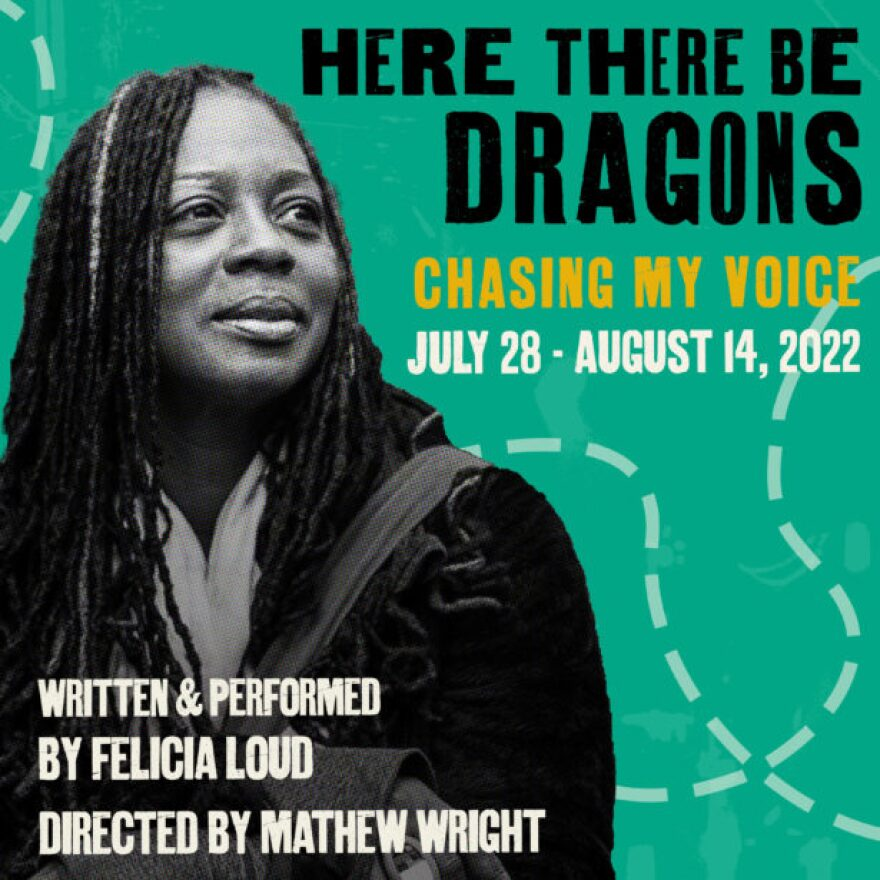
 Here There Be Dragons: Chasing My Voice by Felicia Loud, Directed by Mathew Wright, Arts West, through 14 August, 2022

Those who follow this space know that I go into plays fairly blind. That's one of the pluses of a season subscription - you  have a dinner date, but you don't exactly know what's on the menu. So what I had here is a name and the meta-knowledge that most of the season so far has been involving myths and monsters. So I am expecting some sort of "teenagers playing D&D kinda Stranger Things" performance.

Yeah. Didn't get that at all. Instead I got a memorable live rap show that pulled the audience out of their seats.

Felicia Loud is a local figure in Seattle music and theatre. She has been on the major stages in town. She has taught. She has performed for about 40 years. She's been on KEXP and KUOW. Most recently she is half of Black Stax, a longstanding local rap group. I knew none of this coming in. What I found out is that she's damned good, with a great voice. She blows onto the stage with a coat of many colors and silver boots and takes no prisoners during the performance. She's admirable backed up by musicians Cydney Johnson and Greg Fields, each with their own rig of drums and synths.

The show itself, a surprisingly quick 90 minutes, opens with part memoir, part lounge act, as she tracks her past, from Texas to Seattle to Lynnwood (where she was "the black kid" in a predominately white class) to the Central District. She talks, she jokes, and she is in an excellent position to judge the differences between black and white popular culture. And she does, bringing the audience in and talking about Garfield High.

(Now, as an aside, places like the Stranger refer to Seattle as being a whiter-than-white city. That's both true and false. Seattle is about 59.5% white, King County 54.2%. Those aren't overwhelming numbers. But it is a less-Black city than a lot of other places (6.8% and 6.5 %), And traditional practices such as redlining have kept the African-American population confined to certain areas. That is changing. The thing is, when the Stranger and others framing it in a binary terms, it erases a wide expanse of other PoC  - Asians, Native Americans, Latinos, and  Pacific Peoples. Anyway, thanks for coming to my TED talk.)

Anyway, the opening half is chatty, bouncy, and folksy. And then we start talking about rap and hiphop, and the potential difference between the two, and she brings in her parter in Black Stax, Jace Ejac, and the party gets really rolling, with the two of them wrap up the show with some killer rhymes and beats. 

This was good. This was great. It engaged me more than Free Style Love Supreme at the start of the Rep season, and had more authenticity that Fannie Mae Hammer. Part of it is the raw positivity of Ms. Loud. Part of it in the venue - Arts West is a small theater without a lot of places to hide (And yeah, she called out a patron that had to make an exit to the bathroom). She asks for engagement and energy from the audience, and she gets it.

And to honest, the audience was typical small theater in Seattle - greyer and paler than your standard rap venue. And that's a pity as well, because this is good stuff, and gives me a good feeling about the life in the Central District at the turn of the last century. Worth sharing, worth attending.

So how was the season in general at the Arts West? Here There Be Dragons was a highpoint, as was Justin Huertas' We've Battled Monsters Before. I thought Alma was solid. I liked the This Girl, though the Lovely Bride disagrees. Miku and the gods was all over the place for me, and Monsters of the American Cinema was sabotaged by its staging. So in general, good marks for the Arts West, and I appreciate them trying new things. I look forward tot he next season.

More later,

Monday, February 21, 2022

Theatre: Beat Box Baby

Freestyle Love Supreme - Conceived by Anthony Veneziale, Created by Thomas Kail, Lin-Manuel Miranda and Anthony Veneziale, Directed by Thomas Kail, Seattle Rep through 13 March.

So, let me be honest with you. I go into these plays pretty blind. I may read the summary when we ordered season tickets, but that was months ago. I don't read the preliminary press, the interviews in the Seattle Times, the promos over on the Stranger. Yeah, Lin-Manuel Miranda's name is evoked for this one in that awed "before he got famous" tone. My first warning of what is to come is usually the program book. Of course I still get a program book. I'm not an animal, you know.

In any event, my first warning for Freestyle Love Supreme (FLS from here on in) was the magenta and blue lights that swept the audience and got in our eyes. The stage itself is a wall of speakers with FLS logoed prominently (All about the branding). The actors all have rap names. The program book has a bug-splat qr code that allows you to suggest a word to be worked into the performance. The crew arrives, and, after a number on "Mike Check" introducing the team, start taking suggestions from the floor on what to rap about.

Yep, it is hip-hop improv. Lord have mercy on us all.

And yet, despite settling deep into my seat, pulling my cap down to protect my eyes, and preparing to grumble my way through the hour and half performance, I had a good time, and by the end was bopping and rocking with the rest of the audience, a mix of older regulars and younger families (I blame Encanto). It was light. It was fluffy. The rhymes were dope without being dopey. One of the suggested words was "narwhale". It was cute, and most of all, it was entertaining.

The crew is tight without being a fright (OK, I will stop doing that). Andre (Jelly Donut) Bancroft is one of the founders of the FLS academy and acts as MC, wheedling words and situations out of the audience, who in turn quickly warms to him. Anthony (Two Touch) Veneziale is a founder and one of the show's creators, and comes off as sort of the Dad of the group. Jay C (Jellis J) Ellis is the most physical of the assembly, twisting and turning as he raps. Aneesa (Young Nees) Folds has a wonderful, powerful voice, but the breakout is Kaila (Kaiser Roze) Mullady, who is a fantastic beat-boxer. Yeah, yeah, for all you folk who haven't thought about beat-boxing since the guy on Police Academy, let me say the craft has advanced and she's a wonder to behold. Musical beats are provided by Richard (Rich Midway) Baskin Jr and James (Not Draggin) Rushin. 

So, Jelly Donut wraggles words and situations out of the audience, and they tangle their raps around it. Word choices, things you hate (Big score there with "Girl Pockets"), things you love (Nature), embarrassing situations (someone who as a kid confused exlax with chocolate), and wrapped up with rapping about someone's day so far. They hit gold with that one - a young woman who was attending the show with her mom, boyfriend, and five aunts, who had been teaching belly-dancing that morning and had a local-legend, now-retired belly dancer named Mish-Mish attend the class. Those are the mileposts of this particular show, and the journey the crew weaves through them is both entertaining and impressive. Your mileage WILL vary, because that's the point of it all. 

So. Not the deepest of dives ever to develop on the Rep stage, but still pure enjoyment and a very pleasant way to spend an overcast, rainy day in Seattle. Just keep the lights our of my ancient eyes.

More later, 

Sunday, January 23, 2022

Theatre: Sunday Sermon

Fannie: The Music and Life of Fannie Lou Hamer by Cheryl L. West, directed by Henry Godinez. Seattle REP through 13 February.

We are back in-person at the Seattle REP. Properly masked, cards checked, program book not handed out by the ushers but instead piled neatly by the door, snack bar serving water only. They've made some physical modifications in our absence - moved the audience doors at the Bagley-Wright, changed the angle of the aisles, and remodeled the men's room (European style doors, and where did the urinals go?). The house was about a third of normal, even on the main floor. And we start with a tough play - it is short but extremely heavy.

Fannie Lou Hamer was a sharecropper who rose to champion voter's rights during the civil rights marches of the 60s. Her voice was loud and clear, and she spoke at the 1964 Democratic Convention against the (all-white) Mississippi Delegation (her televised speech was interrupted 18 minutes in by an announcement from LBJ). The play is a one-woman show, and on this Sunday afternoon we got the understudy - Shaunyce Omar, who commanded the stage with the verve and directness of an old-style country preacher. 

The play carries the DNA of black heroine plays like Nina Simone: Four Women (which also featured Shaunyce Omar) or Shout Sister Shout (about Sister Rosetta Tharpe, and by Cheryl L. West as well). But Fannie Lou Hamer was an activist, not a musician, so the musical portion is take up with other people's hymns, gospel, and protest songs of the era. In that way it resembles the "feel-good-old-timey" fair that sometimes pops up in the rep, often with depression-era songs. This confluence is ... odd. Hamer's speeches were full of hymnal references and church-speak, but transforming her fully into a creature of song didn't quite work for me.

Shaunyce Omar was in fine voice, though, and backed up by a trio behind her. She interacted with them and with the audience with a practiced hand, pulling them into her story. And the story gets bleak in places. We are talking about Civil Rights in the American South in the 60s. The play pulls no punches with the brutal violence of small frightened men who define any attempt at equality as a threat. It is tough to watch, but important, and vital to Hamer's story.

Jim Crow has transformed but is by no means gone. He goes by James these days and works more within the system to keep the system from getting TOO equal. But people are still burning churches (and mosques. And temples), and have traded in the hoods for polo shirts and tiki torches. And attackers get caught only when someone videos them. And when these arsonists and racists and attackers do get caught, the secretary disavows all knowledge of their actions. And folk are still trying to suppress the vote. It has been 50 years since Hamer lost the mike, and  we've still got a long way to go.

The play is solid, and does Ms. Hamer well, restoring her at the end to the podium she was denied at the start of the play. But this is not the happy ending you want for her, not the redemption and apology she deserves. But its a good view into the era for those who were not there and hope we have become better, much like the Depression-era plays are for me. And maybe Ms. Hamer will get a coin out of this.  

More later,

Monday, April 27, 2020

Plague Books: La La Land

Be Cool by Elmore Leonard, William Morrow 1994

Provenance: I dunno. The book itself showed up on the bookshelf I reserve for paperbacks.  It has as a bookmark a receipt from the Tacoma Book Center, a mecca of used books in the shadow of the Tacoma Dome. It has a sticker on the back saying it was from Port Book & News in Port Angeles, but even that may be a remainder. In any event, it has been on my paperback shelf, which I have been looking at in my downstairs home office every day. And the trade paperback size and blue steel cover kept taunting me as I was working.

Yes, I judged a book by the cover. That's the point. That's why they have covers.

Review: Look. I'm going to be careful taking on Elmore Leonard. The guy was writing since the 50s, passed on only seven years ago, and a LOT of his books have been turned into movies. New York Times bestseller. So, successful. Lemme walk carefully because, spoilers, I didn't care much for the book.

Mind you, I didn't read the previous book, Get Shorty, nor have I seen either of the movies based on the books. So I walk in without knowing much about our protagonist, Chili Palmer, former sorta-mobster and loan shark who has gotten into movie production. His first movie was a success. His second was a bomb. So he's looking for a new idea. And he's doing lunch with another former sorta-mobster who is now in the record business, and the former sorta-mobster is shot down right before his eyes. And Chili's first thought is - hey, this is a great idea for a movie.

Like I said, I don't know Chili. This is the first time I've encountered him. But I don't particularly like him. This is one of the thing which impresses me about Rex Stout's Nero Wolfe stories (oh, wow, here he goes again about Nero Wolfe). Regardless of the story, you get an idea right up front of who Nero and Archie are, and what their relationship is. And you have a reason to root for Archie, our narrator. In other words, any Nero Wolfe story could be your first Nero Wolfe story. I don't get that break here, so Chili and I get off to a rough start.

To use an Hollywood reference, there's a book out called Save the Cat. It is a short book that for a while was (and maybe still is) gospel in screenwriting. One of the things that it stresses as a "must" is that, in the first few minutes of the movie, you have to give the reader some reason to root for your protagonist. He is kind to a little old lady, fixes someone's tire, or, yes, saves the cat. So Chili meets a former sorta-mobster turned record producer, heads for the men's room, and on his return sees the former sorta-mobster gunned down. And his first thought is how he can turn this into a movie.

As I said: Rough start.

Another bit in the book is the idea that everyone in LA wants to be in a movie about their lives. I am not a LA native. I go down every so often for recording sessions for computer games, which keeps me in the general vicinity of Burbank and the old Bob Hope airport. I don't hate LA or love it. I am more LA-Adjacent. But I haven't met anyone yet who does the whole "you should do a movie about my life" thing. But I like Leonard's LA. It feels relatively comfortable. So that's a good thing.

So Chili gets into the record business, and stuff just starts happening. He discovers a hot new talent. He becomes her manager. He gets her to put her old band from Texas back together. He comes home one night and finds a dead body sitting at his desk. He makes friends with a homicide detective who, surprise, wants to see a movie about his life. Homicide detective is now Chili's new best friend, despite the fact Chili is a witness/suspect in two murders. Chili encounters a gay Samoan bodyguard that sounds suspiciously like Dwayne "The Rock" Johnson, and who is (surprise) played by Dwayne "the Rock" Johnson in the movie version. And then Aerosmith shows up.

You know, it sounds sillier than Leonard lays it out to be, but no sillier than most things that end up in LA's fictional universe. At the end of it all, Chili Palmer is a hustler, flying by the seat of his pants, making up lies on the spur of the moment and not getting called on it. He's got some tight situations but he never pays for his crimes, or realizes fully what he's done. He's not amazingly likeable, and remains an external force in LA, not really part of the entertainment world, but just an opportunist who sees it as he most recent grift.

Leonard is famous for saying, "If it sounds like writing, I rewrite it." And while I agree with the idea that language should sound realistic and natural, clarity has to ultimately rule. There are chunks here that feel like they were written during the Great Punctuation Shortage of 1993, and I had to take a couple runs at a few sentences to determine who is talking about what.

Be Cool is OK fiction. Not great, just OK. Like Chili Palmer, the book is not likeable enough to really pull me onto its side, but entertaining and engaging enough to work. Leonard's writing ethos is akin to some other authors I know - "If you do something wrong long enough, it becomes a personal style". Like LA itself, I can't muster up the emotion to hate it or love it. So I guess I'm Be Cool adjacent.

And now I can take that book off my shelf, so its blue steel cover doesn't distract me anymore.

More later,

Tuesday, December 10, 2019

Theatre: Roundup Edition

Shout Sister Shout by Cheryl L. West, Created by Randy Johnson & Cheryl L. West, Directed by Randy Johnson, Seattle Repertory Theatre through December 22nd
Head Over Heels The Musical, Conceived and original book by Jeff Whitty, Adapted by James Magruder, Directed by Matthew Wright. Arts West,  Through December 29th.
The Great Moment by Anna Siegler, Directed by Braden Abraham, Seattle Rep through November 17th (yeah, it's closed)
Sunset Baby by Dominique Morisseau, Dire ted by Valerie Curtis-Newton, Arts West through October 20th (Yeah, I've been pushing thing off that long)

I have been busy, and let even the barest minimum of this blog slip - to wit, the Theatre Reviews.

This is perishable fruit, because who wants to read reviews of shows that have long since slipped the surly bonds of matinee performances and moved on?  Yet I'm going to do a bunch of them, just to keep things up to date. And two of them are still playing, until the end of the month.

Shout Sister Shout is still going on, and well worth attending (There, you can skip the rest of the page if you want). It is a bioplay (a biopic for theatre) of the life of Sister Rosetta Thorpe, the Godmother of Rock 'n Roll. A foundational African-American performer, mostly forgotten today, more popular in Europe than in Jim Crow America. I know, it sounds like the play about Nina Simone last year, but it has a heartbeat and a verve all its own.

The entire play encapsulates the life and times of Sister Rosetta Tharpe, played incredibly well by Carrie Compere, The actress goes from child prodigy to elder stateswoman with all stops in between. A gospel singer by upbringing, she wanted to bring the music of the Lord forward to the masses, at the cost of rejection by her own congregations for hanging with the heathens. The play portrays Tharpe as no saint, acceding when she should have stood up, or taking the money when offered, but in the end creates a well-rounded picture of this pioneer. We name check the other performers of the era, from Cab Calloway at the Cotton Club, Dizzy Gilespie, and Little Richard, as the story barrels forward, including her relationship with Marie Knight.

Compere, as Stone, is pretty much fantastic, with a wonderful voice and a great guitar chops (the Little Richard Strut? She did that first). It's common to see a performance built around one great voice, but Shout Sister Shout gives us two. Carol Dennis, as Stone' mother and the pivotal other figure in the story, matches her note for note and hearstring for heartstring.

Performances are great, stagecraft (a scrim decked with white guitars) is excellent, and the music top-notch. Go see it.

Hear Over Heels is also very good, but in a different weight class. Arts West, in a renovated department store in West Seattle, is a smaller, more intimate venue, both in stage space and audience. I expected smaller plays in this space, but it goes all out, with a cast as large as Shout Sister Shout that packs the stage and avoids collisions.

The play itself is a celebration of the Go-Gos. OK, I have trouble separating the Bangles from the Go-Gos, but they had about four recognizable greatest hits, all which get their time (hint for those confused between the two - the Go-Gos got the beat, the Bangles walked like an Egyptian). They merge the music with the Countess of Pembroke's Arcadia, from the 16th century, which is ... quite frankly much MORE confusing and darker than the pared-down plot presented here.

Here's the simple version: The King gets a dire prediction from the Oracle at Delphi, but conceals it from his Queen and schemes to foil the predictions. The shepherd, who is in love with the royal younger daughter, masquerades as an Amazon warrior to be near her. Both King and Queen fall for the Amazon. Plus the older daughter rejects all suitors, and comes to terms with her own love of her maidservant. Yeah, its a lot about sexuality and gender preference, with a huge heaping of misunderstandings, layered with 80s pop. Whackiness evolves with a 9 principles and huge supporting ensemble. Not nearly as deep as Shout, Sister, Shout, but impressive in what it attains.

And the cast is uniformly strong. No standout voices, (OK, back me against a wall and I'd say Ann Cornelius as Queen Gynecia is really good (No, I am NOT making up these names)). Serious packed with wall-to-wall music, light and bouncy, and a feelgood production. Even if they don't play "Hazy Shade of Winter".

Sunset Baby was the first play of the season at Arts West, and fits much more within my expectations. It is a simple play with a single set and three actors. Nina (Aishe Keitaa) is the daughter of civil rights warriors and is Bonnie to her boyfriend's Clyde.  Mom's dead after a disastrous decline, Dad has been in jail for years. Dad is out and wants letters that Mom wrote him but never sent. Nina (again, a call-back to Nina Simone) has become hard-shelled and transactional over the years and has the letters. That's pretty much it.

Sunset Baby is an early work by an author who has done things more notable later works (see also: In The Heights). To be frank it shows - the characters are not speaking to each other as much as they are playing to the audience - their dialogue didactic as opposed to engaged. It is noticeable and a warning for my own writing.

The Great Moment is another earlier work, this time from the author of Photograph 51, which I loved to pieces. Again, it shows weakness in the script and promises of better work to come. She keeps the unmoored in time concept, but applies it to a domestic situation and the ruminations on time and mortality. But the author also breaks the fourth wall with an Ellen DeGeneres sort of perkiness, and is an autobiographical character (maybe not one-to-one, but enough to make one uncomfortable). Not a bad production, but still weaker than normal Rep fare.

There - caught up. Now bring on the next batch!

More later,

Tuesday, May 07, 2019

Play: Musical Number


Nina Simone: Four Women by Christina Ham, Directed by Valerie Curtis-Newton. Seattle Rep
through June 2.

Every year the Rep throws into its mix a music-based production. Woody Guthrie, a celebration of Americana, a drag cabaret recasting modern pop as 1920s hits, a storyteller with an accordion. Success is often mixed.

Nina Simone is a singer I have not heard much of: her stance on Civil Rights (and moving to an overseas label) resulted in her being pretty much disappeared in popular media. She made her claim with her brilliance on the keyboard and her vocals - unable to break through the color barrier in classical music, she turned to nightclubs and established herself there. Other singers like Eartha Kitt and Aretha Franklin weathered their political opinions, but Simone was not as fortunate. World-wide she's well-known.

The turning point for Simone was the 16th Street Baptist Church Bombing in Birmingham in September of 1963, which killed four children - Addie Mae Collins, Cynthia Wesley, Carole Robertson, and Carol Denise McNair. Previously she had made her mark singing from "Porgy and Bess" to comfortable white audiences. The bombing in Birmingham radicalized her and she wrote her first protest song - "Mississippi Goddam" supposedly in an hour, and released it in 1964.

The play moves Simone to the interior of the church in the wake of the bombing - the cross is toppled but the piano survives. Simone (Shontina Vernon) is seething with rage at the deaths, and seeking to express it in her music. She is joined by three refugees from the riots and water cannons outside - Maid Sarah (Shaunyce Omar), mixed-race activist (Britney Nicole Simpson), and prostitute Sweet Thing (Porsha Shaw). Together, the four women are characters from another Simone song, "Four Women". The women spar and bicker as Simone wrings her lyrics out and the ghosts of the children cry for justice.

Does it work? Sorta. The back stories and personal secrets of the characters are presented too easily for the distrust they have for each other. There are calls for sisterhood and solidarity, but also some circular firing squads as they complain of ground-level challenges to the movement as opposed to the oppression of the overclass white males. The songs don't always fit exactly right into the play that surrounds them, and a lot of them are from Simone's later works. As a result, you don't a good feeling of the singer's own journey into demanding justice.

The singers are all strong, with Shaunyce Omar as the strongest of the group  - though her character says that singing in the choir is for when you're not good enough for soloist, she's definitely the solo performance. Vernon's Nina was often undermiked and overpowered by the music itself, and while the lines were there, the imperious nature of diva only rarely surfaces.

Yet the show collects itself and rallies to an excellent finale in the song :"Four Women", and in the encore "Freedom Song" (By Vernon, not Simone) was a perfect capper. In the conflict of the four women, there is the discomfort of the past and the uneasiness we are seeing outside our window today. Our churches, temples, and mosques are burning today, and the darkness Simone struggles against is still with us. So call it a bittersweet ending, hopeful but wary about what tomorrow brings.

More later,

Tuesday, March 06, 2018

Theatre: Putting on the Ritz

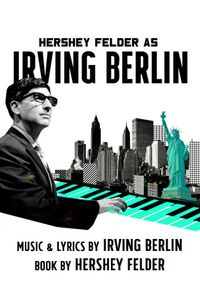
Hershey Felder as Irving Berlin, Music and lyrics by Irving Berlin, Book by Hershey Felder. Seattle Rep through 3/18.

One of the advantages of season tickets (I may have mentioned before) is that it will get you to things that you might otherwise pass on. I mean, you've already paid for the seat, and even if the concept seems like something you would not normally be interested in (One guy with a piano talking and singing Irving Berlin songs?), you might as well show up.

And in this case, you'd be glad you did.

This was an incredible performance, a real highlight of the season. Mr. Felder combines engaging storytelling with his brilliant work on the keys (I was fortunate to get a good view of his hands dancing at the the piano). He has the ability to play complex music and lock the audience into his words at the same time (a talent which he describes as "schizophrenic" is the after-show Q&A - if he offers that session, stay for it). And he embodies the character and brings it to life.

The set-up is basic - Irving Berlin, over a hundred years old and bitter about being passed by on the public stage, looks back at Christmas time on his life. Linear history. Family fleeing Russia for New York City. Job as singing waiter, translating into composer. No formal training, can't read music, just narrates his songs to assistants. Big success. Heartbreak in the loss of his first wife and his son. Becomes the songwriter of the middle of the American Century. Fading with the advent of Rock and Roll and Elvis (though I would pedantically add that the transistor freeing radio from the front parlor had a bit to do with the popularity of both).

But this is a memoir, not an autobiography, so I will park my fact-checker at the door. Berlin was incredibly prolific, so there are a lot of songs you recognize. The themes that swirl around Berlin are both a key eye towards the popular pulse of public, and that all his songs are written with someone in mind. They may go out there, and be attached to a particular singer or movie or play, but the are very personal to their creator. But the emotion that creates them is not always shared with the listener, as they are changed and re-purposed as they move through the population.

Should this be considered a play, or a performance? Doesn't matter. The music is brilliant. The stories are brilliant. Hershey Felder is brilliant. This is one worth seeing, even if you don't have season tickets.

More later,


Sunday, November 26, 2017

Book: Welcome Back My Friends

The Show that Never Ends: The Rise and Fall of Prog Rock;  by David Wiegel, W.W.Norton & Company. (c) 2017

Provenance: I discovered this book through a review. In particular, THIS review, which was not so much about the book as about its subject matter and why that subject matter wasn't worth much in the first place. As a review of a review, I'd say it's not much of a review, but it was on a subject that was a part of my college years: Progressive Rock.

Review: I got into Prog Rock in the late 70s (don't judge) after my John Denver phase (I SAID don't judge). ELP and Yes and Peter Gabriel-era Genesis. Progressive Rock was loonnnng songs with involved, often opaque lyrics that disdained the prepackaged, 4/4, lovesong nature of radio pop. Emphasis on musical techniques, centered on the keyboards as opposed to the guitars, strong influence of classical music, leading edge on tech, displays of arcane knowledge, long percussion solos, bizarre time signatures, and a lot of noodly bits. A lot of these properties, interestingly enough, Prog Rock shared with Dungeons & Dragons, and there was great amounts of overlap in both the performers and the audience.

Weigel intros his book with a nostalgia cruise for Prog Boomers, identifying them as a quirky bunch of anoraks, like model train enthusiasts, but quickly comes to grips with where progressive came from, both from a tech end (the rise of the Moogs and other electronic devices) and the rebellion against the extant commercial pop world, supporting performance over packaging. He follows King Crimson and other early pioneers through the great domain and dominance of the progressive groups as they formed, splintered, and reformed again. He gets into odd trivia (Lemmy of Motorhead was a member of the Moorcock-inspired Hawkwind? I did not know that) and tries to show the forces working to create Progressive Rock - touring, the rise of arena shows, record labels willing to take risks and develop talent, new tech, and the music media. He tries to describe various pieces in detail, which works if you know the songs in question, but otherwise sends me to YouTube for reminders. (writing about music is akin to dancing about politics - a completely different mindset between the words).

Weigel covers the halcyon days of prog with an eye towards personalities and personal development and new ways of putting together music. Then, with the suddenness that it appeared, prog was declared a dinosaur - too expensive, too baroque, too engaged. Punk and Disco (yes, Disco) arose in response to the over-technical banks of keyboards. What was rebellion was itself rebelled against. The rock media turned, the labels looked elsewhere for cheaper acts and quicker turnarounds, and the prog groups faded or transformed, mammal like, into something that could survive the new era.

I liked to book. Weigel's style moves quickly, bouncing from a high-level overview to personal anecdotes and back again. He reminds me of early groups that I had not thought of (like Van der Graaf Generator) and later incarnations I should check out ( Porcupine Tree, Majesty). And a lot of a music of the era that I really liked (though truth to be told  I always found ELP's "Lucky Man" to be a bit twee). So yes, part of this is nostalgia and part is pure rediscovery. If you lived through the era, you should check it out.

More later,


Saturday, April 22, 2017

Play: Thriller in Manilla

Here Lies Love: Concept and lyrics by David Byrne, Music by David Byrne and Fatboy Slim,
Additional music by Tom Gandey and J Pardo, Choreographed by Annie-B Parson, Directed by Alex Timbers. Seattle Rep through May 28th.

So let me right off the bat salute the Rep for the ballisest production of recent years. I have in the past tweaked them for relatively safe performances that fit within the bounds of traditional theatre. Small companies of actors, one-person shows, self-contained productions that fly in and out without seemingly touching the ground upon which the stage rests.

Yeah. All of that goes out the window for Here Lies Love, in which the theater itself, seats and all, is transformed into a disco, where the audience can be on the disco floor among moveable stages, where the actors come down and press the flesh with the masses in front of live TV cameras, where there is a continual disco backbeat and an excellent cast powers through a tight ninety minutes that tells the tale of Imelda Marcos. This is one of those performances that poses and tremendous risk for the theater, and it pays off creatively (and should pay off financially, because - spoilers - you really should go see it).

The theater space is tranformed into a massive disco cathedral. The seats on the main floor are gone, and what once the right and left banks of seats are replaced with huge stacked levels for those who chose sitting over standing. Most of us are on the floor, which it tighter and brighter and noisier. The disco beat plays, and yes, there is a DJ. The action takes place on moving platforms that slide and rotate during the performance. Unsung heroes (in the fact that they don't sing) are the jump-suited attendants with glowing sticks (called aircraft marshalling wands, I have just discovered) that keep the groundlings from being crushed by the action.

Here's the not-quick summary: Imelda is poor, romances and is rejected by Ninoy Aquino, rising young senator. She goes to the big city, has a whirlwind romance with Marcos (who in the real world is 40 years her senior, but here is just a bit older), marries him. She is Jackie to Marcos' JFK, and tries to do good, but is swept up in the heady drug-fueled seventies and betrayed by her cheating husband. She returns to pick up the gauntlet when Marcos gets ill (lupus) and effectively runs the country with an iron hand, claiming to know what's best. Her old boyfriend Ninoy returns in her life as a leader of the opposition - she has him imprisoned, exiled and is assassinated upon his reveiw, but his shooting kicks off the revolution that causes her to flee the country.

It is a potted history of the Phillipines, shrunk to 90 minutes and shown through Imelda's eyes. She is is betrayed time upon time, and feels that the wounds she has suffered justifies her actions. Her costume over time becomes more armored and military as she becomes the Steel Butterfly. Even at the end, she feels betrayed by the people she felt she served in the name of love. 

That sense of betrayal spreads to the audience as well, as the the rousing back-beat and line-dancing becomes a demand to party as the military rolls in, the cities burn, and martial law descends. The feel-good optimism of the early play becomes dark as the audience is forced to uncomfortably condone the heroine. There's a moment when it dawns on each individual (a different moment for each audience member) that this is going down the wrong path, and their encouragement is demanded.

All that said, it is a powerful performance. All the singers are fantastic and the ensemble is frenetic as they change supporting roles at an instant. Jaygee Macapugay is a beautiful, fragile, convincing Imedla. Mark Bautista is Marcos with a seducer's smile. Byrne's style of lyrics comes out fully with Conrad Ricamora, as the white-suited (no subtlety here) Aquino. Melogy Butiu is Estrella, the childhood friend left behind and the reminder of the world Imelda no longer is part of. They are fantastic, throwing everything they have into the performance.

The musical ends (spoilers) with Imelda fleeing the People Power Revolution, but in the real world, its not that easy. Marcos is dead, but Imelda has returned to the Philipines and is a senator for her home district. Two of her four children (shown in pictures but not referenced in the performance) are heavy hitters in politics, and the family fortune, built up from all the corruption, is involved in the recent Panama Papers scandal. Yet that is not the happiest of endings for the people of the Philipines, and the play ends with the positive sense of finality of the revolution and a reprise of its main song.

This is spectacle. This is an event. This is one of those plays that long-term theater goers and those who avoid such traditional forms of entertainment should see. Well worth it.

A final review of this season: Here Lies Love wraps up the Seattle Rep's season (which is just as well, because they have to put all the seats back, now). And the season has felt like a time machine this years. We started in the late 50s with Raisin in the Sun, jumped to the AIDs crisis in the 80s with Roz and Ray, jumped a few years more years to the Post-Queen Elizabeth era of King Charles III, back to the 70s with Vietgone, rolled through the Great Depression with Woody Sez, jumped into a weird interior mindspace of the 60s with Well, went contemporary with Dry Powder (the only one I really didn't care for) and then wrapped up with the 60s-80s in the Phillipines. This was a very political, wide-ranging season, and the Rep did a damned fine job. Theater as Tardis. Looking forward to what happens next year.

More later. 


Wednesday, April 12, 2017

Small talk with David Byrne

The Lovely Bride and I (along with 47 others) had dinner with David Byrne at Canlis. Let me explain what that means and how that happened. Yes, there will be copious links to help out.

As the kids today say: Pics or it did not happen.
David Byrne was the lead singer/songwriter for Talking Heads, a new wave band of the late seventies and eighties. And while I was a fan of the Talking Heads, I really particularly loved his music from Knee Plays, of which the Lovely Bride had a copy. We are not sure where the cassette came from, but we think it came from a mutual friend who was into such things as Brian Eno, Jon Anderson, and Peter Gabriel-era Genesis. Suffice to say, we had the album on an old tape cassette and I knew most of the lines by heart; the music was New Orleans brass band backing up the simple and quirky wordplay of the lyrics.

OK. So. Big fan of David Byrne's work (more recently, he's been recording with St. Vincent). And one of his latest projects, Here Lies Love, will be wrapping up the season at the Seattle Repertory. We won't see it until next week, but (spoilers from the meal), the early previews are doing well. Here Lies Love is the story of Imelda Marcos, First Lady of the Philippines, set to a disco beat. In fact, they have converted the venerable Bagley Wright auditorium into a discotheque for the performance. More on that, again, when we see the performance next week.

Anyway, the Rep had sent out a fundraising flier for a dinner with David Byrne. As long-time subscribers, we got the postcard, which we normally pass on. But this time, the Lovely B, having missed a number of things because it is tax season, decided we should take them up on it. So, we made an (embarrassing large) donation for dinner at Canlis with David Byrne.

The private upstairs room at Canlis.
Ah, Canlis. People in Seattle know about Canlis. It is our legendary top restaurant, the place for big anniversaries and important celebrations, the one restaurant in Seattle where one is expected to wear a suit and tie (I discovered later that evening that the Columbia Club used to have this restriction until recently as well, but has slacked off at the tie thing). Nestled at the southern end of the Aurora Bridge which crosses the canal to Lake Union, Canlis commands a view of the Lake, the ship canal to Lake Washington to the East, Fremont and Wallingford, and the U-District in the distance. The view is wonderful, and the food, which has gone through a couple incarnations in the time we've been there, is legendary.

And, there is a main dining room, and a private room with an even better view directly above. This smaller space has large wooden shutters that can be opened to the dining area below, or closed for more private functions. I had never climbed the stairs to this area, though the Lovely Bride had snuck off during one dinner to explore (the staff caught her, and since there was no function upstairs at the time, gave her the full tour). So, a private function at the priciest joint in town. We arrived slightly early and we were ushered up the stairs.

These excellent photos courtesy of Seattle Rep, by the way.
And I met David Byrne. Lean, grey-haired, bright-eyed, dressed in a powder blue suit with an American flag on the lapel. He was standing next to Braden Abraham, the art director. At the time, I thought he was art director for the production, but eventually, the penny dropped for me  and I realized he was the Art Director for the entire Seattle Rep. So that was a bit stunning. I introduced Kate first, then myself. Handshakes were made. Kate moved on towards the bar for a mojito, Braden faded back into another discussion, and David Byrne and made small talk.

And here's the thing. In my very small modicum of fame (blessedly limited to gaming conventions for the most part), I have met fans who have squeed over my very presence, been dumbfounded at my words, or sought to argue some point of a project I worked on several decades previously. And I want everyone to know, that I completely understand those attitudes. Because as we made small talk, cocktail talk,, the back of lizard brain was shouting My God, I'm Talking to David Byrne! 

We talked about the process that brought Here Lies Love to Seattle, I told him I was a great admirer of his work. We talked about the weather (after constant rain since October, we were blessed with a beautiful beautiful day). We talked about seaplanes. He admired my trilobite pin.We spoke briefly of on-line comics. Others came up the stairs, and, my moment passed, I thanked him again and made way for the newcomers (it always being bad form to bogart the Guest of Honor).

Just a wonderful photo of the Lovely
Bride and I.
And, delighted (that was David Byrne!), I moved off and talked with other guests. By the time Kate returned I was chatting with Darragh Kennan, an actor I had seen at the Rep who was serving as a rep for the Rep that evening. Darragh had been Sherlock Holmes in two productions at the Rep, and we chatter about our long-standing season tickets at the Rep, favorite plays, theater in Milwaukee and elsewhere. Servers circulated with wine, and later hors d'oeuvres. When Kate could not have the steak tartar because of her allergies (a mayonnaise aoli), they retreated and reappeared a few minutes later with a sample that was egg-free. They're good that way.

We mingled. I declare that I am not a social animal, but I do like to listen, and ended up spending time with an expediting engineer who handled programming problem children, a retired couple whose apartment we could see from the horizon, and a UW geologist who had written a book on roadside geology (he, too, was curious about why I would wear a trilobite on my lapel). The Rep had a photographer present, so we did get pictures.

David Byrne takes questions from the floor.
Dinner was a limited menu but completely up to Canlis's standards. Five tables of ten. Ours had Darragh, Braden (alas, I missed my chance to recommend that, since they were ripping out seats at the venerable B-W, they could replace them with recliners), the retired couple, a psychologist working on his dissertation, married to author who writes books on investing. And a couple, the husband of which I had little chance to talk to, but whose spouse worked for Wells Fargo and was part of the Arts Fund, and who worked for one of the OTHER Jeff Grubbs in the universe. Dinner was a perfect filet mignon for me and a flaky halibut for the LB, but out attention was on the discussion, not the food. 

David and Braden gave a brief talk on Here Lies Love, answered a few questions, and had to leave for a preview of the production that evening. We chatted among ourselves -art and politics (Imelda Marcos is still with us - no, she has not seen the musical), and adjourned some time afterward. Kate and I had booked a room in Seattle, overlooking the new site of the Museum of History and Industry, and the next morning brunched at Salty's on Alki and wrapped up a wonderful 24 hours in Seattle, a vacation without a plane trip.

And yeah, people are going to catch me smiling at work for the next week  for no obvious reason.

More later,