Monday, February 28, 2011

Spelljamming (Innnn Spppaaaaaace!)

After doing entries about the Forgotten Realms and Marvel Super Heroes, I had every intention to talk about some of the other games and campaigns I’ve worked on, but put it aside until someone sent me an email asking about the secret history of Spelljammer. I’ve said some of these things elsewhere, but this is pulling all of them together.

1)  The original concept of Spelljammer came out of a now-legendary designer pitch session at Augie’s in Lake Geneva, near the Horticultural Hall (Augie’s became Cactus Club, and is now Ryan Braun’s according to the Google Maps). Manager Jim Ward called the get-together to discuss the boxed sets for the next year. From the table conversation, the waitstaff thought we were location scouts from Hollywood (and that Jim’s assistant manager, Warren Spector, was Steve Spielberg).

2) One of the things that I came into the pitch session with was the idea that I wanted to push the envelope on what D&D fantasy was.  Yeah, we had done FR and DL, but those had been written down as typical fantasy worlds. Vanilla fantasy. Default fantasy. Background static. Here was a chance to go out on more of a limb and push the envelope.  So this was the chance to do D&D in space. I’m sorry – Innnnn Spaaaaaaace!

3) Here is the image I pitched. A knight standing on the deck of a ship in space.  He doesn’t freeze. He doesn’t blow up. He doesn’t float away. Everything that follows comes out of that one image, which is captured (with more to it as well) on the final cover Jeff Easley did.  All what people have called “Grubbian Physics” with its air envelopes and its gravity planes, comes from creating a universe where that image is true.

4)  Despite pitching hard for the idea, I almost didn’t get the nod to do it. The other idea that came out of the meeting was a boxed set for the far side of Krynn, in the lands of Taladas. Zeb Cook said something along the lines of “Well, I’ve never worked on Dragonlance, so I guess I get AD&D in space.” Jim Ward, bless his heart, countered with, “Since you haven’t done any Dragonlance, Zeb, this would be a great place to start”. And that was how I ended up with Spelljammer and he ended up with Time of the Dragons.

5) For the boxed sets at that time, we had a format – two 96-page books, 4 big color maps, and a bunch of light cardboard sheets. Our task was to fill that space. Sometimes the format worked, sometimes it was less successful. For Spelljammer, we used them to create the ship stat cards and standups. So that worked out pretty well.

6) So, the name. Descended from the windjammers, the old ships. In the game we used it to describe the act of moving through space magically. And it was the class of ship that moved through space. And it was the proper name of the legendary Spelljammer, a supposed Flying Dutchman/White Whale. It was a noun, a proper noun, and a verb. If I could have made it an adverb I would have done that as well.

7) The trademark guys hated the name (“So you’re the one,” said one of our lawyers, after publication). This was a regular nightmare in the office – marketing would want a name that captured everything about the product, making it easier to sell. The trademark lawyers would want the name to mean absolutely nothing, so it would be easier to trademark in a variety of fields. Spelljammer was clearly in the former but not the latter.

8) Spelljammer was initially thought of as being AD&D in space (Sorry - Innnnn Sppaaaaace!), but soon became obvious as a way to tie the existing campaigns together. One of the challenges of all the campaigns existing in the same reality, was that there are small differences like gods, for example, some of which overflow into other campaigns and others which do not. And things like the constellations of Krynn moving around . Crystal spheres, enclosing each solar system in its own container, were the answer to that.

Probably less medieval than it appears
9) The crystal spheres were inspired by the picture on the right, which was the cover of Daniel Boorstin’s The Discoverers. I thought it was a medieval woodcut, depicting the wise searcher of knowledge piercing the walls of reality to find the elegant clockwork beyond it. Actually, it’s not a medieval woodcut at all, but an from the late 1800s. Still, it is a cool picture.

10) The spheres allowed us to have whatever rules we wanted within the spheres themselves. Want to run a hard science version? It works that way in the sphere. Want the constellations to move around? There you go. Want a flat world resting on elephants, with iterative turtles below? Go for it. Krynn and Toril were presented as heliocentric universes, but Oerth ended up geocentric, primarily because I always felt that Oerth was the center of its universe, and here was the chance to prove it.

11) The crystal spheres also allowed us to have tactical drive and hyperdrive. This is a challenge in both games and fiction  – you want one set of rules for moving ships around in-system, and another that allows much quicker movement between the stars. Star Trek has warp drive and impulse power.  Rather than have two types of spell-powered space drives, we had two different types of space.

12) One thing we avoided was aether, which was an old-time theory of how the universe worked. It goes as follows - if light is a wave, then it has to travel through a medium, so there had to be a medium between the planets that did not slow down the planets but allowed light to propagate. Aether was conceived as a substance that had to exist to make the theory work. Mock it if you want, but nowadays we talk of dark matter, which has the same sort of odor wafting off it. We ALSO (in the real world) once had phlogiston, which came out of theories of how fire worked. The French theorized that fire was extremely fast oxidation. The English mocked the French and declared that items had an inherent “burning-ness”, called phlogiston, which was undiscovered by clearly made their theory work. So that’s where we got phlogiston in the game, and why it was so explosive.

13) The ships of Spelljammer were created by an interesting process. I would give broad art suggestions to Jim Holloway (“Give me a squid ship. How about a translucent butterfly? OK, have about a chambered nautilus?”) Jim would draw them up, we would select the ones we liked (mostly all of them) and Dave (Diesel) LaForce would do the deck plans, according our rules with the gravity planes. This accounts for a lot of the diversity of the ships.

14) Jim did four or five beholder ships, and we liked all of them, so we married that idea to the fact that a lot of artists have done different takes on the beholder over the years. So the beholders became genetic racists, each clan of which believing they were the “real” beholders.

15) The best ship was the Nautiloid, which pretty much cemented the mind flayer in the setting, which makes sense since a ray-gun wielding illithid was in Expedition to the Barrier Peaks way back when. The mind flayers were so identified with Spelljammer that later, when we wanted to do them for Ravenloft, marketing pushed back, worried that we would take something cool from Spelljammer.  We had to show that mind flayers predated Spelljammer.

16) The infamous giant space hamster also came out of ship designs. The gnome ship looked like a galleon and a sidewheeler slammed into each other. Someone asked what the big paddlewheel housings were for, since there was no air other than in the air bubbles. I said they were giant hamster wheels. Roger Moore (editor of DRAGON) thought that was hilarious and it was off to the races with the giant space hamster.  So I’m not taking the fall for that one by myself.

17) The giff, however - hippo-headed humanoids with a penchant for explosives, are my fault. They join the thanoi of Dragonlance and the yak-men of Al- Qadim in that animal-headed humanoid department of things I have done.

18) The neogi came about because, if mind flayers were slowing getting more background and depth (and in doing so, becoming a bit more domesticated), I needed a new really bad-guy race. And a marriage of the moray eels and spiders was great. Plus the fact they kept umber hulks (another criminally underused race) as slaves. In the original the Neogi were much more fragile than their slaves.  I think 4E did a good job with them.

19) The clockwork horrors were daleks in different skins. Oh, and with different colors. You realized that, right?

20) Unlike the Realms or Tekumel or Greyhawk, Spelljammer did not have a previous life before being incarnated as a game. I think this had an effect that we didn’t have a heritage to lean back on, to point at and say “this is how we did it.” So we had some strange structures grow up as numerous other creatives got involved. I would have named the Scro something else, for example. And I wouldn’t have put battleship guns on the bottom of the Rock of Bral (whose origins are the ROCK of GiBRALtar – again, I will take the blame for that one).

21) But my big regret is that I didn’t salvage the nautiloid model we had made for demos for the game. When we retired the line I tried to get hold of it, but was told it was going to be used to try and sell in a theme park ride. And then that during the presentation, someone had dropped it, smashing it into pieces. And then because it was broken, they threw it away. Sigh.

22) I’m happy with both how the product ended and up, with my contribution to it, though I was deeply engaged only in the original set and the Legend of the Spelljammer, and overseeing the first year of product before moving on to new challenges. Years later, Andy Collins revived the concepts, shed some of the sillier stuff, and put out Spelljammer: Secret of the Spider Moon. I thought that was pretty good as well.

23) And the whole thing about stretching the boundaries of D&D? It turns out that, after doing so, people STILL considered D&D to be “generic fantasy”, but now “D&D in Space” (Innnnn Spppaaaaaace!) was considered generic. Typical, vanilla fantasy. So what I learned was that D&D so dominated the market that ANYTHING we did was considered part of the background static. Not that this would keep me from doing it again.

More later,

Saturday, February 26, 2011

Play: Super Sized

The Brothers Size by Tarell Alvin McCraney, Directed by Juliette Carrillo, Seattle Repertory Theatre, through 27 February.

Well, this is disappointing. Not because this isn't a good play - it's an excellent play, a fantastic play. I am just disappointed that we were supposed to see this two weeks back, but the Lovely Bride had a horrible, horrible head cold, so we moved it to a week ago, and at that point I had a horrible, horrible head cold, so we moved it to this Saturday afternoon right before the darn things closes (If I got paid for these I would be very disappointed in myself indeed).

Which is a pity, because this is play worth seeing, the most recent addition to an extremely strong season from the Rep. It is a well-written, well-directed, well-acted play, about the difference between brothers of flesh and blood and brothers of situation.

Oshoosi (Warner Miller) is young and just out of prison, living with elder brother Ogun (Yaegal T. Welch) who is a mechanic with his own garage. Oshoosi is also friends with Elegba (Eddie R. Brown III), who he befriended in the joint. Part of the play is about how Oshoosi is pulled in different directions by hard, responsible Ogun and flightier, enthusiasitc Elegba. Part of it how Ogun has to deal with his responsibilities of his younger brother. And part of it is about how Elegba is trying to live up to Ogun's status as role model and falling short. In brief, then, it is a great play where the character move and rub up against each other and spark and grow.

It also has different language and different levels. Part of it is the hard-voiced language of the Black American street, but also it has a mythic quality in the story as well. The names are those of Yorubu deities - Ogun at his forge, Elegba the trickster, and Oshoosi as the questing hunter. The Vodoun tradition identifies them as Ogoun, Legba, and Oxossi. Now add to that poetry of the language and the body as dance infects the actors as they are being ridden by their orisha namesakes.

Now add another point, where the actor as storyteller comes into the fold, and the characters narrate their own stage action ("Ogun goes back under the car"). It feels like it should be pretentious, a writerly trick, but it really works here, both underscoring the characters as well a elevating the language into the realm where the characters see themselves as mythic. It ends up as a passionate play that moves the theater goer.

It is also part of a genre I have written about before - the African-American-Male-Experience, which concentrates on the tethers of family versus the outer world. I saw it in Blue Door and in Top Dog/Under Dog. But this one gets it right and transcends its own feeling of genre (and interestingly enough, the previous examples were four and eight years ago). It grapples with the idea that you are in "theater-land", and timespace of the "Distant Present" and declares victory over it.

The production takes place on a bare stage dominated by a concrete raft stacked with tires that are chairs, beds, women, dreamspace, luggage, and all other morphible objects. It helps create the timeless nature of the mythos that it occupies.

And the actors themselves pivot physically, emotionally and mentally, dancers both in language and expression, switching from addressing the audience with stage directions to wrapping themselves fully in the reality of the play. Messers. Miller, Welch, and Brown all are brilliant, but it is Welch's Ogun that provides the ultimate center for the play.

This is a play worth seeing, and my only regret is that I did not get a chance to see it earlier. It is a recent play, and McCraney a new voice worth hearing. Wish I could have told you about it sooner.

More later,

Thursday, February 17, 2011

The Borders on the Borderlands

Borders Books has declared Chapter 11 bankruptcy. It is closing about a third of its stores in an attempt to right itself, and a lot of people are viewing it as an end of an era, where the big box stores have been sunk by the rising power of online stores like Amazon, and the digital future chorused by kindles, ibooks, and nooks. And not a few give an ironic look at how these large chains sounded the deathknells for small indy bookstores, which apparently rampaged across the landscape like so many buffalo.

I don't quite remember it that way. I grew up in a bedroom suburb of Pittsburgh, and didn't have access to much in the way of a "real" independent bookstore. I had the spinner rack at the drugstores, the book department at Kaufmann's (yeah, once upon a time, department stores had book departments), and the local and school libraries. That was my ground level. Book stores were elsewhere - in the city, in other neighborhoods, and near universities.

(And as an aside, those looking for the secrets of the creation of D&D could get a leg up by knowing what volumes were available in the Lake Geneva Public Library back in the seventies - the situation there was similar to the Mt. Lebanon of my boyhood, but I digress).

Anyway, large enclosed malls showed up in our neck of the wood (nearby Upper St. Clair/Bethel Park) in the midsixties, and with the the chain bookstore. Waldenbooks first, then B. Dalton's. These became the vector for books as I got older and more mobile.They didn't drive any local stores out - we didn't have a lot of indies to take away in the first place. Later these were in turn superseded by Borders, which was the anchor store of the nearby Norman Centre II, at the top of the next hill over, practically on Mt. Lebanon's borders.

That first Borders was an amazing bookstore for its time. Two levels (!) with huge sections, wide selection, deep chairs, a fireplace, an elevator. Yeah, it sounds like standard equipment nowadays, but for the age it was pretty amazing. A magazine section that you would normally have to be in downtown Pittsburgh to see. As an author, I did readings there, and it was a regular stop in later years for taking my nieces for birthday books.

Of course, such infrequent visits were not enough to keep it going. The store at the top of the hill is on the list of stores that are going to close. When I was last there, it was like visiting an old friend wasting away from a debilitating disease. The shelves were moved further apart. The selection was diminished. A lot of volumes, previous set on groaning shelves, were now face-out to take up more apparent space. And the SF/Fantasy section was no longer a haven of new volumes, but rather overwhelmed with omnibus editions (like collections that hold my Warcraft and Starcraft books) for mass sales.

Later I would find the Barnes & Nobles in other cities, as well as other Borders - huge big boxes that made themselves destinations as opposed to someplace to visit when you were at Sears and Woolworth's. And these big boxes took their own toll on the Waldens and Daltons, though they were part of the same families as their gigantic cousins. So yeah, the chains got to places that indies would miss.

The chains also had an effect on gaming. TSR fought hard through the years to get a piece of the bookstore trade, aided by strong efforts by the merchandising division of Random House, which was seeking to expand out the presence of more than just books in the bookstores. One the reasons TSR did more hardbacks as the years went by as opposed to shrinkwrapped boxes was input from the bookstores - the problem was shrinkage, which translated into people breaking to boxes and looting the dice. Hardbacks showed less wear and tear, so they were the way to go. With the success of paperback gaming-world fiction like Dragonlance and the Forgotten Realms series, we had carved out a chunk of the store as our domain. You go into a big box and it has a gaming ghetto on the shelves with WotC, Pathfinder, and other hardbacks, you're seeing the results of those early efforts.

The big chains did a job, carrying games into a new world. It was not always the smoothest or most impressive presentation (hence the gaming ghetto title), but it created a stable platform of sales over the years (good for the companies) and created a literate gaming-savvy repeat business (good for the stores).

And now Borders is no more. Whatever survives in its place will be charming and archaic, like those old live theaters that have been retrofitted for movies, the balcony sealed off and the mighty Wurlitzer silent. Independents will survive, even thrive in the post-asteroid landscape now that one of the big saurian families have been knocked back. Indeed, those survivors who understand books may re-establish themselves in the very same ecological niches. Maybe even in the empty space at Norman Centre II.

I know that some are quick to dump the moist earth on Borders' coffin and inter it, and its list of faults and flaws are many. But I also know the effect that these big chains had both on the development of my own reading habits and the growth of gaming, should not be forgotten.

More later.

[Update: Scarlettina provides a mothership of links. Scrivener's Error does a great summary, notes some stuff I had forgotten (Borders was part of K-Mart for a while), but gets wrong that it would be a while before the closing stores would be announced.]

Wednesday, February 16, 2011

On Wisconsin!

For many years I lived in Wisconsin, which has always been a politically diverse state. It has strong urban centers and old big-shoulder industry, farming and granger movements, universities and a proud heritage of progressive politics. Historically, the state politicos have ranged from Bill Proxmire to Russ Feingold. As a result, it can move politically from the very progressive to the very conservative according to the whims of its voting mass.

And at the moment, it is in the hands of its conservative faction, and paying the price for it. Its new governor, Republican Scott Walker, has already made waves by turning down funding (and jobs) for pointy-headed intellectual stuff like high speed rail and rural Internet (which gives more for the other states, so - Thanks Governor). And it should be no surprise that he wants to engage in the time-honored sport of union-busting, particularly with the state workers.

So the governor wants to deny collective bargaining to the state unions (we're talking public service, teachers, prison guards, but not police and firemen (he specifically did not hit them in hopes of their support)), and have the right fire employees engaged in labor actions. Again, not out of the ordinary for this stripe of politico. Thing is, he's not doing it in a legislation, but rather as part of his emergency budget, hoping to slide it in without any type of opposition.

OK, that's a little snakier than normal. Oh, and when announcing it, he said he has already contacted the National Guard in case the people get all uppity about all this.

Hang on. He did what?

The Governor's office clarified that he did not call OUT the National Guard. He just briefed them on the possibility that as a result of his imperial, unilateral action, people might take umbrage and they should be aware. I think that this is the one bit that went too far, that spun everyone around from "Oh, this is politics as usual" to "Hey, this guy is crazy". Despite having a governor funded heavily by the US Chamber of Commerce (hence the union-busting), the population has a strong history of union support.

The end result has been protests today and tomorrow in Madison, a gem of liberalism in the midst of farm country (think of Austin with better weather). They had 12,000 people there Tuesday, and another thousand who decided to drop by the governor's house to express their displeasure.[Update: Estimate from NPR for Wednesday is 30,000]

Why do I bring it up? Just to get the word out. Most of what I know about this is coming through Facebook and email, from fellow Alliterates who live in the area, and individuals like comic artist John Kovalic (who does the strip Dork Tower). The teachers are turning out tomorrow, and the firefighters are showing up (so much for splitting up the unions). I'm getting some bits from the lefty analysis from the Stranger Blog. But for the most part, the media is pretty durn quiet  (The Seattle Times covered the initial statement from the governor on Page A8, burying the lede in paragraph four). Not a lot of news teams seem to be bound for Madison, Wisconsin.

Maybe they're caught up dispatching teams to Egypt, trying to catch up with THOSE protesters.

More later

[Update: As of the next morning, the story in the Times had moved to A4 and a picture showed huge numbers. The NY Times has picked up the story as well. And the Packers Player Union has chimed in with solidarity for the state workers]

[Update Update: You know the budgetary crisis that the Governor states that the unions have to take cuts to pay for? Turns out it is the result of the Governor's Own Budget.]

[Update Update Update: Now the media is paying attention, but I gotta say - Guys, It ain't Cairo. It's important, but it ain't Cairo. Just saying.]

[Final Update (and I mean it)]: Page one, Seattle Times, below the fold.  Rightwing pundits refer to protesters as rioters. Local police chief, who is used to students burning sofas after a big game, thanks the protesters for their well-mannered behavior so far.

Saturday, February 12, 2011

DOW breaks 12000!

OK, it happened a couple weeks back, but there was this stuff in Egypt and the Super Bowl and things got busy at work. Truth of the matter is, it has only been three months and change since we hit 11000, so the rate of recovery (for those that invest in stocks, at least) seem to be increasing at a rate that would put the go-go Clinton years to shame. It seems to be rising as faster than when it was falling previously.

Yet despite this, we seem to be spending an inordinate amount of time fretting about the idea that, if we don't give the corporations another cookie, they are going to shut everything down and put us into another deprecession (yep, its a new word. Coined right here. You can send me a nickle whenever you use it). Part of it may be because chunks of the economy are still crashing down around us. Part of it may because our local paper of record both thunders about cost-cutting and then bemoaning the pain of that cost-cutting. And part of it may be that, looking at the gap between Wall Street and Main Street, more and more of us seem to be on the Main Street side, watching the engines of industry pulling away.

And it may just be that stock prices, like gas prices, have no connection to real world anymore (gas is just past 3.33 around here - did we start another war and no one told me?). On the stock market, it is not small investors or even master-level money-crafters, but robotic AIs that spin according to their own algorithms, ignoring the meatspace that surrounds it.

I dunno. Maybe I just need a new way to keep score. Maybe at 13000.

More later,

Wednesday, February 09, 2011

Stop Muppet Sense

It is shaping up to be an uphill fight all day, so enjoy this instead:


More later,

Tuesday, February 08, 2011

Academia

I'm sharing this with the audience beyond Facebook. Editor extraordinaire Jim Lowder posted a note on his page that two books I have contributed to: Family Games: The 100 Best and Hobby Games: The 100 Best are both going to be used as textbooks at DigiPen a local college which teaches video game design (and among whose alumni include a number of fellow ArenaNet employees).

I am delighted by my increased standing in academia, and realize that I am one step closer to becoming the "Official Gaming Pundit" on the Daily Show.

I've also been reminded the Steven Schend that today is Jeff Grubb Day. So be sure to load up on all the necessities for your Jeff Grubb Day celebrations. Oh, and the Roger Moore story mentioned is here.

More later,

Sunday, February 06, 2011

Superbowl Narratives

Oddly enough, as I've moved around the country, I've tended to pick and discard my loyalties for baseball teams but accumulate my loyalties for football clubs. I grew up in Pittsburgh during the time when they were horrible (The big play of the game as deciding which way they would run off the field at the end of the game) and when they were mighty (Franco Harris, Terry Bradshaw, the Immaculate Reception, Myron Cope and the Terrible Towel, etc...). And I lived in Southeastern Wisconsin in a town that literally straddled the line between Bear and Packer territory. And now I live in Seattle. So I can usually count on one of "my" teams getting to the playoffs, and have a good track record of going all the way.

In this case, two teams that I root for made it all the way to the Superbowl. Packers and Steelers. The Packers are a wild-card team that outperformed in the playoffs. The Steelers are continuing their Dynasty with a third Super Bowl under the same QB. And once again I am looking at the narrative behind the game.

I've been here before in rooting for multiple teams and seeing the narrative evolve behind them - Steelers versus Seahawks in Detroit. The narrative at that time swung towards the Steelers - It was rusher Jerome Bettis's last game, in his home town. The Steelers were representing a town of old industry against a town of new tech. Pittsburgh had Primanti Brother Sandwiches, Seattle had Starbucks. Pittsburgh was steelworkers (ignore the diminishing number of mills in the 'burgh), while Seattle was tech support (that is to say, wimps). A national poll showed the Steelers overwhelmingly favored both on the field and in the hearts of America.

And this narrative had an effect - the Steelers got a close call that, years later, the ref said should have gone the other way (hey, thanks guys). The influence of who SHOULD win the game affects the play of the game itself.

This year, the cleated shoe is on the other foot for the Steelers. Far from the favorites, they operate under a cloud. The QB Rothlisberger was suspended for sexual misconduct early in the season, and much of the Pittsburgh narrative has been about how this is the redemption tour. Most folk have already made up their minds, and he and the black and gold have been fitted with the black hat. The attention (and the fan jerseys) have shifted over to number 86, Hines Ward. The Packers, for their part, are the scrappy underdogs this time, ignoring their own great heritage. Their QB is there for the first time, and they have their future ahead of them.

The end result? The Steelers should be heavy favorites but there is only a spread of a couple points, and national opinion polls give the game to the Packers. Will this spill out on the field in the officiating? Into the broadcast booth in the calling of the game? Seahawk fans know about this type of pain.

Then there is the political aspect. The President was a big supporter of the Steelers two years previously, and owner Dan Rooney was made Ambassador to Ireland. The game is on Fox with a big celebration of Ronald Reagan's 100th Birthday (come on, guys, the Republicans need their own FDR/Kennedy legend, even if they have to build it themselves). So, ignoring that Wisconsin has been a "blue" state, is there a political polarization to the game?

And finally, for those who are going to watch for the commercials, here is what I am predicting - Dead Celebrities, Animal Attacks, and teaser commercials that tell you to go to a website for a punchline. Because nothing claims the dominance of a media like ads that send you to a completely different media.

Am I calling the game one way or another? I'm no fool. I have good friends on both sides of line this time. I'm just going to enjoy it, knowing that by the end of the day, one of "my" teams is going to win. And that works out well for me.

More later,

Monday, January 31, 2011

Cop Spotting

So after a recent traffic ticket (no, I didn't mention it here - jeez, I don't have to tell you guys EVERYTHING, do I?) I found myself sensitized to the local police presence. Hyper-sensitized. To the point of wondering "Wow, do I see cops EVERY day?". So piqued, I spent most of January keeping a notebook in the car, and every time I saw I cop, I wrote it down (once I had reached a safe and convenient spot) where I had seen the officer, what branch the officer belonged to, and what he or she was doing at the time.

I quickly found I had to develop a bunch of ground rules:
  • I would count by instances, not numbers of police vehicles. Four cops responding to a call in the International District would count as one, not four.
  • I would only count vehicles, not officers. Foot patrolmen got a pass. Motorcycles, police vans, and those dinky little parking vehicles the Seattle cops used all counted.
  • No fair counting cops parked at police stations. Ditto fire stations and city halls. That's just cheating.
  • Similarly, no counting officers in my living room or at my dining room table (Hi, Dave!). That's cheaty as well.
  • Wreckers, fire trucks, emergency vehicles and anything else that has bubble dome lights is a count for another day. 
  • Only count as IDed it you can figure out what branch they belong to. Most of my unidentifieds are motorcycles, since they are hard to pull out affiliation as you drive past them.

I ran this for the first four weeks of January. My normal commute is down Benson and Talbot to Renton, then north to Bellevue either by I 405 or back roads, depending on crowds. Once a week I would drive to Federal Way for comics, and once a week I would drive downtown to the ID for Tai Chi. Upon looking at the notes, I saw that I rarely traveled on weekends, staying home to work, and though I would get out to play games with friends, I did not rack up enough instances to really rate them, so I'm taking Sunday and Saturday off the table.

So what did I end up with? Here's the summary - 47 sightings over 20 days. That's over two, nearly two and half police encounters a day. Let me did into the tables a bit:


Day Numbers
Monday 04
Tuesday 08
Wednesday 17
Thursday 06
Friday 12

Note - Wednesday gets the big number here, but that makes sense because it is the day I'm doing Tai Chi downtown and getting comics. More travel = more sightings. But Friday is not out of the ordinary as far as travel but gets a higher number, while Monday is the slowest day. So if you're going to violate traffic laws in the Renton and Bellevue areas (which this blog does NOT endorse), Monday is your best day.


Location Numbers
I-405 14
Bellevue 09
Downtown 06
Benson/Talbot 10
I-5 03
Lake Washington Blvd 03
Auburn Way 02

There is a surprise there, but one I did not expect. Lake Washington Blvd. is a noted speed trap for drivers who are avoiding I-405, the main artery between Renton and Bellevue, but it pales compared to local cops in Bellevue proper, or along Benson and Talbot, which seems to be a new hotspot in the evenings for squad cars.


Affiliation Numbers
State Police 06
Bellevue Police 09
Seattle Police 05
King County Police 03
Renton Police 11
Other 03
Unidentified 10

So we have here an embarrassment of riches for the various departments keeping an eye on the streets. Renton and Bellevue have the lion's share, which is to be expected. Most of the Unknowns are, as noted, motorcycles. The others are New Castle, Redmond, and Auburn, but oddly enough, nothing from Kent, where I currently live.


Activity Numbers
Patrol 29
Responding 05
Ticketing 07
Parked 02
Accident 02
Breakdown 01
Unoccupied 01

The vast majority of the cops were in motion from one place to another for reasons unshared with me (my lone Redmond cop I picked up in Bellevue and followed all the way to Federal Way). Responding was in motion with the lights flashing. Tickets, Accidents, and Breakdowns were all pretty obvious. Parked is a none-of-the-above situation, where they COULD be waiting for the unwary, but I have no proof that they were not reporting in, doing paperwork, or just keeping the speed limit down by their presence.

So did I learn anything (besides the fact that there is probably a better way to do tables on Blogger)? Just a bit. The sample size is still pretty small, but it shows that there are likely heavy and light days in rotation, that the bulk of the police seen are in motion, and that supposed legendary speed traps were not, and new ones may be opening up. If anything, this type of activity needs more spotters and a more cohesive way to manipulate the data. In short, enough with the long-hand calculations - there's gotta be an app for all this.

Next up? Sketchy research on why there's never an officer when you need one.

More later,

Tuesday, January 25, 2011

The Kid of Death

The K of D: An Urban Legend by Laura Schellhardt, Directed by Braden Abraham, Seattle Repertory Theatre through February 20th.

Before getting to the heart of the matter, a detour into the bidness side of show bidness. You'd think that holding season tickets might render you immune to the long touch of fund-raising for theater, but such is not the case. If anything, you are moved HIGHER up the list because you actually GO to theater and you enjoy it and should be disposed to part with a tad more to keep the lights on.

One recent phone fundraiser from the Seattle Rep was refreshingly honest - "I know you gave us money, but we were damned fools and spent it, so we're back." Probably the best pitch I've heard in years, but I still put him off, saying that the Lovely Bride handled donations (which is true). And she kicked in a bit to help out the Rep at the end of the year. And those contributions go to thing like the Yes Project, dedicated to getting more young voices on the stage and more younger butts in the seats.

And K of D is a part of one this Yes Project, and though most of the audience was considerably grayer than the target demographic, it is an excellent start.

It is a one-actress show, the actress being Renata Friedman, who plays The Girl, and moves with quicksilver grace as she inhabits the other characters in the play, holding down multiple ends of the conversation, downshifting from animated bounds to a dancer's stillness, holding the moment, containing and embodying the story.

The story itself (as we get to the heart of the matter) is about story-telling, in part, and the growth of an urban legend. But is it also about the hermetically sealed world of the young, before consensus and convention and even reality has a deepening effect. It is a place where magic still exists, when magic and the uncanny, is the best interpretation of the events of the larger world.

The place is a small town in western Ohio, and the urban legend is about Charlotte McGraw who loses her twin brother in an accident, stops talking to people, and picks up a strange and deadly superpower. Charlotte's silence is portrayed with mute delicacy, but the rest of her pack, the gathering of young teens who hung out together, do enough talking. We're thrown into their conversations early and without proper IDs, but The Girl doubles back and soon we know that Becky always has a cig and Stephanie has that squeaky fearful voice and they become internalized.

They are the stable ones in this town, in their own way of thinking. The adults are quirky with a good layer of menace beneath it. Charlotte's mom is a teacher with a bit too much competitiveness in her heart. Charlotte's dad is a bit of a thug, but a bigger thug is Johnny, who hit Charlotte's twin with his rusted blue Dodge as is the unrepentant villain of the piece. We start out telling stories about telling stories, but soon settle into the real tale of watching an urban legend unfold.

Friedman is all the characters, shifting smoothly from one to another. But this is no monologue, but as the stagecraft and in particular the sound couples and supports as an invisible partner, from the voice calling off-stage to the frogs and the closing of a lid on a glass jar. Friedman is perfectly timed, creating that bit of misdirection that is part of the magic. (OK, I will throw in one gripe - they identify a heron's call at one point, but use a loon instead. Loons sound mournful and sad, while herons sound like a bag full of ratchets. It's a small point).

And at the end, its the type of play that people who don't go to see plays should go see - it doesn't have a big name or a big issue or a big meaning. It is solid and powerful and well-written acted. I liked it, and the Lovely Bride loved it. On the way out, she said "Well, that's the best hundred dollars we've ever donated."

Indeed.

More later,

Walking in Pittsburgh

Steve Lammert posted this up on his Facebook Page, and I had to share.


Godda say, it made me tear up n'at.

More later,

Sunday, January 23, 2011

(Five of) The Ten Little Indians

The problem with the permanent record that is the Internet is that every photo, comment, and action has the chance to resurface suddenly and without warning, creating that embarrassment of looking back at your college photos at any time, and a reminder of how the years have worn on.

Case in point, the photo to the left. It is a promotional shot for the South Park Conservatory Theater's production of Agatha Christie's Ten Little Indians (Also called "And Then There Were None"). The time is thirty years ago - 1980 would be my guess. And the players were all part of my D&D group.

Let me back up a moment. The Lovely Bride's mom, Nardi, is an actress and a stage director, and at that time was involved with South Park Conservatory Theater (which was situated in South Park a large county-fair-sized park south of Pittsburgh). They were doing a production of Ten Little Indians (yeah, it goes by other names, but that was the one we used), which is a manpower-intensive plays - a lot of roles to fill. A bit of a challenge for straw-hat volunteer theater.

So Nardi turned to her daughter's D&D group, which met regularly at the house. She had already grabbed me for a production of Arsenic and Old Lace (I played one of the cops), and she recruited some of the rest of the team to fill in the other roles.

We were all murderers, of course, of one type or another, and are bumped off over the course of the play.

The young lady to the left, I fear I have forgotten her name, played Emily Brent, transformed into an elderly woman through the wonders of makeup. Next to her is Kirk Botula, who now is COO of a tech firm in Pittsburgh, but at that time was playing Anthony Marston, an effete twit who presages his own death with a toast at the close of Act 1. Next to him in yours truly, with my stern grown-up face on, since I will be aged as well to play General Macarther (No, not that one), who sent his wife's lover to his death during the war. Next to me is Jeff Liebmann, who posted this photo to Facebook in the first place, as Doctor Edward Armstrong. Jeff's now a Unitarian minister, and still has the beard. And reclining on the settee is the Lovely Bride as Ethel Rogers the maid. All of us were second bananas who would add to the body count.

It was summer stock and it was fun and it showed I had a high forehead back in those days, and that my hair was not more manageable than it is now. And while I have not descended into the full grey-haired, wrinkled look of the old general, I have picked up a few grey hairs and wrinkles along the way.

More later,

Thursday, January 20, 2011

Animaniacs

Kind of busy right now, but I had to share this, liberated from Andrew Sullivan's site:


More later,

Friday, January 14, 2011

Tombstones and Breeder Tags

I think there is a PHD dissertation, a heavy coffee-table book, and a permanent spot as a pundit on NPR for anyone who creates a definitive history and analysis of bumper stickers and similar vehicle personalization devices. From mudflap girls to fake bullet holes, from "Don't Mess with Texas" to yellow ribbons (now sadly in decline, despite the fact that we're still in Afghanistan, people), what we put on our cars is a window into who we are and what we want others to think about us.

And recently, I've hit two new phenomena, which I have chosen to name for lack of better things to do.

The first involves Tombstoning. I noticed this a couple times over the past few months. The entire back window of the vehicle ahead of me is taken up by a full decal saying in something along the lines of "In Loving Memory - *Insert Name Here* - You Will Be Remembered". The vehicle itself has been turned into a memorial for the loved one, with the back window of the vehicle its epitath.

I find this touching, but also started wondering - is there a time limit on vehicular mourning? If another loved one dies, do they get the slot, or would a simple additional line merit? Is it bad taste if the deceased died in a vehicular accident, or merely ironic? Does it effect resale value? I don't think Miss Manners has the answers for these questions.

The other new effect is something I'm calling Breeder Tags. They are pretty popular, and you see them on the back window of vans and SUVs. Usually it is Dad, Mom, and a number of kids, divided by gender and sometimes by age/height. I know this one has gone national, since the ones I've seen have been Disney-inspired, where everyone except the girls are wearing Mickey Mouse ears (and the young girls are princesses).

Part of this strikes me as justification - I need the big vehicle because I have a lot of kids to haul. I'm cool with that, though I notice that some are a little be disingenuous - What looks like a large family at first blush turns out to include dogs, cats, and even goldfish. Now your back window is not an IRS form, and you can claim as many dependents as you choose to stick there, but it just doesn't stand up under examination. It feels like a criminal use of the inherent promise of a "Baby on Board" decal.

And there was one set that combined the first development with the second. It was a set of breeder tags in the lower left-hand corner with one member positioned at the top of the windshield, with wings and halo. And all at once I am consumed by the sadness of losing a child and creeped out by the fact that you'd want to broadcast this to people zipping along at 60 MPH on I-5.

More later,

Wednesday, January 12, 2011

Girl Genius Day

OK, here's the plan.

Over to the right, there are a bunch of online comics that I read. One of these is Girl Genius, which is a very cool "steampunk romance/mad science" strip by Phil and Kaja Folgio. With me so far?

Now, Phil and Kaja have written a novel, Agatha H and the Airship City, from Nightshade Books (which is a small independent publisher of really good SF novels, but I digress). It is a novelization of Agatha's origin story. And said book is available at your local independent or chain bookstore, or online at Nightshade or at sites like Amazon.

The plan is that, if you want to buy the book, buy it today. That way there is a bump in the electronic sales (it is at #27 in books at Amazon as I write this). It's a birthday present for Kaja. Also, if you're in the Seattle area, Phil and Kaja are doing readings in the area over the next couple days.

Am I buying the book? Well, to tell you the truth, I bought it a while back, at my Local Comic Store. It showed up there just before Christmas, and made a great gift for the Lovely Bride. So if I can get it back from her, I'll read it. No, really.

More later,

Tuesday, January 11, 2011

Return of No Quarter (Part II)

With the new year we bring into being the latest crop of new collectible quarters from the US Mint. And as in years past I'm going to go over the designs with sarcasm dripping from my cudgel of kindly observation.

For those who tuned in late, the US Mint, having successfully launched the state quarter collection, is doubling back and taking a second dip, this time with a "National Parks" series. Actually, since not all states HAVE National Parks, it is the National Parks/Forests/Monuments/Recreation Areas series, and is also referred to as the "America the Beautiful" series.

One thing that has struck me is the improvement of technology and design since the state quarter program. I think the designs are more challenging then they were previously (see - Wyoming's State Quarter) in their attempts to show depth of field with a bas relief. Similarly, the subject matter is more concise and directed than the grab-bags you see in then previous States collection. On the other hand, the challenge of showing natural vistas or national battlefields loom large, as getting a message across in the space of a small circle.

But enough serious consideration, on with the snark,


Gettysburg National Military Park - Pennsylvania

One of the great battles of the Civil War, which, with Vicksburg (see below) sealed the fate of the Confederacy, shows Abner Doubleday preparing to lay down the first official bunt in baseball. No, no, I'm sorry. Actually, this is the monument of the 72nd PA regiment, which fought at the Bloody Angle and caught Pickett's Charge in the teeth. It is a great monument (but that's another series of blog posts) in that it captures the feeling of the hand-to-hand combat, but the statue probably gets the nod over the other monuments because it is PA's coin. Home field advantage, you know.

The coin itself captures those levels of depth I was talking about. We have the partial cannon in the foreground, making this feel more like a window than a display. The monument itself is centered and has the dominant white space. But beyond it we get the rolling hills and farmland of Pennsylvania which sets the monument into the greater world.

The monument itself was the center of a fight that reached the Supreme Court, by the way. The rules for placing monuments (yeah, they have rules), a battlefield monument should be placed where the main line of the battle existed. In the case of the Angle, the 72nd PA was driven back by Pickett's Charge, rallied, and fought back to the original front line. The Supreme Court ruled in 1891 that the monument should be placed at the original line of scrimmage instead of counting any forward progress. Talk about a booth review on the play.

Rating: A (Way Cool)


 Glacier National Park - Montana

So here's the problem of trying to create perspective: It doesn't always work. The intent here is to show the mountain goat on an outcropping in the foreground, with pines in the middle distance, and Mount Armadillo-Head Reynolds in the background. The problem is with little or no white space, we have little feel for perspective, such that we either have dwarf pines or the mountain goat is the understudy for Paul Bunyan's big blue ox. Further, the musculature of the the furry goat blends too easily.with the rocky outcropping behind it, with a deep cut along the goat's back is the only strong defining line (which in turn looks like the mountain ridge behind it). As a result, the goat disappears into its background like carved chameleon and the resulting coin is a muddle of textures.

Rating C (Meh)


Olympic National Park - Washington

So this comes out of the same kit as the Glacier Quarter - Animal, Trees, Mountain - ship it! But this works a bit better, because in part of the use of the white space of the Hoh river to clear up an otherwise muddled lower half of the coin. The elk has a clearly different surface treatment than the background, so it pops from the plane of the coin.

Still, it is the part of the scenic mountain series that we have seen way too often, even if it features Mount Olympus, which always gets second banana treatment when compared to Mt. Rainier. And the little splashy marks where the elk steps in the water? It looks like we're dealing with the rare electric elk, and soon salmon will be floating to the surface, shocked by its lightning hooves.

Rating B (Not Bad)


Vicksburg National Military Park - Mississippi

American History is filled with internal conflicts and divisions, and none so bitter as when Dr. Loveless sailed his steam behemoth up the Yazoo river, and was only foiled by Secret Service agents James West and Artemis Gordon.

OK, its really the USS Cairo, which was not AT the final Siege of Vicksburg (which was wrapped up almost simultaneously with the Battle of Gettysburg, creating an interesting dualism in the coins). The Cairo had been lost the previous winter on the Yazoo, but was later raised and is now on display at the Vicksburg National Park (there were gunboats at the Siege of Vicksburg - just not the Cairo). So Mississippi has a coin dedicated to a Union victory, depicting a Union gunboat flying union pennants. I think it is a very gutsy move, but I can't wait for the nutters to get wind of this one.

As a coin, I have to say that this is really impressive. Single image, dynamic, good balance of white space and carving. It is probably the most industrial coin we have seen, practically a steampunk quarter, and will probably be the coin the people really look at when it shows up in their change. Unlike the plethora of natural vistas with wildlife (Not that I'm pointing any fingers .... WASHINGTON).

Rating A (Way Cool)

Chickasaw National Recreation Area - Oklahoma

This is the tough thing about giving every state their own National Park quarter - not every state has a National Park, and even when you spread it out to include memorials and recreational areas things are still pretty thin on the ground.

Case in point, Oklahoma. The Oklahoma City National Memorial would have been most dramatic and meaningful, but the bombing of the Alfred P. Murrah Federal Building is still a raw wound in the American psyche, even 15 years later. Fort Smith is part of the Trail of Tears, and Washita battlefield commemorates Custer's attack on Black Kettle's Camp. Neither of the two is great grist for national coinage.

So, Chickasaw, which the National Park booklet describes as "An Oklahoma Oasis" (which, of course, says something about the rest of Oklahoma). It is a nice, verdant park with mineral springs and creeks and not a lot as a stand-out feature. Except, maybe, for the Lincoln Bridge, depicted here. Built in 1909 to celebrate the centennial of President Lincoln's birth (giving us the Civil War trifecta with this year's coins), the bridge itself just celebrated ITS centennial, making it a favorite as a historical feature. So that's why a coin for Oklahoma has a very un-arch-typical Oklahoma scene.

The coin itself is not horrible at all. It actually has a sends of balance from left to right with the river banks, and from top to bottom with the mirrored white space of stream and sky. The addition of the birds in flight both underscores native wildlife (which must have been in the design document for a lot of these coins). The bridge melds into the treeline behind it, but may come out better in the final casting. In short, it is a completely suitable rendering of a relatively obscure and traditional feature. And it still better than the West Virginia state quarter, another coin-with-a-bridge.

Rating B (Not bad, but when it is all said and done, it is STILL just a bridge).

And that's it for this year. Tune in next year for the "All Points of the Compass" edition - Maine, Alaska, Hawaii, Puerto Rico, and, um, New Mexico (OK, one of them would have to be more in the center).

More later,

Sunday, January 09, 2011

Midgard

Yes, the rumors are true. I am helping Wolfgang Baur and some very talented writers with creating a Midgard campaign setting, exploring the world that Kobold Quarterly has placed its Free City of Zobeck.

And by "helping", I currently mean, "asking a lot of pointed questions about the world  and how we build campaign settings in general."

Hey, we even have a trailer!


More later,

Saturday, January 08, 2011

Picasso

So Friday I took the day off from work, with the excuse to go see the Picasso Exhibit at the Seattle Art Museum (SAM for you non-locals). The SAM itself merits its own entry, so let me concentrate on the exhibit itself. And mention the crush of people who ALSO decided that that last Friday was the time to go. So there were a LOT of people, such that with timed ticket and two sets of lines, it was a crush of school kids, old folks, and bozos like me listening to the provided audio track (and kudos to the young woman who thought enough of others to park her stroller in the media room and carry her child, just like in the old days. You, my dear woman, rock).

So Picasso himself, I've had mixed emotion about. On one had he is Twentieth Century Art with a capital "A". On the other hand, the process of the art is such that it becomes unmoored from representational art and starts drifting, balloon like, into an emotional realm.

What that means is, that when it works, it works very, very well, and when it doesn't, you end up scratching the side of you head and asking "Is that a nose? Is that an idealization of a nose?" When I was young LIFE or LOOK magazine did an article on Picasso (this was in the 60s) and then two weeks later ran a series of letters, each one of which declared that their seven/six/five/four/three/two year old could paint better. Which is part of the point and nothing like the point.

This Picasso, he confuses me, and I think he wanted it that way.

The exhibition itself comes from the Musee National Piccaso in Paris and reflects works that the artist considered part of this legacy, and consists of finished works as well as sketches, studies, and uncompleted projects. That gives an idea of what lies behind the thinking, as well as minor or personal work. Les Demoiselles d'Avignon is not here, but represented by similar works, and Guernica shows up as preliminaries and a photo-progression of the work shot by one of his lovers. Yet he has generated so much material, in so many different media and in so many different ways, that the entire experience is unexpectedly overwhelming. I overheard one patron say that he felt like he had just left a Thanksgiving dinner - he was overloaded on art.

And of the art, yes, the early Blue and Rose periods show him capable and establishing himself as an Artist-with-an-A. It is his cubist work that connects for me at the most basic level - I find the transformation of figure into planes and the creation of motion through angles to be exciting. This is the part that works. And yet after this, as it moves most fully into Picasso' style of teardrop shapes and morphable eyesockets that I lose a bit, that the excitement is not as present. It feels like he is doing art because that is what he does.

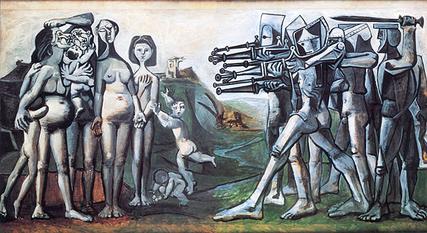
Massacre in Korea, Pablo Picasso, 1951
My greatest surprise was to find Massacre in Korea at the exhibit. A "sequel" to Guernica, inspired by Goya's The Third of May, 1808. I had thought its purported subject matter was part of the resistance to the work (it was supposedly critical of American involvement in Korea, and it easier to chastise fascists than Americans), but now dealing with the piece up close, I find that it is effectively a lesser work - clunky where Guernica was fluid, heavy-handed where Guernica was universal. The message is clear, but execution fumbles.

I guess that is where I come down to on one of the finest artists of the 20th Century. When inspired, when in action (ever with still lives and portraits), the artist Pablo Picasso was impossible to define except in terms of his own brilliance. He had the ability to reach into the heart of his subject without directly stating it - he was jazz in a visual media. And when it doesn't work, whether for limitations on the part of the artist or the viewer, it feels like a parody of his material, like the 60s comic artists (and yeah, you can see Bob Crumb in some of the work, or Basil Wolverton),

Sometimes he was pushing the envelope to see what lies next, and sometimes Pablo Picasso was following in the well-trod path of ... well, Pablo Picasso.

The exhibit is in town for only a week more, and worth cutting class to see it. Good luck with the crowds.

More later,

Thursday, January 06, 2011

Ten Years

ArenaNet celebrates its tenth year anniversary with a retrospective about us, our games, and our world. Enjoy.


More later,

Saturday, January 01, 2011

New Year's Expansions

Last night we had an New Year's Gaming Eve here at Grubb Street, and had a very nice evening indeed, with a variety of games played, in particular expansions of games we already knew.

I asked the Lovely Bride for a Christmas for a game we could play together. Usually that is my job in the relationship, and we would end up with a nice European board game or something for Playstation 3 (we just finished the Indiana Jones Lego game after a year or two). I discovered that I should NOT leave the LB alone in a game store with such a directive, since she picked up THREE expansions - for Settlers of Catan, Carcasonne, and Alhambra. Plus I had an expansion for Ticket to Ride that I hadn't cracked open yet, so this became a gaming session to play expansions.

Board game expansions are a little wonky, or rather wonkier than RPG expansions. How far do you go with it? Are you looking to create a new experience with well-known features? Are you seeking to extend the experience of the original game? Are you trying to correct weaknesses in the original? Are you trying to make a popular original (which would be one reason to do it in the first place) even more popular? It is sort of like movie sequels, and filled with many of the same perils.

So here's how we did:

Carcasonne: Princess and Dragon. The original Carcasonne is a tilebuilding game with a lot of quirky little rules in it (we tend to play the later Carcasonne: Hunters and Gatherers, which is set in prehistory and is a bit more streamlines). One of the challenges with Carcasonne is that it is like watching someone put together a jigsaw puzzle for most of it. Indeed, the game pulls people together as someone gets a city piece that he can't put anywhere, and people start lobbying for a particular play to help themselves. In addition, the original game had a problem with "mega-farms" - large, sprawling amounts of territory that will tip the game for one player.

The Princess and Dragon expansion is billed as taking the game into fantasy, but actually takes it more into randomness. New tiles bring into play and move around the Dragon piece, which takes pieces (meeples) off the board. The sudden swinginess introduced prevents someone from taking an early lead and holding it, but proceeded to carve a huge swath of empty cities, untended farms, and abandoned cloisters through the center of the map. We went through a phase where the time-honored strategies were suddenly blowing up in our faces, and quickly descended into a giggling mass of disaster. Result: It did make the game more fun by making it less serious. Your well-thought-out play can be overturned by a Dragon rampaging through your home.


Settlers of Catan: Traders and Barbarians. The original Settlers is a classic, the first to hit the beach in the new wave of European Boardgames, and remains an excellent game to teach people who has grown up on Candyland and Monopoly to show that board games don't have to be boring. It is nearly a perfect game in itself, the Platonic ideal, which makes it tough to expand. Traders and Barbarians is a bunch of individual expansions which could encourage repeated play, but the sheer number of them left the gang unwilling to experiment - after one "reminder game" to teach new people, we moved on to other activities. The addition of Fishermen, Camel caravans, and Barbarian raiders looks interesting, but it is toy box that will have to be sifted through.

Ticket to Ride: 1910 Edition. The original Ticket to Ride was brilliant and flawed. A train-building game that was easy to access, its small cards were difficult for the young and the old to shuffle, and its game play (determined through routes pre-selected on cards) tended to funnel everyone through the same corridor of the Mississippi valley, which made for frustrated play and nearly destroyed relationships. 1910 is a patch that works nicely - New decks of reasonably-sized cards, plus a 1910 deck of destination tickets, which concentrated on more east-west lines than north-south lines, making the valley of death less frustrating. Using both original and 1910 cards produces a much more random game where what tickets people had were not as clear.

Alhambra: First Expansion. The original Alhambra is another excellent core game involving tile-building a city, and buying those tiles with four different types of money cards. This expansion creeps around the edges, tweaking the game with small improvements that increase complexity without gumming things up too much. There is now a mechanic to interrupt the game to grab the city piece you really want. There are cards that let you change one type of money card to another. There are bonus cards that make you want one particular piece very, very much. And there are worker's tiles, which can increase in value depending on their adjacent tiles. We added ALL of these, and found that the original game stood up very well, and encouraged people to engage with the game when it was not their turn.

That's the lot of them, for the moment. In general, expansions, like the games themselves, vary in success. Carcasonne created a very different game, while Alhambra's deepened the play experience and Ticket to Ride's patched some issues. I don't make resolutions, but were I to make one to play more games, I would say that I was well on the way to keeping it.

More later.