Monday, October 07, 2024

Theatre: So It Goes

 The Skin of Our Teeth by Thornton Wilder Directed by Damaso Rodriguez, Seattle Rep, through 20 October,

The new play season at the Rep began for us with another adventure in short-distance theater commute. The weekend traffic situation has been painful in the region for the past couple weeks, so we chose to leave early. Which was fortunate because an accident on one of the freeways ate up all the time we gained. We still got there before curtain rise, but it has been a challenge.

Anyway, Skin of Our Teeth:

I wanted to like this. I SHOULD like it. It ticks a lot of boxes that I grouse and complain about in this space. It is traditional theatre, as opposed to dance troupes and improv groups. It uses talented actors I have seen before on the boards, living up to the "Repertory" part of the name. It has a huge cast in a world where five-person plays push the limits. It has community volunteers on stage. The author is well-known. It won a Pulitzer back in '42. It had a successful revival recently on Broadway. It runs 2 1/2 hours with three full acts, making it a blockbuster in theater terms.

And it landed with a thud for me. 

Let me summarize. The Skin of Our Teeth is a the story of the immortal Antrobus family, who represent the human race. Everything is allegory here. George (Carlos Lacamara) is the patriarch, and represents progress and authority. Maggie (Emily Kuroda) is his wife, domesticity and family. Son Henry (Chip Sherman) is violence, daughter Gladys (Rachel Guyer-Mafune) is the future. Their story takes place in three periods where the world is ending, by ice, flood, and war. There is a lot of anachronism and absurdity. The first act takes place as the glaciers are bearing down on the Antrobus's suburban home in New Jersey, where they keep mammoths in the house and invite the great philosophers in for coffee and sandwiches. The most accessible character is the maid, Sabina (Sara Hennessy), who breaks the fourth wall to complain to the audience about the absurdity of the play itself. Allegorically, she is human nature, and is really the main character here. 

So first act, threatened with extinction during the Ice Age. Second act, rinse and repeat. Third act comes to the resolution that, in the words of Rosanne Rosannadanna, "It's always something". The program book comes with a handout explaining that we're being non-linear and absurd in places, and that's part of the point. 

Plus in the middle of this, the play being presented is plagued (in the script) with mishaps, miscues, and labor troubles, ending in most of the cast breaking character, having some honest moments, and recruiting volunteers to finish the play itself. The last is a good comment on the relationship between play and audience, but with the pacing it just sort of trundles along.

The main actors are fine, but their characters are flat, and only when they break away from them (portraying the actors who are portraying the characters) do they seem to come to life. The secondary tier of support characters are excellent, with callouts to Sunam Ellis as the nervous stage manager and Laura Crotte as the Atlantic City fortune teller. The teeming masses on-stage are pulled from the Rep's Public Works program, and some subscribers get to read quotes towards the end. I like that part.

The stagecraft is excellent. I usually bash on the overproduced nature of these things, but here the collapsing roofs, advancing ice sheets, and arrival of a ferry/ark all work out just fine. Also, a dinosaur and a mammoth. And a hydro race.

Ultimately, all this had more meaning some 80 years ago, and was experimental and engaging in 1942, but now it tends to creak from its age. There were two intermissions, and after each there were more empty seats in the house. The Lovely Bride would never insult the actors by leaving, and I wanted to see if the third act redeems that which came before (it does. A little). 

But really, the history of humanity? It all boils down to "It's always something". 

More later, 


Sunday, September 29, 2024

The Book Backlog: Knives Out

 [Bloggers Note: So, I've been fretting over one particular entry for a while - a review of a game product that I'm spending way too much time fiddling with. I'd take it off the shelf, rewrite chunks of it, then put it aside as more immediate matters (the Political Desk, plays that have a closing date) get in the way. But as a result, I have created a backlog of books on the corner of my desk I want to talk about. So this is the Book Backlog. I will (once again) put aside the much longer piece and try to whittle it down, though  that may be a fool's errand. 

Anyway:]

Court of Daggers by Alexandre Dumas Translated by Lawrence Ellsworth, Cyrano Productions, 2022.

Provenance: It is no surprise to long-term readers (both of you) that I've been a fan of Lawrence Ellsworth's translations of the Musketeer Cycle. So I was a little disappointed when I could not find the continuance of the series on the Pegasus Books site or its distributor Simon & Schuster. But I found this volume and the next one on Amazon, continuing the story under Ellsworth's own imprint. 

Review: I'll be frank - we're in the doldrums here. It is season 5 of 7 seasons and the movie. The original Musketeers stories were written to be serialized in newspapers, and while that makes for reading them fairly neatly and compartmentalized, collecting them together lacks a bit of heft as we move further away from the original adventures. 

This is the second part of the Visconte de Bragelonne, which started in Between Two Kings. As such we get a a chance to deal with other characters than the four core musketeers. In particular, the rising star is the titular viscount, who is the son of the almost saintly Aramis. Of the others, Athos is now a clergyman. Porthos is nobility. D'Artagnan has land in France and England, and still works, off and on, for the Crown, resigning whenever the Crown displeases him.

There are three arcs within the text. The first centers the conflict between the Superintendent of Finance Fouquet, and Jean-Baptiste Colbert, who controls the late Cardinal Mazarin's wealth. The King sides with Colbert and signs the death warrant for two of Fouquet's underlings. Fouquet  hires mercs to capture his minions, escaping through a nearby building, and then covering their tracks by setting the building ablaze. Oh, yeah, the building is owned by D'Artagnan, who is on the scene when this goes down. D'Artagnan foils the plot, kills Fouqet's mercs, and lets Fouquet's men be properly hanged.

D'Artagnan is then hired by Colbert to investigate Fouquet's building up a fortress on the coast. D'Artagnan finds that Porthos is charge of the fortifications, and since Porthos is not the sharpest mental blade in the basket, discovers that Athos, now a bishop, is behind this particular development. Fouquet does from fancy diplomatic tapdancing to avoid the noose himself. Interestingly, Dumas (and D'Artagnan) likes Fouquet better than Colbert, even though he is working against him. 

The last act consists of the King marrying off his brother to the sister of King Charles of England (who our glad lads helped put back on the throne). A lot of young men are hot for Princess Henrietta, including the second Duke of Buckingham (which worked out SO well the last time). Bragelonne has to be the voice of reason here, even though he is himself smitten with his childhood love, who in turn has been elevated to a Lady in Waiting (and caught the eye of the King). More drama to come, but that will wait for the next volume, Devil's Dance. 

Bragelonne, the titular hero, threads his way through all this. He is D'Artagnan's Padawan in the first third. He argues with his father a bit in the second set of chapters, but then we scarcely see him until the final bit, where he comes into his own. And while the Viscount worships his father, he shares much with the bravado and cunning of D'Artagnan.

Ellsworth acquits himself well here, covering a lot of territory that most Americans and English-speakers have not heard of in the canon. He trims, edits and modernizes, without losing the plot or burying small bits. An earlier translation of the text can be found here, and it is clear that Ellsworth makes the work readable and engaging for the current readers, just as it was for serial readers in Paris itself. He smooths things out and reduces the stuffiness (to our ears) of the earlier translations. Plus he backs up with footnotes and character descriptions in the back that help clarify where everyone is standing with each other and what any asides and allusions refer to.

In short, I'm still enjoying the series, through we are now 30 years out from when D'Artagnan first entered Paris with his wobbling horse. And it gives me wonderful source material for Miseries & Misfortunes. And I'm looking forward to reading the next volume as well.

More later 


Sunday, September 22, 2024

Edition Wars: Player's Handbooks

 So I got a copy of the new D&D Player's Handbook, and it's pretty good, but my problem is what to call the darned thing. The official WotC version is that it is just D&D. Not a new edition. Not a halfway 0.5 revision. Just D&D. OK, but how do I separate it from all the other D&Ds we've played over the decades? This got me quickly rabbit-holing down the various flavors of Dungeons & Dragons, and what it means to have a new edition. And if the latest version is really counts as a new edition or not. 

And for the purposes of this discussion, I'm going to be talking about the main line development of the hardback books. There are a lot of interim points in this lineage that I'll touch on in passing (like Unearthed Arcana and the 3.5 edition), as well as the alternate D&D line of the three Basic Boxes, the BECMI line, and the D&D Cyclopedia. Not to mention the Open Gaming and OSR clones. Like I said, it is real easy to rabbit hole. I'm going to look at seven products and see where they differ.  And what I'm looking at is primarily significant rule changes, particularly character creation and combat. To a lesser degree, I'll track presentation, because that evolves as well. Also influential on the discussion is who is writing these various editions, who is playing them and how the market has changed over the years, though that's really a story for another day.

Enough caveats? OK, let's get to it.

Let's start with the Original Gangster D&D - the little brown booklet in the woodgrain (later white) box. Dungeons and Dragons Rules for Fantastic Medieval Wargames Campaigns Playable with Paper and Pencil and Miniature Figures by Gary Gygax and Dave Arneson. in particular Volume 1, Men & Magic. Written and presented by people knowledgeable in wargaming, it required some understanding of miniature gaming. The original presented classes are Fighting-Man, Magic-User, and Cleric. The Races are Dwarves, Elves, and Hobbits (Changed to Halflings in later editions). The combat system was literally opaque to anyone who has not played Chainmail, but has as an Alternative Combat System the Attack Matrices for Men Attacking and Monster Attacking. These charts were the ones we were using back in the 70s when I started playing.

And while it doesn't tell you specifically how to create a character, it does state that "Prior to the character selection by players it is necessary for the referee to roll three six-sided dice in order to rate each as to various abilities, and thus aid them in selecting a role". Putting aside the note that the DM (not called as such yet) is rolling the players' ability scores, it does make generating ability scores the first step in character creation, followed by race, class, and everything else (including modifying those ability scores depending on class).

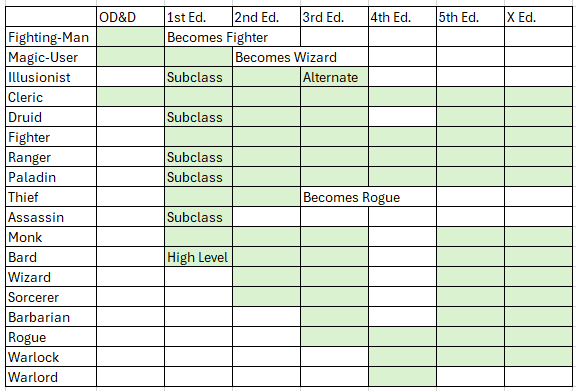
That's OD&D, our ground zero. The next step is Advanced Dungeons & Dragons Players Handbook (no apostrophe) by Gary Gygax, later called 1st Edition. And it stuns me when I see the quantum leap between those original booklets and what we find here. Big, sturdy hardback. Tiny type. A lot more definition on the rules, often with unique cases for specific situations. Character Classes are now Cleric, Fighter, Magic-User, Thief, and Monk, with the subclasses of Druid, Paladin, Ranger, Illusionist, and Assassin. Bards are there, but are in the back of the book as high-level play. Most of these classes showed up in other OD&D products or the Strategic Review, before becoming Core Canon. Races added the Half-Elf, Half-Orc, and Gnome. The attack matrices have moved to the Dungeon Masters Guide, but are the recognized method of combat (there was a year between PH and DMG - we used the tables from the original set during this lull). Saving throws are situational, as it was in the original flavor D&D, and it mattered you we being hit by a wand or dragon's breath.

In character generation, the player generates abilities first, then race, class, alignment, name, starting gold pieces, and hit points. Methods of ability score generation were also moved to the DMG, and four methods were provided; 1) roll four dice, drop the lowest, put the rolls in any order on your sheet. 2) roll 3 dice 12 times, keep the highest six, put them in any order 3) Roll in order listed, roll 3d6 six times each, keep the highest. 4) Roll 3d6 , in order, for 12 characters, then chose the character you want to run. Yeah, it sounds overly complex, but it fits with the complexity of the rest of the game. The ability scores in order were Strength, Intelligence, Wisdom, Dexterity, Constitution and Charisma. These were the Prime Requisites of Fighters, Magic-Users, Clerics, and Thieves, respectively, plus hit points and the dump stat (unless you were aiming at being a paladin).

The sheer massiveness of all this says that AD&D is clearly a different edition of the game, though still backwards compatible, in part because there was so much NOT Covered in the original. This was the version that showed up in the mall bookstores in the late seventies.

Then comes Second Edition, or rather the Advanced Dungeons & Dragons 2nd Edition Player's Handbook (note the apostrophe) by David "Zeb" Cook. Again, there's a presentation change as the accessible printing tech improves. Now we have a second color in the book, with full-color pages. The contents reflect the changes provided through a lot of the other 1st edition hardbacks, and excluded some (goodbye, Comeliness from the Unearthed Arcana, You are not missed.) from the canon. 

Races/Species through the Editions

The 2nd Edition has the least number of changes between the editions - THAC0, which was being used in conventions and embraced by the RPGA, is now fully incorporated (goodbye, attack matrices). The Half-Orc disappears from the racial lists. Classes are reorganized under four general groups - Warrior (with Fighter, Ranger, and Paladin all presented as equal classes), Wizard (Mage and Specialist Wizard, with Illusionist as a detailed example), Priest (Cleric, and Priest of a Specific Mythoi, with Druid as the specific example), and Rogue (Thief and Bard). The ones outside the "Big Four" character classes are presented as optional, but everyone used them in their base games anyway. 

One of the major changes has been presentation and organization of the book - the order of chapters in the Player's Handbook, sketched out by editor Steve Winter- Ability Scores, Races, Classes, Alignment, Proficiencies, Money/Equipment, Magic, Experience, Combat, Treasure, Game and Combat Mechanics). This basic outline would remain pretty much intact until the most recent Player's Handbook.

Of the editions, the transfer between 1 and 2 is the slightest as far as core rules are concerned - a lot of this is necessary housekeeping. During the design there was discussion of more radical changes ("Hey kids! We're gonna nuke the Cleric!"), but in general this was a clearing of the kudzu and ivy that had grown up around the core rules. The arrival of 2nd Edition came along with the spread of the "Big-box bookstores", which needed a lot of content to fill its shelves. 

The Third Edition, now (no longer Advanced)  Dungeons & Dragons Player's Handbook Core Rulebook I by Jonathan Tweet, Monte Cook, and Skip Williams, was a major overhaul. THAC0 is banished. Higher armor classes are now better.  Saving throws move from individual cases to three general classes (Fortitude, Reflex and Will). Feats and Skills are added. The races snap back to the 1st edition list with the return of the Half-Orc. The classes are Barbarian (back from Unearthed Arcana), Bard, Cleric (now with Domains), Druid, Fighter, Monk, Paladin, Ranger, Rogue (Formerly Thief), Sorcerer (new), and Wizard (With Illusionist as alternative, as opposed to a subclass). 

Ability scores are re-arranged - Strength, Dexterity, Constitution (the physical scores), followed by Intelligence, Wisdom, and Constitution (the mental/social scores). More importantly, we see the rise of the ability modifiers as opposed to the ability scores themselves. The ability scores are rolled with four dice, drop the lowest, then assign. The order for character creation is Ability Scores, Class and Race, Assign/Adjust Ability Scores, Record Racial and Class Features, Select Skills, Select a Feat, Equipment, Record final you Skill and Combat Numbers, Finally Name, Gender, and Appearance.  
Character Classes through the Editions
Reversing the AC also has the effect of solidifying the D20 roll. THAC0 is abandoned for a more straightforward and modifiable die roll, though the result in play was often that the players and DM were hunting for plusses to see if they could boost the die roll into a success. 

Presentation is upgraded as well - full-color throughout, and the art is more diegetic - looking like sketches that could be from within the fantasy world itself, he covers looked like ancient tomes, the pages looking like old parchment. It had a Conversion Manual to bring your game from 2nd to 3rd. They did eventually do a 3.5 revision, but kept the same layout, adding new abilities, class features, and skills, but it is not thought of as a new edition - it kept the 3 designation. Tap this one with the rise of the Internet booksellers. 

Fourth Edition is the red-headed stepchild of the lineage, which is a pity, because it was a pretty good design, and if it was not D&D, it would have hailed as an important rival to D&D. On the cover it is Dungeons & Dragons Player's Handbook: Arcane Divine and Martial Heroes,  Roleplaying Game Core Rules by Rob Heinsoo, Andy Collins, and James Wyatt. Ability Scores remained the same, though Constitution and Dexterity switched places.  There are now three methods of rolling Ability Scores - 1) A standard array of six numbers, assigned by the player, 2) six basic scores, and spending 22 points to raise them, and 3) Roll four dice, drop the lowest, and assign them to your abilities. 

The order of character creation is Race, Class, Ability Scores, Skills, Feats, Powers, Equipment, Number Skills (AC, hit points, attack and damage bonuses), Character Details (everything else).  Race is missing the Half-Orc and the Gnome, but added now are the Dragonborn, Eladrin and Tieflings. Classes simplify to Cleric, Fighter, Paladin, Ranger, Rogue, Warlock (new), Warlord (new), and Wizard. Bard, Barbarian, Monk, Druid, and Sorcerer are all absent. Subclasses (called Paragon classes) branch off at 11th level. They also delve into general character roles (Controller, Defender, Leader, and Striker), but don't do much with that concept elsewhere. 

But the big change here (the one that may have irritated a lot of people) was Powers - called different things (Prayers, Exploits, Spells), they a pretty much spells for every class and every level. And while this created a more balanced game, it also turned each class into a similar style of play (tracking your cards), and people did not care for that. This system, though, did survive in many of the D&D board games that showed up during this period.

Now, Fifth Edition, or simply the D&D Player's Handbook by Mike Mearls and Jeremy Crawford, (2014). In some ways it is a throwback to Third Edition. Ability Score order is the same as Fourth. You choose Race, Class, Ability Scores, a grab bag of descriptions ( alignment, ideals, bonds, flaws, and background), then equipment. The core classes change again to 12 total - Barbarian (back), Bard (back), Cleric, Druid (back), Fighter, Monk (back), Paladin, Ranger, Rogue, Sorcerer (back), Warlock, and Wizard.  Races are everything from Fourth, minus the Eldrin, plus the return of the Half-Orc, and Gnome.

A big system change for this one was the use of advantage and disadvantage. Allowing rerolls was previously used for feats (lucky) or racial traits (halflings). Now they become situational, where you can roll two die and take the highest (or lowest in case of disadvantage). More importantly, any number of advantages can be negated by a single disadvantage, and vice versa. This helps avoid the hunting for bonuses seen in Fourth Edition.

And then, (FINALLY) we get to the new kinda-edition, also called the Dungeons & Dragons Player's Handbook. Bigger and beefier in page count. Completely revised text. Art is not nearly so bad as the Internet will tell you (though I did get the Gold Dragon cover, since I liked it better). 

Part of the big change between PHs is organization. Mention of proficiencies, saving throws, skills, combat, and difficulty classes are moved to the front of the book, BEFORE you get to character classes, More importantly, there is a detailed rules glossary in the back, which allows them to mention something important in the front matter, then get into the gritty details later on. Combat comes early as well and that works out just fine, since I usually tend to start flipping pages when I have to deal with pages of each new character class abilities. This is the first edition I've seen where things like mounted combat is not relegated to a detailed discussion in the back (or the DMG), where most people never see it. 

Creating a character is very different: Class, Origin, Ability Scores, Alignment, Details.  Same twelve classes as 5.0. Origins are a new thing, a combination of species (formerly race, which grant special abilities), backgrounds (which affect ability scores, skills, and feats), and languages.  We change up the species again, as the core species are Aasimar, Dragonborn, Dwarf, Elf, Gnome, Goliath,  Halfling, Human, Orc, and Tiefling. Half-elf and Half-orc are gone again. As with the other editions, there is stuff that has been tried out in other products and then added to the core (like, say, Ranger abilities, which I have opinions on, but that is another discussion). Subclasses are back, but framed as a career choice when you hit 3rd level, similar to d20 Modern.

So, after all this, is this a new edition? If you compare it to the 1st to 2nd shift, the answer is definitely yes. In addition to changes in the system, it has been completely rewritten with an eye to clarity and presentation. If you look at the difference between 3 and 3.5, there are definite differences that could merit that designation as well (5.5). But if you compare it to its predecessor Fifth Edition, though, the core mechanics are all still there. It all depends where you draw the line as Core Canon. Does breaking up Race into Species and Background change everything? Do adding more Species/Races options count as a new edition? Is the way we handle subclasses enough of a change? The d20 resolution system first presented in 3rd edition is still there, and the Ability Score Modifiers are a piece that have survived since them. 

Ultimately, I am good with calling the game Dungeons & Dragons in general usage, and when I'm talking about this particular version, I've decided to use the designation D24. As in the year of release. Here's my reasoning - the game will continue to evolve, particularly with the expansion of D&D Beyond and its table-top initiative, Sigil. Much like the old Strategic Review, or new options provided in hardbacks like Tasha's, there will continue to be expansion and development. But for Core Canon, which this is until the next edition shows up, I'm going with D24. 

And that's my TED talk. More later, 


Tuesday, September 17, 2024

New Arrivals: The Gen Con Haul

 So, I was invited out to Gen Con back in early August as a Guest of Honor this year in Indy, and despite the Covid, it was pretty darn good.

The official house was 71,000 gamers, all of whom I suspect were on the exhibit floor at the same time as I was. The convention had spread out even more than the last time I attended, which surprised me, and worked into every nook and cranny of the surrounding hotels (and they are building more hotels in Indianapolis, which bodes well for future conventions). I had been invited to sit of several panels for the 50th anniversary of D&D (Here are some videos), and helped out with the Writer's Symposium as well. And I picked up a lot of stuff, including huge blisters on both feet from all the walking around (and Covid).

I will confess I packed a large suitcase, half-empty, just to account for all the things I was intending to bring back. I also sent a copy of Shadowdark to a colleague who asked for it, and it was a good thing, because they sold out of the last of their print run at the con itself. 

OK, so what do we have? 

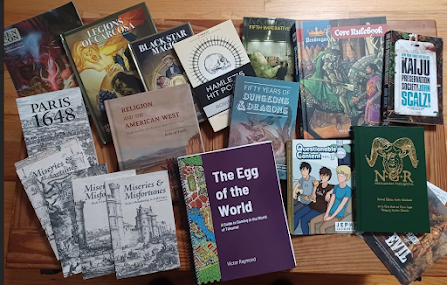
Gen Con Program Booklet by Peter Adkison and many diverse and talented hands, 170-page magazine format. This bears out a call-out because of how much it shows the depth and diversity of Gen Con as it celebrated 50 years of D&D. Stuffed with ads from exhibitors but also showing the maps of all the locations, it covers the history of D&D, the guests of honor (I'm on page 91), the writer's symposium, the costume contest (one of my old D&D group from college is on page 125), and all sorts of subcons and special interest groups. An excellent memento of the convention.

Legions of Carcosa by John Harness, Kira Magrann, Sarah Saltiel and Monica Valentinelli, with Daniel Kwan, Pelgrane Press, 200-page hardbound, 2023, Gen Con, and Black Star Magic,  by Robin D. Laws, Sarah Saltiel, Gareth Ryder-Hanrahan, and Ruth Tillman, Pelgrane Press, 184-page digest-sized hardbound, 2023 Gen Con . Pelgrane's The Yellow King is one of the more intriguing games I have in my collection and one of the more challenging. Its system is a simplified version of their Gumshoe system, which uses condition cards as opposed to more traditional hit points and the like, yet it remains a bit of a mental climb for me. The setting itself is four settings based on the work of Robert Chambers, who in the 1890s created an alternate 1920s with a dictatorship in America with suicide booths in the major cities. The game itself has four separate time periods to it - Paris in the 1890s, during the Continental Wars, and post-war, post-dictatorship US, and a modern era. So all this is background. Legions of Carcosa is a monster book, Black Star Magic is a book of spells. Nice additions, though I know I'll have to do a bit more digging to see how they can be implemented. 

The Fifth Imperative by Robin D. Laws, Pelgrane Press, 192-page softbound digest, 2022, Gen Con  Also from the Pelgrane Press and also dealing with the alternate history of The Yellow King. This one is set in the period following the dictatorship, and involves politics and otherworldly conspiracy. I really like the lateral development and fiction books that Robin D. Laws and Pelgrane put out, and usually don't see enough of them through my standard purchasing venues. So this will likely end up as a "plane book" to be read en route to conventions.  

Hamlet's Hit Points by Robin D. Laws, Gameplaywright Press, 196-page softbound digest, 2010, 2015, Gen Con. This is the third time I have purchased this book. On the two previous occasions, I have recommended it others, loaned it out, and never saw it again. It is an interesting examination and mapping of beats and pacing within narrative stories. For Laws, such beats are instances with specific purposes, be them - Dramatic, Commentary, Anticipation, and the connective tissue of Pipe, and combine to create Hope and/or Fear in the audience. He then uses this analysis to examine Hamlet, Casablanca, and Dr. No, under this lens. It's an interesting approach, and the only thing I can ding it with is the each beat is considered as a single unit - a particularly positive beat gets the same weight as a negative beat, so that the progress of beats is downward, regardless of resolution. But that's just a quibble. I'm glad I got another copy of this. No, you can't borrow it. 

Pendragon Core Rulebook by Greg Stafford, with input from myriad others, Chaosium Inc./Moon Design Publications, 254-page hardback, 2024, Gen Con. I'm a fan of Chaosium's games - I've played a lot of Call of Cthulhu. I've played almost no Runequest (but love the lore). Pendragon falls between those two poles, where I've done a bit as both player and gamemaster. And so a goal of this trip was to pick up the new version (I would have also picked up some Miskatonic Library volumes, if they had any on-hand, just so you know). The latest version is polished and is incredibly readable. The downside is that this is primarily a Player's Guide, with a lot of good information for players. For a GM, it would more of an uphill stroll, and hopefully there is a GM resource in the works. In the mean time, I would still likely spring the Starter Set on my players.

Kaiju Preservation Society by John Scalzi, Tor Books, 266 page Trade paperback, Gen Con. So what's the deal with including all these books here? Well, they were part of the Gen Con swag I returned from Indy with. This volume was a reward for helping out the Writer's Symposium, spending part of an afternoon stuffing swag bags for the attendees. A good group activity. The book itself deals with a slacker taking on a temp job that takes him to another dimension filled with giant monsters. That's about all I know about it right now. Kate's read it on Kindle (I have a hard time concentrating on devices when I have other options to engage with) and says its pretty good. It becomes another plane-trip book. 

Miseries and Misfortunes: Roleplaying in 1648 by Luke Crane, Burning Wheel, six softbound digest volumes for 852-pages total, 2022-2023, Gen Con. This is the sort of thing I love at Gen Con - finding something I had never heard of before, something that is much tougher in this Internet Age. So I was delighted I found the six volumes of this game at the Burning Wheel booth and snapped them up. The gamer takes place in the post-Richelieu, post- Louis XIII era of the Musketeers Cycle, where you had the underaged Louis XIV, the Queen Regent, and a noble revolt known as the Fronde. While it notes its descent from Basic D&D, it has morphed from those early designs into a completely different animal with a lot of different mechanics. The books themselves are 1) a system book for game mechanics, 2) a character creation book (which should be read first so you know what they're talking about in book 1, 3) a book on magic, 4) and expansion to books 1-3, 5) an adventure set in Catalonia, and 6) a MASSIVE book on Paris itself. So yeah, I'm pretty pleased with myself.

Religion in the American West: Belief, Violence, and Resilience from 1800 to Today.  Edited by Jessica Lauren Nelson, University of New Mexico Press, 196-page hardbound, 2023. So at Gen Con, my hosts put me up at the Fairfield, which was one of a collection of interconnected Marriot-branded lodgings. My room faced the Eiteljorg Museum of American Museums and Western Art. And since I had arrived a day early, I actually had the chance to see something in the city where I was. And it is an excellent museum of Native American and European Western art, and I would recommend it just on the basis of that. But the special exhibit was on Religion in the American West, and covered both the stuff most folk know about (The Mormons, the Spanish missions), as well as lot of things that tended to get pushed to the back (Presbyterians and their influence on the Erie Canal, the rivalry between Catholic priests and Protestant ministers among the Native Americans). It was a good exhibit, and I went back on Sunday to get the book (which was half-price since that was the last day of the exhibit). Look forward to reading it. 

Fifty Years of Dungeons & Dragons, Edited by Premeet Sidhu, Marcus Carter, and Jose P. Zagal, the MIT Press, 372-page Trade paperback, 2024, Gen Con. Purchased at the MIT press booth, no less. The 50th anniversary of D&D has encouraged a spurt of commentary and analysis. This volume is a collection of essays from a number of talented individuals. I've been reading this is bits and pieces, and there are parts I find engaging, and those that I give the hairy eyeball and raised eyebrow at. The final collection probably should have had one more pass through it by a well-intentioned grognard or two to catch the nits. One obvious nit? For a document that pushes cultural accuracy in many of its essays, the cover shows two Viking-types fighting what I would guess to be a Lindwyrm. And the Vikings have wings on their helmets. Its a minor thing, but triggers that eye-roll thing. 

The Egg of the World: A Guide to Gaming in the World of Tekumel by Victor Raymond, 256 page ringbound draft, 2022. Gift of the Author. It is well known that I am a fan of Empire of the Petal Throne, but recognize that the very alienness and completeness of the world is a major stumbling block for new players. There's a lot to grok - no only all the strange names and alien creatures, but the non-Western-European concepts of rigid class and clan. The original EPT had 11 pages of backstory for the world at the start, before digging into it properly. So this volume sorts out a lot of this for the referee, hitting the important points of what makes a Tekumel campaign, as well a host of scenarios, adventures, factions and patrons that can be grist for your mill. This is a referee's source material to get your players into EPT without overloading them, and allow them to experience the world as opposed to confronting them with a big data dump. I'm looking forward to seeing this in its final form. 

Questionable Content by Jeph Jacques, TopatoCo Books, 592 page trade paperback, Gen Con. Look to the blogroll to the right, and you'll see QC listed. And I check it out on weekdays. At Gen Con, I hunted down Jacques among the teaming thousands and myriad booths. He had already sold out of Volumes 1 and 2, but I bought Vol 3 and he included a drawing of Hannalore (I have friends who are artists, but it still lifts my heart when someone does that). Anyway, Questionable Content has been around for twenty+ years, and deals with the relationships of Marten and Faye, who were a couple back at the beginning, then broke up and dated others, then broke up with those others a few more times and now are in pretty stable relationships. This is of the era when Hannalore, who grew up on a space station, shows up more, Marten still has a band, and has such things a whether Penelope, the new employee, is really the superhero Pizza Girl and the threat of the the VespAvenger and her transforming robot scooter. The writing is smart, the characters are intelligent, and the strip remains excellent. The strip has evolved as it deals more with robots and SF elements, and there are a host of characters that rotate in and out, sort of like Doonesbury. I really like the strip, and you can rabbit hole through the archives if you don't want a physical copy. So check it out. 

Neoclassical Geek Revival Second Edition Acidic Rulebook (it is acidic instead of basic, get it?), by Zzarchov Kowolski, Neoclassical Games, 170 page hardback digest, Gen Con.  I'd seen mentions of this product elsewhere, and was delighted to see it with a booth (low-tech and high pressure), so I picked up the core book and a couple support products. I expected another OSR-clone hewing close to the original little booklets, but instead discovered that they took the core concepts and headed for the exits, changing them over time to produce something completely unique. The tone of the books are that same jaunty in-your-face attitude of the guy across the gaming table explaining his house rules, but everything has changed dramatically, such that you're learning a completely new game. The part that is most like original D&D is the presence of a GM (mentioned briefly) and the 1st edition tendency to create a new system whenever confronted with a new challenge. It's really impressive. I also picked up Havenvale (16 pages), a tidy little starting area in a mountain valley, and The Price of Evil (32 pages), a way to create haunted houses with a deck of cards. 

Whew! And that's the lot. And more have shown up, but we'll deal with them later. So, more. Later.


Saturday, September 14, 2024

Play: Two Hander

 Guards at the Taj by Rajiv Joseph, Directed by Samip Raval, a co-production with Pratidhwani, Arts West, through October 6. 

And so it begins. The sun sets earlier. I awaken in darkness. There is more dark than day in Seattle. It has started raining. Theatre Season has begun. 

The Lovely Bride decamped to West Seattle, dined at Mashiko, our favorite high-end sushi place, and since we were early this time, I had a chance to grab an ice cream cone at the Husky Deli (which usually closes at 7). Also then discovered that right next to the Arts West Theatre a Top Pot donut has opened. Nice.  

Guards at the Taj is a dark and bloody comedy, leaning more towards the dark and the bloody. Humayun (Sumant Gupta) and Babar (Varun Kainth) are guards outside the the newly completed Taj Mahal (Agra, India, 1648). Babar is chaotic, human, and imaginative. Humayun is precise, lawful, and dedicated to both the government and his friend. They are on duty. They are not supposed to talk (they talk). They are not supposed to think (they philosophize) They are not supposed to look at the Taj in the first light of the dawn (they look). They have a crappy job assignment, and it is only going to get worse. Much worse.

The actors are excellent. Gupta's Humayan is tightly-wound, pragmatic and dedicated to his role in life, no matter how crappy it is. Kainth's Babur is an everyman, bubbling with ideas, fancies, and inventions. Their conversations are wide-ranging, but always circle back to the fact that they are little wheels within a much crueler machine. They banter, argue, and joke. They have an easy rapport and have to do horrible things, but are a matched pair. The framework is similar to other two-person plays like Waiting for Godot and Rosencrantz and Guildenstern Are Dead, but the play moves well and there is no lagging in the 90-minute production.

The set and presentation is well done, with rotating walls for scene changes, space on the main stage for those who want sit on pillows (the Lovely Bride and I are too old for such things), Dabbawalla containers (with gruesome contents) litter the perimeter. Musicians (Sampada Bhalerao on Sitar, Jayant Bhopatkar on drums) are tucked in a forward corner of the stage, providing the Greek chorus for the guards. 

The play is co-produced with Pratidhawani, a local non-profit dedicated to promoting South Asian culture in music, dance, and drama. A couple years ago, the theatre did a production with Pork Filled Productions, an Asian-American theater group. And I'm kind of grooving on these team-ups, in that it brings different flavors of theatre into the house. 

As I said, it very dark in its comedy. There is blood on the stage and body parts strewn about and horrible decisions and repercussions (I told you - it gets worse for both men). It is not one of those toe-tapping, feel-good plays that is standard playgoer fare (but next up at the Arts West, their Christmas musical). It left me more than a little stunned. Which I think is the purpose of theatre well-done.

More later, 

Thursday, September 05, 2024

New Arrivals: Lull Before the Storm

 I picked up a lot of stuff at Gen Con (including Covid) back in August, but I want to deal with the stuff that came into the household before that. Because there's just so much stuff from Gen Con (including Covid).

There are a lot of independent RPGs in this collection, and one big chunk of D&D history. Let's take the tour:

Troika! Numinous Edition, by Daniel Sell, Melsonian Arts Council, 2023, 138-page Digest-sized softbound, Purchases from Mox Boarding House in Bellevue. I've seen some references to Troika and Troika-related projects elsewhere, but never has a clear line to purchase. So when I saw it a the Mox, I picked it up. And even by Roleplaying Game terms, Its a bit ... strange. Sort of two parts Jack Vance and two parts Doug Adams. Character creations is flavorful, and ranges from giants from a lost empire to trepanned Zoathrops that have abandoned sentience. The rules themselves are relatively straightforward, with a 2d6 to resolve most tasks. The provided adventure is to reach the top floor of a hotel. It is a delightfully weird little oddity that is a shining example of an independent RPG. I'm going to keep my eye out for related projects.

Mork Borg by Pelle Nilsson, Ockult Oktmastare Games/Stockholm Kartell/Free League, 90-page digest hardbound book, 2024, Purchased at The Game Shelf in Kent. Mork Bog (Swedish for Dark Fort, and pronounced Murk Boriy, like that helps) was one of those games that took the indy RPG field by storm a few years ago, winning a host of awards, and spinning off secondarty games right left and center. I had picked up Pirate Borg, and on Steve Winter's recommendation, went after the source. And Wow. The yellows. The horrible, pulsating yellows. Mork Borg is an art game where the presentation attempts to overwhelm that is presented (and sometimes succeeds). The rules are solid, with a very 3E sensibility (4 attributes, 3d6 rolls, but then convert to a table for the ability modifier). The world is serious heavy metal grimdark, and probably one of the most heroic versions of it I've seen.  That part is excellent. Good game, but oh god, the yellows.

Knave Second Edition by Ben Milton, published by Jacob Hurst and Swordfish Ilse, 2024,.80-page digest hardbound book, Kickstarter. This is a nifty little alt-OSR, which put original D&D in the blender, sieved out the crunchy bits, and then simplified those bits. A lot of old rules with altered effects (like Wisdom being used for ranged weapons, or Charisma Bonuses used for initiative checks) and a really nice way to bring encumbrance back on-line (which I'm seeing elsewhere). Milton pulls his inspiration from a lot of previous OSR material, and then credits accordingly. And in doing so, his alterations create an entirely new game system within an established set of expectations. That's nice. Worth checking out.

Deadpool Role-Plays the Marvel Universe, Cullen Bunn and Michael Shelier (Comic), Cullen Bunn and Matt Forbeck (Game adventure and stats). 48-page comic book, 2024, Purchased at Midgard Comics. This was a bit of surprise treat, spotted on the shelves of my Friendly Local Comic Store, And I think this sort of thing is important to get out there. My early Marvel Super Heroes carpet-bombed the hobby market with a lot of short, diverse modules that captured shelf-space and told the players that there was a big world out there to play in. In addition, DRAGON magazine regularly did The Marvel-Phile, which gave the stats for a slew of esoteric characters (Howard the Duck's Iron Man armor, for example). The comic-book format used here has the potential to do the same for the latest iteration of the license. The first 8 pages is a story is where Deadpool puts together a band of lesser-known mercenaries for a job, while the remaining pages is a starter adventure that sets the recruits into action. They need to find out what happened to the other mercenaries and henchmen being kidnapped. Told through Deadpool's voice and mannerisms, it is a light, fun adventure, and a good intro to the system. Marvel would be well-rewarded to do more of this, or even to put game stats in the back of their regular books, instead of a gimmicky QR-Code. Just sayin'.

Musketeers vs. Cthulhu by M. Bill Heron, Nightfall Games Ltd. 112-page Digest hardback 2020, Kickstarter. This is an amusing set of adventures (for 7th Edition Call of Cthulhu) based on a short story by actor Claudia Christian and Chris McAuley, who co-created the Stokerverse, which had its own RPG mentioned here. Set in the time of Louis XIII, the adventures are very sandboxy and setting based, but do not have to follow linearly from one another. The Court of Chaos, ultimately backed by Nyarlathotep, plans the overthrow of the King. Your job? Stop it from happening. The setting includes most of the characters from the first book, as well as such things as deep ones and werewolves. The Kickstarter had a collection of extremely useful maps. Plus the four musketeers as potential PCs. A tidy little package that I could throw my regular CoC crew into.

Moria: Through the Doors of Durin, By Gareth Hanrahan, Free League, 228-page Hardbound book + full-sized map, 2024, Kickstarter. Free League produces some wondrous-looking books, and this one is no exception. Tolkien himself never drew up maps of Moria, so all of this is "lateral development" and non-canonical, but it is so cool-looking. Set in the era of the One Ring RPG between The Hobbit and The Lord of the Rings, it provides a variety of locations within (and nearby) the dwarven mines as the original dungeon delve.

The Making of Original Dungeons & Dragons 1970-1979, Jason Tondo (Project Lead), Wizards of the Coast, 578 Page hardbound book, 2024, Gift from a colleague at Wizards. This is a massive tome that is a wondrous stroll through the original material of D&D. It is an upsized reprint of the first six small booklets of D&D, along with other material. I still have the (worn, coverless) originals downstairs, but these up-sized versions give folk fifty-years-later the idea of what we had as our original Burgess Shale of gaming. More importantly, there are reproductions from gaming 'zines of the pre-D&D 70s, internal correspondence, and most importantly the early drafts and notes on the game before production. All in all, and excellent dive of primary sources for the gaming historian.  

The Wildsea Expansion: Storm and Root, Felix Isaacs and others, Mythworks/Quillworks Studio, 304-page Landscape formatted  hardbound book, 2023, Kickstarter.  The Kickstarter included the scenario One-Armed Scissor,(30 pages) the expansion Ship-Gardens (38 pages), and the scenario Red Right Hand (46 pages), along with sent of six 6-sided "Cthonic Dice" (not shown, arrived at the house after the picture was taken - ah, the vagaries of  Kickstarters). I find Wildsea both interesting and challenging. It is set in a world where toxic vegetation has run wild, and players pilot chainsaw ships through the upper canopy of trees. As such, the world has some similarities to my ancient Storm Front proposal. But it is a complex, alien world, and uses a descendent of the Forged in the Dark and Powered by the Apocalypse systems, which makes it even more of a challenge to this venerable grognard. These expansions push the boundaries back, with both flying craft and submarines (sub-arboreals?), adding a lot more depth (sorry) to the world. In addition, it further helps with adventures and more detailed working. I don't know if I will get a chance to play Wildsea, but I find it fascinating in its creativity.

OK, that's it. Have to delve into the GenCon collection next. Stay tuned. More later. 

Tuesday, August 20, 2024

Life In the Time of the Virus: Redux

Chair Car by Edward Hopper, 1965
 I've come down with Covid again, and that's been my excuse for the past three weeks.

"You want to do lunch?" "Sorry, Covid"

"How's the deadline coming along?" "Sorry, Covid"

"Have you mowed the lawn recently?" "Sorry, Covid"

"Did you know your shed was on fi-" "Sorry, Covid."

I picked up this lovely strain at GenCon, and until I tested positive thought it was a bad cold (Protip: It is NEVER just a bad cold). GenCon was a textbook spreader event - 71,000 people, a minimum of masks, and a huge, packed exhibit hall. The resulting debacle swept through the creative community, taking out a lot of the professional class (and those that evaded it came back with some other form of con crud). One of the booths blamed a particular creative as "Patient Zero" as they showed up from the earlier San Diego con already infected, and had to bail, but I think there was more than enough opportunity from everyone else who was slowly shuffling through the show floor.

Despite that, it was a very pleasant convention. I saw a lot of friends (and to my knowledge infected none of them), and overcommitted to helping out on a number of panels (Saturday I had five panels and book signing, so that when I felt the first symptoms on the flight back Sunday, I was kinda expecting some bad news). I was on the waning side of my latest vaccination, though, and while I kept masked in crowded, public areas, there was more than enough opportunities outside of the exhibit hall to pick up something nasty. 

The culprit was likely the new hotnesses in the Covid family - FliRT, an Omicron variant, or LB.1, which was a related variant (We're still giving them cute names). Those are the two big contenders right now. And just so you know, there's a spike right now in the virus from checking wastewater (though not from hospital admissions or deaths). It seems milder but still miserable. I rolled through a cascade of cold symptoms (head, throat, chest, doubling back to the sinuses), stuffiness, lack of appetite, headaches, and exhaustion. And that last one was the worst - a continual mental fuzziness (brainfog) that still has not fully dissipated. I've tested negative after about a week of the worst of it, but symptoms can persist for about two weeks afterwards. Lovely.

So for the time being, I'm doing a lot of Ricola and rest. Working from home, I've been able to take naps and then return to the task. I consider myself fortunate, but send out the warnings to others who have been dealing with this. In about a week I head off to Grand Rapids for another (smaller) convention. And I'm working on making sure I don't bring anything back from that on.

More later,

Tuesday, August 13, 2024

The Political Desk: Results

 Hey, wasn't there an election last week? What happened? Why so quiet?

Good question. And while I could blame a recent bout with Covid for my lack of response (and in fact, I will be blaming Covid for a number of things in the near future), I've pushed of reporting the results until I had more firmer ground to stand on. On of the things about Washington State elections is that we have all mail-in ballots. And while it a really convenient way to vote intelligently (you can do it at home, check out candidates on the internet, you can have wine while you're voting ...) it means that it takes a while for dust to settle. In particular since late votes can and do move the needle, particularly in close races.

And we had it happen in this case as well, so this is the most updated results, a week out. No promise that it won't shift a little more again. In general, Incumbents did well, Democrats did well. If someone has 50% plus, they're doing OK. 

Oh, and Boldface is used for the folk I recommended. 

US Senator: Marie Cantwell (58%) versus Dr. Raul Garcia (22%)

US Representative, 9th District: Adam Smith (54%) vs. Melissa Chaudry (21%) - This one is interesting as the Democratic incumbent is being challenged from the left as opposed to the right. Usually Smith is up against a conservative talk-show host. This one should prove interesting. 

Governor: Bob Ferguson (45%) vs. Dave Reichert  (27%) - Again, expected, but low totals for both, so both have work to do. The official State GOP-approved republican only got 10%.

Lt. Governor: Danny Heck (49%) vs. Dan Matthews (23%)

Secretary of State: Steve Hobbs (49%) vs. Dale Whitaker (36%)

Attorney General: Pete Serrano (42%) vs Nick Brown (36%) - The well-endorsed Brown has work to do, but the only other candidate in the race was another Democrat, who got 23% of the vote.

State Treasurer: Mike Pellicciotti (58%) vs. Sharon Hanel (41%) - only two candidates for the role. 

State Auditor: Pat (Patrice) McCarthy (59%) vs Matt Hawkins (41%)  - again, only two candidates. 

Commissioner of Public Lands: Jamie Herrera Butler (21.9%) vs, Dave Upthegrove (20.99%) This was a crowded field - 2 Republicans and 5 Democrats, and on election night the two GOP candidates (Butler and Sue Pederson) we ahead. Late votes tend to skew more left, but we still split among a number of candidates. Only over the weekend did Upthegrove catch and pass Pederson).  [Update: the final tally was close enough to require a hand recount (yeah, we have options for that), and UptheGrove took second by only 53 votes. And this is why you should always vote, folks.}

Superintendent of Public Instruction: Chris Reydal (39%) versus David Olson (31%)

Insurance Commissioner: Patty Kuderer (45%) vs. Phil Fortunato (29%) 

State Senator, District 11: Bob Hasegawa (95%) vs. no opponent 

State Representative, District 11: David Hackney (95%) vs. no opponent.

State Representative, District 11: Dave Berquist (80%) vs. Justin Greywolf (18%). Though the numbers are low, I'm glad to see the Libertarian wing fielding their own candidate. 

State Supreme Court: Sal Mungia (43%) vs. Dave Larsen (36%)

Final totals have a voting total of around 40%, which isn't horrible at all for a primary, but can always improve. We've managed to dodge the loonier candidates (some other parts of the state are not so lucky), and there I can vote against based on their positions as opposed to their propaganda. And with this, the Political Desk becomes as dormant as you lawn, currently, only to return with the rains in late October. 

More later, 

Sunday, July 28, 2024

The Political Desk: The Jeff Recommends

 Let me explain. No, there is too much. Let me sum up. 

The past few weeks have been interesting, politically. An assassination attempt, a stepping down, a stepping up, a convention, a former VP candidate and a weird VP candidate. Here we though things would be boring. And yet we have the same ballot, and the same deadline.  

My own notes started here, and include a lot of other links for people who want to dig deeper into matters. I just dropped off my own ballot at one of the many drop boxes throughout the county (I mean, it is SO easy to vote, more people should do it). Here are my recommendations. You can check out various entries elsewhere on the blog for details. 

US Senator: Marie Cantwell

US Representative, 9th District: Melissa Chaudry

Governor: Bob Ferguson

Lt. Governor: Danny Heck

Secretary of State: Steve Hobbs

Attorney General: Nick Brown

State Treasurer: Mike Pellicciotti

State Auditor: Pat (Patrice) McCarthy

Commissioner of Public Lands: Patrick DePoe

Superintendent of Public Instruction: Chris Reydal

Insurance Commissioner: Patty Kuderer

State Senator, District 11: Bob Hasegawa

State Representative, District 11: David Hackney

State Representative, District 11: Dave Berquist

State Supreme Court: Sal Mungia 

Like the line-up? Go vote. Think I'm full of beans? Go vote. Whatever you think, this is your chance to impact who we are voting for in November. You've got a week to make up your mind.

Go vote.

More later, 


Saturday, July 27, 2024

The Political Desk: Judgement Day

So, State Supreme Court Judges. We have one open slot  with multiple candidates this time, as Susan Owen must retire since she is over 75 (yes, we do that out here). Four contenders, each with their own take. All sound like solid, professional folks. Their write-ups are in the Voters guide, but Crosscut summarizes that and add material from other sources and their own interviews.

(And this is where I once regret the loss of Voting for Judges site and the Municipal League. Ah, well.)

OK, one more thing - if one candidate gets 50% plus, the get the job. No playoff round. But this time, given four candidates, that's unlikely. Here goes:

Todd A. Bloom comes out of private practice with 20+ years of experience and ten years as a tax attorney. He's running with the encouragement of the Washington State Bar Association Board of Governors. He didn't respond to Crosscut's questions. 

Sal Mungia is a litigator with 40+years of experience, and a lot of backing - 8 of the 9 current current justices, Gov. Inslee, the Stranger, and Candidate Bob Ferguson. He's successfully pitched changes to the state's jury selection process. He's got an impressive resume and an embarrassing amount of cash.

David R. Shelvey has the least experience of the group with 9 years as a lawyer and come primarily from the business side, as well as a radio personality. In his bio, he also mentions double-checking with God before making decisions.

Dave Larson comes from the Judge-side of the equation, with 16 years as a judge and 23 years as a trial attorney. He believes strongly is therapeutic sentencing, and many of the reforms have been made into law from the bench. 

Four pretty solid candidates, with a low (mostly) percentage of dog whistles. I would like to have to make the choice between Sal Mungia and Dave Larsen this fall. But force me into a corner, and I'll go with Sal Mungia.

And that wraps up my ballot. I will post a summary, and after the primary, post the results.

More later, 


Friday, July 26, 2024

The Political Desk: Our Boring Local Elections

I don't have much to say about the State Senators and Representatives races, because there isn't much of a race going on here. Grubb Street is located in Legislative District No. 11. The district curls around the southern end of Lake Washington, and represents most of Renton and chunk of Kent. We're in the lower right-hand corner of this ornate, crenelated district.

And we're kinda boring this time out. Our State Senator, Bob Hasegawa, is running unopposed, as is our State Representative Position No. 1, David Hackney. Lucky for us that they're good at their jobs. For Position #2, we have two candidates who are guaranteed to go on - Incumbent Dave Berquist and Libertarian Justin Greywolf. And I favor Dave Berquist in this one, but I do note that we have 28 people running for Governor, 24 of which are not going to get more than 1% of the vote. It is almost like most of the gubernatorial candidates are about sending in their resume to the largest number of people, and fewer want the experience and responsibility of smaller job.

And for the city of Kent? Nothing. Nada. Zip. OK, I can live with that. We've got enough on our plates right now. 

More later, 

Thursday, July 25, 2024

The Political Desk: The Rest of the State

 The entire State Government Executive Branch comes up for election this year. Here's what we got:

Lt. Governor: This role oversees the State Senate, breaks ties, and fills in for the Governor when he's out of town. While not overly powerful, it is probably one of the more colorful offices in the state, and its primary requirements are to not blow things up and not embarrass the voters. And we have had a spate of excellent Lt. Governors, even though the bar may seem low. The current one, Denny Heck, had an original campaign slogan ("Give Olympia Heck!") and has failed to blow things up or get himself immersed in scandal. This is job interview - he's fine. His likely competition is Dan Matthews, who is a bag of Trumpian dog-whistles. So yeah, Denny Heck.

Secretary of State is responsible for overseeing the elections, and I am very much in favor of Steve Hobbs, for no other reason that he plays table-top RPGs. He's been very supportive of D&D and the tabletop industry which is kinda a big deal out here, to the point of accompanying a trade delegation to Japan with some colleagues of mine. But that same favoritism also makes me look harder at what he's done in his time in office, and, yeah, he's actually a worthy successor to Kim Wyman in protecting our elections. Good job, Steve.

Attorney General: Nick Brown has copped endorsements from both the Times and the Stranger, and has the qualifications as a US District Attorney as well as a deep knowledge of navigating state law. Manka Dingra comes out of the criminal prosecutions, which is also excellent, and I would look forward to having the make the decision between the two in November. For the moment, go with Nick Brown. 

State Treasurer: Handles the money. Two candidates, so you'll be seeing them again. I lean towards Mike Pellicciotti. He's the incumbent, and has kept his domain scandal-free while pushing for more transparency. Not bade.

State Auditor: Keeps an eye on the folks handling the money. Again, two candidates, so you'll get Deja Vu when we hit November. I prefer the incumbent, Pat (Patrice) McCarthy. Actually, both these positions of Auditor and Treasurer are so boring (and so fore-gone) that none of the major news sources have weighed in on them. Really?

Commissioner of Public Lands: This position oversees our state forests, and concerns a lot about lumbering and wildfires. A lot of candidates here, but two stand out. Department of Natural Resources Director Patrick DePoe gets the Times' nod, while former (local) legislator Dave Upthegrove has ability dealing the legislature (plus, cool name for taking care of trees). I'd like see both of them on the ballot, but for the moment, I think Patrick DePoe will do an excellent job. 

Superintendent of Public Instruction: Chris Reydal is the incumbent. Has been doing a good job. Yeah, let's keep him.

Insurance Commissioner: Does what it says on the tin - oversees our sprawling insurance industry. Mike Kriedler has held the position for years, but is stepping down after it was revealed he wasn't particularly good to his employees. That's the thing about elections - you screw up, you lose your job. Refreshing, isn't it? Patty Kuderer comes out of the legislature, is pro-renter, pro-single-player healthcare, pro-consumer. Her chief opposition is a self-declared progressive but fundraises and votes Republican. OK, then. 

And that fills out the State Executive Positions. Yeah, I'm blowing through them at a good clip. More later. 


Wednesday, July 24, 2024

The Political Desk: Guv'nor

 There are 28 candidates on the ballot for Governor of Washington State. Of them, there are four that have any sense of support. Of those, it will be former King County Sheriff Dave Reichert versus Attorney General Bob Ferguson in the Finals. I'm calling it here.

Bob Ferguson has been a big noise for the past decade, an aggressive legal voice who has been fighting against corporate malfeasance and Trumpian nonsense. He's got the funding, the endorsements, and the attention. And yeah, he's got the proven competence to be Governor.

Mark Mullet, the other recognized Democrat, is frustrating. A moderate, he's got a good provenance as well (State Senator for a decade), as well as ground-level endorsements (local mayors, firefighters), but has just flamed out as far as the campaign is concerned. But, if you hate Ferguson, Mullet is a good alternative, and I would be very comfortable with a battle between the two in November. Such is unlikely, sadly.

Dave Reichert should also be doing better, though it is likely that he will be Ferguson's competition in the Big Show due to name recognition from his time as King County Sheriff a couple decades back (Yeah, I know, everyone is OLD. It's thing). But, he failed to get the endorsement of both his own party and of the Seattle Times, which has traditionally been in the tank for him. It seems that he was saying one thing to the Times in interviews, and something completely different to his supporters on the other side of the Cascades. Apparently they didn't like that much.

Semi Bird DID get the official GOP endorsement, and does embrace the Trumpian nonsense. He lost his job as a school board commissioner for opposing mask updates in a recall election, and in the GOP tradition has been failing upwards ever since. He also never mentioned he had an ancient criminal record (misdemeanor bank larceny, thirty years ago), which makes him a typical Republican candidate .

And the rest. As elsewhere, some are perennials, some are well-intentioned newcomers, some are single-issue candidates seeking to front their particular concerns/grind their proverbial axes. And there was some hijinks, in that a Republican operative went out and found some OTHER Bob Fergusons to run for office, in hopes of confusing the issue. And then bragged about it publicly. When it was pointed out that this was specifically a felony, his chosen candidates dropped out, and the GOP weasels complained about how unfair the system was that wouldn't let them cheat.

So yeah, Bob Ferguson for Governor.

More later, 

Tuesday, July 23, 2024

The Political Desk: National Offices

 Let's start at the top - US Senator and House of Representatives. Like the rest of the country, we get two Senators, and one is up for re-election. Our neck of the woods for the US House is District 9, a narrow district straddling Lake Washington with bits of Seattle and Bellevue, and running south to Federal Way.

Senator: Maria Cantwell has been our junior senator for 24 years now, and is still chugging away. She's one of the engines behind the CHIPS act that kept semiconductor jobs here in the US. Yeah, wonky stuff, but still effective. The other candidates on the list make it a point of pride to not have held a previously elected office, and run the gamut from the well-meaning to the regular also-rans to the ones desiring a soapbox (which is cool, since the bulk of them are underfunded, such that the Voters' Guide is the only place they can reach out). Her likely opposition is Dr. Raul Garcia who is ... not horrible in Republican terms. But yeah, Maria Cantwell for Senator.

US Representative: Adam Smith has been serving in Washington for longer than Ms. Cantwell, and has experience and incumbency on his side. Usually he emerges from these primaries with a conservative talk-show host challenging from the right and cruises to re-election. But this time, there is a viable and more liberal candidate available in Melissa Chaudry, who wowed the Stranger board with her depth and width of knowledge and proposals, and even got good marks from the Seattle Times.  Downside? She's light in elected experience. Smith, though, was one of the ones pushing for Biden step aside because of his age, a bold stance for someone approaching 60. So for the Primary, check out Melissa Chaudry.

More later, 

Monday, July 22, 2024

The Political Desk: The Primary Is Upon Us

 August 6th will be the Washington State Primary, and it will be a big one. We have a US Senator, US Rep, Various members of the State House, Governor, and the entire executive wing of the state government up for grabs. That's a lot. 

Making matters more complex, Washington State has a top-two election strategy. That depowers (somewhat) the traditional political parties, in that we have a general scrum of the position, and the top two-vote-getters, regardless of allegiance, go on to the main event in November.

It's not a bad system, but like all systems, it can be gamed. Assume you have two Republican candidates and four Democratic candidates vying for a particular office. Say that Dems and GOPs are split evenly. and each candidate gets an even share of their side. So your four Democrats get 12.5% of the vote, and the two Repubs get 25%. So you can end up with two Republican candidates on the final ballot. This sort of thing has happened in the past, and can happen again. 

Also, you the candidate can declare your party own allegiance (referred to as "Preference") as you the candidate sees fit. So we usually have a party-approved candidate and not party-approved candidates flying under the same banner, and occasionally people sailing under false flags. You can also create your own party, so we see a lot of ... creative ... names for parties over the years. There is a lot of potential for shenanigans here, but more of that when we get to the Governor's race.

Two large matters loom over this primary which are not on the ballot. One is a set of cynical initiatives launched by some conservatives to help their main investors (the wealthy) at the expense of everybody else (that would be you). These initiatives are not on the ballot, but will be there in the fall. For the moment, we can put it aside, but the prime reason for these initiatives is to get out the vote on the conservative side, in hopes of it helping more conservative candidates. 

The other large matter is the Presidential race. At the time of this writing, the ballot will be most likely Vice President Kamala Harris versus Former President/Convicted Felon Trump. The former is taking over for President Biden due to inner party doubts about his age and health. The latter also has concerns about age and health, and in addition is an anchor around the neck of every Republican candidate, since they can endorse Trump and have people laugh at them every time they say "Law and Order", or they can distance themselves from Trump and  have the right-wing chunk of the party turn on them. Or they can be vewy, vewy quiet, which seems to be the course in general. Yet that's going to have an impact of this vote as well.

The Washington State Voter's Guide for King County is here. The Seattle Times has been doing its due diligence here, and has surprisingly swung more liberal/center than normal. The Stranger has grumped its way through the candidates, disappointed that they don't check all their required boxes. The Urbanist, talks about a lot of races I don't cover here, and refuses to recommend any candidate that did not meet with them (which is fair). The Cascade Advocate (a progressive blog) has an article comparing The Stranger and Times lists, and finds that they mostly agree. The Washington State Standard summarizes some of the races here, but does not make specific recommendations. Voting for Judges and the Municipal League sites, previously good places for info, are now shut down and available from GoDaddy.

Since this is a top-two primary system, I will be sometimes mentioning a second-choice as well. The Political Desk tends to lean left, but ultimately I want competent people in office. Elections are not a beauty contest or a two-team game, though there are components of both those things. It's a job interview - yeah, imagine that you have to re-interview for YOUR job every two/four/six years.   

Usually, I do a deep dive on these, giving even the minor candidates their time in the spotlight. This time, not so much. I've got a convention looming at the end of the month (GenCon) and don't have much time to savor the races. Some races are pretty obvious, some are going to very interesting. So when you hear the bell, turn over your papers and begin. 

More later,

Sunday, July 07, 2024

Book: Which King? That King!

 Witch King by Martha Wells, Tordotcom, 2023

Provenance: Christmas gift from the Lovely Bride. She also got me a copy of the latest Murderbot book, by the same author, but I went with this one first. And while I have a lot of other books in the reviewing queue, I thought to jump this one forward while it is still fresh in my mind.

Review: This was a very enjoyable, challenging and rewarding read. It is a fantasy novel, but it bends (but not breaks) a lot of the traditional tropes, creating a distinct world and and engaging story. I'll admit, this was the bedside book for several months, and was put aside three times due to its complexity, but always lured me back.

The story is told in two parts, a present and flashback. Kaiisteron, Prince of the Fourth House, is a demon, a otherworldly race that takes over the recently deceased to live in this world. In the past narrative, his plains-dwelling adopting people were overrun by powerful invaders, the Hierarchs, and he was taken prisoner. The story there is his escape of bondage how he helped create a rebellion. In the present, some 60 years later, the Hierarchs have been defeated and a new empire is rising, Kai awakens from being imprisoned again by persons unknown, alongside Zeide Daiyahah, a Witch. In order to figure out what is going on, the two need to find Zeide's wife, who is a Marshall of the Blessed Lands, and has also vanished without a trace.

That's about as organized as I can make it. Wells has created a world with extremely diverse peoples and types of magic. The demons can drain life, and Kai learns to transfer between bodies as well. Witches are the progeny of Demon/Mortal mating, and have elemental powers. The Blessed are angelic figures pulling from a central power core for their spells.  And the conquering Hierarchs use as similar central well of power, but pull from death magic. And that's pretty much the reason for invasion, which eliminates a host of unique cultures, and gives them more power from their deaths. 

Kai is our viewpoint character, in that we only learn about the world through him, and he shares only as much as he needs to. There is not a lot of exposition here - no explanation of a timeline, no lecture on how the world came to be, no moment when one character turns to another and say "As you know ...". There is a list of Dramatis Personae at the front of the book, a needed tool since there are a large number of allies and enemies for Kai and Zeide. And there is a map, is a bit more perfunctory than your standard issue fantasy, giving me general locations with a lot of space in between.  

And we are dealing with two Kais, here. In the past, Kai is swept up by the Hierarchs' assault. In the present, the Hierarchs have been overthrown and a new Rising World coalition has formed, verging on becoming its own empire. But you have to put that together, and that requires a bit more from the readers than your standard fantasy. Even the intro italicized excerpts from in-world histories fronting the chapters makes little sense in and of themselves, and only when I finished the book did I go back and re-read those sections, just to get a handle on what the world-building was. Wells shows and not tells, and what she shows is often colored by Kai' viewpoints in the two eras.

And there are two eras to Kai's personality as well. Past-Kai is a junior demon coming to terms with his role among his people, and as such more innocent. Present-Kai has lived through an empire's rise and its fall and is much more cynical and untrusting. You can see how the character had grown (and been harmed) over the interim. And it is not impenetrable as, say, aGene Wolfe novel but it takes some awareness to understand.

Magic is similarly not explained, but demonstrated. Spells are intentions, magicians are expositors, constructs are amalgams or chimera. Its more than just a renaming, but rather a reconfiguring of traditional tropes, and you the reader are expected to keep up. 

AND Wells turns a couple fantasy-tropes upside down, literally such as when Kai talks about the Top of the World being the south pole. Pale-skinned folk come from the colder southern islands. There are a lot of matriarchies, which are not presented as exceptions but as norms. Gender preference and identity is fluid. Women in Kai's orbit are the majority, not the token minority. 

And, all this works. Wells is fantastic writer who has created an involved world with a complex story to it. She skips of the epic bits - how the Hierarchs specifically captured Kai, and how the new alliance drives out the Hierarchs. It concentrates on the important bits for Kai - survival in the past, and discovery of a conspiracy in the present. As I said, I put the book aside several time, but each time I re-engaged, I found myself swept up in it. 

This one is up for a Hugo, and yeah, I can see that. It is a doorstop fantasy novel, and I am relieved to know that it is (currently) only a solitaire. While I really like Wells' shorter, more contained works, the presentation of world and the flow of the narration is excellent, and I would not be surprised if it took the award this year.

But yes, it does put demands on you, the reader. And it rewards them. 

More later. 

Monday, June 10, 2024

Theatre: Season's End

 Clyde's by Lynn Nottage, Directed by Valerie Curtis-Newton, Arts West, June 6-30, 2024

Jinkx Monsoon & Major Scales Together Again, Again! Created by Jinkx Monsoon and Major Scales, Original Music by Major Scales. Seattle Rep, 31 May-23 June,2024

The Lovely Bride (herein known as the LB) and I have season tickets to local theatres Arts West and the Seattle Rep, but rarely do the stars align such that we have plays at both the same weekend. On this particular sunny Seattle weekend, we did, and so the entire weekend became theatrical in nature. And eating. Lots of eating.

Friday we set out for West Seattle on the far side of the industrialized Duwamish river for dinner and show. The dinner was at the Phoenicia, our go-to place in good weather as we like to eat on the patio outside. They know us there by now - we're the older couple that orders way-too-many small plates and defeats the lot of them. Olives, pita, hummus, burrata, manila clams, green beans and lamb chop lollypops. Baklava to go. This time, for once, there was no parking weirdness. 

On to the play. Clyde's is a truck stop restaurant on the off-ramp to purgatory run by Clyde (Tracy Michelle Hughes), literally the boss from hell, who torments a kitchen crew of ex-cons that no one else will hire. The kitchen staff in return have banded together into a demi-family who trade fantasies of sandwich combinations and try to create that perfect bite. Montie (Reginald Andre-Jackson, last seen tearing up the stage in the Rep's Fat Ham) is the zen master of sandwiches, and the only one who doesn't seem afraid of Clyde. Rafael (Jacob Alcazar) is the acolyte, seeking to learn from the master. Tisha (Deja Culver) tries, but is too weighed down by her reality. And Jason (Joe Moore), is the new guy, whose racist tats are scribed on a very sensitive flesh.

The dialogue is as rapid-fire and intense as a kitchen in the weeds. The character laugh, yell, argue, and fume at full volume. The actors throw everything into it, and leave nothing in the tank afterwards. Hughes' portrayal of Clyde is that of head devil, rampaging in make everyone's life miserable, knowing that her staff has nowhere else to go. The set itself is an intensely detailed kitchen, its walls stained by smoke and pain. 

The LB says it was the best play of the season, and I would agree, though I will note that the entire season from the Arts West was excellent. English was very good, Born with Teeth was excellent, and Matt & Ben was OK in a weird, quirky way. Hedwig didn't work for me, and I am filled with Christmas charity for the cheesy, breezy Snowed In. In General, Arts West had more hits than misses, and is a strong season of seriously good performances. 

So, that was Friday. Saturday, after the last practice session of our Tai Chi class (we get three weeks off) and poke (from Big Island in Renton), we decamped for Seattle Center. This year they moved the matinee performance up to noon, so we decided to stay in town overnight as opposed to rushing around on Sunday morning. So we stayed overnight at the Mediterranean Inn, a nice 3-start hotel caddy-corner from Dick's Drive-in (and with that, everyone in Seattle knows where I am talking about). Most of clientele are families going on cruises, gathering in Seattle before heading off to parts unknown. Nice rooms, but the strong recommendation is the rooftop patio, which gives a sweeping view of Queen Anne Hill, the Needle, Rainier, the docks, West Seattle, and the Olympics. The LB and I spent the afternoon and early evening on that deck, reading (Demon Copperhead for Kate, while I finished up a Raymond Chandler novel (more on that sometime later). I got takeout from our fave place in the area, Racha Thai - calamari, fresh rolls (for her) chicken satay (for me), bananas in coconut milk (desert for her) and black sticky rice (for me). So yeah, we've been eating out a lot this weekend.

Breakfast was at the Mecca Cafe, a bar that serves all day breakfast. Denver omelet and hash browns for me, oatmeal and ham for the LB. One of the two elevators in the hotel broke down, so all the guests going on cruises with all their luggage had to manipulate the surviving lift (the younger couples took their luggage down multiple flights of stairs instead). We spent the late morning on the roof again, which the cruise people had abandoned. The LB had gotten some advance parking in a lot a few blocks away, and to my surprise, everything worked. Has the curse been lifted? (OK, the lot was a little too far from the theater, and the LB had to take the walk in stages, but we still got there in plenty of time - she is a little brilliant that way).

So, the Rep. I can honestly say we has seen Monsoon and Scales back in the before-time, before she won RuPauls' Drag Race a second time and got to be a Doctor Who villain. I likes the performance then. This one? Not so much. The conceit of the show is that this is the final reunion of vocalist Monsoon and pianist Scales in a dystopian future where the sun has burned out and gelatinous aliens are in charge.  Fun times. And both characters have seen better days, as Monsoon Norma-Desmonds her way through memories and songs, while the age-makeuped Scales is equal parts provocative Larry David and subservient Renfield. There's not much of plot, rather just a framework for the songs, most of them about the perils of getting old. Maybe that's what frustrates me, as a bonified, card-carrying old person. A lot of references to Drag Race, which I had never watched and so the references went over my head (but landed firmly with the quartet of young women behind us). Monsoon's voice is amazing and Scales keyboard work was great. In the intimacy of a cabaret show, or even the smaller Leo K theater, all this probably could work, but up on main stage of the Rep, not so much. Monsoon made the best of it interacting the decidedly less-than-full-house on that way-too-early-matinee, but it was just OK.

And I think "just OK" is the final judgement I have to throw at this Rep's season. Passengers was another not-quite-a-play but was another good performance. Islander was good. The queer-themed Little Women had challenges living up to the original text. Same with Fat Ham, thought the end result was much better. And ditto Quixote Nuevo, which had the additional sin of using puppets.  Sanctuary City was probably the best of the season and was darn good. So yeah, there have been better years, and this season had a brace of solid performances. But were this baseball, we would be talking about it being a building year. Next year's agenda looks much stronger. 

And that was our weekend. We headed home, got a couple small pizzas from the local Romio's, and collapsed in the hanging chairs overlooking our back yard. I think I've had enough activity for a little while.

So how was your weekend?

More late,