Saturday, August 06, 2022

This Just In: Kickstarter Fever

 Large packages have been arriving at Grubb Street, as Kickstarters that have been on the water for several months have finally arrived at the docks and deliveries have been made. Most are late to a minor or major degree, owing to the pandemic, the massive snarl in shipping, and the phases of the moon. For the most part, I'm OK with that - I funded stuff so long ago that I had frankly forgotten, so the arrival feels like a gift from the ghost of my former self. Thanks, past-me. 

Some of these are original games, and some are "line extensions" - modules, sourcebooks, and expansions. As always, these are not so much reviews as notifications - I haven't done enough digging to give a full review to them, so this is all initial responses. Even so, I've got a lot to say about them.

So, what do we have here?

Vaesen: Mythic Britain and Ireland (Graeme Davis, Lead Writer, Johan Egerkrans, Lead Artist, Free League, 156 page hardback) Vaesen: Seasons of Mystery (Gabrielle de Bourg, Tomas Harenstam, Andreas Marklund, Kiku Pukk Harenstam, Writers, Free League, 96 page hardback).  Free League makes great-looking books, often build around existing art - solid hard covers, thick pages, luscious illos. The downside of the original core book was that the text felt slighted in favor of the art and graphic design Both Mythic Britain and Ireland and Seasons of Mystery make up for that with a hefty textural density. Mythic Britain is by long-time game design veteran Graeme Davis, and expands the setting out into the British Isles. Seasons of Mystery are four smaller adventures, which have the investigative nature of a Call of Cthulhu game without the world-threatening and senses-shattering results. Mythic Britain came with a separate map pack which I hesitate to open and then immediately lose all the pages from.

Carbon Grey (Andrew E.C.Gaska, Creative Director/Lead Writer, Magnetic Press, 224 page hardbound). This was a bit of a disappointment. It came with a hardbound collection of the comics it was based on, and, upon review, I hated the comics. Billed as "Diesel Punk", it was WWI politics and intrigue with WWII weapons with a dash of magic, involving anime girls who sever heads and limbs with grand guignol style. I found the comic art jarring and murky, and the story impenetrable in places. The game, on the other hand, concentrates more on the world, using the West End d6 System as a base but concentrating on primarily combat in the game. Came with a bundle of tchotchkes (badges, decals, art prints), which will soon be scattered throughout the home office, to be found years later with the question "what was THIS for?"

Level Up Advanced 5th Edition Adventurer's Guide (30+ listed designers, EN World Publishing, 656 page hardback), Trials and Treasures (20+ designers, EN World Publishing), 370 page hardback), and Monstrous Menagerie (Paul Hughes, Lead Designer. EN World Publishing, 532 page hardback). This was the most massive of the shipments coming in. It is not D&D 5.5, but rather D&D 5E's Pathfinder, in that it takes the original mechanics (ability scores, combat, die conventions), strips away the additional material, and rebuilds the structure entirely. You don't get a new variant of Ranger to stand alongside the previous ones, but a completely new version. I play a Ranger in our 5E campaign, and have to admit that their version is a serious upgrade. The monsters are similarly redesigned, and are close but different - the numbers tweaked, and most information on encounters provided, as opposed to a direct reprint of OGL material. This one feels like the early variants of D&D, where someone pulls at a loose thread for their personal campaign and ends up with a completely different game. It is a massive undertaking, and is effectively like learning a full new edition. It arrived with Memories of Holdenshire, an intro adventure that looks solid and self-contained.

A Shadow in the Downs (Kate Baker, Green Ronin, 36 page softbound). Some projects, even from trusted and reliable professionals, are just snake-bit. Case in point - The Lost Citadel from Green Ronin. Kickstarted in 2017, it was delayed by personal issues, covid issues, shipping challenge issues, and all manner of sundry other issues, such that this introductory adventure is finally showing up five years later. Yet, the Ronins have delivered on their promises, which is greatly appreciated. The Lost Citadel was a "grimdark" setting where the world has fallen, the undead roam the land, and the last bit of civilization is confined to a single city, the Redoubt. The adventure takes place in the city itself and in the underground mazework beneath it. It looks pretty good, and hits all the points that set Lost Citadel apart from others of its subgenre.

Nightfall (Angelo Paluso, Mana Project Studio, 240 page hardback) and Nightfall Bestiary (Angelo Paluso and Andrea Lucca, Mana Project Studio, 168 page hardback). This is also "grimdark" (It says so on the cover), but is written to a larger scale. Darkness from the shadow plane has risen, the sun has gone out (its deity dead/converted), though the moon still provides what light is available. The moon still works without the sun, because, well, magic. It is literally a points of light campaign, with only a few places that not overrun with monsters. Nightfall is Italian, and comes out with a beautiful look for a dark setting. The monster book eschews redoing D&D monsters for more Italian Folklore, though it does list creatures in subcategories (Dragons, Horrors, Witches). This can make for a more cohesive read, make it harder to find what you are looking for as opposed the alphabetizing the entire list. I probably will not play it, but I will read it through. Came with a boatload of Kickstarter-Tchotchkes which are generally useful in play - a DM (Sorry, Nightmaster) screen, Standups, separate map, pregens, and a cute pin.

Cults of Cthulhu (Chris Lackey, Mike Mason, and Friends, Chaosium, 368 page hardback). This was NOT a kickstarter, but rather picked up at the Mox Boarding House where a group of friends were gathering. It's been a book I've been looking forward to, and contains a summary of all the Cthulhu Cult information from various sources, five different versions of the cults through the different play periods, information on creating your own Cthulhu Cult, and some adventures. I'm looking forward to reading it. It does raise the question in my mind of "What is cult, beyond being a religion or organization that the dominant society does not like?"). I had Remarkable Cults in the previous writeup, and there are other cult books out there. The book itself is up to current Chaosium standards, but the spine is making these disturbing creaking noises as I open it.

Lex Arcana: Italia, Land of Ancient Magic and Dark Intrigue, (Francesca Garello and Andrea Angiolino, Quality Games, 260 page hardback) and Dacia and Thracia, Storm at the Empire's Borders (Mauro Longo, Quality Games, 160 page hardback). Lex Arcana is a game set in the 5th Century where Rome, propped up by magic, is threatened but not collapsing. You are part of the special investigations branch of the Cohor Auxiliaria Arcana, the Empire's X-File department, tasked with dealing with the weird, supernatural, and deadly. The game uses original RPG rules (as opposed to 5E offshoots). These two supplements bore down into the Italian peninsula and the territories to the east, respectively. Looks good and involved, though I still have to engage with the the game itself. Only comment I can make is that if you are going to talk about features in the game, put them on your map. Tchotchkes include separate maps of the areas and some cities, and multiple decks of cards with magic items and opponents on them. Looks good.

That's it. I remain impressed by the stuff that comes in from overseas producers, and am delighted to see them appear in English, and yeah, I'm will to wait a bit longer as the entire shipping question clears itself out. Kickstarter has been a boon to overseas game manufacturers and players on this side of the pond. This is good stuff.

More later,

ADDENDUM: Nightfall Bestiary and Cults of Cthulhu both won ENNIE Awards at GENCON. Hard copies of both just arrived here, so I assume they are voting based on PDFs.

Friday, August 05, 2022

The Political Desk: Summarizing the Summer Primary

 So, how did things go?

Well, not bad at all. Big scores for Democrats, centrists, and incumbents. Kinda meh for those further left. Not so much to cheer about for the further right. The two Washington Congressional Representatives who voted to impeach Trump made it through, though primarily because so many pro-Trump candidates on the ballot split all the opposing votes. And there are a couple squeakers that are still hanging fire, but not for stuff on my ballot. The ballyhooed Red Wave sort of petered out before it got out here. For this election at least. 

US Senator: Patty Murphy got 53%, and the approved GOP candidate 33%. Senator Murphy is in a good position for the general election.

US Representative Congressional District No. 9 will be Adam Smith against perennial foe Doug Basler. Adam Smith got 56%, while Basler got 21% The progressive candidate on Smith's left pulled around 14%, which is good but not good enough

In the congressional district right next door, the 8th seemed less swingy than it did two weeks ago. Incumbent Kim Schrier got 48%, Matt Larkin emerged from a crowded field to be the Republican challenger with 17% (despite being unwilling to confirm to The Stranger that Biden won the last election). I expect the GOP loser's voters will just fall in line under the winner, with no hard feelings (despite some really nasty intra-party mailers in the campaign). Still, reading the tea leaves from the primary, Representative Schrier cannot take her foot off the gas for her re-election.

Washington State Secretary of State had a full slate of candidates, but incumbent Steve Hobbs (who plays RPGs) pulled in 40% of the vote. Julie Anderson, running as an independent, is slightly ahead of the Republicans at 13%. So after a long period of SoS being a GOP fief, there are no official Republicans on the ballot. And I think that's a good thing about our "top two" system - Independents are a viable choice, and we are not necessarily locked into a "chosen candidate" from either major party.

Locally, for State Legislative District No 11, Positions 1 and 2, we had two candidates going in and still have two candidates going to the big dance.  In Position 1, I go with David Hackney was over Stephanie Peters, and Steve Berquist was over Jeanette Burrage.

In the district next door (the 47th), the three-way race is still tight for the number two spot. Republican Bill "Not  a Trump Guy" Boyce has the plurality (45%), while the two Democratic Party candidates, Kaur and Kaufmann, are still jockeying for position around the 27% mark.

And that's about it. See you in the fall!

More later,


Monday, August 01, 2022

Theatre: Dragons of Positive Vibes

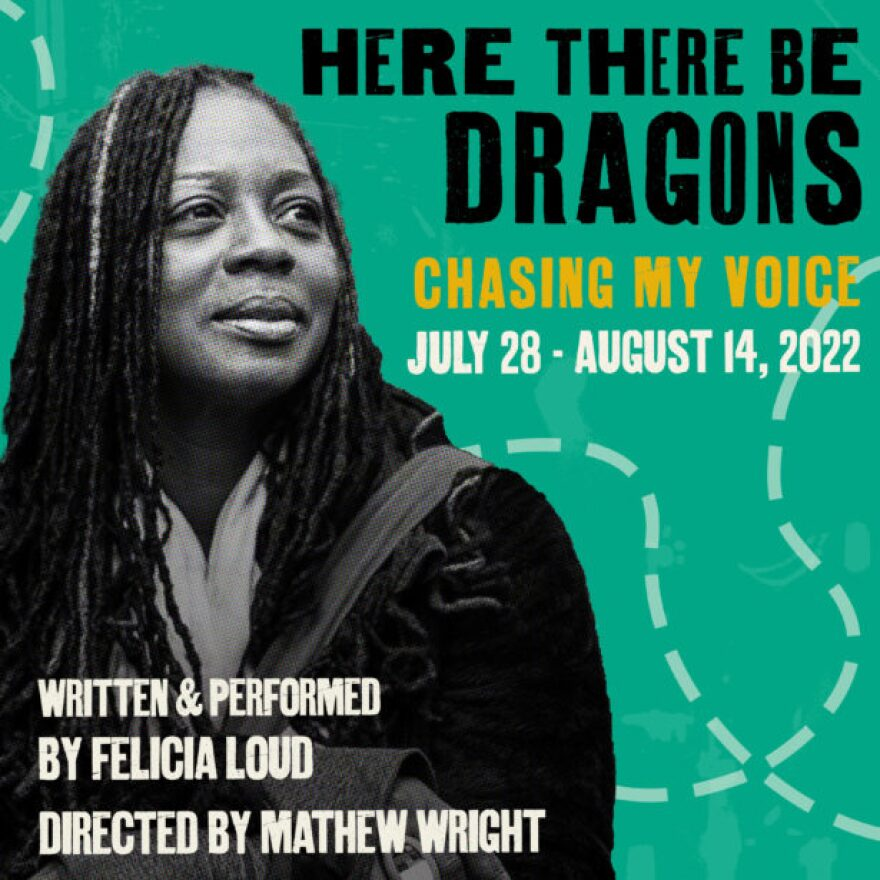
 Here There Be Dragons: Chasing My Voice by Felicia Loud, Directed by Mathew Wright, Arts West, through 14 August, 2022

Those who follow this space know that I go into plays fairly blind. That's one of the pluses of a season subscription - you  have a dinner date, but you don't exactly know what's on the menu. So what I had here is a name and the meta-knowledge that most of the season so far has been involving myths and monsters. So I am expecting some sort of "teenagers playing D&D kinda Stranger Things" performance.

Yeah. Didn't get that at all. Instead I got a memorable live rap show that pulled the audience out of their seats.

Felicia Loud is a local figure in Seattle music and theatre. She has been on the major stages in town. She has taught. She has performed for about 40 years. She's been on KEXP and KUOW. Most recently she is half of Black Stax, a longstanding local rap group. I knew none of this coming in. What I found out is that she's damned good, with a great voice. She blows onto the stage with a coat of many colors and silver boots and takes no prisoners during the performance. She's admirable backed up by musicians Cydney Johnson and Greg Fields, each with their own rig of drums and synths.

The show itself, a surprisingly quick 90 minutes, opens with part memoir, part lounge act, as she tracks her past, from Texas to Seattle to Lynnwood (where she was "the black kid" in a predominately white class) to the Central District. She talks, she jokes, and she is in an excellent position to judge the differences between black and white popular culture. And she does, bringing the audience in and talking about Garfield High.

(Now, as an aside, places like the Stranger refer to Seattle as being a whiter-than-white city. That's both true and false. Seattle is about 59.5% white, King County 54.2%. Those aren't overwhelming numbers. But it is a less-Black city than a lot of other places (6.8% and 6.5 %), And traditional practices such as redlining have kept the African-American population confined to certain areas. That is changing. The thing is, when the Stranger and others framing it in a binary terms, it erases a wide expanse of other PoC  - Asians, Native Americans, Latinos, and  Pacific Peoples. Anyway, thanks for coming to my TED talk.)

Anyway, the opening half is chatty, bouncy, and folksy. And then we start talking about rap and hiphop, and the potential difference between the two, and she brings in her parter in Black Stax, Jace Ejac, and the party gets really rolling, with the two of them wrap up the show with some killer rhymes and beats. 

This was good. This was great. It engaged me more than Free Style Love Supreme at the start of the Rep season, and had more authenticity that Fannie Mae Hammer. Part of it is the raw positivity of Ms. Loud. Part of it in the venue - Arts West is a small theater without a lot of places to hide (And yeah, she called out a patron that had to make an exit to the bathroom). She asks for engagement and energy from the audience, and she gets it.

And to honest, the audience was typical small theater in Seattle - greyer and paler than your standard rap venue. And that's a pity as well, because this is good stuff, and gives me a good feeling about the life in the Central District at the turn of the last century. Worth sharing, worth attending.

So how was the season in general at the Arts West? Here There Be Dragons was a highpoint, as was Justin Huertas' We've Battled Monsters Before. I thought Alma was solid. I liked the This Girl, though the Lovely Bride disagrees. Miku and the gods was all over the place for me, and Monsters of the American Cinema was sabotaged by its staging. So in general, good marks for the Arts West, and I appreciate them trying new things. I look forward tot he next season.

More later,

Monday, July 25, 2022

Book: The First Mythos

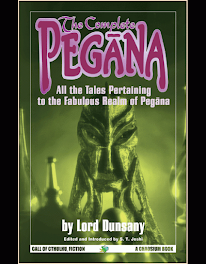
 Gods Of Pegāna by Lord Dunsany, originally published in 1905, Collected and republished by Chaosium in The Complete Pegāna, 1998.

Provenance: Back in the 90s I collected all the Call of Cthulhu Fiction line from Chaosium that I could get my hands on. They were excellent compilations of not only authors contributing to the Cthulhu Mythos but new pieces that expanded out the mythos. One of the books in the collection was The Complete Pegāna, which collects this book with a second novel by Lord Dunsany, Time and the Gods from 1906, and three additional stories from 1919. I'm just going to think about the first published book as a separate entity, and may come back to the others later.

The reason I've  suddenly had an interest in Dunsany comes from discussions with Sacnoth, better known as Dr. John Rateliff. John had written his dissertation on Lord Dunsany, and I've become fascinated by the man and his work as a result. So here goes.

Review: Lord Dunsany is one of the forgotten master of fantasy, invoked but rarely read. Edward John Moreton Drax Plunkett, 18th Baron of Dunsany, was a larger-than-life individual. Nobility, he served in three major wars and was wounded in the Easter Rising. His domain was a castle in Ireland, on the borders of the Pale, which was the English-controlled zone of the island (think of it as a big Green Zone). He ran for Parliament and went on African safaris. He was a master at chess and pistols. Were he alive today (he died in 1957), he would have starred in those Dos Equis beer commercials.

The original Gods was self-published and was well-received, and Dunsany went on to write a number of fantasies, plays, and novels, including The King of Elfland's Daughter, for which he is best -known. But he gets full marks for being one of the first fantasy world-builders with Gods. Unlike previous recordings of legends, folk tales, and faerie stories, Pegana was about the creation and evolution of a imaginary world. 

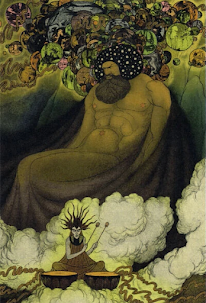
MANA-YOOD-SUSHAI
Pegana as a place was the home of the gods, an Asgardian/Olumpian place apart from the mundane world. It was made by overaarching creator god, MANA-YOOD-SUSHAI, who created the smaller gods, and then went to sleep, lulled by a godly drummer. Those lesser gods in turn created the world, the animals, and humanity. These small gods are demi-urges, creations of a greater creator, and are the one who would be worshipped. For no one worships MANA-YOOD-SUSHAI.

The stories are all incredibly short and literary. Dunsany's language is lyrical and poetic, filled with repeated language and pacing. It has the vibe of the Burton translation of the Tales from the Arabian Nights. Dunsany starts with a description of  MANA-YOOD-SUSHAI, the ultimate creator, who creates smaller gods, then goes to sleep, lulled into slumber by Skarl, his drummer. Dunsany then moves to these small gods - Demiurges who create the world and humanity, then to the extremely localized home gods that make their abode on Earth, and from them to the priests, and to the prophets, and at last to the various kings, before circling back to speak of a very quiet Ragnarok. There is not of expository material here, and much is left hanging (is Skarl the Drummer a small god or something else entirely? Is one set of home gods different from another?), but the language is excellent - it feels good to be read aloud.

Dunsany, interestingly, has a decidedly cynical attitude towards his gods, priest, and kings. His gods fear when MANA-YOOD-SUSHAI will awaken and clear the deck of people, worlds, and small gods. The Priests interpose themselves between man and god and say that only through their organization can their prayers be truly heard (and that keeping those jobs is a priority). And the kings themselves often make remove those priests that get in their way and don't say what it is expected. 

The connection with Lovecraft can be seen in the crafted cosmos with an uncaring overgod - Azathoth is surrounded by his court of demonic pipers much as MANA-YOOD-SUSHAI by his drummer. But Dunsany's smaller gods are much more aware of humanity and use them to play their godly games. The connection to Tolkien, though tempting, feels more tenuous - The professor's approach to creation seems further apart than the Dunsany/Lovecraft version, and is more deeply imbedded in the mythology that was Tolkien's preference. 

Ultimately, Dunsany is remembered as that distant uncle in fantasy's family tree. Important when mentioned, his name invoked among the founders, but otherwise left alone. And the interesting thing is that in creating the first mythos, the first collection of original gods and their stories, he laid the groundwork for the fantasists to come.  

More later, 

Sunday, July 24, 2022

The Political Desk - Swinging Summer Edition

 Ah, it is July. The rain has finally stopped. The temperatures are moving towards balmy. The Mariners are playing above .500 ball, and people are losing their minds over it. Yard signs are sprouting like late-season dandylions. Of course, we have an election. 

Its a primary, There are five offices up for grabs at GrubbStreet. US Senator, US Representation Congressional District Number 9, Secretary of State, and two State Reps for Legislative District Number 11. Our primaries out here are "Top Two", which means the top two voter-getters will go on to the November Election. This usually means an Endorsed Republican against an Endorsed Democrat, but in Seattle it can mean a Centrist Democrat against a Progressive Democrat.

As we have done for years. GrubbStreet is rolling through its ballot, not only giving recommendations but also sending you to other sources so you can make up your own mind. The Voters' Guide is online here, and consists of candidate statements about themselves. The elections office does not fact-check or edit them. Crosscut has put together a nice summary of the major candidates here. The Public Disclosure Commission has its info here, if you want to see who is behind the various candidates in financial support. 

The Seattle Times has been spending the past couple weeks endorsing various candidates - they tend to prefer pro-business, conservative-to-centrist candidates, and will often recommend Republicans. This year, you can hear their teeth grate as they have endorsed primarily Democrats, particularly for the big offices. The Stranger just dropped its recommendations here, and while they are usually rather glib and foul-mouthed, they are currently engaged in their own teeth-grinding frustration as their chosen candidates don't tick all their required boxes.

What about Grubb Street? I tend to lean left and like people who have been doing their job. We are also a little sad that we aren't dealing with any cool battles - we are literally about two blocks away from those districts with hard-core political fights. Here are my recommendations:

United States Senator: Patty Murray has been the incumbent for quite some time, and has been very effective in her role. The Times compares her to previously powerful Washington State Senators like "Scoop" Jackson and  Warren G. Magnusson. Her primary opponent will likely be Tiffany Smiley, who has the support of the State Republican Party. She doesn't have a lot of government experience (Murray was at least a State Representative before running for office), but will likely do what she's told. The OTHER 17 candidates are the standard mix of regular office-seekers, well-meaning souls, one-issue candidates, and cranks (The highpoint is one who is running as the "JFK Republican Party"). So yeah, Patty Murray.

United States Representative Congressional District No. 9. The 9th reaches south from SoDo and crosses Renton along the south end of Lake Washington. We're in the far southeast corner of that area. The district has been well-represented by Adam Smith. I will point that he is being challenged on the Left by Stephanie Gallardo,, who is running on a pro-education platform. I like that, but Ms. Gallardo's resume, like Ms. Smiley's, doesn't have the underpinning I would be looking for. Go with Adam Smith.

The big action, by the way, is just a few blocks away from here in the 8th District, which was rezoned to make a bit more rural and red. Incumbent Kim Schrier (who is again, doing the job) will likely be challenged by GOP Fixture Reagan Dunn, who has spent the past few decades on the King County Council, explaining why he can't get things done (His solution to homelessness - A bus ticket to Spokane). This is a definitely a swing district, so money is coming in from both sides. The Times, which has treated Dunn with kid gloves in the past, has endorsed Schrier this time).

Washington Secretary of State: This position oversees our elections, and has been for many years admirably overseen by Republican Kim Wyman. She did a great job, such that other Republicans got mad at her. She has left to take a position in the Biden administration, and has been replaced by former state senator Steve Hobbs. Hobbs has continued Wyman's policies to guarantee the safety of elections and get people voting (The GOP? Some members have been posting signs near the ballot boxes, declaring that they are under surveillance, in hopes of suppressing the vote). Also good is Julie Anderson, also Republican but running as a nonpartisan, who has run elections down in Pierce County, and has the experience as well. But, Mr. Hobbs has been teaching other state representatives to play D&D, so I've got an inborn prejudice there.

State Legislative District No 11, Positions 1 and 2: Two candidates for each of these positions, so they will go onto the general regardless of what I say here. In Position 1, I go with David Hackney over Stephanie Peters, and Steve Berquist over Jeanette Burrage, but you're going to see them again in the fall.

Again, we are on the edge of this district, and the action is happening next door, which makes up the bulk of Kent and has three very good, experienced candidates running for two slots. It is almost like they redrew the district boundaries just to deny me some cool options.

That's it for this ballot. No judges, no initiatives, no school board or sewer district commissioners. Short and sweet. Get your ballots in by 2 August, and keep an eye out for shifty-looking characters monitoring the ballot drop-offs.

More later.

Friday, July 08, 2022

Life in the Time of the Virus: Endemic

No, it is not going away.

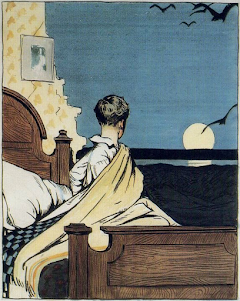
Boy and Moon, Hopper, 1907,
Whitney Museum

Cases went down, deaths went down, but the numbers have slowly been rising again. And the narrative has shifted a bit as well. Last time I wrote on the subject, my social media coverage has slid from "Person hating on vaccines gets COVID and dies" to "Famous person who is vaccinated has COVID, is OK, but is calling in sick for a while." Now I am getting a lot more "Friend/Colleague has COVID, is OK, but feels miserable." 

It does feel like we are undereporting when I compare the number of people I know with people who are being reported with COVID. It is a strong possibility, particularly if the cases among the vaccinated are merely horrible and not life-threatening. Still, there have been over a million deaths in the country since this situations started, with a lot more people sidelined with long-term effects. I know people are griping about how nobody wants to work anymore, but taking a million people out of the workforce has that sort of effect (though someone is probably researching "Animate Dead" to keep the MacDonald's functioning (though a better use of their research time would be "Animate Shake Machine" but then that's another set of gripes.))

The latest wrinkle is not just a new alphabetized variant, like Omicron, but now breaking down into subvariants. The one the is currently on the rise is B.A. 5, apparently named after B. A. (Bad Attitude) Baracus of the A-Team. This latest version is more contagious but less deadly, which is sort of the thing that a virus should evolve into, since an effective virus does not kill the host, but leaves them just wobbly enough to spread it around.

Anyway, a number of friends have called in with COVID over the past few weeks, and they are doing ... OK. Still in the category of "Worst Flu Evah." Our household has been unscathed so far, through both I and one of the housemates works from the home office. The other housemate is doing part time with the Lovely Bride's tax company. One of the housemates got their booster and spent a couple days laid up with a fever (though the fever has broken, and he's doing OK, thanks for asking). The pressures on the medical system has diminished to the point where the Lovely Bride had a knee replacement this past week, and is slowly recovering (She has moved from a walker to a cane, and again, thanks for your concern, but she's doing well.)

The Lovely Bride has also been dealing with a lot of external meetings for her tax groups. Last month, she and I went to a Water Park resort near Chehalis, Washington for a tax convention. I worked from the hotel room while the LB attended classes, then spent a couple hours riding water slides. Still, we emerged from this potential hotbed relatively unscathed. There were few masks, but people were still distancing well enough, though everyone has forgotten how elevators work (but that's another rant for another day.

I have had my second booster (amazingly quick, and got a 10% coupon from the Safeway for groceries), felt under the weather for a day, and moved forward.  Still, I tend to remain masked when out and about. Particularly if the staff is masked up, I will support that in solidarity. The masks really don't bother me - coming from Wisconsin we had these things called scarves, which were standard garb when the temperature dropped below freezing (which is to say, six months of the year). 

This may be as close to the "new normal" as we're going to get for a while. We may slide into annual COVID Vacs like flu shots, and every so often a news report talks about one group or another working on Vaccines. By the same taken, on our way to the theater the other day we saw a small band of protesters at the Gates Foundation (well-organized - pavilion, loudspeaker, matching t-shirts) consumed by a fever-dream of microchips. So we're still going to see people dying out there.

Stay aware, stay safe. More later,

Monday, June 27, 2022

Essays: Young Jorge Borges

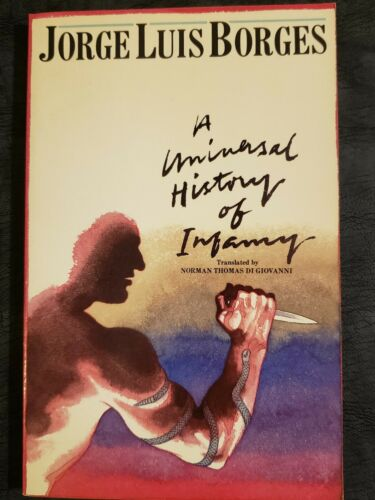
 A Universal History of Infamy by Jorge Luis Borges, Translated by Norman Thomas Giovanni, E.P. Dutton, 1979, Original publication 1935.

Provenance: From Sacnoth's library by odd happenstance. The company that helped put together miku, and the gods, is putting together another show called She Devil of the China Seas, about the Pirate Ching Shi*. I had brushed up against this legendary figure a number times in my life - including as model for an unpublished character for Crucible.. I mentioned it to Sacnoth at one of new post-Covid gatherings, and he plucked this book off the shelf, which contains a short essay by the renowned Argentinian writer Jorge Luis Borges on the subject. 

Review: Jorge Luis Borges is sort of that distant relative to most fantasy  gameplayers thkat they have heard of, maybe see at weddings, but never really had a good talk with. People may have read "The Library of Babel" or "The Book of Imaginary Beings". but Borges was not one to follow the traditional fantasy quest traditions, so gets overlooked by our rank and file. He is a founder of the school of Magical Realism, which is thought to be installing fantasy elements into traditional settings and writing, but has revolved over the years into a genre that means Elves as London Coppers. 

The book is a collection of essays and short works that break down into three categories. First there are fictionalized biographies of particular villains of the past - Bill the Kid, Monk Eastman of the Gangs of New York, and the aforementioned Widow Ching. As a hinge in the presentation there's a short story written in first person about young urban punks, and then finishes up with a collection of "Etcetera" - short parables, for lack of a better word. The biographies are more eloquent, less factual, Wikipedia entries, and the Etcetera are short enough to merit a multi-entry Twitter chain. Indeed, if Borges' medium was the net and not the printed form, these would have been lost to the ever-widening electronic gyre of Facebook. It was good he was writing when he did.

These essays are from early in Borges career, yet immediately set himself out as a master teller of tales, his work based philosophically in their underlying morals. They can be a great underlying foundation for a campaign setting or adventure, but lack the deep exposition, quest-like plotting native to our sub genre. What they do have is a lyricism and magic that sweeps the reader along to a brief resolution. The are as eloquent as they are brief. Magical realism, indeed. 

The originals are in Spanish, and the English translations (in Borges own opinion) are excellent. Still, in reading foreign translations, it feels like attending a play and standing in the lobby, while a stream of people come out and tell you what's on the stage. Yet even in translation it is worth it to hunt this down and read it, if nothing else as to indicate philosophical underpinnings to potential settings. And because it is a darned engaging set of reads. So need to go down to my library and pick up the Borges Collected Fictions that I have had on the shelf for a while.

More, later,

*An incredibly famous female pirate you've never heard of, Ching Shi (also known as Zheng Yi Sao, Shi Yang, and Shi Xianggu, all of which translate as "Wife of Ching" or "Widow of Ching") inherited her pirates from he husband, and built the family business up to an armada that terrorized the mainland. The fact that we name her in the shadow of her less-successful husband is telling.


Saturday, June 18, 2022

Theatre: Beauticians and the Beasts

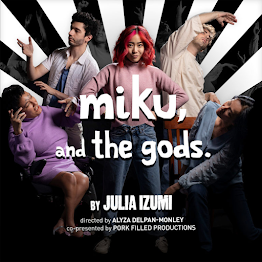
 miku, and the gods by Julia Izumi, Directed by Alyza Delpan-Monley, co-presented by Pork Filled Productions

This one left me confused. 

I'm not alone. The Lovely Bride and I always wait to get back to that car and start the drive home before discussing a play, mainly because we've had strangers dip into our discussions with their own insights (not a criminal offence, but not appreciated). And as we made our way down off the hill of West Seattle, she said, "That was ...." and she paused.

"Weird?" I said.

"Weird." She repeated almost immediately. "Nice costumes though."

And it was weird. More performance than play, it was narratively frustrating. It started strong, but threw me off the path about forty-five minutes in and I never quite recovered. Even now, I have a hard time describing what the play was ultimately about.

OK, here goes for a summary: Miku (Lola Rei Fukushima) is a brilliant 12-year old who lost her brother in an accident in a river. Determined to fix an unjust world, she seeks out the One Who Is Wise (NEVE), an acid-tongued beautician to find out how to become a god. She also encounters Ephraim (Ben Symons) who wants to become an Olympic-level swimmer. Seeing connection between Olympians and Olympians, she recruits Ephraim to help in her god-quest. Meanwhile, Miku's grandmother Seiko (Naho Shioya) is dealing with dementia, aided by Shara (Sherif Amin), who is a minor god of Beauticians and War. Or maybe just a beautician. We're not quite sure.

And that's about as far as I can go before I get kinda confused. I am not sure exactly who the story is about and whether it is real or in one of the characters' headspace. There is interpretive dance. There are announcements. There are muffled announcements, and I'm not quite sure if that was intentional. There is a strong feeling if these characters are the characters they have declared themselves to be, or are gods, or mortals, or memories. The play has good bits, but defies me to put them together in a coherent order. Which, since they are talking about gods and mythology, may be part of the point. The play ends softly, and again, I am not sure that it has ended, except for an announcement that "The Play Has Ended." But has it ended? Really?

The actors are great, committing to characters that are over the top gods and super heroes - you know, maybe. Fukushima had been at the Arts West previously, and brings that same direct energy into holding the center together here. The stage is minimalistic and effective, bringing the question of where are we to the front. 

But ultimately is does not bring me anywhere close to enlightenment or closure or comprehension. Gods, death, memories, all sort of get thrown up at once. That's cool. Some forms of art don't engage at a cerebral level or an emotional level, but rather at a quasi-mystic feeling. Ballet and poetry come to mind, which are spider-webs, beautiful but incredibly delicate, unable to withstand a harsher examination. I didn't hate it. I was just puzzled and frustrated by it. The play ultimately feels like it is still trying to figure out what it is.

Nice costumes, though.

More later

Saturday, June 11, 2022

Theatre: The Bigger Boat

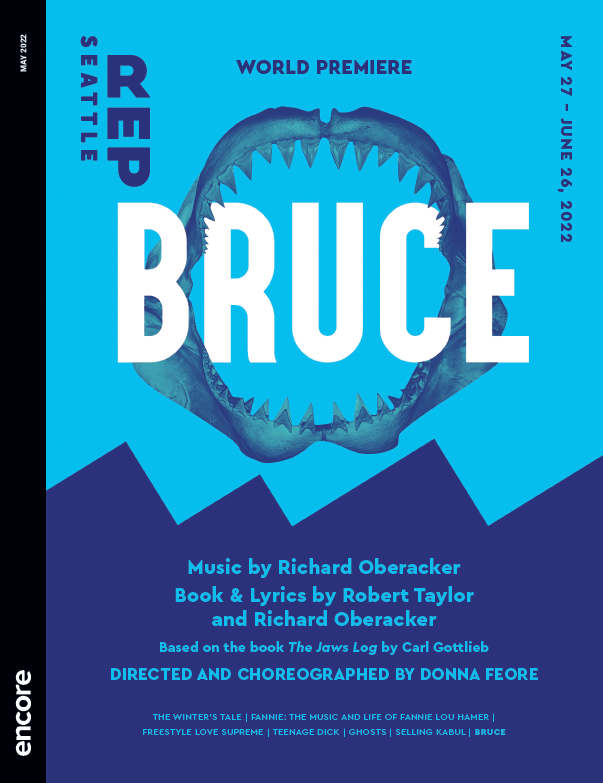
Bruce, Music by Richard Oberacker, Book & Lyrics by Robert Taylor and Richard Oberacker, Based on the book The Jaws Log by Carl Gottlieb, Directed and Choreographed by Donna Feore. 

Spoilers: I loved this, and strongly recommend that others go see it. Fair warning: The Lovely Bride did not, but we will get to that.

Long ago, musicals would show up on Broadway, then turn into films in Hollywood. Now the opposite is true - Intellectual Properties arrive from films and TV shows and are turned into comfortable songfests in NYC, then tour the nation in road companies. And this particular project goes even further - it is a musical based on a book about a movie about a book. So I will admit I was a little cautious going into this one.

And I enjoyed myself tremendously. I thought it was great. This is one of those performances I want to heartily recommend to others. Five years ago, I got to see Come From Away at the REP before it got big and was floored by the production. Bruce had the same effect on me. It a musical about the making of one of the first big modern Hollywood blockbusters. And you should go see it.

It is about the making of Jaws, and Bruce is the name for the infamous, problematic, mechanical shark that almost sunk the entire production. A young film-maker off his first modest success gets the nod to bring a best-seller about a killer shark to the big screen. At that time the best-seller was not yet published, and did not even have a final title. This was the first of many hurdles in the process.

And the show is all about the process. Putting together the initial team, casting, planning to record in a real ocean, finding the set location. The first chunk of the musical is laid out on a three-by three vertical grid, where the various component parts are spinning and people are contacted, recruited, convinced to come together. Like Jake and Elwood Blues, they are going to put the band together. Like Judy Garland and Micky Rooney, they're going to put on a show. About a shark.

And then they go to the island itself - Martha's Vineyard, and as with every plan, it disintegrates upon first contact with the greater reality. Problems with locals. Problems with scripts. Problems with the weather.  Problems with the actors. And most of all, problems with the mechanical shark that fails spectacularly and repeatedly, forcing the team to shoot around it. In the process, they succeeded with the shadow of the knife as opposed to the knife itself.

The cast is fantastic here - strong-voiced and solid, top to bottom. Jarrod Spector is an idealized Steven Spielberg at the start of his career. Ramzi Khalaf is a pugnaceous, insecure Richard (Ricky) Dreyfus. Hans Alwies is a drunken veteran Robert Shaw who acts the diva right up to the Indianapolis scene, where he disappears into Quint's character. Beth Devries is Lorraine Gary, whose character in the movie gets sidelined by the three male stars but here is a supportive foundation. Geoff Packard is the production company's Dad-figure as Roy Scheider. But it is the people behind the scenes, Alexandria J Henderson (as talent director Shari Rhodes) and E. Faye Butler (as film editor Verna Fields) that are fantastic, even if their real-life counterparts of that era were much paler. Top to bottom, everyone was brilliant. Heck, they even have you rooting for the producers (Eric Ankrim as Richard Zanuck and Timothy McCuen Piggee as David Brown).

How much of the story is ultimately true? Don't care. This musical actually hit me where I live and work. I have spend much of career as a corporate creative, working with teams of talented people, sometimes but not always in a leadership position, and the things found here ring true to me. I have done casting, I have been in the room where the deals are made, I know the chaos that often results in looking like we had it all planned. In many ways, this play gave me the reverse of PTSD - it was joyous and my eyes were wet by the end of it (It might have been the smoke, but hey, its Hollywood). And to honest (and a little cynical), while the actually making of the film involved a lot of plucky young professions working against long odds and nasty conditions, the original book got a huge promotion from Doubleday and the movie itself had a major ton of promotion, licenses, and distribution.  Don't care. It really hit me.

I even marveled at the set design. I have an allergy to "gizmo plays" that have flying sets and sliding furnishings and multiple levels of production to fill vertical space. But the Hollywood Squares initial set-up actually WORKED, and when everyone decamps to the island, that set splits apart to reveal a wider, more open world, and I was completely taken in. It was Dorothy stepping into Oz. 

The Lovely Bride did not care for it. In fact, she used the word "deplorable". And the big reason was that for her is did not work as a musical. I think that's a fair cop. A lot of the tropes you get from a Broadway Musical are missing = There is the "Statement of Purpose" song at the beginning, but there is not a lot of toe-tapping memorable melodies here. There is no catchy little comedy number or showstopper solo or big production number right before the intermission (heck, there isn't even an intermission). She felt it was closer to opera, and she doesn't care much for opera. But I liked it. I would buy the CD (Do they still do CDs?)

And, to be fair, would it have the same effect as it had on someone my age as on someone who had never seen the movie it was based on, or knew anything about the stories that have grown up around it? I dunno, go find someone who doesn't know about the film that traumatized a generation about swimming in the ocean. I can wait.

Summary on Bruce? Let me oversell it. I think it is great. I think this was a tonic for everyone who is involved in creating things in the real world. It made me want to return to projects that have been abeyance for a while, and return to my daily creative task with new vigor. 

So yeah, I think you should go see it. 

More later,

Saturday, May 28, 2022

No Quarter: The Next Gen I

So, I don't know if I really want to go on with this blog's ongoing practice of talking about collectible quarters, but old habits die hard. After the States Series and the National Parks series, the US Mint has launched a new collection of collectible/commemorative quarters. And it was pretty easy to mock pictures of birds and mountains and the mudflap that Wyoming used for its quarter. But this new series is on famous American Women, some of whom have passed on in recent memory. So I think I will walk a tad more respectful this time out.

Originally, this was supposed to be similar to the previous currency series, in that each state would get one woman to brag on, but that was revised because they want to do a sesquicentennial (250 years) set in 2026. So we get four years of famous women for 20 total as opposed to 50 national parks/monuments/seashores/parking lots. The idea that women get about 40% of the attention given to other subjects is such an American Thing.

But as I said, I'm going to walk a little more carefully, in part because a lot of these women are unknown/forgotten/ignored in the standard narratives. Also, I'm going to go out on a limb and say that the majority will be from the twentieth century, as opposed to something from the Civil War era, in part because women have been unknown/forgotten/ignored in a lot of traditional texts.  I'd like to to concentrate (and mock) the design a lot more than the subject matter, and to encourage readers to follow the links to learn more in detail of these remarkable women.

But first off, let's talk about the other side of the coin, literally. The side with Washington on it.The face/heads/obverse of the coin has made some major changes, and some minor ones. Big one you'll probably notice - Washington is facing the other direction. Also, the sculpture is from a 1931 dollar, and you can see differences in the artistic approach (George has an even thicker neck, and the rat-tail at the back of his head is more pronounced). Also some of the text has switched sides - The denomination and United States of America are now on the other side, and the year moves back to being on the same side as George. As a result the reverse side does have more text to deal with as it previously had

Anyway, I am not expecting a lot of coins to get a review below C (They have gotten much better at it over the past 20 years), but here are the review levels. 

Way Cool =A
Not Bad = B
Just Average (also known as Meh) = C
Kinda Lame = D
So bad you don't want to show your mother = E

Maya Angelou (1928-2014)

This is a strong lead-in, both from subject and presentation. Maya Angelou is known for her autobiographic works and her poetry, but also for her work in Civil Rights. Now I Know Why The Caged Birds Sing is pretty much a standard text for a generation of English classes, and she was the second poet to read one of her poems at a presidential nomination (the first was Robert Frost, the most recent was Amanda Gorman). 

Her pose is dynamic and evokes Caged Birds in its presentation. I really like it because, right off the bat, it gives us more than the standard portrait and creates an active presentation for the coin. She is also the first African-American woman on a coin. Buckle up, there are going to be a lot of firsts in this series.

Rating: A

Dr. Sally Ride (1951-2012)

It is no longer big news to have women in space, but Sally Ride was a big thing back in the 80s - the first (American) woman in space. I know - it took us THAT long to put a woman in space, but hey, equality has always been a process. She is also the first known LGBT person on a US coin (get back to the closet, Buchanan - your family burned all your correspondence, so we're still not sure about your status, shy of a seance). 

The coin itself is, well, OK. Sitting portrait along one side, big globe in the background, bit of a swirl that evokes orbit and window on the shuttle. Its a pretty nice quarter, but nothing that makes me really engage with it. 

 Rating: B

Wilma Mankiller (1945-2010)

No jokes on the name, please.While there's a good chance you know about Maya Angelou and Sally Ride, now we get into more esoteric heroes. And its a pity, because Wilma Mankiller's background is impressive, including both Native American activism in California and Oklahoma, and as a chief of the Cherokee people. 

The coins are already settling into a comfortable type - figure on the left-hand side, shown torso up, symbology in the background on the right-hand side (A symbol of the Cherokee nation,  all contained by a circle with all the required data. I think we are going to lose her note as Principal Chief and the Cherokee words beneath in the folds of her shawl. It is a very busy coin.

 Rating: C

Nina Otero-Warren (1881-1965)

We are probably going to see a lot of suffragettes, particular for those famous women born before 1900.  Maria Adelina Isabel Emilia "Nina" Otero-Warren is the oldest representative of this crop of coins, and her achievements span politics and education. She argued for bilingual education and was the first Latina to run for the US House of Representatives (as a Republican. She lost). She is the first Hispanic-American portrayed on US Coinage.

Like Mankiller and Ride, we see the sitting portrait on the left side of the coin. In addition, there is a LOT of text - in addition to the stuff shoved onto this side from the obverse side, we have Votes for Women on this side, which to some folk is STILL a controversial subject.  Plus a collection of Yucca flowers to represent her native New Mexico. I think it is going to be a cluttered quarter, much like Mankiller's. One good bit - her head does break the plane of the surrounding circle, making it a bit more dynamic.

Rating: C

Anna May Wong (1905-1961)

Wong Lui-tsong is the first actress on the group, and a pioneering Asian-American in the film and TV industries. That's good. However, a lot of her roles were very much in the stereotypical vamp/dragon lady that smacks of Orientalism and exoticism, so that's a little less good. Plus the fact that a lot of early work are "lost films" that have not survived into the present day, and her ground-breaking TV show was on the now-extinct Dumont network, and few records exist of it as well. Yet she has been recognized for her work in recent years, as well as her work for the Chinese-American community.

The quarter itself is exceptional in that it gets away from the already-trope of the previous three with a closer headshot that plays off the natural beauty of Ms. Wong. This is a very stylish coin that feels like a silent movie poster of the era. I like it.

Rating: A

That's it for the first batch - tune in next year for five more, and keep checking your change!

More later,


Sunday, May 22, 2022

This Just In: Latest Arrivals

So, more Kickstarters have shown up at Grubb Street, along with the occasional purchase from local brick and mortars and one author copy. As always, I want to note that these are not reviews so much as "first looks", and in most cases I have not read them cover to cover nor tested out their mechanics. But I still want folk to know what's out and what's happening, as opposed to doing a thorough deep dive and getting back to around, let's say ... Christmas.So this is a better approach for me.

And what do we have in this collection, Johnny?

Grimstone Roleplaying Game (Angelos Krypianos, Writer/Creator Spiral Lane Productions, 126 page Hardback). Greek writers, Greek publisher, this is part of what I was talking about last time in the global nature of RPG design. This is actually the crunchiest of this collection of games, with a great backstory - all of the races are human, but made up of different parts of the Sun and Moon. A nice setting, low-magic, with a unique RPG system.

Ships of the Expanse (Keith Garret, Lem Lemke, Mari Murdock, Nicole Winchester, Writers/Designers, Green Ronin Games, 144 page Hardback). I have not played the Expanse RPG, but I really like the design of the games in this line, and the spaceships in general. It scratches that Traveller itch of my game design history. The Ronins have done a fantastic job with this production, not only on presenting the ships but also talking about hard-science intra-solar system space travel. And I want to unleash these deck plans on others, now. Picked this copy up at Olympic Cards and Comics down in Lacey, which has a LOT of non-traditional RPGs that I don't find elsewhere..

Coyote & Crow (Conor Alexander, Creator/Writer/Developer), Coyote & Crow LLC, 474 Page hardback) There has been a strong movement for authenticity in game design, in particular for games which find their origins in other cultures and heritages. Coyote & Crow, rooted in Native American heritage, is created by mostly Native American talents. The game deals with an alternate cyberpunk North America on a world where the European colonizers were wiped out by a space anomaly before they could get up to any mischief, and the survivors on this side of the planet gained low-level magical abilities. The book is a massive full-size, full-color hardcover. The system itself looks like Shadowrun with d12s, and the worldbuilding itself is interesting. It has also was nominated for a Nebula, which is a rare thing for RPGs (Alas it lost out to Thirsty Sword Lesbians, which was covered in an earlier writeup).

Marvel Multiverse Role-Playing Game Playtest Rulebook (Matt Forbeck, Writer, Marvel Worldwide, Inc, 120 page softbound). Got this at Fantasium, my local comic store as an inexpensive addition to my weekly comics pull, and read through it over the weekend of its release. It is the "playtest copy", but it compares favorably with the now-ancient Yellow Box Marvel. Amused that the ability scores spell out MARVEL instead of FASERIP, and there are diceworks that echo the old D6 system from West End (it has botch dice, which can be negated by .... Karma!). It is what it says on the tin - a playtest copy, so it is not a complete overview of all of Marvel and its powers, and I don't think it has anything for experience and character advancement. Inexpensive and definitely worth checking out (And I welcome Matt into the "Brotherhood of Marvel RPG Game Designers" - next week we fight the Great Lakes Avengers!).

Kobold Guide to Worldbuilding Volume 2 (John Joseph Adams, Editor, Kobold Press, 108 page softbound digest). The Kobold Guides are just fantastic reads - essays by some of the best and brightest in the field on a variety of subjects. The books are veritable wonderland of insights and commentary on various components of campaign, fiction, and world design. An excellent product. Oh, did I mention that I have an essay in this edition? I talk about Space Hamsters.

Corsairs of Cthulhu, Fighting Mythos in the Golden Age of Piracy (Ben Burns, Writer, New Comet Games, 297 page hardback) Pirates Vs. Cthulhu! Who could argue with that? The book consists of a set of modifications to the core Cthulhu rules (the Investigators are now Corsairs, and have skills like Alchemy and Artillery), and a huge world-sweeping adventure. I like some of New Comet's Games (Devil's Swamp was quite good), and don't care for others (A Time for Sacrifice  left me cold). Leafing through Corsairs, the adventure itself looks like they have everything and the kitchen sink involved here. Looks very interesting, and may yet get to my gaming table..

Remarkable Cults & Their Followers (JVC Perry, Jeff Lee, RP Davis, Writers, LoreSmyth, 180 page softbound). This is a 21st century version of the Book of Vile Darkness, though its definition of cults extends to factions and secret societies, but has enough that are just Evil Evil Evil. This is a really beautiful book that deals with a great subject for players - Setting up and running cults both as opponents and as player organizations. They have about a dozen cults/secret societies/factions that can be dropped in (including maps of their secret headquarters), along with rules for setting up your own. Plus evil artifacts! It is "system-neutral", which means it plays well with 5E. Of this group, I particularly like the layout and art.

And that's about it for this haul. Did I mention that I have an essay in The Kobold Guide to Worldbuilding, Volume 2? As luck would have it, I talk about Space Hamsters.

More later,


Sunday, May 08, 2022

Theatre: Mother's Rave


Alma, by Benjamin Benne, Directed by Sophie Franco, Arts West, through May 22.

The Lovely Bride and I took another journey to that mystical land beyond the Duwamish River called West Seattle. I am almost at a point where I can get there without getting lost (the West Seattle Bridge is still shut down). Our goal (in addition to great sushi, is the Arts West Theatre, a small but great theater group ensconced in the shell of a renovated former furniture store. The LB and I have been hitting opening nights, and to a great degree, have be rewarded for the effort.

Case in point, Alma. Yolanda Suarez is Alma, Leah Sainz-Jones is her daughter, Angel. Angel is supposed to be taking her SATs tomorrow. Alma has been preparing for this day, the next step of her daughter's success, to have the life she was denied. Angel does not plan to take the test. The resulting discussion/argument is the core of the play itself. Two actors, one problem, ninety minutes.

And the playwright pulls it off. The analyst in me can tweak to the ratcheting up and unwinding of dialboue as their relationship plays out over the course of the argument. Alma and Angel are friends and also mother and daughter, with all the baggage and hidden traps that that involves. They curse, bluster, accuse, mock, make up, cuddle, cry, tease, and love each other, and the script itself dances from one point to another.

Also a sizable chunk of the dialogue is in Spanish, in that halfway domain in families where the parent has come from another country and the child groks the new language. Yet they slip in and out of it gracefully, and there are only a few points where I felt I missed something - that would be the universal nature of parent/child relationships. Also the PTSD that comes from High School testing.

There's a third player on-stage, unseen but not unheard- America and the American Dream. The ghosts of an old country. The play takes place in that weird temporal borderland between Trump's election and inauguration, in that weird quantum state when everyone was wondering how bad could it be. The newly-elected voice, over a malfunctioning TV, blasts into their lives about building a wall and making Mexico pay for it (yeah, how did THAT work out). Alma is an illegal, and Angel is aware that the rules have changed, and what they have both hoped for is now much, much more difficult. 

The set design is excellent, open-spaced and beneath (at times) the stars, setting the eternal nature of the parent/child discussion. The program book also carries a bit of weight in the proceedings. There is interview with the director, which is par for the course, but also a page of translations and explanation of what the Prologue (storms, horses, soldiers, Military music) means within the larger whole. Even th art in the hallway underscores the players on the state. It was very much a total package.

Alma is a small play (Two people and the ghost of the American Dream) and a greater play as well, set within its time and within the long timeline of mothers and daughter. I liked it, and think you would too.

More later, 

Wednesday, May 04, 2022

Book: Pulp Fiction

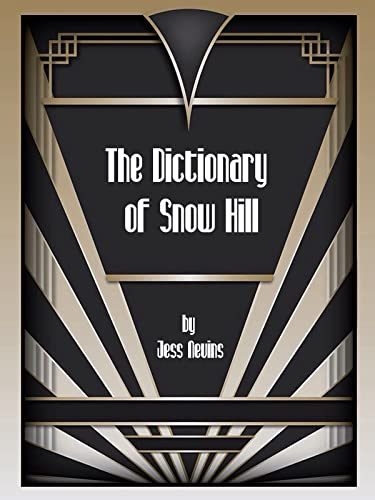
The Dictionary of Snow Hill by Jess Nevins, 2022

Provenance: Another book recommended by Facebook ads. I get a lot of ads for books on Facebook, so the Algorithm has me pegged.  Yeah, I'm getting worried about that as well. This one caught my attention because of the Author - Jess Nevins. Nevins has written one of my favorite reference books (You have a favorite reference book, right?): The Encyclopedia of Fantastic Victoriana, as well as doing annotations on things like Alan Moore's League of Extraordinary Gentlemen comics. So, yeah, he comes from a good background, so I'm in.

Review: This is a love-letter to Pulps of the 20's and 30's, with parts spilling over to before and after that era. Set in the Maryland city of Snow Hill, the largest and shiniest city in the US, it is a collection of tales involving Science Heroes and Villains. This is tropes gone wild, and features a host of familiarish players - Micheal Ferrum, the two-fisted "Doc Bronze" and his Sensational Six, World-famous Consulting Detective Havelock Blake, the Shadow-esque Laughing Monk, along with talking ape detectives and luchadors. Roman a clef with the predecessors of the super hero universes.

Yes, it is a madhouse, literally so in places. There are invasions from other planets, inner worlds, and undersea menaces. Lovecraftian horrors abound (and we have the Doctor Strangish/Inner Sanctum magician named Anton Weird in the mix as well). It is a world where all the heroes of the pulps are all active at the same time, sharing the same universe and the some of the same enemies. Physics itself tends to bend around such challenges.

The format is in encyclopedia format with rough alphabetization. Entries are narrated by different in-world inhabitants, so we have unreliable narrators throughout. Radio scripts, media articles, and personal memories all mix and twist. Being an overview of the various characters' careers, many of them end badly. Particularly there is a lot of reference to the events of June 21st, 1937, a solstice where many things go badly for many, many people. This is the ongoing narrative that stretches throughout the book, the approaching cliff that the characters are hurtling towards.

So, does Nevins gather together the collected strands and resolve them? He has been an annotator of a lot of Alan Moore's work, and Moore has had challenges with stories not so much resolving as running out of pages, and of playing nastily with his creations. Does Nevins "stick the landing"? Yes, in part because of the unreliable nature of his narrators and the who is giving information when in the book. There are a couple tweaks and twists, but the book delivers.

The Dictionary of Snow Hill entertains and delights. It would make a solid sourcebook for a era-specific superhero gaming campaign. It feels very much like Kurt Busiek's Astro City comics - Set firmly within its genre, with characters whose archetypes are easily identified. It's a great read if you remember the pulps, and worth checking out even you don't.

More later,

Sunday, May 01, 2022

Theatre: Tuned to a Dead Channel

Selling Kabul by Sylvia Khoury, Directed by Valerie Curtis-Newton, Seattle Rep through 22 May

This one is rough. It is a challenge. It was also the best production of the year so far. 

Part of the challenge is subject matter - a play about Afghanistan so soon after the recent departure of US military support, the collapse of its government, and return of the Taliban. And part of it because of the characters themselves, all of whom are confronted with the ever-increasing danger resulting from the lies they tell to protect each other. You empathise with them and and internalize their peril.

Taroon (Yousof Sultani) has been hiding in the apartment of his sister Afiya (Susaan Jamshidi) and her husband Jawid (Barzin Akhavan) for four months now. Taroon worked for the Americans and is hiding from the rising Taliban. Jawid is making uniforms for the Taliban in exchange for their protection. Afiya is trying to hold everything together, including keeping Taroon's presence hidden from the outside world, which is embodied by friendly/nosy neighbor Leyla (Fatima Wardak). At the start of the play, Taroon's wife has given birth to their son in the hospital, and Taroon is willing to risk everything to see them. However, the Taliban has people at the hospital looking for him. Afiya want to keep her brother alive.

And from there is just gets worse for everyone involved. It is a slow burn as the truth regarding the devastation from the authoritarians is revealed, and as the knowledge of the danger to the major characters is slowly leaked out. The risks ratchet up, the potential dangers increase, and the collateral damage is high. 

The actors are excellent. Most of them are "making their Seattle Rep debut" with the exception of Wardak, who had been in A Thousand Splendid Suns from the Rep a few years ago (and which is being apparently being turned into an opera). They embody their characters and their secrets with grace and humanity. Jamshidi as Afiya is the heart of the play, as she struggles to work out the most survivable results in an ever-darkening landscape. The set is no-nonsense, will none of the flying props or multiple levels we've seen in other Rep productions. And the directing is subtle, direct and well-placed. As I said, it is a slow burn.

This is a bleak play. Much bleaker than Ghosts, and much, much more immediate. There are fewer laughs at these characters, less distance between us and them. The performance is gifted with excellent actors, a tight script, and spot-on direction. I really, really don't want to take it apart and analyze why it works right now because it really connected and affected me. So yeah, with all the caveats that this is not a musical, not a blast from the past, not a retelling of another better known play, but is really solid, good theater. Just don't expect to feel good about it afterwards.

More later,

Friday, April 22, 2022

The Reading

 So, how did it go?

All in all, it went very well. Very well indeed.

Readers at the Theater
This past Monday, our play-writing group, The Quills, held a reading of our works at the Driftwood Players in Edmonds. The Quills are a group of would-be playwrights who have been meeting mostly monthly for the past few years, reading scenes and commenting on each others work. This was the first public reading of most of them.

This was reader's theater, which meant we were not doing blocking, sets, action, or anything. Just sitting in chairs. The Readers, a group of students from Shorecrest High School and some women of a certain age who were friends of the other playwrights were seated in front of the curtain. OK, I read for one of the plays, which needed an older man of a certain age for the reading. 

The plays were a a mixed bag of types we've been working on, and included: Plays about earthquakes, WWII history, masking, layoffs, moving to Seattle, sending kids to college, making a recipe book in a concentration camp, and wildfires. And lest you guess, I was responsible for the layoff and wildfire scenes. They were comedies.

The venue was excellent, with great sound (though we had to get the young people to speak up initially), and they even managed to put the music from the Moving to Seattle play over the speaker system. It is a large small theater with a lot of seating. Edmonds is more than an hour north of Grubb Street, but I'd definitely take in a play there again.

And the readers were good. There were a couple misfires - one young person referred to a local restaurant as "Ivan's" instead of "Ivar's - but in general they acquitted themselves well. There were a couple of the younger folk who understood the brief and took control of their parts. That qwas greatly appreciated.

We had, counting authors, actors, and audience, about 50-60 people total in the house. The overwhelming bulk were friends and family of the playwrights. We passed out review sheets and encouraged people to respond to the plays. Most of the friends and family were very kind their comments. Since my plays were comedies, I was hunched in my seat, seeing what lines landed and which ones missed. Most of them landed.

The Housemates made the long drive up to Edmonds, as did a couple who were members of my regular Monday Night D&D group and a fellow designer from Amazon. Afterwards a group of us adjourned to Bucatini, a small Italian joint about four minutes south of the theater. The food was excellent, the portions large, and the conversation involved a lot of gossip about Amazon. 

Thanks to fellow Quills Catherine Benson, who organized the whole shebang, Susan Weingarten, who MCed the proceedings, and Lisa Emerson who provided the response sheets. And of the young readers, a shout out to Peyton Catt, who will never know I've given him proper credit unless he's the kind of person who googles his own name. 

And who knows? We may do it again sometime. 

More later, 


Saturday, April 16, 2022

Invitation to a Reading


You are cordially invited to: 

The Quills New Works Evening 

Monday, April 18th, 2022

6 PM to 8 PM


Edmonds Driftwood Players

(Wade James Theater)

950 Main St. Edmonds, WA


The Quills are a group of amateur playwrights from the Seattle area. Please join us for the first public reading of our short works and scenes from longer plays.

Free (But we will be soliciting feedback)

Masks are required for the audience.

So what's all this?

Many (many) years back, I took a couple play-writing classes at the Seattle Rep, taught by Kristina Sutherland. After those classes, a group of us would-be playwrights stayed together, and have met once a month to share scenes and talk about play-writing. This is the first time a lot of these scenes are going to be seen in a readers' theater atmosphere (Readers up on the stage but in front of the curtain, no blocking or sets, but real voices reading our stuff).

While I would not recommend flying in for the event (and even a drive from Tacoma might be a bit much), if you happen to be in the North Seattle area and have a free evening this Monday, come check us out!

More later,

Friday, April 15, 2022

Theatre: Norwegian Would


Ghosts
by Henrik Ibsen, Translated from the Norwegian by Paul Walsh, Directed by Carey Perloff, Seattle REP through May 1

On the drive home from this play, the Lovely Bride wondered if it was time to retire Ibsen from the theatrical canon.

This is a major statement on her part. Ibsen had a strong impression on her in her youth. The LB had an Ibsen phase growing up (She also had a Bertolt Bretcht phase, but we won't dwell on that here). Ibsen wrote strong women into his works and castigated moral hypocrisy and talked about issues that were at that time conveniently buried beneath the floorboards. If modern theatre had a list of saints, Ibsen would at the head of the line. So, retire him from performance? Seriously?

Let me get to that matter in a moment - I need to walk through the play itself. Helena Alving, widow of ten years, lives on a manor out in the wilds of Denmark. She is on the verge of dedicating an orphanage on her grounds to her late husband. Her son has returned from Paris. She has a dedicated maid, whose ne'er-do-well father is overseeing the orphanage's construction. She is dealing with the final details with the family pastor, who is an old and affectionate friend. Things are going well.

Well, no. Secrets start leaking out. Helena's sainted husband was a philandering bastard. The dedicated maid is really the husband's illegitimate child. The son is taking a shine to the maid, risking inadvertent incest. And the son, back from Paris, has venereal disease, which in the Ibsenian universe is inherited from the father and also results in sudden and certain madness. And the orphanage is uninsured, for, in the words of the Pastor, to insure it would be to show a lack of faith in god to protect it. So you know where that is going.

And yeah, that line about insurance got a laugh in the audience. In fact, a lot of Pastor Mander's lines got inadvertent laughs, which I am going to say was not the intent back in the 1880s. Mander's hypocrisy and stiff-necked morality is met with derision by modern audiences, so the lines land completely differently now than they did then. For a harbinger of modern theater, Ibsen comes off as, well, quaint.

The cast is crackerjack. Award-winner David Stratharin as Pastor Manders is soft bullying, responding to society's requirements as his compass. But Mary Elizabeth Mastrantonio  is the heart of the play, dominating the stage and by turns conventional and rebellious, the look on her face when the Pastor's plans come crashing down on his ears is electrifying. Albert Buio III and Thom Sesma are good in their roles as the scion of the Alvings and the carpenter, respectively, but it is Nikita Tewani as Regina, the maid, that ultimately shines as she denies Helena her happy ending, and for excellent reasons.

The roles throughout are played subtlety as well. Sesma's carpenter could be more snakelike, Straitharn's Pastor even more stiff-necked, but the direction gives them nuance and depth that could otherwise be lacking. The actors are portraying their characters more realistically, to a degree that I don't know would have been possible on the 19th century stage.

The set design is intriguing as well. The manor's setting with its grass roof makes it feel like a barrow grave, its pale wood timbers definitely fit for IKEA. And in the center back is a glass-paneled room that serves both as storage for lost furnishings and as housing for David Coulter, who provides the music. Coulter's work does a lot of the heavy lifting for the tone of the work, creating musical effects on tympani, zither, and glass armonica (I'm guessing here) that underscore the unsettled nature of the characters. 

The pieces are all here, but it still feels odd. And the fault is not in the original work or the actors, but rather in the fact that it belongs to a different time and a different audience. The 21st Century has moved through the shock value of forbidden topics (though we will always still find them) and what required stern reflection is now met with nervous laughter. What was once scathing is now just cringe. The past, indeed, is another country, and in the case of Ghosts, it is a desolate county indeed.

More later, 


Sunday, April 10, 2022

Life in the Times of the Virus: Mandate's End

So, an end of things is in view, I think. It is not as clear-cut as I would like, but rather is a ragged tear, a muffled gasp, and a hopeful (if chancy) outlook.
Blackwell's Island - Hopper, 1928

The numbers have come down, and with it the barriers are slowly falling. Mask mandates and working from home decisions are falling, one by one. There are no church bells ringing - this is not a war declared won. It is merely a war declared over. A draw, if we are lucky. A resurgence if we are not.

And the reasons for declaring this cease-fire are good enough, but not great. We don't have maximum vaccination, but we have enough in our region to staunch the outbreaks. Those who are vaccinated seem to be having milder symptoms, but are still getting "Breakthrough" Covid. The stories have shifted from "Public anti-vaxer who then dies horribly" to "Famous person, vaccinated, who tests positive and secludes for about a week". A lot of those reports, ironically enough, have declared Coivd is like having the flu, something the nutjobs were claiming at the beginning of all this. It might be the worst flu of your life, but still .... the flu. And yeah, the flu can kill people.

But we are no longer overloading ERs and storing bodies in refrigerator trucks or buried in mass graves. We still have people super-spreading (most recent, someone attending GDC, a big game developers' conference, after they tested as positive with the disease). We still have people catching it and yeah, dying from it. But the numbers are almost in the manageable state, and we really, really want to forget about it.

So the mask mandates are elapsing and not being renewed. Compliance varies from situation to situation. My grocery store is about 50-50 right now. My friendly comic shop has dropped mask requirements and resumed evening gaming events. Theaters are definitely still requiring masks for the audiences. My favorite rib joint has done away with them entirely. On the other hand, the airline industry is completely fouled up because it doesn't have enough staff in the face of folk calling in sick.

Me? I'm still comfortable with masks, so I keep using them for the moment. If the workers where I go shopping are masked, I'm going to help out by wearing a mask. If not, I'm still going to go with masking becuase they are not horribly uncomfortable (speaking as someone who spent many winters in Wisconsin, and used to something called scarfs). I have a mask in my jacket pocket. And a spare mask in my zippered jacket pocket. And one in the car. And a door mask. And a desk mask, still in its original plastic bag. Just to be sure. 

As I write this, the numbers are slowly bumping back up again. They are talking about a new variant. Omicron XE, which sounds like it was named by Microsoft's marketing department. There are articles on long-term effects of Covid. And the Feds have approved a second booster for us late-middle-aged folks. It does not feel like it is truly over, but I really, really want to be done with it this time. 

But if it is not, well, we know what we have to do.