Monday, February 21, 2022

Theatre: Beat Box Baby

Freestyle Love Supreme - Conceived by Anthony Veneziale, Created by Thomas Kail, Lin-Manuel Miranda and Anthony Veneziale, Directed by Thomas Kail, Seattle Rep through 13 March.

So, let me be honest with you. I go into these plays pretty blind. I may read the summary when we ordered season tickets, but that was months ago. I don't read the preliminary press, the interviews in the Seattle Times, the promos over on the Stranger. Yeah, Lin-Manuel Miranda's name is evoked for this one in that awed "before he got famous" tone. My first warning of what is to come is usually the program book. Of course I still get a program book. I'm not an animal, you know.

In any event, my first warning for Freestyle Love Supreme (FLS from here on in) was the magenta and blue lights that swept the audience and got in our eyes. The stage itself is a wall of speakers with FLS logoed prominently (All about the branding). The actors all have rap names. The program book has a bug-splat qr code that allows you to suggest a word to be worked into the performance. The crew arrives, and, after a number on "Mike Check" introducing the team, start taking suggestions from the floor on what to rap about.

Yep, it is hip-hop improv. Lord have mercy on us all.

And yet, despite settling deep into my seat, pulling my cap down to protect my eyes, and preparing to grumble my way through the hour and half performance, I had a good time, and by the end was bopping and rocking with the rest of the audience, a mix of older regulars and younger families (I blame Encanto). It was light. It was fluffy. The rhymes were dope without being dopey. One of the suggested words was "narwhale". It was cute, and most of all, it was entertaining.

The crew is tight without being a fright (OK, I will stop doing that). Andre (Jelly Donut) Bancroft is one of the founders of the FLS academy and acts as MC, wheedling words and situations out of the audience, who in turn quickly warms to him. Anthony (Two Touch) Veneziale is a founder and one of the show's creators, and comes off as sort of the Dad of the group. Jay C (Jellis J) Ellis is the most physical of the assembly, twisting and turning as he raps. Aneesa (Young Nees) Folds has a wonderful, powerful voice, but the breakout is Kaila (Kaiser Roze) Mullady, who is a fantastic beat-boxer. Yeah, yeah, for all you folk who haven't thought about beat-boxing since the guy on Police Academy, let me say the craft has advanced and she's a wonder to behold. Musical beats are provided by Richard (Rich Midway) Baskin Jr and James (Not Draggin) Rushin. 

So, Jelly Donut wraggles words and situations out of the audience, and they tangle their raps around it. Word choices, things you hate (Big score there with "Girl Pockets"), things you love (Nature), embarrassing situations (someone who as a kid confused exlax with chocolate), and wrapped up with rapping about someone's day so far. They hit gold with that one - a young woman who was attending the show with her mom, boyfriend, and five aunts, who had been teaching belly-dancing that morning and had a local-legend, now-retired belly dancer named Mish-Mish attend the class. Those are the mileposts of this particular show, and the journey the crew weaves through them is both entertaining and impressive. Your mileage WILL vary, because that's the point of it all. 

So. Not the deepest of dives ever to develop on the Rep stage, but still pure enjoyment and a very pleasant way to spend an overcast, rainy day in Seattle. Just keep the lights our of my ancient eyes.

More later, 

Sunday, February 13, 2022

The Political Desk: Quick Shot Results

You folks know the drill. It takes a while to process all the ballots for a mail-in election, so it will be a little while before know for certain. Still, early results see that most of the School Board measures are passing, including Kent School District No. 415 Proposition No. 1 Replacement of Expiring Educations Programs and Operations Levy.

The KCD results are a little quicker, in that they were totally on-line this year. Kirsten Haugen is dominating the race with 70% of the vote, but only three-quarters a percent of eligible voters (of less than 10,000 voters total) cast their ballots. That ain't a great result.

But here's an interesting thing. One of the candidates, Dominique Torgeson, gave a nice, balanced candidate statement, finishing up with "KCD is a non-partisan organization. I shall not seek the endorsement of any politician or political party." She may not has sought it out, but this spam DM showed up on my phone right before the deadline.

"Hi, Richard. I am Jay for ElectTorgeron-R. Official Online Election of King Conservation District has begun. You will not get a ballot in the mail., We need every conservative Vote for Torgerson! Please go to the official website [Link] Tks STOP to Stop"

Yeah, first of all, I'm not Richard, but I get messages for him all the time - usually conservative pitches. But that's not the thing - The thing is that while such positions are listed as non-partisan, the candidates may be as partisan as they choose to be - they just don't have to tell you. So we have to dig a bit more to find out where the support is coming from. 

So NOW we're done. At least until the next primary. I hope.

More later,

Sunday, February 06, 2022

Theatre: They Did The Mash

Monsters of the American Cinema by Christian St. Croix Directed by Lamar Legend, Arts West, through 20 February

Let me not bury the lede on this; The Lovely Bride loved this play. I did not care much for it. Yes, our marriage will sustain such a bitter disagreement.

Let me tell you what The LB liked about it. The actors were excellent, the characters felt real, and the story was poignant. Lamar Legend (also the director) is Remy, a 30(mumble) gay black man who runs a drive-in in the deeper-red part of San Diego County. He got the drive-in from his late husband. He also got a white, straight step-son, in the process - Pup (Alexander Kilian). And the two have a great relationship, bound together both by their love of monster movies and the ghost of their deceased spouse and father. Legend brings out all of Remy's mother-henning and protectiveness, while Kilian get's Pup's gangly teenagehood and affability as well as his haunting nightmares. But when there is a gay-bullying incident at a homecoming dance, Remy has to face up that Pup is growing up, and not in the best possible way.

All of the above is true. So what's my problem?

It's all in the delivery. The set design, of the interior of their trailer, including the roof where they watch monster movies on the big screen has too many blocking sight lines for the seats. One of the climactic scenes of Pup crawling about on the floor would be more poignant if the sink hadn't been blocking the view. The final scene, on the roof of the trailer, might as well have been on radio. There may have been great acting involved (and no doubt there was), but I didn't see it. 

Theatre in the round often demands a sparsity of props and the ability to play to all angles easily. We've Battled Monsters Before did this. The wood-frame of the trailer basically forced the actors to the perimeter and held them there, so they played to a fraction of the small audience at a time. 

But wait, their's more. Protracted blackouts between scenes for minor set changes broke up the flow. The pacing of the play itself was a collection of present-action, monologues, memories, and nightmares, and telling which one was currently running and how it fits into the larger story was difficult. Putting the audience off-balance is not a bad thing, but too much of it became frustrating. 

The worst of it was that, during the play, I started thinking about what would fix this. That's a terrible thing, and something I do while watching movies too much (which is why you don't see a lot of movie reviews here). Probably a more traditional stage design, pushing the stage back into the north seats would provide better sightlines (I know they've done that before). But the point is, I should not be trying to implement change when the play is in motion. It is not quite as bad (or as visible) as falling asleep in a performance, but still bad in view of what is happening on stage. 

And that's frustrating, because what the Lovely Bride said was right. Legend and Kilian have a great chemistry together, and both created characters that were very human in their mix of strengths, passions, and flaws. But their expression of their personal baggage was blocked, like the sight lines, by the amount of structural baggage dominating the stage.

More later, 

Wednesday, February 02, 2022

The Political Desk: Quick Shot Edition

 Wait, its not November! Why are you talking politics? I cry shenanigans! 

Nope, that's the way things go. New ballots have shown up at Grubb Street, and they may or may not be at your address as well in King County. If it has shown up, it is most likely a ballot with one thing on it.

For us, that single thing is the most localized of local elections - School Funding. Yep, boring, exhausting, eat-you-vegetables school funding. For our locality the measure is Kent School District No. 415 Proposition No. 1 Replacement of Expiring Educations Programs and Operations Levy. Yeah, try saying that in one breath. It puts a rate of a buck-eighty-eight per thousand dollars of assessment for 2023, and $1.86 for 2024. There is no raise in the rates here - it is just a replacement for funding that will help fund the schools.

And, to no one's surprise, I say YES on the matter. Check your local listings for your own neighborhood's funding. Deadline date for getting in the ballots is 8 February.

But wait, there' more. There is an entire OTHER election that you don't know about. The King County Conservation District is filling a position, and because of the way these elections are set up, does not share the regular ballot operation. But you can vote electronically, so go HERE to get a ballot. The candidate statements are here. The Stranger leaves its urban bubble to comment on it here. The candidates all seem like rational, reasonable human beings with concerns about our wild spaces, I recommend the incumbent, Kirstin Haugen, based on record and her attempts to actually get people to vote on this. But that's just me.

One last thing. Our state legislature is a part-time job, and is currently in session. There are matters great and small snaking their way through committees and approvals and, hopefully, votes. Here is a list, and their status. 

Even though the state legislature works of a short schedule, politics (and elections) is a full-time thing. 

More later,

Sunday, January 23, 2022

Theatre: Sunday Sermon

Fannie: The Music and Life of Fannie Lou Hamer by Cheryl L. West, directed by Henry Godinez. Seattle REP through 13 February.

We are back in-person at the Seattle REP. Properly masked, cards checked, program book not handed out by the ushers but instead piled neatly by the door, snack bar serving water only. They've made some physical modifications in our absence - moved the audience doors at the Bagley-Wright, changed the angle of the aisles, and remodeled the men's room (European style doors, and where did the urinals go?). The house was about a third of normal, even on the main floor. And we start with a tough play - it is short but extremely heavy.

Fannie Lou Hamer was a sharecropper who rose to champion voter's rights during the civil rights marches of the 60s. Her voice was loud and clear, and she spoke at the 1964 Democratic Convention against the (all-white) Mississippi Delegation (her televised speech was interrupted 18 minutes in by an announcement from LBJ). The play is a one-woman show, and on this Sunday afternoon we got the understudy - Shaunyce Omar, who commanded the stage with the verve and directness of an old-style country preacher. 

The play carries the DNA of black heroine plays like Nina Simone: Four Women (which also featured Shaunyce Omar) or Shout Sister Shout (about Sister Rosetta Tharpe, and by Cheryl L. West as well). But Fannie Lou Hamer was an activist, not a musician, so the musical portion is take up with other people's hymns, gospel, and protest songs of the era. In that way it resembles the "feel-good-old-timey" fair that sometimes pops up in the rep, often with depression-era songs. This confluence is ... odd. Hamer's speeches were full of hymnal references and church-speak, but transforming her fully into a creature of song didn't quite work for me.

Shaunyce Omar was in fine voice, though, and backed up by a trio behind her. She interacted with them and with the audience with a practiced hand, pulling them into her story. And the story gets bleak in places. We are talking about Civil Rights in the American South in the 60s. The play pulls no punches with the brutal violence of small frightened men who define any attempt at equality as a threat. It is tough to watch, but important, and vital to Hamer's story.

Jim Crow has transformed but is by no means gone. He goes by James these days and works more within the system to keep the system from getting TOO equal. But people are still burning churches (and mosques. And temples), and have traded in the hoods for polo shirts and tiki torches. And attackers get caught only when someone videos them. And when these arsonists and racists and attackers do get caught, the secretary disavows all knowledge of their actions. And folk are still trying to suppress the vote. It has been 50 years since Hamer lost the mike, and  we've still got a long way to go.

The play is solid, and does Ms. Hamer well, restoring her at the end to the podium she was denied at the start of the play. But this is not the happy ending you want for her, not the redemption and apology she deserves. But its a good view into the era for those who were not there and hope we have become better, much like the Depression-era plays are for me. And maybe Ms. Hamer will get a coin out of this.  

More later,

Monday, January 17, 2022

The Oval Puzzlebox

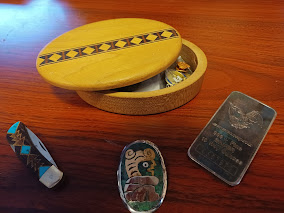
Part of the contents of the package.
 My brother in Pittsburgh sent me some of my parents' mementos which he discovered in the basement. The package included. among other things, a duck decoy, my father's pocket knife, some of Mom's silver jewelry, some coins, a 10 oz silver bar they purchased in 1989 (with invoice), and a wooden oval box. The box contained some of Dad's military pins, including his honorable service pin (also known as the "ruptured duck"), some masonic pins, and a plastic Heinz pickle pin. But it is the box that this story is about.

When I first opened the oval, wooden box up, I heard something rattling around inside the lid. I thought it might contain a false top, and, looking at it, there was a small hole at one end, with scotch tape covering it. I pulled off the tape, and started to try to figure out what the hole was for. After some man-handling, a small metal peg came part-way out of the hole.

At this point I realized that the puzzlebox did not have a false top, but rather a secret lock, and the pin was the locking mechanism. But now I had put it in the locked position, and that way I could not put the lid back on the box correctly. After about ten minutes of fiddling about to no avail, I turned to the Internet, and much to my relief, there was a video for how to unlock (and lock) the box, called an oval spin box. Mastering that craft, I got the metal peg back into the lid, and could close the box properly.

And that also explained the scotch tape. My parents had taped up the little hole in the box lid to keep the pin from sliding out and accidentally locking the box, which they would have to figure out how to open again (withOUT the benefit of the Internet). Needless to say, I put the scotch tape BACK, and now the box in on the shelf over my desk, with other mementos, like a zeppelin stamp, a Maltese Falcon, and a framed copy of our wedding invitation.

And I am putting this down in case some future generation comes across the box, and finds that either it cannot be opened or, worse yet, cannot be closed. And to them I will give the warning that all investigators are faced with when dealing with some eldritch chest - don't remove the scotch tape. 

More later, 

Saturday, January 15, 2022

Life In the Times of the Virus: Omicron Update

Drug Store - Edward Hopper 1927
So, are we back to normal? No, no we are not.

Am I tired of this? Yes, I am. You're tired too. We are all tired. And yet we row on.

When last we spoke on the matter, some six months ago, Delta was just blooming. Viruses mutate over time, and on occasion, one shows up that is more adapted to its environment and overtakes the previously popular model. And it was the case with Delta, and now Omicron (which sounds particularly threatening - wait until we get to Omega in the alphabet). Now, Omicron is a more successful virus because not only is it more virulent (spread faster and more easily) but it has the added feature of not killing its host immediately (Dead host = dead virus, so actually Delta is not an very effective virus from a continuing existence standpoint, but speaking as the potential host, it is nasty enough).

Anyway, the end result is after declining numbers, we are seeing more cases and hospitalizations, and the resources are strained right now. In Washington State, we have seen fewer deaths over time, particularly among the vaccinated, but still have hit 1 million cases and 10,000 overall deaths (WA's population is 7.6 million). And people are saying it is going to get worse in the next couple weeks.

And why? Well, part of it is because Omicron is better adapted to its environment. But part of it is because we've gotten tired of it. We want to go out. We want to go back to work. We want the kids back in school. We want to put this whole thing behind us. We want to miss it, but we can't miss it if it doesn't go away. 

And yeah, most of the current casualties are from people who decided that the vaccinations are not for them. There is an entire sub-Reddit dedicated to people who have publicly come out against vaccinations, then catch the coronavirus and die. And that makes me more sad than angry. Yeah, it is the perfect sort of inverse Boy Cries Wolf tale, but I am still saddened by people who are deciding to take the risk that somehow they won't be victims, and then lose. Despite this, I don't think they should be turned away at the hospital, or charged more, or otherwise punished for decisions that overclog the hospitals. I'm just sad.

But there are breakthrough infections, and those who have gotten vacced and boostered are catching the coronacrud as well. It is not nearly as fatal, but still is no walk in the park. The vaccinations can reduce the severity of the disease, but not limit exposure to it. Sort of like seat belts - they can increase survivability in a crash, but not take that drunk driver running the redl ight off the road.

Here on Grubbstreet we got boostered, and the results were a lot more severe than last time. Last time was no biggie, but this round of boosters left both the Lovely Bride and I wiped out of the day. Which makes a little sense, since our immune systems were prepared for something coming in, and then responded heavily. So it was an expected day off.

Mask discipline has changed. Over time, I've lost the hand-made masks I started with, and the logo-ed masks from my company (discarded/lost masks have replaced cigarette butts as the urban refuse of choice). I've switched almost entirely to the black KN95s that are this year's fashion statement. And we are fortunate, because our neighborhood is pretty solid as well - I go to the grocery store and the overwhelming majority are masked, and the overwhelming majority of those are wearing them correctly. Good going, team.

No one wants to shut everything down, but we may not get a choice. Schools are closing for lack of teachers. Alaska is losing 10% of its flights because it doesn't have the manpower. We've called out the National Guard to support the hospitals. I hate the idea of returning to quarantine and to vaccine mandates, but I am just so tired of it all. And yeah, you probably are too.

And the most frustrating thing about it is that we have shifted in an attitude of "Let's do everything to stop the spread!" to one of "Yeah, you're probably going to get it, but it (hopefully) won't be too lethal". So this contributes to the feeling of frustration and exhaustion.

And here's a thing. In the before times, I remember how we talked about the Spanish Flu of a century ago. Not Spanish in origin, but that's where it first identified (sort of like people getting made at South Africa for announcing Omicron). There were a bunch of hygiene attempts and resistors and overburdened hospitals, and yeah, it sounds AWFULLY similar to the present. But then there was the Great Forgetting, as the news of the Influenza got swallowed by the Roaring Twenties and Prohibition and labor disruptions and rising Fascism and ...

Hey, the future doesn't repeat, but sometimes it rhymes. And the rhymes are pretty tight these days.

More later.

Tuesday, January 11, 2022

Book: A Sudden Case of Death

The Case of the Canterfell Codicil: The First Anty Boisjoly Mystery, by P.J.Fitzsimmons, 2020.

Provenance: A Christmas present I purchased, then entrusted to the Lovely Bride to deliver to me on the day itself (I in turn order clothes that she has specifically noted in catalogs, wrap them and return them to her - it is a system that works). The book was endlessly flogged on Facebook to me, as the Mighty Algorithm had determined my interest in mysteries of the interwar years (of course, if you read this blog, you might determine that as well), and I was curious.

And the book,  apparently self-published, cuts free of the stuff and nonsense of modern publishing process, allowing the tiller of the literary fields to deal direct with the consumer with a severe reduction of middlemen and gatekeepers. A farmer's market for literature! Huzzah the revolution!

The Review: And how was it? Not too bad, but not as strong as it was hyped. The book was oversold, promising a collision of Wodehouse, Sayers, and Christie. A high bar to be sure. The frothiness of Bertie and Jeeves, the eloquence of Peter Wimsey, and the clockwork plotting of a Miss Marples cozy, all compressed within its covers. Demanding such comparisons, however, reminds the reader the the originals, written in the era itself, are well-remembered classics for a reason. My expectations were high, and while the end result was a romp, it does not measure up, and left me a bit disappointed.

Anthony "Anty" Boisjoly (Boo-Juhlay) is residing at his club when a telegram from his old college pal summons him to Canterfell Hall, where the much-disliked Uncle Sebastian has just taken a header out of an upper-story window.  Anty arrives at  Canterfell to find a cross between Blandings Castle and a Poirot-inspired railway trip. Mysteries abound, small and large, starting with a locked room mystery and spiraling out from there.

Anty as a character falls between two chairs. He is neither the cloth-headed Bertie Wooster nor the supreme intellect Lord Peter, but exemplifies traits of both, depending on the situation. So it is hard to get a handle on him as he sometimes lumbers through some scenes, then has flashes of brilliance and glory. If you're going to ape Wodehouse (*cough* The Wyvernspur *cough*), you have to catch his ear for banter, and some of the chat falls more into the Realm of Monty Python and Blackadder than into the era itself.

Also, in presenting Wodehousian descriptions, there is a much of muchness, which makes you appreciate Plum's tact and reserve (there's a line I never expected to write). Every briar patch and weir, every doorknob and newel post, gets an achingly florid string of similes and comparisons. Sort of like being trapped in an esoteric comedy routine from the 80s.  Also, there seems to be a decided lack of synonyms for the word "thatch".  In a similar fashion the mysteries sort of pile up on each other, as EVERYONE has a secret or ten. The locked-room death of Uncle Sebastian, the nature and location of the titular codicil, the disappearing painting, the horrible dinner and excellent breakfast, they just tend to pile up over time. But yes, they all get answered, to some degree, by the end. 

Does Fitzsimmons play fair with the reader? Mostly. Some of the brain blasts that Anty gets are based on previous information that he, the character, does not share with us, the reader, until the time for the reveal (such as how an off-handed complaint from an Police Inspector tells him that a member of Parliament is lurking about). And the cause of the first death is less of a well-executed plan and more of a random roll of the dice. Yet it barrels along merrily to its resolution.

As a self-published work, the book's production values are high. The cover has that slightly tacky plasticized cover which continues to disappoint me, but I am afraid that, publishing-wise, that ship has sailed. The cover is a stylized art deco with a metro-retro font (also in the chapter headings). It coulda stood a map, to be honest, to position various rooms in the manor correctly (which Nine Tailors did), but that is a minor point.

So will it leave the major publishers quaking in their boots? Not really, but that's OK. It is a pleasant enough volume, and I would recommend it above the recent Westlake. If you approach it as a lark and paean to the previous masters, it is fine. But I would be very wary about the ad copy in the future.

More later,


Monday, January 03, 2022

Book: You Say You Want A Revelation?

Perhaps the Stars by Ada Palmer, Tor Books, 2021

Provenance: Purchased from Amazon.Com. The first three volumes were available as trade paperbacks, but I could only find the American edition in hardback. Receiving it, I can see why - it is a massive tome, longer than its predecessors.

The Review: This is the final book in Palmer's Terra Ignota series. Books one and two are reviewed here. Book three is here. Go read those reviews, because it gives the best summary I can come up with about how we got to a future world of rational actors who are going to kill each other over valid reasons. As noted previous, it is impossible to give a detailed review without spoilers, so consider yourself warned. 

So, here's where we are. The world's population is divided into non-national Hives, which are now pitted against each other. The cassus belli is the arrival of a god. Not the god of this universe, but a god from somewhere else, who seeks to flush out the god of our reality by remaking the world. Some of the Hives support this - they are the Remakers. Some do not. They are the Hiveguard. Now, not all the Remakers are fighting for a complete remaking, and not all Hiveguard are united either. And there are factions within each Hive that disagree with what their parent Hive is doing. AND there are smaller groups which are neutral, but not really neutral, as it is revealed. AND it turns out there is another subtextural war going on between those who want to go see Mankind spread throughout the solar system and those who want to psychohistory our way to a better existence on earth.

So, yeah, it is confusing. And as the war progresses just gets moreso. The allies from the previous chapter are revealed to be enemies, the enemies of the next chapter turn out to be allies, apparent victories are really defeats, and defeats turn out to be victories as far as ultimate goals are concerned.This is not "You can't tell the players without a scorecard" in that you are provided with a scorecard at the start of the book and by the time you're halfway through, it is untrue. That chapter there? Never really happened. Or maybe it did. Plus, the fact that everyone calls everyone else by different names deepens the confusion.

Which is OK, in that book moves through these twists and turns with the expertise of Odysseus moving between whirlpool and monster. Our unreliable narrators become even more unreliable. We have two - Mycroft and the 9th Anonymous. Well, kinda. Like everything else in this future, it's complicated. Lemme leave it at that. It is one of those books that have to be paid attention to, to be conquered, to be scaled, to pull away its understanding. 

Everyone here is a hero. Everyone is a villain. Everyone does bad things for supposedly good purposes. Each of the Hives is not a monolith, but riven with its own subfactions and rebellions. There is war on multiple levels, by multiple prime actors, and individuals change sides swiftly. Things that are presented as very good things when they occur are later reveled to be very bad things. 

This book challenged me. I am no student of philosophy, so if you tell me that a particular philosophy is X or Y, I will believe you. I've got the wiki-version of most philosophers, boiled down to a few choice points. But I can tell you that while the earlier books belonged to Voltaire and Hobbes, this one belongs, blatantly, to Homer, as Mycroft identifies all manner of roles from the Iliad to the various players. 

Once upon a time we referred to Dune and Lord of the Rings as being "unfilmable" - their scope and depth was too much for the screen. Now, portioned out over several movies and backed up with supercomputer animations, they have been filmed. Ignota has that challenge now, in part because of its nongendered/gendered nature of all the characters. Characters have swapped gender identifications throughout the story, from a non-gendered they to either he or she, depending on who is talking and what they are talking about.

One thing that is interesting is that over the course of the publication, out language has moved to the point that singular They is no longer as weird as it  once was. Palmer points out that this is flaw in her future, by assuming that the eradication of noticed gender differences stymies gender equality (sort of like, since we now use the term Ms, equality has been achieved).

In one of the earlier reviews, I pointed out how a lot of the presented Utopia of the book is progressive, liberal, and ultimately wrong. Now I feel there is a stronger religious element to the book as well lurking not-too deeply under the surface. JEDD, the Alien God, is taken at face value as a god without too much demand of credentials. Bridger, the young mutant (?) with the power to create anything, seems very much the much the miracle worker, who ultimately transforms himself to fit a more savage world. And Mycroft's super-ability, reworked by Bridger, involved imbuing and transforming others. So I wonder if JEDD, Bridger, and Mycroft can be interpreted as the Trinity - Father, Son, and Holy Ghost. 

This is a tough series to scan properly, and Palmer's style harkens back to Gene Wolfe's ability to be completely clear and opaque at the same time, along with Herbert's tendency to delve deep into political discourse. (Indeed, the Alien God JEDD in many ways is an echo of the Kwisatz Haderach). It is a rewarding book, in that it encourages me to think more about what has happened, and even now, two weeks after finishing it, I am still considering what lessons it holds.

More later, 

Friday, December 31, 2021

Snowed In

As you may have heard, we've had a a bit of snow up here in the Pacific Northwest. It is not unusual to have snow once or twice a year, and by snow I mean snow-level-at-sea-level, lasts-more-than-a-day type of snow. We're used to snow with visiting rights - if we want snow, we can just go up to the passes, or to watch it at a respectful distance from the foothills. Rarely does it come to visit, squatting down in your driveway, and showing no intention of moving on.
After the first wave

This is one of those times. The there was a light set of flurries just before Christmas, and the main onslaught began that night. About 6 inches up here on Grubb Street, judging from the pile-up on the deck railings. Then a few days of flurries as the high
dropped into the 20s, then another wave of about 3 inches more. Currently it is hovering just around freezing, with most of the blacktops clear from melting.

So, enough to shut everything down - this level of snow is so rare that the local authorities are limited in response. King County has all of 14 plows. Kent itself has 8 de-icer or sander trucks that have snow blades on them. Kent does have a priority list of streets to plow. Odds are that your street is not on that list. Businesses are either shut down, running with reduced staffs, or closing early before the roads freeze. I haven't had a newspaper delivered to the house for a week, though the Post Office, Amazon delivery guys, and milk deliveries have been uninterrupted (thought one of them has lost his gloves in our driveway - if you're missing brown fur-lined gloves, they are on the bench out front).

Snow Halfling
Still, this is an opportune time, and not just because so many folk are still working from home. Hitting the Christmas break puts a lot of kids at home from school. Our department had already decided to take off between Christmas and New Year's. We managed in the break between storms to get out to the grocery store, and while the deli counter was shutting down (not enough workers that day) and the bread aisle was severely depleted, there were neither major shortages or panic in the aisles.

Swedish Snow Lantern
And the housemates have been playing in the snow, making both a snowman and a set of Swedish snow lanterns. The Lovely Bride and I have been keeping to the warmth of the house, and I have enough new books to tide me over.

We still have power and the Internet, so that puts us ahead of game, as opposed to several years back, when the power went out and we relied on the fireplace and wind-up emergency radio. So we are fortunate. Rumors (meaning the weather report) say that it should warm up in the next few days, then we get hit with another round of snow. Nothing is overheated, nothing is on fire, so we are doing well. And we at Grubb Street hope you're doing well, too, and have a safe and sane New Years.

More later.

Monday, December 27, 2021

Ten Movies

 So, talking about other things, I considered what my favorite ten movies were. And I had to think about I would mean as "favorite". There are movies that a really like, and would recommend to others, but probably not watch again. They were a great experience - blockbusters, indie films, but they were one-and-done for me.

And there are "films" where you want to take apart how the plot is unspooled, how the shots were taken, how they got that take, or sought out that emotion. Films can be analyzed. Movies are just embraced.

And then there are the films that I will watch. Every time. Channel hopping or random streaming, coming in on the middle of them, and I will hang on until the end credits. I know the lines. I know how they end. I know the stories behind them. But these are movies that I will WATCH again and again. This is what I'm talking about.

Not all of these are great movies. Not all of them have "worn" well since their release. Some of them are a bit cringe. Many of them lack deeper meaning. A lot of them bunch up in my teen aged years. Some are even in Black and White. But I will watch them. Every. Damn. Time.

Here are ten movies:

The Thin Man (1934)

The Maltese Falcon (1941)

The Longest Day (1962)

It's a Mad, Mad, Mad, Mad World (1963)

The Great Race (1965)

The War Wagon (1968)

Ice Station Zebra (1968)

2001: A Space Odyssey (1968)

Star Wars (1977)

Big Trouble in Little China (1986)

So what are YOUR Ten?

More later,


Thursday, December 23, 2021

Season's Greetings

 Wishing you a safe, sane, and secure Holiday Season.

Art by Eyvind Earle

More later, 

Monday, December 20, 2021

Seattle Weather

When we moved to Seattle twenty-some years ago, I started encountering weather features and climate conditions that I hadn't encountered before, or had few references to. Here's a handy list for new arrivals:

Weather Forecast: Fiction. 

5-Day Forecast: Science Fiction. 

Mountain Day: We are surrounded by mountains - Cascades to the east, the Olympic range to the west. But when we say "The Mountain is Out" (and we do), we are talking about Mount Rainier (rah-NEER), which looms to the south like something out of Greek Myth.If we can see it from base to tip, we call it the "Full Mountain".  People are usually happy when we can see the Mountain, despite the fact that Rainier is an ACTIVE VOLCANO (not erupting, but not quite dead, either).

Sunbreaks: The opposite of Partly Cloudy, but rarer out here. It a term used from the Fall to Spring, and usually means "You might see some sun today." Most of the summer is pristine, blue, and cloudless. That's when your relatives from back East visit and tell you how nice it must be to live out here. You want people to stop moving to Seattle? Invite them out in the dead of winter.

June-uary: When we say "summer" in Seattle, we don't count the first two weeks in June. Sure, May is nice, with soft rain in the evenings and fogs in the morning, but a grey overcast dominates the landscape in early June, so much so that it gets its own month. Also called June Gloom.

Atmospheric River: A recent term, it reflects the fact that Washington State doesn't really have any large agricultural states to the west of it we can call up and ask for steady weather forecasts.What we often see on the doppler radar is the thick stream of heavy red bearing down on us. Makes the weathermen on the evening news excited.

Pineapple Express: When the atmospheric river commutes from Hawaii. Really makes the weathermen excited.

Convergence Zone: I mentioned the Olympics, they are a massive upthrust of mountain due west of us. They tend to stand in the way of the atmospheric rivers that buffet the coast. Of course, the weather tends to go AROUND this big chunk of mountains, so Seattle is often at the point where the weather coming around the northern side hits the weather coming around from the south. When they hit, we get interesting, local effects. So Kirkland can get heavy rain and hail while Kent gets nothing.

Rain Shadow: The flip side of the convergence zone. Because the mountains are in the way, some places get untouched by rain while it rains heavily to both the north and south. The Olympics become Seattle's umbrella, and like an umbrella, a treacherous wind can turn it inside out.

Microclimates: As a result of the differences in altitude, plus the rain shadow and convergence zone, microclimates mean that you can have radically different weather in relative close proximity. While in certain parts of the country, the saying is" If you don't like the weather, wait fifteen minutes" in Seattle it is "If you don't like the weather, drive fifteen miles."

Misting: What Seattlites call it when it really ISN'T raining. You don't need a slicker. You don't need an umbrella (a sign of being a tourist). It's just misting. Works up to the point when you start seeing hail.

Thunder:  A rarity. It happens maybe once a month, consists of one long, rolling peel. and people will talk about it at the office the next day. It is so cute to those who come out from the Midwest. 

Snowed In: More than a quarter inch on the roads. Everyone forgets how to drive. Archaic term now that everyone is working from home.

Snow Level: Snow is measured by altitude here, and as winter proceeds the snow level descends down from the mountains to the sea. So we really pay attention to where the snow level currently is. "Lowland Snow" sets off alarm bells and closes schools. Grubb Street is located at the 500 foot mark, just in case you were wondering. 

Seattle Freeze: Has nothing to do with the weather, but is as close as we get to feeling chilly. 

Black Ice: Not a uniquely Seattle phenomenon, its the scarier way of saying "It's a little slick out there".

Closing the Passes: The main east/west highways out of/into Seattle go over the Cascade Mountains, and as winter arrives, travel over them become perilous and often avalanche-y, until finally the passes are closed, sealing us off from the rest of the northern US. We're pretty happy with that.

Polar Vortex: Not so much a Seattle thing, this is a weather effect that has been picked up on the national reports. It is bitter cold with heavy snows and wind - what Wisconsin used to call "A pretty average winter".  The weakening of the Jet Stream around the Arctic Circle results is sudden bulges of cold air descending on the heart of of the country, giving Climate Skeptics the chance to complain "Where's your Global Warming, now?"

Pyroclastic Flow: We have an active volcano nearby (see Mountain Day, above). Someday, it will go off, and send a cascade of molten rock, hot mud, and melted snow down the surrounding valleys, including the Green River valley, where Renton, Kent, and Auburn lay. This is a reason that Grubb Street is up on a hill. Have a pleasant day. 

Subduction Zone: The Big One - that massive earthquake that will cause the West Coast to fall into the sea, belongs to us, Oregon and California, so it not unique to Seattle. However, we DO talk about the tectonic plates far out to sea that have the potential to slip and create a Tidal Wave, which, given the narrowing of the Straits leading to Puget Sound, will channel it like a shotgun blast at the city.

Tsunami Route: You can see signs occasionally. I'm not sure they're being kept in order. They are usually pointing towards higher ground (well, yeah), in case the subduction zone triggers a tidal wave that will swamp the low-level areas of the Sound.

Solstice: Solstice is an important holiday in Seattle. We are the furthest north major metropolitan center in the continental US. We are further north than most of the population of Canada. So this means that our day/night cycle takes wide swings back and forth during the year. In the summer months, we are used to the sun setting in the Northeast, and twilight showing up around 10 PM. In the winter months, we are looking commuting in the darkness both to and from work. Both are a bit wearing on the senses, and the Solstice is the moment when the pendulum reaches its furthest point, and starts slipping back.

Happy Solstice. More later.

Thursday, December 16, 2021

Book: Jail Break


Help, I'm Being Held Prisoner By Donald E. Westlake, Titan Books, original publication 1974

Provenance: Half-Price Books. When I am in a used bookstore, I check the mysteries to see if there are any Rex Stouts I am missing. In the same area of the alphabet I found this Donald Westlake in trade paperback format.

Review: So, Donald Westlake is an incredibly accomplished author, and wrote the original Parker novels. He also wrote the novel The Hot Rock, which became the film of the same name with a screenplay by William Goldman, starring Robert Redford, George Segal, Paul Sands, and Zero Mostel. Funny movie. So if you want funny crime stories, Westlake has you covered. And the original publication of this book falls hard on the heels of The Hot Rock movie, so there was probably a demand of funny crime stories.

And it is a prison fantasy, in that it takes place in a prison, but is scripted in a way that breaks your sense of reality if you think about it too hard. 

The unfortunately-named Harold Künt (with an umlat - it just gets worse the longer you look at it) is inveterate and uncontrollable practical joker whose latest stunt on the Long Island Expressway gets him sent up the river for a short stint. He falls in with a band of tough guys who have tunneled out of the prison, but they are not planning an escape. Instead they leave the prison, commit a few crimes, go out to dinner, take in a movie, then come back for roll-call. Harold accidentally and easily crashes the party, and after some deliberation, the tough guys take him in because they have a big plan - they are going to knock over not one, but two banks in the town the prison is located in, then come back to prison because that's the last place anyone would think to look for criminals.

And we're ignoring stuff like, you know, fingerprints. Like I said, let's park reality at the door for this one.

Its a fun, light read. Harold is a nervous wreck, trying to keep himself from committing any more practical jokes, plus keeping the gang's secrets, plus dealing with someone else pulling practical jokes and him taking the blame, plus trying to keep the gang from finding out that he is NOT a tough guy, plus desperately trying to keep the gang from robbing the banks. So most of the book consists of him going to greater and greater lengths to keep all the balls in the air. Sort of French farce, with a lot of door slamming, but the doors have bars on them in this case. 

I have to call out the Paul Mann cover of this one, only because, in the tradition of hard-boiled mysteries, it conveys the theme while misrepresenting what is going on inside the covers. The protagonist is a broad-chested he-man dressed up in classic hamburglar stripes (he is not, and the book is set in a period of Folsom prison denims). The babe is all legs and bare;y-buttoned men's shirt (there is a love interest, but not as dolled up) with an obligatory gun - It is something something off the old Carter Brown covers by Robert McGinnis. 

So, it is a fun book, and a nice break from change ringing in the fens of East Anglia, but not one to hunt down. 

More later,

Monday, December 13, 2021

The Things On The Doorstep

Recent Acquisitions, with a Cameo from Kia

Here are some of the game products that have been piling up here at Grubb Street. The bulk of them are Kickstarters that have delivered. Kickstarter has a been a boon for small and medium publishers which might otherwise not have the reach to find their audience.

This Kickstarter boom, though, has been kicked in the teeth of late by the global situation, not just the perils of the pandemic but the shipping crisis as well. The backup has delayed delivered even further and small shipments are getting lost in the shuffle. And, given Brexit, I do think twice before ordering anything from England, as the shipping fees can rival the cost of the product itself.

However, I do have a long trail of material that I've ordered previously which continues to show up at my door. And this is a very mixed bag this time. As always, these are not reviews,. in that I feel you need to play the game in order to review it fully, but a rather is a first glance and reactions to them.

Southlands (Richard Green, with Wolfgang Baur, Basheer Ghouse, and Kelly Pawlik; Kobold Press; 316 page hardbound) as well as the Southlands Player's Guide (Green, Marks, McFarland, Merwin, Pawlik and Suskind; 80 page softbound) and City of Cats by Richard Pett; 202 page hardbound). The Southlands was originally detailed for the Pathfinder Game, but makes the transition to D&D 5E with this volume. It deals with the territory south of the core Midgard territories and is a melding of Arabian Nights, Dynastic Egypt, and Lost World African themes. Looking forward to reading it in more detail, given my background with Al-Qadim. The Player's Guide gives you a lot of the nuts and bolts for creating characters and new races in this region for 5th Edition. The City of Cats looks at first blush to be this world's Cairo analogue, with a lot of urban fantasy intrigue. Full color, high production values, excellent maps.

Bayt Al Azif (Jared Smith, editor; Bayt al Azif Inc.; Issues 1-3; 80-120 pages squarebound magazine) This is an irregular magazine on the Call of Cthulhu game. The release schedule is "When the Stars Are Right" which means I have three issues so far, the most recent from 2020. I got it off Amazon, but you can order it in real-world or pdf form off DriveThruRPG. Really high production values, echoing the old World of Cthulhu magazines from Pegasus Spiele. Contents are a mix of adventures and articles, the latter being about the history of the game, and reviews/overviews of recent Cthulhu products. Their website is here.

The Oracle #14 (Stephen Hart (writing/design/layout) and Jane Spenser (editing); The Grinning Frog; 50 page squarebound). Ordered this during the 'Zinefest on Kickstarter, but to call it a 'Zine is to round down. Landscape formating, glossy stock, excellent art,. This particular issue deals with a fantasy version of Venice, with canals, duels, masques, masks, and magic. Great on flavor and inspiration, light on mechanics. Website is here. 

The Dee Sanctions Adventures - (Paul Baldowski and Richard August; 44 pages squarebound) I got the ruleset for this a while back, and while the kickstarter included these rules in pdf, I picked them up in print and got a bonus adventure as well. Short version - John Dee's Suicide Squad. This one is softback and nice production values.  Website is here.

All Must Bow (Ryan Hatt and Joshua Flaccavento,; Bleak Horizons Press; 58 page saddlestitched) This one is weird, and more of art-project than a game setting.The idea is that there are uncaring, monstrous Dreadful Ancient Things in our universe, and you're working with/for  them to achieve - whatever it is you think they need to achieve. It mentions the use of X-cards at the start and actually feels like it may need it. System Agnostic (with hints and helps about particular systems in the back  it almost feels like it is an experience hung on an RPG's blasted skeleton than a full RPG itself. Includes a sealed envelope that I am quite frankly a little frightened to open. Company website with links to other sites is here.

Nahual (Miguel Angel Espinoza, 288 pages Squarebound)- This one is very interesting. An RPG by designer of Latino heritage, Nahual is based on a comic book that has only been published in Mexico, where the angels, representative of Western Colonizers, are hunted by descendants of native shamans, Upon slaying the angels, the shamans turn the bodies into drugs and food served from taco trucks  Powered by the Apocalypse Engine but complete in and of itself,with high production values and good B/W art, it is an urban fantasy not based on traditional western tropes. . Website? Here.

Orun (Misha Bsuhyager, Jerry D. Grayson, Eloy LaSanta; New Agenda Publishing; 288 hardbound) Also from diverse voices and avoiding traditional western tropes, this game is billed as Post-Apotheois Afro-Futuristic Space Opera. So that's a bit of a niche market, but it looks great. Pulling from  the "Lost Present" school of SF (like Tekumel and Dune, our present is far in the game's past and Western Civilization has wiped itself out long before mankind made it to the stars), the game uses Nigerian/Yoruba terminology like Oya (for Earthers) and Orisha (for ascended humanity) to craft a futuristic setting with multiple planetary heavens and a Sauron-level meme-devil as an ultimate big bad. The product itself is high production values - Hardback, full-color, glossy stock, with a book ribbon and a slip case. Worth a deeper dive.

The Black Hack (David Black, Black Label/Squarehex, 124 page hardback)- Hacks are something that have popped up in the past decade - Minimalist designs, using old-school games that push ease of play over detailed background. Take a system (usually a 3d6 one) and reducing it to its most basic components. This Black Hack is the revision and has a clean presentation and art that would fit in the liner notes for the Gorillaz Clint Eastwood album. Player's section has four classes, like the classic. DM's section has a lot of tables for random results. The Kickstarter came with a bunch of small tchotchkes, like mini-booklets for maps, lore, and spells. This one (and the Dee Adventures) actually shipped from England, and made it in a timely fashion. Stripped-down web page is here.

And that's about it. If I get a chance to actually play any of these, I will come back to them. But in general, Kickstarter has produced some really fine opportunities to get hold of games that might not otherwise make their way to your friendly neighborhood gaming store.

More later,

Friday, December 03, 2021

Book: Whom the Bell Tolls

Mass Market Paperback The Nine Tailors Book

The Nine Tailors by Dorothy L. Sayers, Harcourt Brace Jovanovich, 1934

Provenance: Picked up at Page Turner Books down in Kent, took with me as an airline read.

Review: I've said before that Dorothy Sayers mysteries are about other things, which just happen to have a mystery, a murder, and a detective mixed in. Murder Must Advertise gets into the weeds with advertising and office culture. Unpleasantness at the Bellona Club deals with men's clubs and the casual damage from the war. The Nine Tailors is a mystery that involves deep discussions of  bellringers and water management in the fens of East Anglia. The full title is The Nine Tailors: Changes Rung on an Old Theme In Two Short Touches and Two Full Peals.

And I'll be honest, the book put me to sleep on the trip back from Florida. I don't sleep on planes as a rule, but it put me under for a good two hours.

That's not bad in any way, shape or form - if there is anyone who can write about bellringing and East Anglian fens, Sayers is the person to do so. But there is a lot of text to be waded through, and much of it steams of a writer showing off their research.

So here's the general gist of it. Lord Peter Wimsey and his manservant Bunter get into a car accident near the village of Fenchurch St. Paul. They are taken in at the local vicarage, and Lord Peter lends a hand with a nine-hour ringing session of the church bells for the New Year. He stays for the funeral of the Lady of the local manor. He returns a few months later for the funeral of the Lord of the local manor, but when they open up the Lady's grave to inter the Lord's body, there is another unexpected body in the grave.

There are more tropes here than in an episode of Murder She Wrote. The befuddled minister. The town fool who speaks in riddles. The old-timer who remembers everything. The busybody who is incensed about the placement of the mourning wreaths. The young heir with the grumpy uncle. The well-meaning souls who cover up for those they think guilty. The key piece of evidence destroyed by someone washing up. The body where it shouldn't be. The missing emeralds. Add to that clues which are in code using the script of campanology and the ever-present threat of flooding in the fens, and there is a lot going on here.

Lord Peter does his detective thing, but he almost feels incidental. He doesn't have much of a character arc for himself in this one other than to hunt down clues and make deductions. He's not in his native clime, but adapts well, people like him, no one is really working against him. He sort of Mary Poppins his way into the lives of those at Fenchurch St. Paul. By this time (9 books in), Wimsy's personality is pretty much crystalized, but his reaction to a sudden flood (which gives him the final piece of the puzzle) still feels overwrought and unexpected. 

Oh, and the nine tailors of the title are not about men making suits, but about the nine tolls of the bells to commemorate the death of a man.  There is a lot of jargon within the book, particularly about bellringing (more exactly, change ringing), and it is easy to lost in the Stedman's Trebles and the Grandsire Triples..

Mind, Sayers can write, and she writes up a storm. Her writing is eloquent and literate. If you are forced, through circumstance or at gunpoint, to read a mystery featuring bellringing and water management in the East Anglian marshlands, this is as good as you're going to get. This volume has a reputation as being one of her best, and if you love it, you love it utterly, and if you hate it, it is one of the worst. I would not make this a first read for the series or the character, but it stands well of its own right.

More later,

Monday, November 29, 2021

Book: The Gygax Years

Game Wizards: The Epic Battle for Dungeons & Dragons by Jon Peterson , The MIT Press, 2021

Provenance - One of my housemates heard me mention that I interested (and maybe mentioned in) this book, and she ordered me a copy. I read it in the evenings over my stay in Disney World.

Yep, I'm mentioned in it.

Review - Jon Peterson has been doing a fantastic job detailing the history of roleplaying games. His Playing at the World is a voluminous history of the hobby from the first Kriegspielers to the arrival of Dungeons & Dragons. The Elusive Shift is a detailed study of the early TTRPG gaming environment, its fandom, and the effect that fandom had on the development of D&D. This time he gets into the meat of the situation - the business history of TSR, D&D's original publisher, from its conception to when Gary Gygax lost control of the company.

Peterson uses primary sources to great effect. He's not relying completely on the stories of those who were there, as memories fade and are often refurbished by their owners over time. He's done the digging through old records and sales information and memos that have survived to this day. And as a result, the picture he paints is detailed and accurate.

The core of the story begins with the creation of the game and the foundation of the company. Originally a group of hobbyists codifying rules, it tracks through the early Geneva Conventions (GenCon, in the old Horticulture Hall) to the conversations between Lake Geneva and Minneapolis to the creation of a going concern that actually paid people to early success and later challenges.

Peterson credits both men for their achievements - Arneson for the key components of roleplaying and Gygax for developing and presenting them. The bone of contention is what happens when that development outstrips the original concepts. To a great degree, the evolution of D&D left Arneson behind, and that lack of not only recognition but also recompense lay at the heart of their disagreements.

This was a slow read for me, as I would read a few pages, then stop to reflect. Is this something I already knew about? Is this new information? Does it fit with what I knew at the time? There are a lot of stories from the past that surface here - The passing of original founder Don Kaye, Dallas Egbert and the Steam Tunnels, BADD. And there is stuff that I have tucked into the back of mind over the years - Gygax versus the small press, the Origins/GenCon Rivalry, the Avalon Hill Rivalry. And there is stuff that I really didn't know much about - for example, the original split not only between Gary and Dave, but  between the Lake Geneva and Minnesota crews, or that the original Chainmail published by Guidon games, or the idea that GAMA (the Game Manufacturers Association) was founded in response to TSR's actions in the hobby at large.

I was there for part of the time covered, but this isn't my story. The design department of 1985 - Me, Tracy, Zeb, Doug, Bruce, Merle, are sources, but we're minor actors in this particular passion play. At the time we were mushrooms (literally, our offices on Sheridan Springs Road had no windows). We were hobbits (to quote one of our managers, who referred to himself as a Ranger protecting Hobbitown). We were the country mice in our rural environment, far from the cool stuff in Hollywood. We were the little folk we. We would hear the distant thunder. We were mostly innocent bystanders, and on more than a few occasions, collateral damage.

So I am here, but as a cameo. My arrival (and Tracy's) is noted in passing, as are our early work during this turbulent time (sales, to my surprise, were declining when I was hired, but by the time the torch was passed, we in the design department were "pulling its own weight" financially, and we started such projects as Dragonlance and Marvel Super Heroes). There's a picture of us in a tug of war contest from a company picnic, and we look like the Junior Achievement branch of the Not Ready for Prime Time Players - I am in denim jeans and a denim vest, wearing a headband - I look like I was an extra from "The Warriors". 

But the main players here are Gary and Dave, and the conflict that came out of their early collaboration. Peterson delves deep into the lawsuits and the sales records to bust some earlier myths and to track the economic history of TSR. He makes the case that Egbert, BADD, and the horrendous 60 minutes episode served to raise people's awareness of D&D and with it the game's popularity. I have to concur, but I think another factor was the rise of the mall and big box bookstores - TSR was distributed at the time not by another publishing group, but by Random House's merchandising department, who was looking to fill space in these now-larger venues.

Peterson tells much but not all and, I will still have stories to tell over beers. Things like the Dungeons & Diamonds game show, or the D&D Amusement Park we were going to set up in Lake Geneva. Or any of a half-dozen other blue-sky projects or wild ideas that may have been spun with moonbeams. Peterson treats most of his subjects gently, pushing points that he can support only through factual material. Gary's lifestyle in Hollywood is portrayed as merely "wild", and Lorraine William in credited with saving the company, and comes off as rational and sensible.

I'd be very interested in seeing "what happens next", but I don't know if the circumstances would allow it. The post-Gygax, post-Blume years at TSR were a bit of a tighter ship, absent a lot of the internal and external drama of the earlier years. There are fewer source documents and internal memos to rely on, less public denouncements of our competition, and less of a paper trail. Still, it would be interesting to see. 

If you play D&D and want to know its history, this is the book to pick up. It shows where the bodies are buried and unearths treasures from the past. It was a different world in the 70s for game design, as opposed to today, and it is solid tale of relationships, design, and the growth of RPGs.

An Epic Battle, indeed. More later.

Saturday, November 27, 2021

Theatre: Here Be Monsters

We've Battled Monsters Before - Book, Music, and Lyrics by Justin Huertas, Directed by Mathew Wright, Arts West, Through December 28.

Theatre is back. Sorta. The Lovely Bride and I attended what turned out to be opening night for We've Battled Monsters Before at the Arts West. They were checking vaccination cards at the door and the audience remained masked through the performance, and empty seats were more the case of social distancing than lack of interest. But, it was live theatre after too many months of empty stages.

Arts West is set up in a former department store at the Junction neighborhood in West Seattle, a neighborhood that is now mostly cut off from Restof Seattle by the anticipated collapse of the West Seattle Bridge. So between plague and impending construction, it is not the easy access venue that it once was. But on the other hand parking was not as hard to come by (though my lot of choice is soon to be plowed under for more condos). As for the theater itself, the performance area itself was in the round (well, in the oblong, at least), with a raised stage and for this play, a tree about three feet away from my seat at the top of an aisle.

The tree exists in the Whisper, a timeless (literally) chuck of property outside of Seattle. Here is a rift in time that grants wishes, and is used by a family of Filipino babaylan wise women. The current generation consists of the not-so-wise Adarna (Rheanna Atendido) and her brother Diego (Justin Huertas, who is also playwright, lyricist, and takes on the role of Lola, their grandmother, when need be). Adarna is studying to become a spellcaster, and aches to be a warrior for her people. Her attempts, even when well-meaning, often affect Diego (he becomes a werewolf. And then becomes a GIANT werewolf, but the play is focused primarily on Ardarna). It is about spellcasting, responsibilities, family, and food. Oh, yeah, it's a musical. 

Huertas has a wonderful flair for urban fantasy and magical realism (his songs aren't bad, either). His Lizard Boy was super-heroes in Seattle. His Last World Octopus Wrestling Champion was a chunk of NW folklore turned mystical. Here he pulls from the tales of his own heritage to transpose Filipino folklore into a modern age. This one was good - I liked Last Octopus more, and the Lovely B still prefers Lizard Boy, but this was a small, tidy, personal musical which sought out the magic and found it. It is an excellent start to the Arts West season, and worth a trip to the distant wilds of West Seattle.

More later.

Monday, November 08, 2021

Book: Life In Dis-United States

Break It Up; Secession, Division, and the Secret History of America's Imperfect Union by Richard Kreitner, Little, Brown, and Company, 2020

OK, we're done talking about politics. Let's talk about a book instead ... about politics!

Provenance: Purchased from Amazon after seeing it reviewed on a progressive website.

Review: History is a big bag of stuff, from which we spin out narratives and create our own national backstory. George Washington is a folktale figure, his lore filled with cherry trees and skipping coins across the Potomac. Washington is the great man of Valley Forge and the First Presidency. George Washington is the man with dentures made from the teeth of slaves. George Washington is a land speculator seeking to keep the Forks of the Ohio out of the hands of those Pennsylvanians, and in the process kicking off the Seven Years' War in Europe and America. All these are stories, all have their truth, and if you pick apart the threads of our past, you can see a number of them all functioning at the same time.

In the case of Break It Up, the story presented is that United States has never been particularly United, and at any one time part of its population is threatening, edging, or dashing for the exits. Krietner's work overturns a big box of data points to make the case that US and its people have always been heading for a crack-up.

How could it be otherwise? The thirteen English colonies were founded for different reasons by different groups. Here is a prison colony, there a group of religious separatists, over there a failed business venture or three, and here's one to pay off a debt by the Crown. We swallowed New Amsterdam, and New Sweden, expanded into established Native American lands and grabbed territories claimed by other European Powers. Those groups that were not disenfranchised were set up in continual rivalries. The Beta Test of the whole shebang, known as the Articles of the Confederation, crashed and burned.

And the big elephant in the room for much of our history is slavery and the elites that supported it. Even within the Constitution itself, which by counting the South's declared property as partial people for representation, put Virginia in the driver's seat for many years (Such that four of the first five presidents were from Virginia - there's a reason for that). From that moment on, our political history is a case of "Make Virginia (and by extension the South) happy". And where things happen like New England seceding (yeah, it was a thing), it was because the northerners felt Virginia had TOO much power. 

And that's sort of where secession comes from - You won't let me do something, at a state level, so I'm going home. From nullification acts to outright secession, the ruling class of those states pushing headlong into separatism are fired up about their rights being trampled. In example after example, those heading to the exits are claiming that they are the "real" Americans, the followers of those original founding fathers that believed in life, liberty, and often the ownership of slaves. 

Further, where states break off from other states, it is because they don't feel they are getting their slice of the power - the brief state of Jefferson comes to mind, as well such nascent movements as the Upper Peninsula and east of the Cascades. Heck, in the last few elections, nonbinding resolutions in Oregon have eight counties expressing a desire to join Idaho.

The flip side of "Make Virginia Happy" is "Virginia Gets Kicked In the Teeth", which could be the title of another book with much of the same facts. Virginia's original colonial claims went out to Minnesota, yet the same spirit of compromise whittled it back and eroded its power. When push came to shove in the 1860s, they lost about half the state west of the mountains (which didn't like the eastern half that much anyway - see previous paragraph) to form Kanawha/West Virginia. Of course, Virginia got their part of the original District of Columbia back so they could still bring in slaves through Alexandria. 

Krietner grabs fistfuls of examples in the first hundred years, though in doing so chooses to glances briefly over a bunch and other parts gets lost in the shuffle. He addresses the Mormon migration and Deseret, but not the other utopian communities that set themselves up apart from the world, like the Shakers, Millerites, and Amish. He hits the origin of Texas as an independent nation playing into the them of separatism but gives a short shrift to Hawai'i. And the fate of the Indian Reservations and federal lands throughout the west are not addressed (And the nature of the reservations to the rest of the country? The most recent examples are that Oklahoman law does not apply to the area that at one time wanted to be the state of Sequoyah, and Elon Musk is setting up dealerships on New Mexican reservations to avoid NM's prohibition of manufacturers directly selling their cars).

The bulk of the book is antebellum America, where the spirit of compromise and consensus passes the nation through an ever-narrowing set of gates, such that ultimately secession seemed inevitable, though each generation would make sure it didn't happen on their watch. After the Civil War, the book jumps about 50 years to tensions on the borders with Mexico in the First World War. The Civil War was a period when we went from the The United States are to the United States as a singular, but still, such a large gap it undercuts the argument.

And he makes connections between the separatism of the prewar and that of today's Red and Blue America. The thing is, I don't see this current crisis as being Unity versus States' Rights, but rather about who is controlling the whole shebang. Further, the weakening of States' Militias (and the rise of the National Guard as a national military unit) has weakened the ability of entire states to walk away. Still, the thriving right-wing militia movement (which hit a high point on Jan 6 of this year) and the ongoing attempts of Nullification of Federal Laws by Texas indicates that the nature of the battlefield has changed, but still remains a battlefield.

I think that Separatism, Factionalism, and Sectionalism are features, not a bugs, in modern nations regardless of their origins and intentions. This is not just a US thing. I'm looking at a European union that is currently dealing with Brexit and Polish nullification. Britain itself deals with continual calls for Scotland and Northern Ireland to go their own ways. Canada has always had to deal with its Quebec problem. And the entire Soviet Union collapsed on itself like a shaken souffle, and its primary inheritor, the Russian Federation, is trying to put the pieces back together. 

One thing I am going to dun Kreitner for is his footnotes, particularly coming off the latest Three Musketeers novels. This book's foot notes are not numbered where they appear, so you have to check in the back to see if there are any references or additional comments for that particular line or quote. Worse, the footnotes in the back are not tied to page numbers, so you really don't have any idea what is getting footnoted or not. That's a basic error, and weakens his presentation.

From a gaming side, this book does have some resonance. We designers love to carve up the map. Shadowrun. Cyberpunk, Castle Falkenstein, Crimson Skies. Deadlands. Heck, even my own FREELancers took a shot at it. The idea of separatism a (even if we don't aspire to it) and a balkanized United States is a gaming trope - it creates conflict, and out of that, stories.

But there is another interesting gaming intersection here I want to touch on briefly. In the classic (1975) White Bear and Red Moon, the foundation of Runequest and Glorantha, the two cultures in collision are guided by separate and equally powerful principles. The Lunar Empire believes that "We are All Us", while the barbarian Sartar live by the motto of "No One Can Make You Do Anything." Inclusion vs. Individuality. Oddly, that echoes with the current situation.

In the books I want to write but never probably will is one called "Worst Election Ever", which works off the initial idea that EVERY presidential election is worse than the one preceding it. Given the tonnage of data points I can utilize, I think I can make a good case for it. Kreitner gives a great amount of points, but needed to carry through on how the separatism of the Antebellum period downshifted into the current state of affairs. Same battles. New battlefields.

More later,

Friday, November 05, 2021

The Political Desk: The Dust Settles

 I wait a few days after the election to post the results because of the nature of elections in Washington State. We vote by mail, so it takes several days for the final results to be determined. Votes postmarked by the evening of election day need to be counted, and they can often swing the election. In most places, that will often swing conservative as older voters finally get around to voting on election day. In King County, it goes the other direction, and the more left-leaning, younger folk tend to get their ballots in under the deadline, so leading on election night is not a definite victory.

On the other hand, if you're ahead 10+ points on the first count, it is likely you're good for the position, in particular in elections with low voter turnouts (and we're talking about 33 40 percent of the eligibles this time out).

OK, so how did things turn out up here in the upper left-hand corner of the country? Here are the results three days after election day.

Advisory Vote No. 36 - Engrossed Second Substitute House Bill 1477 -  Maintained. Like, you know, it matters.

Advisory Vote No. 37 - Engrossed Substitute Senate Bill 5096 - Repealed, but it still kinda close. Like, you know, it matters. (Whups, it flipped to Maintained. Still doesn't matter).

Advisory Vote No. 38 - Second Substitute Senate Bill 5315 -  Maintained. Like, oh, you know the drill.

King County Charter Amendment No. 1 Preamble - YES

King County Charter Amendment No. 2 Initiative, Referendum and Charter Amendment Timelines and Processes - YES

King County Executive - Dow Constantine

Metropolitan King County, Council District No 5 - Dave Upthegrove

Port of Seattle Position 1 - Ryan Calkins

Port of Seattle Position 3 -  Hamdi Mohamed

Port of Seattle Position 4 -  Toshiko Grace Hasagawa (Both Mohamed and Hasagawa were slightly behind on the day one count, but made up the difference and are now ahead).

Mayor of Kent: Dana Ralph

City of Kent Council Position Number 4 -  Tina Troutner

City of Kent Council Position Number 6 - Brenda Fincher 

Kent School District No. 415, Director District No. 4 -  Awale Farah

Kent School District No. 415, Director District No. 5 - Tim Clark

Soos Creek Water and Sewer District Commissioner Position No. 4 - Darold Stroud

Soos Creek Water and Sewer District Commissioner Position No. 5 - Logan K. Wallace

Public Hospital District No. 1 Commissioner District No. 2 -  Jim Griggs (but, again, close).

Public Hospital District No. 1 Commissioner District No. 4 -  Monique Taylor-Swan (and this one actually made me nervous - Ms. Taylor-Swan's opponent ran as an open-communication and transparency candidate, but is reported by KUOW to be a stealth anti-vaxer and was at the Jan 6 rally that kicked of the insurrection. So now I guess I'm going to have to check out candidates' social media as well).

General overview? Incumbents did well, except where they didn't. A lot of work on the ground game from those who won - Mayor Ralph did a LOT of mailers and positive robo-calls ("We've done well and have more to do."). You want to win? You get out the vote. 

The Centrists did OK. I recommended some more progressive candidates, and they didn't do as well. But it is not like rooting for a sports team. The goal here is to put good people in office, and we're fortunate that in most cases that we had a choice of good candidates, with only a couple choices of good versus Oh-My-God.

One thing to whine about? The Stranger finally got outside its Downtown-shaped bubble and reported on us out in the hinterlands. On election day. Yeah, thanks a lot for that timely advice, dudes. 

And with that the Political Desk goes dormant for the winter. More (about other stuff) later.